Movement & Strength
Types of Exercise Explained:
Cardio, Strength, Flexibility and Balance, and Why You Need All Four
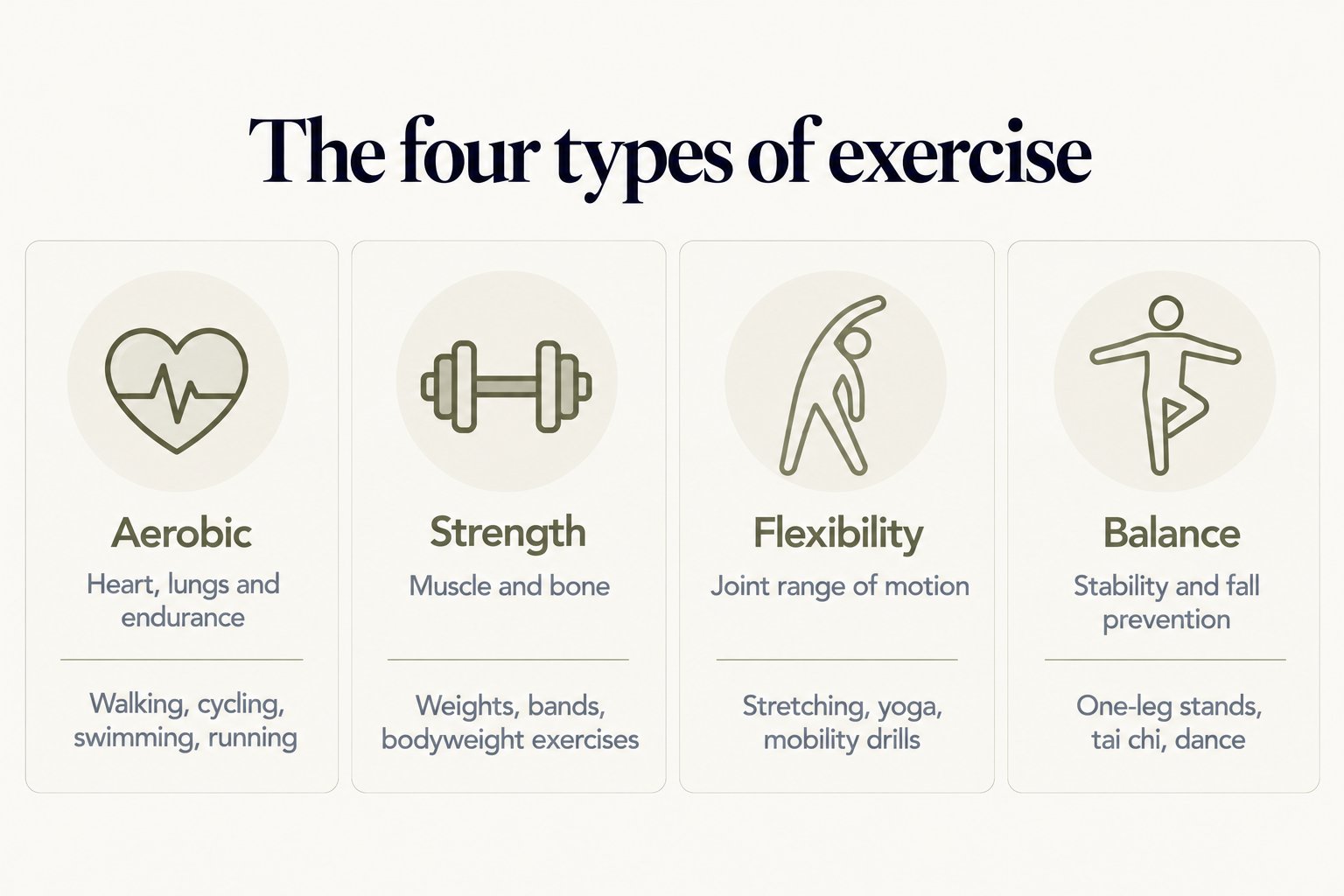
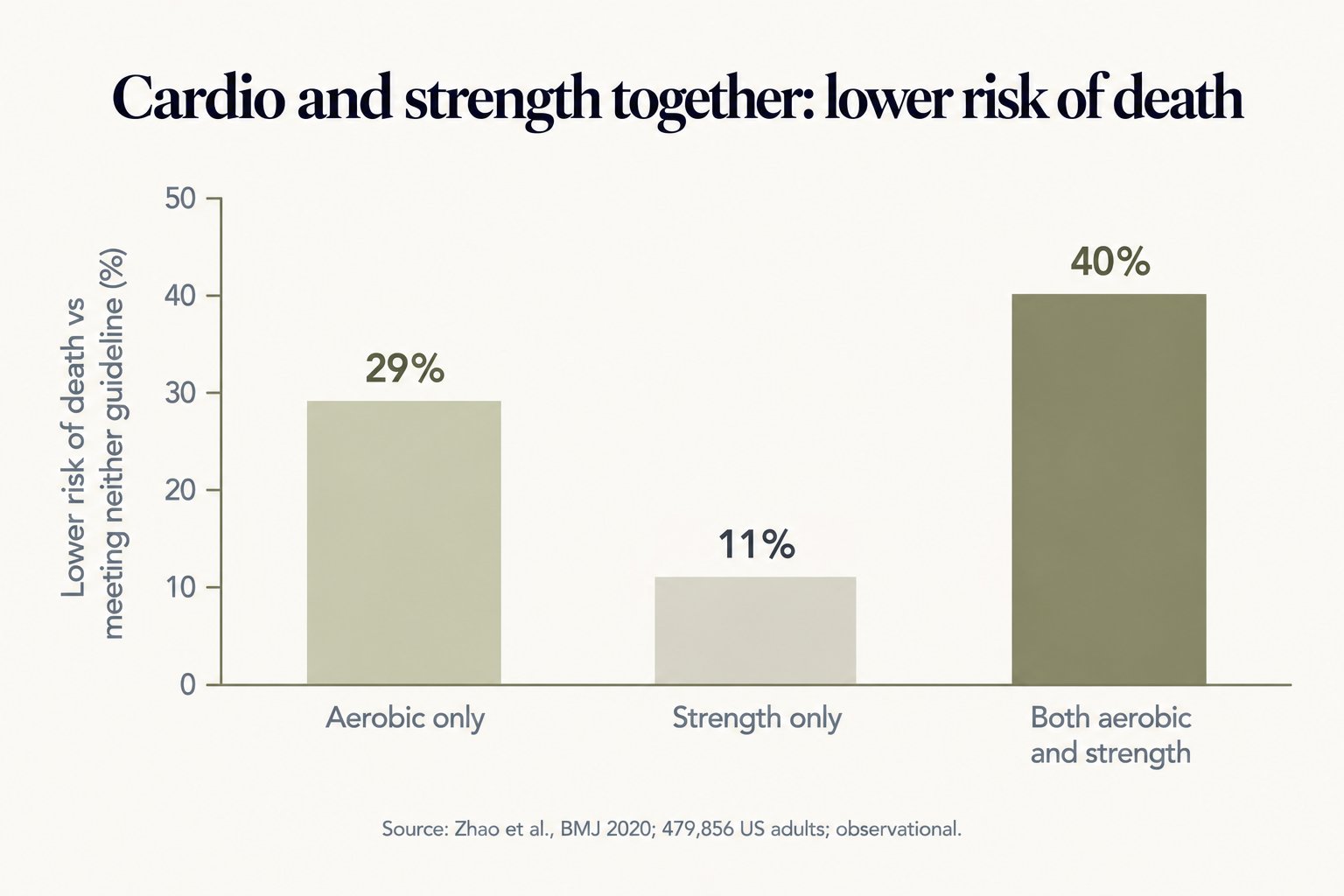
Exercise comes in four main types, and each does something different for your body. Aerobic or "cardio" exercise, such as brisk walking, cycling or swimming, strengthens the heart, lungs and blood vessels and improves endurance. Strength or resistance training, using weights, bands or your own body weight, builds and maintains muscle and bone. Flexibility training keeps joints moving through their full range, and balance training helps prevent falls. The World Health Organization recommends 150 to 300 minutes of moderate aerobic activity (or 75 to 150 minutes of vigorous activity) a week, muscle-strengthening on at least two days, and for people over 65, activities combining balance and strength on at least three days. Doing both cardio and strength training appears especially powerful: in a US study of nearly 480,000 adults, meeting both guidelines was linked to a 40% lower risk of death, compared with 29% for aerobic activity alone and 11% for strength training alone. Yet about a third of adults worldwide, and 45% in South Asia, don't get enough activity. This article explains each type of exercise, how much you need, and how the activities covered in this series fit together.
Key numbers
| Finding | Detail |
|---|---|
| WHO aerobic target for adults | 150 to 300 min moderate or 75 to 150 min vigorous per week |
| WHO strength target | Muscle-strengthening on 2 or more days per week |
| WHO target for people over 65 | Add balance and strength activities on 3 or more days per week |
| Meeting both aerobic and strength guidelines (479,856 US adults) | 40% lower risk of death; aerobic only 29%, strength only 11% |
| Muscle-strengthening (16 studies) | 10 to 20% lower risk of death, greatest at about 30 to 60 minutes a week |
| Unable to stand on one leg for 10 seconds (1,702 adults, 51 to 75) | 84% higher risk of death over about 7 years |
| Adults not active enough (2022) | 31% worldwide; 45% in South Asia |
The four types of exercise
1. Aerobic exercise (cardio). Aerobic exercise uses large muscle groups continuously, raising your heart rate and breathing. It trains the heart, lungs, blood vessels and the muscles' ability to use oxygen.
- Moderate intensity: you can talk but not sing, for example brisk walking, easy cycling or gentle swimming.
- Vigorous intensity: you can only say a few words without pausing for breath, for example running, fast cycling, fast swimming or competitive sport.
- Interval training: alternating harder and easier efforts (see HIIT vs. Steady-State Cardio).
Aerobic fitness, measured as VO2 max, is one of the strongest predictors of longevity (see VO2 Max: The Single Best Predictor of Longevity?). Many people build their base with easy, conversational-pace training (see Zone 2 Training).
2. Strength (resistance) training. Strength training makes muscles work against a resistance: free weights, machines, resistance bands or your own body weight. It builds muscle, strength and power, and stimulates bones to stay strong. Muscle mass and strength decline from mid-life, and keeping them is central to independence later in life (see Resistance Training for Longevity: How Much Do You Actually Need? and Bone Density and Resistance Training).
3. Flexibility and mobility. Flexibility training, such as stretching, yoga or mobility drills, keeps joints and muscles moving through their full range. It's useful for comfort, posture and specific activities, though it has less evidence for long-term health outcomes than aerobic or strength training (see Flexibility and Mobility).
4. Balance. Balance training challenges your ability to stay steady, for example standing on one leg, heel-to-toe walking, tai chi or dance. Balance declines with age, and falls are a leading cause of injury and loss of independence in older adults (see Balance and Fall Prevention).
How much do you need?
The WHO's 2020 guidelines recommend:
- Adults: 150 to 300 minutes of moderate aerobic activity, or 75 to 150 minutes of vigorous activity, or a mix, every week, plus muscle-strengthening involving all major muscle groups on two or more days.
- Older adults (65 and over): the same, plus varied activities combining balance, coordination and strength on three or more days a week to prevent falls.
- Everyone: limit time spent sitting, and replace it with activity of any intensity. Doing more than the minimum brings additional benefits.
You don't have to reach these targets all at once. Any activity is better than none, and short bursts count (see Exercise Snacking and The Minimum Effective Dose).
What the research shows
Combining cardio and strength. In a 2020 study in The BMJ of 479,856 US adults, followed through national death records, people who met only the aerobic guideline had a 29% lower risk of death than those who met neither, and those who met only the strength guideline had an 11% lower risk. Those who met both had a 40% lower risk. Like most studies of this type, it relied on self-reported activity and shows association rather than proof of cause.
How much strength training?. A 2022 meta-analysis in the British Journal of Sports Medicine of 16 cohort studies found that muscle-strengthening activities were linked to about 15% lower all-cause mortality, 17% lower heart disease, 12% lower cancer and 17% lower diabetes risk. The benefit peaked at about 30 to 60 minutes a week, with uncertain gains beyond that. Combining strength and aerobic activity was linked to 40% lower all-cause mortality and 46% lower cardiovascular death. The certainty of evidence was rated low to very low, as all the studies were observational.
Balance as a vital sign. In a Brazilian study of 1,702 adults aged 51 to 75, followed for an average of 7 years, about 1 in 5 couldn't stand on one leg for 10 seconds, rising to over half of those aged 71 to 75. After adjusting for age, sex and health conditions, failing the test was linked to an 84% higher risk of death.
How active are we?. In 2022, 31% of adults worldwide, about 1.8 billion people, didn't meet the WHO's activity recommendations, up from about 26% in 2010. Women (34%) were less active than men (29%), and people over 60 were less active than younger adults. South Asia had one of the highest rates, at 45%. In a Sri Lankan study of adults aged 30 to 60 in Sabaragamuwa Province, 63% were physically inactive, with women significantly less active than men.
Activities that train more than one type
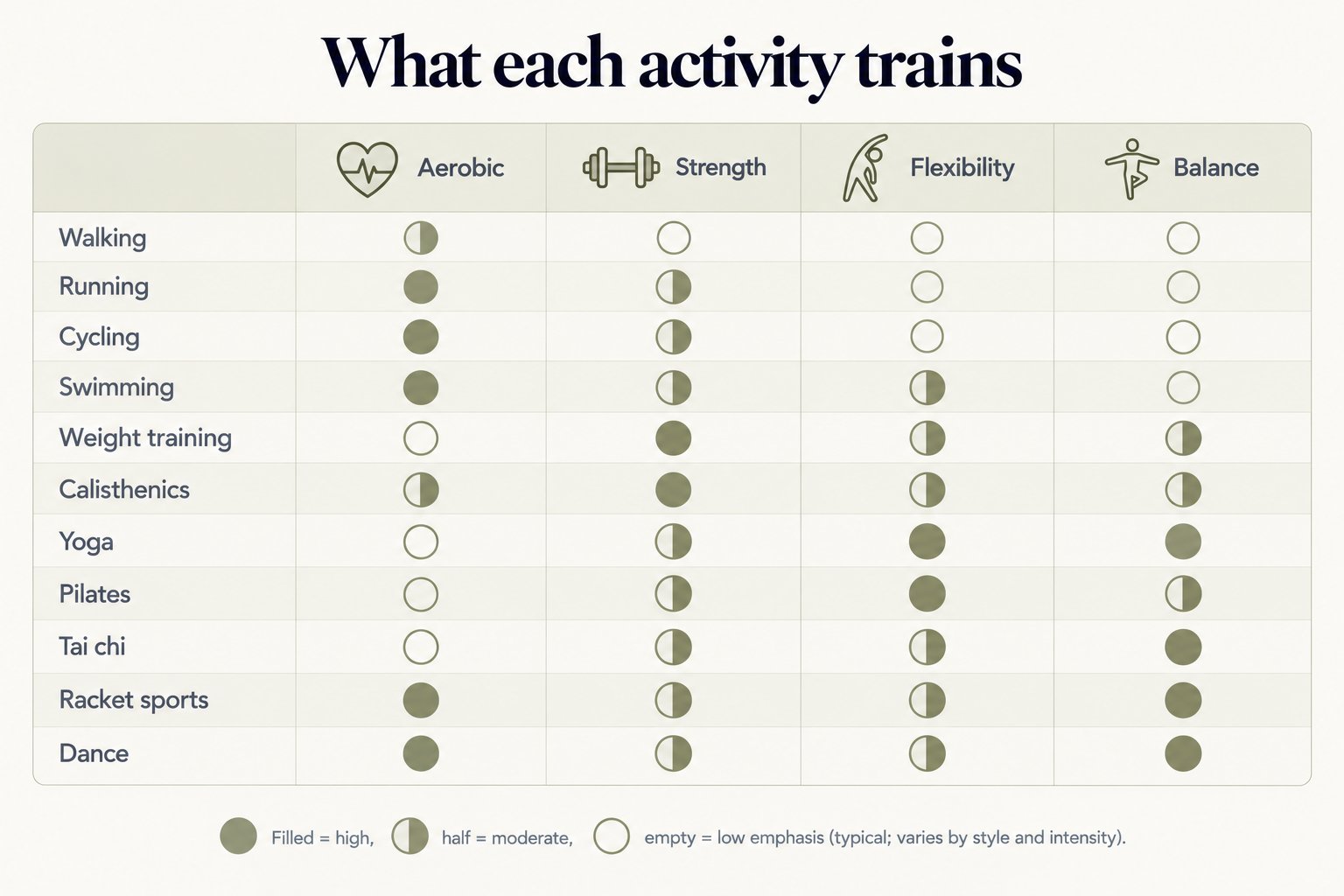
Most activities emphasise one type of exercise, but many train several. Choosing a mix helps cover all four:
- Walking, running, cycling and swimming: mainly aerobic; running and stair climbing add some strength and bone loading.
- Weight training and calisthenics: mainly strength; circuit-style sessions add aerobic benefit, and many exercises train balance.
- Yoga and Pilates: flexibility, core strength and balance, with modest aerobic demand in faster styles.
- Tai chi and qigong: balance, coordination and leg strength, with a strong mind-body component.
- Sports and dance: often all four, plus social connection and enjoyment, which help people keep going.
To combine them into a routine that covers all four types, see Building Your Weekly Exercise Mix.
Why this matters for longevity
Each type of exercise protects a different part of healthy ageing: aerobic fitness protects the heart, brain and metabolism; strength protects muscle, bone and independence; flexibility supports comfortable movement; and balance prevents falls. Doing only one leaves gaps. The good news is that a well-chosen mix of two or three activities you enjoy can cover all four, and it's never too late to start.
Recommendations by life stage
- Adults 18 to 64: aim for at least 150 minutes of moderate cardio a week plus two strength sessions. Add stretching or yoga if you're stiff or sit a lot.
- Adults 65 and over: keep cardio and strength, and add balance training on three or more days, such as tai chi, dance or simple balance drills.
- Beginners: start with walking and two short bodyweight or band strength sessions a week, then build gradually.
- People with heart disease, diabetes, arthritis or other conditions: exercise is usually beneficial, but check with your doctor first, especially before vigorous activity.
- Busy people: combine types, for example brisk walking plus a 20-minute circuit of bodyweight exercises twice a week.
Practical notes
Think of exercise as four tools rather than one: cardio for your heart, strength for your muscles and bones, flexibility for your joints, and balance for staying on your feet. Most people do some cardio but skip strength and balance, so those are often the easiest wins. In Sri Lanka's heat, exercise early in the morning or in the evening, drink water before and after, and consider indoor options on very hot days. Start where you are, increase gradually, and choose activities you enjoy enough to keep doing. Our Longevity Doctors can assess your fitness, strength and balance, check for any health issues before you increase your activity, and help you plan a weekly routine that suits your age and goals, starting with the free longevity assessment.
- Bull FC, et al. World Health Organization 2020 guidelines on physical activity and sedentary behaviour. British Journal of Sports Medicine, 2020;54(24):1451-1462.
- Zhao M, et al. Recommended physical activity and all cause and cause specific mortality in US adults: prospective cohort study. BMJ, 2020;370:m2031.
- Momma H, et al. Muscle-strengthening activities are associated with lower risk and mortality in major non-communicable diseases: a systematic review and meta-analysis of cohort studies. British Journal of Sports Medicine, 2022;56(13):755-763.
- Araujo CG, et al. Successful 10-second one-legged stance performance predicts survival in middle-aged and older individuals. British Journal of Sports Medicine, 2022;56(17):975-980.
- World Health Organization. Nearly 1.8 billion adults at risk of disease from not doing enough physical activity. News release, 26 June 2024 (Strain T, et al. Lancet Global Health, 2024).
- Behavioral risk factors for cardiovascular diseases among adults in Sabaragamuwa Province. Sri Lanka Journal of Medicine, 2022;31(1).
Free longevity assessment
Not sure which exercise
mix is right for you?
Take the free Aevum Protocol assessment to see how your movement & strength and 6 other longevity domains are performing — and get a personalised 90-day plan.
Take the free assessment