Movement & Strength
Walking for Longevity:
Steps, Pace and How to Get the Most From Every Walk
Walking is the most accessible form of exercise: it's free, needs no equipment or skill, suits almost every age and fitness level, and carries a very low risk of injury. It's also surprisingly powerful. A 2025 analysis of 57 studies in The Lancet Public Health found that people who walked about 7,000 steps a day had a 47% lower risk of early death and a 38% lower risk of dementia than those walking 2,000 steps, with little extra benefit for most outcomes beyond that. The famous 10,000-step target wasn't originally based on research: in a 2022 analysis of 47,471 adults, the benefit for death levelled off at about 6,000 to 8,000 steps a day for people over 60 and 8,000 to 10,000 for younger adults. Pace matters too. Walking at an average or brisk pace was linked to a 20 to 24% lower risk of death than walking slowly, and a few minutes of walking after meals lowers blood sugar more than standing or sitting. Walking mainly trains aerobic fitness, so it works best combined with some strength and balance training. This article explains how many steps you need, how fast to walk, how to build up and how to walk safely in Sri Lanka's climate.
Key numbers
| Finding | Detail |
|---|---|
| 7,000 vs 2,000 steps a day (57 studies) | 47% lower risk of early death; 38% lower risk of dementia |
| Where benefit levels off (15 cohorts, 47,471 adults) | About 6,000 to 8,000 steps (over 60); 8,000 to 10,000 (under 60) |
| Highest vs lowest step quartile | 53% lower risk of death (about 10,900 vs 3,500 steps) |
| Average or brisk vs slow pace (50,225 British walkers) | 20% and 24% lower risk of death |
| Pace for moderate intensity | About 100 steps per minute in adults |
| Light walking breaks vs prolonged sitting (7 studies) | Blood sugar 17% lower; standing 10% lower |
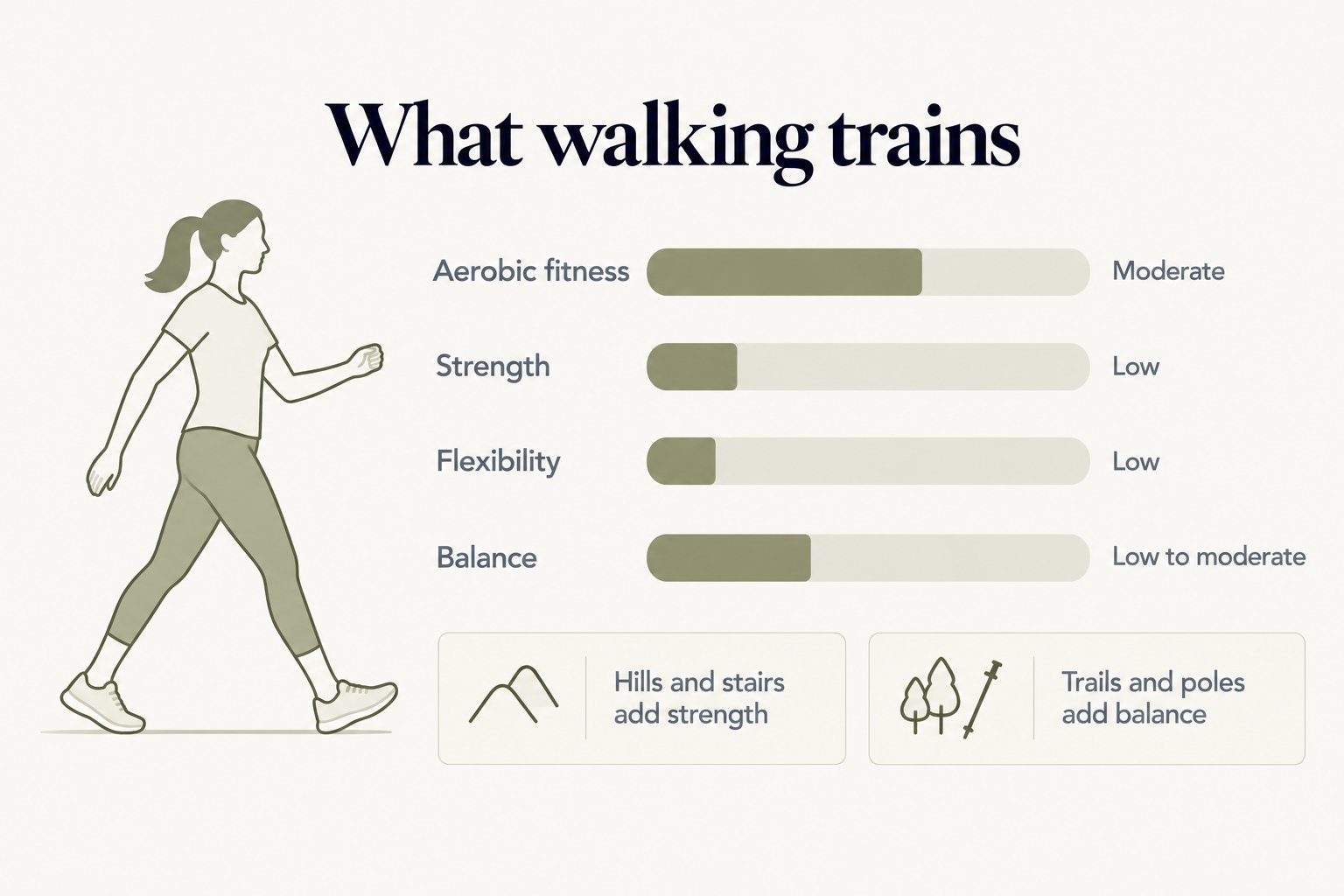
What walking trains
- Aerobic fitness: moderate. Brisk walking counts as moderate-intensity activity for most adults, and as vigorous activity for some older or less fit people.
- Strength: low, though uphill walking, stairs and carrying loads add some leg and bone loading.
- Flexibility: low.
- Balance: low to moderate, higher on uneven ground, trails or with Nordic walking poles.
Walking is an excellent foundation, but it doesn't replace strength training (see Types of Exercise Explained).
Styles of walking.
- Everyday walking: errands, commuting, walking meetings.
- Brisk walking: a pace where you can talk but not sing.
- Interval walking: alternating 3 minutes fast and 3 minutes slow, a simple way to raise intensity.
- Hill and stair walking: adds intensity and leg strength.
- Nordic walking: using specially designed poles to engage the upper body.
- Hiking: longer walks on trails, with more balance and strength demand.
What the research shows
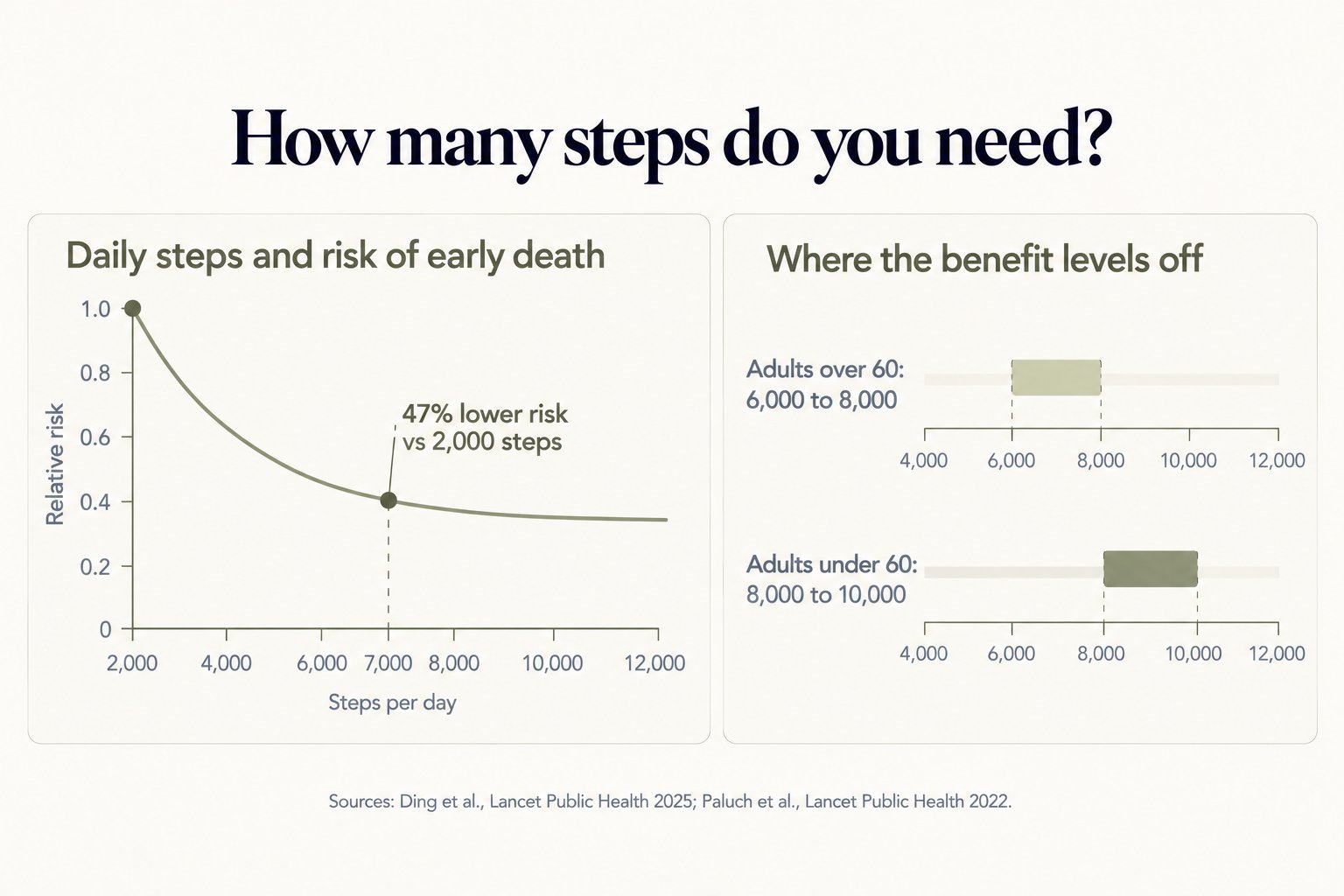
How many steps?. A 2022 meta-analysis in The Lancet Public Health combined 15 cohorts with 47,471 adults followed for a median of 7 years. Compared with the lowest quarter (about 3,500 steps a day), people in the highest quarter (about 10,900 steps) had a 53% lower risk of death. The benefit levelled off at about 6,000 to 8,000 steps a day in adults over 60 and 8,000 to 10,000 steps in younger adults.
A larger 2025 review of 57 studies in the same journal found that, compared with 2,000 steps a day, walking about 7,000 steps was linked to a 47% lower risk of early death, nearly the same as 10,000 steps, and a 38% lower risk of dementia. Most of the gains came from moving from very low step counts to 5,000 to 7,000. The authors suggested 7,000 steps as a realistic target, emphasising "progress" over "perfection".
These studies are observational, so healthier people may simply walk more, but the consistency of the findings across many populations is striking.
Does pace matter?. In a 2018 analysis of 50,225 walkers from 11 British surveys, walking at an average pace was linked to a 20% lower risk of death, and a brisk pace to a 24% lower risk, compared with walking slowly, after accounting for total activity. Among people over 60, average and fast walkers had 46% and 53% lower risk of death from heart disease. In a UK Biobank study of over 450,000 people, brisk walkers had better 10-year survival than slow walkers regardless of most other lifestyle habits, except smoking.
A simple guide: about 100 steps per minute is moderate intensity for most adults, and about 130 steps per minute is vigorous. If you can talk but not sing, you're at a brisk pace.
Walking after meals. A 2022 analysis of seven studies in Sports Medicine found that short bouts of light walking, 2 to 5 minutes every 20 to 30 minutes, lowered blood sugar by about 17% compared with sitting, while standing lowered it by about 10%. Walking also kept insulin levels steadier. Blood sugar usually peaks 60 to 90 minutes after eating, so a short walk soon after a meal is particularly useful, especially for people with prediabetes or diabetes (see Exercise Snacking).
Nordic walking. Nordic walking uses poles to work the arms, shoulders and core. In a small 2026 trial of 32 adults aged 65 to 80, 12 weeks of Nordic walking improved the 6-minute walk test and arm and leg strength more than ordinary walking, though the authors called the findings preliminary.
How to start
A simple 8-week plan for beginners
| Weeks | Plan |
|---|---|
| 1 to 2 | 10 to 15 minutes at a comfortable pace, 5 days a week |
| 3 to 4 | 20 minutes, including 5 minutes at a brisk pace |
| 5 to 6 | 30 minutes, mostly brisk, 5 days a week (150 minutes a week) |
| 7 to 8 | 30 to 45 minutes; add hills, stairs or intervals once or twice a week |
Tips to get more from walking.
- Track steps with a phone or watch, and aim to increase your daily average by about 1,000 steps every week or two until you reach about 7,000 to 8,000.
- Pick up the pace for part of each walk.
- Walk after meals, even for 5 to 10 minutes.
- Build walking into your day: walk to the shop, take stairs, park further away, walk during phone calls.
- Walk with others for safety, motivation and social connection.
- Add strength and balance: two short strength sessions a week, and balance drills, complete the picture.
Injury risk and who should be careful
Walking is one of the safest forms of exercise, but:
- Wear supportive shoes that fit well, especially if you have diabetes, foot pain or flat feet. People with diabetes should check their feet regularly for blisters or sores.
- Knee or hip arthritis: walking is usually beneficial and doesn't wear out joints (see Exercise and Joint Health). Start with shorter walks on flat ground and build gradually.
- Heart or lung disease: check with your doctor before increasing intensity, and stop if you develop chest pain, unusual breathlessness, dizziness or palpitations.
- Balance problems or a history of falls: walk on even surfaces, consider poles or a walking aid, and add balance training (see Balance and Fall Prevention).
Walking in Sri Lanka
- Beat the heat: walk early in the morning or after sunset, wear light, breathable clothing and a hat, and drink water before and after. On very hot or humid days, slow down or walk indoors.
- Monsoon season: shopping malls, covered walkways, indoor tracks or walking on the spot at home can keep you moving.
- Safe places: parks, lakesides, school grounds and temple premises often offer safer walking than busy roads. Wear bright clothing if walking near traffic.
- Hills and pilgrim climbs: hill-country walks and pilgrimages such as the climb to Sri Pada are excellent endurance challenges, but build up first and take care if you have heart disease.
Evidence strength
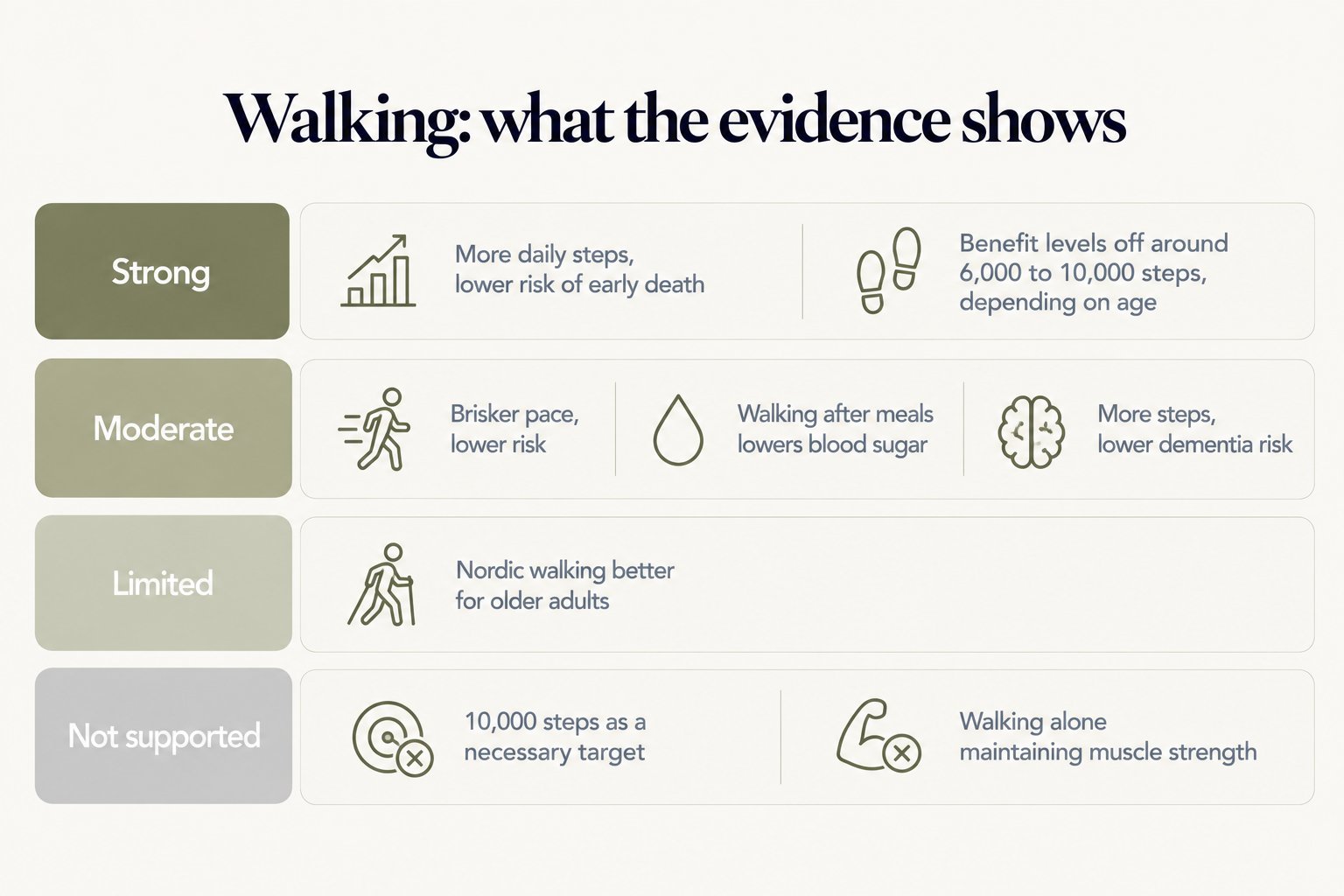
- More daily steps linked to lower risk of early death: strong and consistent, though observational.
- Benefit levelling off at about 6,000 to 10,000 steps, depending on age: strong.
- Brisker walking linked to better survival: moderate.
- Walking after meals lowering blood sugar: moderate.
- Nordic walking being superior for older adults: limited.
- Walking alone preventing muscle and bone loss: not supported; add strength training.
Why this matters for longevity
Walking is the activity most people can do for the rest of their lives. Raising your daily steps from very low levels to around 7,000 is linked to some of the largest reductions in risk of early death, heart disease and dementia seen anywhere in prevention research. It lowers blood sugar, supports heart and brain health, and lifts mood. Combined with strength and balance training, it forms the backbone of a lifelong exercise habit.
Recommendations by situation
- Inactive adults: start with 10 to 15 minutes a day and build towards 7,000 steps.
- Older adults: aim for 6,000 to 8,000 steps, include brisk sections, and add balance and strength training.
- People with diabetes or prediabetes: walk for 10 to 15 minutes after meals, especially the largest meal of the day.
- People with arthritis: walk on flat, even ground with good shoes, building gradually.
- Already active walkers: add pace, hills or intervals, and two strength sessions a week.
Practical notes
You don't need 10,000 steps to benefit. If you're currently walking very little, every extra 1,000 steps counts, and 7,000 a day is a realistic and well-supported goal. Walk briskly for part of each walk, take a short walk after meals, and choose cooler times of day in Sri Lanka's heat. Wear good shoes and build up gradually. Remember that walking is mainly aerobic, so add strength and balance exercises for complete fitness. Our Longevity Doctors can assess your fitness, joints and heart health, and help you set safe and realistic walking goals as part of a complete exercise plan, starting with the free longevity assessment.
- Ding D, et al. Daily steps and health outcomes in adults: a systematic review and dose-response meta-analysis. The Lancet Public Health, 2025.
- Paluch AE, et al. Daily steps and all-cause mortality: a meta-analysis of 15 international cohorts. The Lancet Public Health, 2022;7(3):e219-e228.
- Stamatakis E, et al. Self-rated walking pace and all-cause, cardiovascular disease and cancer mortality: individual participant pooled analysis of 50 225 walkers from 11 population British cohorts. British Journal of Sports Medicine, 2018;52(12):761-768.
- Zaccardi F, et al. Mortality risk comparing walking pace to handgrip strength and a healthy lifestyle: a UK Biobank study. European Journal of Preventive Cardiology, 2021.
- Tudor-Locke C, et al. Walking cadence (steps/min) and intensity in 21–40 year olds: CADENCE-adults. International Journal of Behavioral Nutrition and Physical Activity, 2019;16:8.
- Buffey AJ, et al. The acute effects of interrupting prolonged sitting time in adults with standing and light-intensity walking on biomarkers of cardiometabolic health in adults: a systematic review and meta-analysis. Sports Medicine, 2022;52(8):1765-1787.
- Investigation of the effectiveness of Nordic walking training on geriatric individuals: a randomized comparative study. European Geriatric Medicine, 2026;17(4):1901-1909.
Free longevity assessment
Want a walking plan that
fits your health and goals?
Take the free Aevum Protocol assessment to see how your movement & strength and 6 other longevity domains are performing — and get a personalised 90-day plan.
Take the free assessmentKeep reading