Movement & Strength
Running:
How Much Is Enough, How Much Is Too Much and How to Start
Running is one of the most efficient ways to build aerobic fitness, and you don't need to run far or fast to benefit. In a study of 55,137 adults followed for 15 years, runners had a 30% lower risk of death from any cause and a 45% lower risk of death from heart disease than non-runners, and lived about 3 years longer. Benefits appeared with as little as 5 to 10 minutes a day at a slow pace, and those who ran the most gained no extra survival benefit. A 2020 meta-analysis of over 232,000 people confirmed that any running, even once a week, was linked to a 27% lower risk of early death, and found no clear evidence that more running brings more longevity benefit. Contrary to popular belief, recreational running doesn't wear out healthy knees: recreational runners have lower rates of knee arthritis than sedentary people. The main downside is injury, which is most common in beginners who increase too quickly. Running also places more stress on the body in Sri Lanka's heat and humidity. This article explains how much running is enough, the risks of doing too much, and how to start safely.
Key numbers
| Finding | Detail |
|---|---|
| Runners vs non-runners (55,137 adults, 15 years) | 30% lower risk of death; 45% lower heart disease death; about 3 years longer life |
| Minimum dose linked to benefit | 5 to 10 minutes a day, at about 10 minutes per mile (6 mph) |
| Any running vs none (14 studies, 232,149 people) | 27% lower all-cause, 30% lower cardiovascular and 23% lower cancer death |
| Knee arthritis prevalence | Recreational runners 3.5%; sedentary people 10.2%; very high-volume competitive runners 13.3% |
| Injury rate | About 18 per 1,000 hours in novice runners vs 8 in recreational runners |
| Cardiac arrest during marathons and half-marathons | About 1 in 185,000 participants (0.54 per 100,000) |
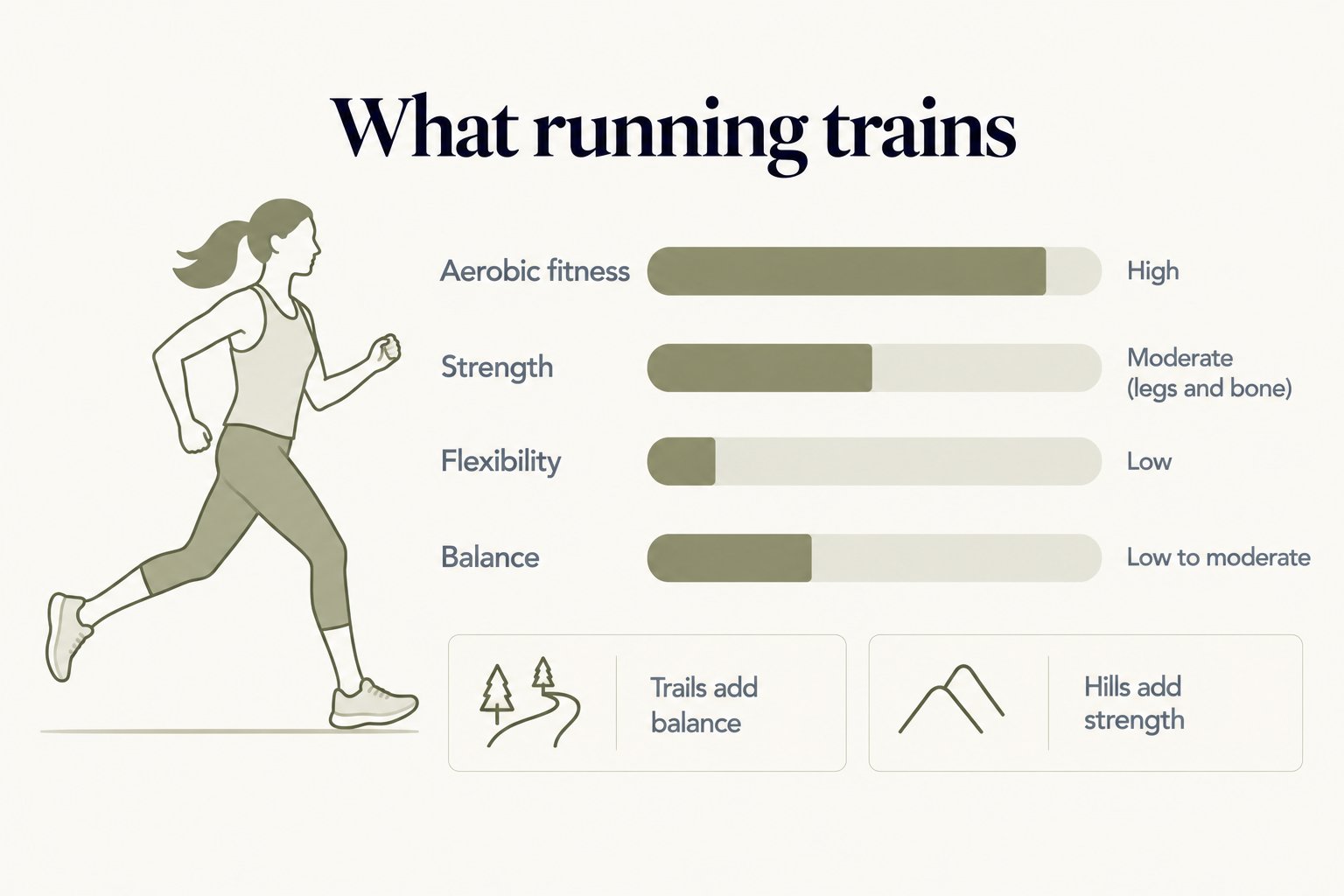
What running trains
- Aerobic fitness: high. Running raises VO2 max efficiently, one of the strongest predictors of longevity (see VO2 Max: The Single Best Predictor of Longevity?).
- Strength: moderate in the legs; running loads bones, which helps bone density in the hips and spine.
- Flexibility: low.
- Balance: low to moderate, higher on trails.
Styles of running.
- Easy running: conversational pace, the foundation of most training (see Zone 2 Training).
- Run-walk: alternating running and walking, ideal for beginners and older adults.
- Intervals and tempo runs: harder efforts that improve speed and VO2 max (see HIIT vs. Steady-State Cardio).
- Long runs: for building endurance for 10 km, half-marathons and marathons.
- Trail running: softer surfaces with more balance and strength demand.
- Treadmill running: useful in heat, rain or for safety.
What the research shows
A little goes a long way. In a 2014 study in the Journal of the American College of Cardiology, researchers followed 55,137 adults with an average age of 44 at the Cooper Clinic in Dallas for 15 years. Runners had a 30% lower risk of death from any cause and a 45% lower risk of death from heart disease than non-runners, and on average lived about 3 years longer. The benefit appeared with as little as 5 to 10 minutes of running a day, at speeds of about 10 minutes per mile. Those who ran the most gained no extra benefit over those who ran a little, and the benefit was strongest in people who kept running over the years.
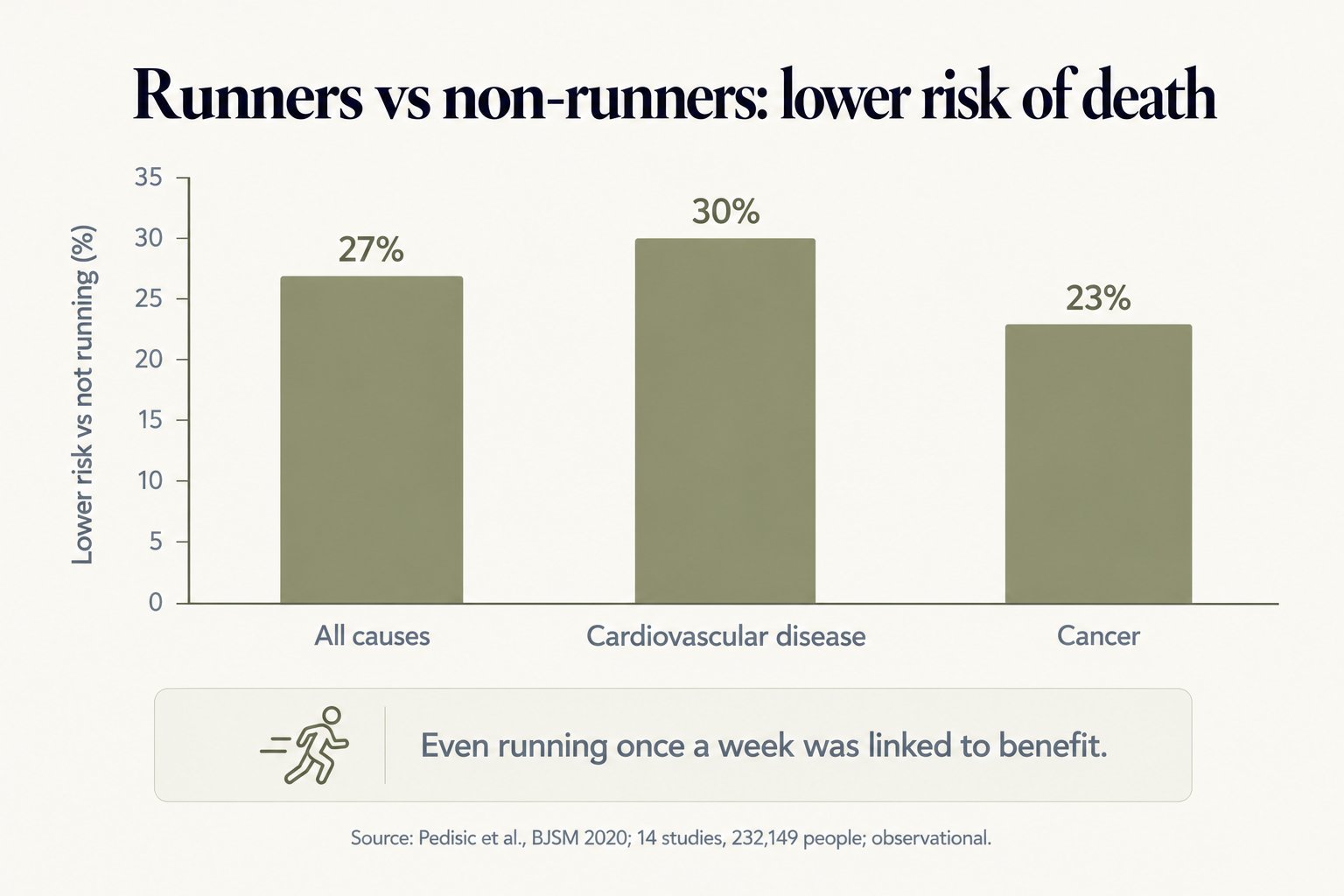
A 2020 meta-analysis in the British Journal of Sports Medicine pooled 14 studies from 6 cohorts with 232,149 people. Any running was linked to a 27% lower risk of death from any cause, 30% lower risk of death from cardiovascular disease and 23% lower risk of death from cancer. There was no clear evidence that running more often, for longer or faster brought greater survival benefit, and even running once a week was better than none.
Running and your knees. Running doesn't appear to wear out healthy knees. In a meta-analysis of hip and knee arthritis, 3.5% of recreational runners had arthritis, compared with 10.2% of sedentary people. Only very high-volume competitive runners, covering more than about 92 km a week, had higher rates, at 13.3% (see Exercise and Joint Health). People who already have knee arthritis can often run comfortably at lower volumes, but should get advice first.
Can you run too much?.
- Injuries: a 2015 meta-analysis found about 18 injuries per 1,000 hours of running in novice runners, compared with about 8 in experienced recreational runners. Most are overuse injuries from increasing distance or speed too quickly: shin pain, runner's knee, Achilles and plantar fascia problems, and stress fractures.
- The heart: for most people, running strengthens the heart. Very long-term, high-volume endurance training has been linked to a higher risk of atrial fibrillation, an irregular heart rhythm, particularly in men. The risk of cardiac arrest during races is very low: in a study of 10.9 million marathon and half-marathon runners over 10 years, it was 0.54 per 100,000 participants, higher in marathons and in men, and most cases were caused by undiagnosed heart disease. Bystander CPR was a key predictor of survival.
- Overtraining: too much training with too little recovery can cause persistent fatigue, poor performance and low mood (see Overtraining Syndrome).
The evidence suggests the longevity benefits of running are achieved at modest volumes, and that more is mainly about performance and enjoyment rather than extra health.
How to start
A 9-week run-walk plan for beginners. Do 3 sessions a week, with at least one rest day between sessions. Start each session with a 5-minute brisk walk.
| Weeks | Each session |
|---|---|
| 1 to 2 | 1 minute jogging, 2 minutes walking; repeat 6 to 8 times |
| 3 to 4 | 2 minutes jogging, 2 minutes walking; repeat 5 to 6 times |
| 5 to 6 | 4 minutes jogging, 1 to 2 minutes walking; repeat 4 times |
| 7 to 8 | 8 to 10 minutes jogging, 1 minute walking; repeat 2 to 3 times |
| 9 | 20 to 30 minutes of continuous easy jogging |
If a week feels too hard, repeat it. There's no rush.
Tips to run well and avoid injury.
- Run slowly: most running should be at a pace where you can talk.
- Increase gradually: raise your weekly time or distance slowly, and build in an easier week every 3 to 4 weeks. The traditional "10% rule" is a reasonable guide, though the evidence behind any specific figure is weak.
- Choose comfortable shoes: comfort matters more than any particular shoe technology. Replace shoes when they feel worn out.
- Strength train: two sessions a week of leg, hip and core strength exercises can reduce injury risk and improve running (see Progressive Overload).
- Listen to pain: mild muscle soreness is normal; sharp, localised or worsening pain, especially over a bone, isn't. Rest and seek advice.
- Mix surfaces: grass, tracks and trails, as well as roads.
Who should be careful
- People with heart disease, chest pain, palpitations, fainting or a family history of sudden cardiac death: see a doctor before starting vigorous running.
- People who are inactive and over 40, or have diabetes, high blood pressure or high cholesterol: a medical check is sensible before starting vigorous exercise.
- People with significant overweight: start with walking and run-walk intervals to reduce joint stress.
- People with knee or hip arthritis, or previous injuries: get advice on a gradual programme.
- People with low bone density or a history of stress fractures: review nutrition, hormones and bone health.
Stop and seek urgent help if you develop chest pain, severe breathlessness, dizziness or fainting during exercise.
Running in Sri Lanka
- Heat and humidity: high humidity reduces sweat evaporation, so the body heats up faster. Run early in the morning or after sunset, slow down on hot days, and wear light, loose clothing and a cap.
- Hydrate: drink water before and after, and carry water on runs longer than about 45 to 60 minutes. Add electrolytes for long or very sweaty runs.
- Heat illness warning signs: dizziness, confusion, nausea, headache, cramps or stopping sweating. Stop, cool down in the shade and seek help if symptoms don't settle.
- Safety: run facing traffic where there's no footpath, wear bright or reflective clothing, and choose parks, tracks, school grounds or group runs.
- Indoor options: a treadmill or indoor track is useful during heavy rain or air pollution.
- Events: local fun runs, 10 km races and marathons can be motivating goals, but build up gradually and get a health check before your first long race.
Evidence strength
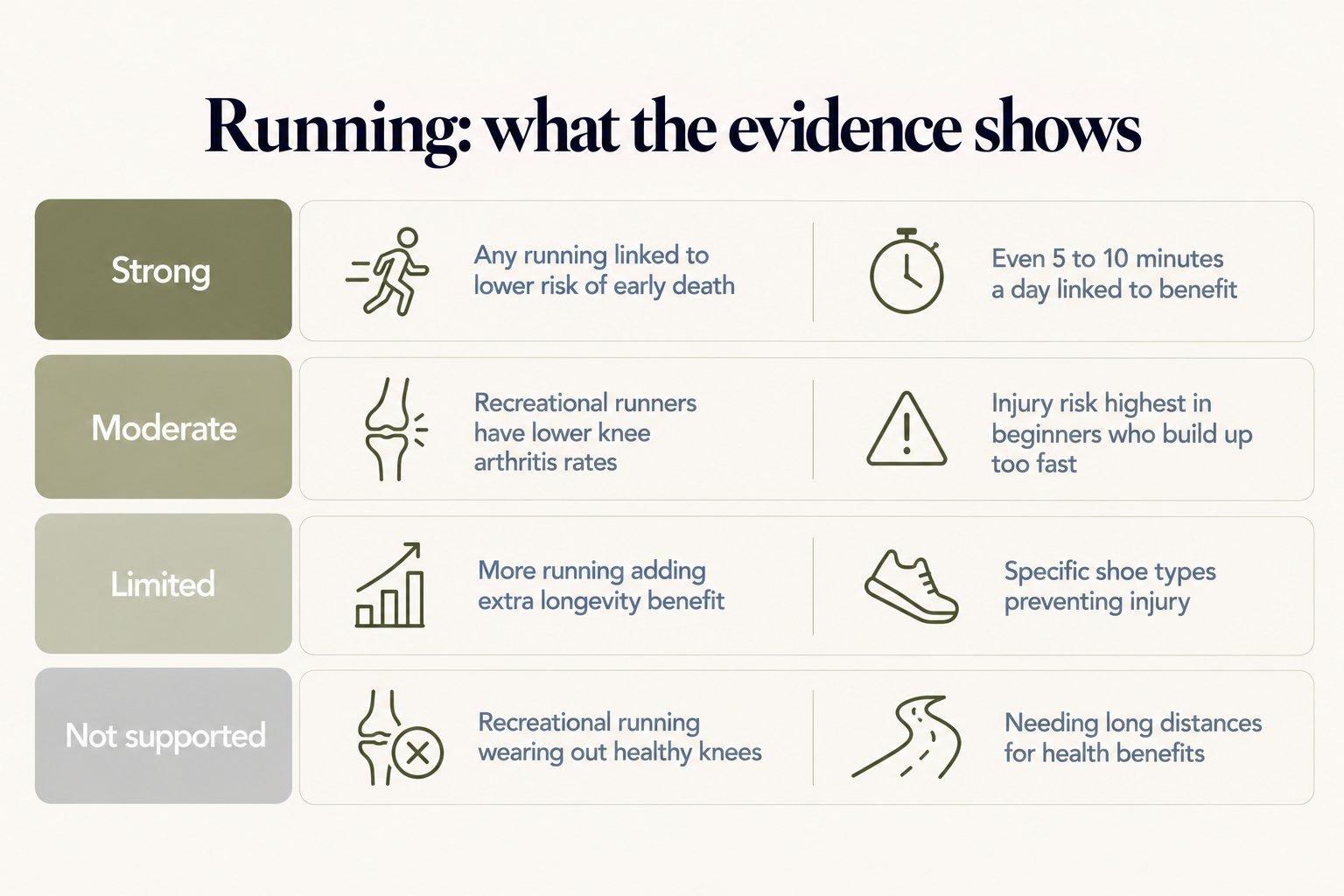
- Running linked to lower risk of early death and heart disease: strong, from large cohorts, though observational.
- Small amounts of running bringing most of the benefit: strong.
- Recreational running protecting rather than harming knees: moderate.
- More running bringing extra longevity benefit: limited; current studies don't show a clear dose-response.
- Very high-volume endurance training raising atrial fibrillation risk: moderate.
- Any specific shoe type or the 10% rule preventing injury: limited.
Why this matters for longevity
Running is one of the most time-efficient ways to raise aerobic fitness, which is strongly linked to longer life and lower risk of heart disease, diabetes and dementia. The best evidence suggests you don't need marathons to benefit: a few short, easy runs a week can bring most of the gains. Combined with strength training to protect joints and muscles, running can be a lifelong habit.
Recommendations by situation
- Complete beginners: start with the run-walk plan, 3 times a week.
- People short on time: 10 to 20 minutes of easy running, 3 times a week, delivers most of the longevity benefit.
- Older adults: run-walk at an easy pace; combine with strength and balance training.
- People training for races: follow a gradual plan, include easy runs, and get a heart check before your first marathon.
- People who keep getting injured: reduce volume, add strength training, review shoes and technique, and consider cycling or swimming as alternatives.
Practical notes
You don't have to run far or fast to benefit: 5 to 10 minutes a day at an easy pace is linked to most of the longevity gains. Start with run-walk intervals, increase gradually and keep most of your running easy. Add two strength sessions a week to protect your joints. In Sri Lanka's heat, run early or late, slow down on humid days, drink enough water and learn the warning signs of heat illness. If you have heart disease, risk factors or symptoms, check with a doctor before starting. Our Longevity Doctors can assess your heart health and fitness, check for risk factors and help you build a safe running plan that fits your goals, starting with the free longevity assessment.
- Lee DC, et al. Leisure-time running reduces all-cause and cardiovascular mortality risk. Journal of the American College of Cardiology, 2014;64(5):472-481.
- Pedisic Z, et al. Is running associated with a lower risk of all-cause, cardiovascular and cancer mortality, and is the more the better? A systematic review and meta-analysis. British Journal of Sports Medicine, 2020;54(15):898-905.
- Alentorn-Geli E, et al. The association of recreational and competitive running with hip and knee osteoarthritis: a systematic review and meta-analysis. Journal of Orthopaedic & Sports Physical Therapy, 2017;47(6):373-390.
- Videbæk S, et al. Incidence of running-related injuries per 1000 h of running in different types of runners: a systematic review and meta-analysis. Sports Medicine, 2015;45(7):1017-1026.
- Kim JH, et al. Cardiac arrest during long-distance running races. New England Journal of Medicine, 2012;366(2):130-140.
Free longevity assessment
Thinking of taking up
running safely?
Take the free Aevum Protocol assessment to see how your movement & strength and 6 other longevity domains are performing — and get a personalised 90-day plan.
Take the free assessment