Movement & Strength
Overtraining Syndrome:
Why It's Harder to Diagnose Than Wearables Suggest
"Overtraining" gets used loosely for anything from a tired week to a genuine, months-long medical syndrome — and the difference matters, because the real condition is far more serious and far harder to pin down than a wearable's "high training load" alert implies. This article covers the actual clinical distinctions (a spectrum, not a single state), what the evidence says about diagnosing it, and why no single biomarker — including the HRV metrics covered in our Resting Heart Rate and HRV article — can reliably catch it on its own.
Key numbers
| Finding | Detail |
|---|---|
| Functional overreaching recovery time | Days to a few weeks |
| Non-functional overreaching recovery time | Several weeks to months |
| Overtraining syndrome recovery time | Months, potentially years |
| Reliable single biomarkers for OTS (per joint ECSS/ACSM consensus) | None — "none of the currently available markers meet all criteria" for reliable diagnosis |
| Scoping review sample | 39 studies, 952 subjects (328 OTS, 624 controls) — no single marker reliably distinguished OTS from healthy athletes |
What overtraining actually is: a spectrum, not a switch
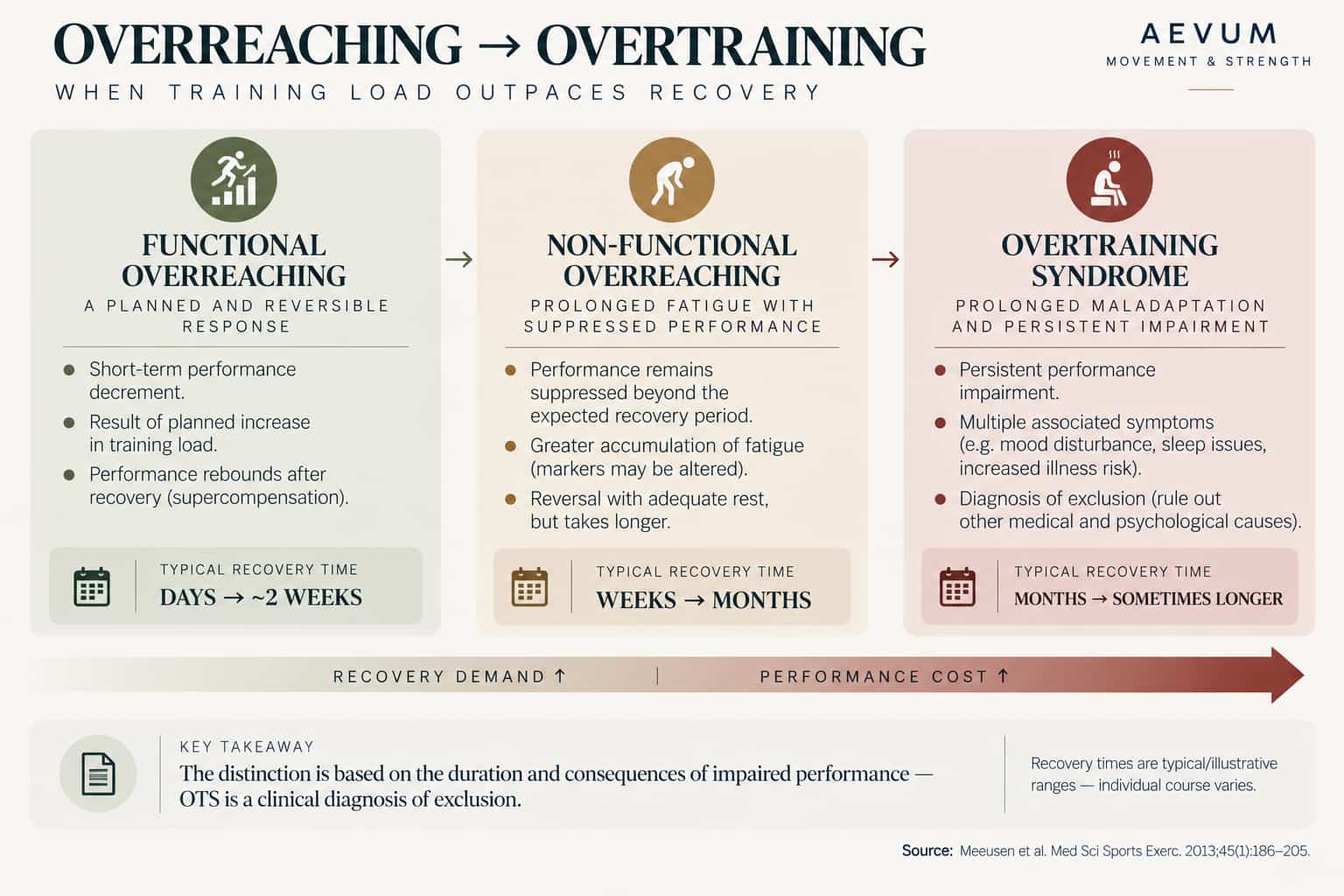
A joint consensus statement from the European College of Sport Science and American College of Sports Medicine defines three distinct points on a single spectrum, distinguished mainly by how long the performance decrement lasts and how it resolves.
Functional overreaching (FOR) — a short-term performance dip lasting days to a few weeks, followed by full recovery and, often, a performance rebound above baseline once rest is taken. This is a normal, even useful part of periodized training — deliberately pushing past comfortable limits before backing off.
Non-functional overreaching (NFOR) — performance decline persisting weeks to months, with qualitative changes beyond simple fatigue: psychological distress, hormonal disturbances, and a recovery process that takes meaningfully longer than FOR.
Overtraining syndrome (OTS) — the genuine medical condition, involving prolonged maladaptation across multiple body systems (hormonal, immune, psychological, neurological) and requiring months, potentially years, for complete recovery. This is a serious, relatively rare condition — not simply "training too hard this week."
The practical implication: most of what gets casually called "overtraining" in everyday conversation is actually functional overreaching — a normal and reversible part of training, not the syndrome itself.
Evidence Strength: Why Diagnosis Is Genuinely Hard
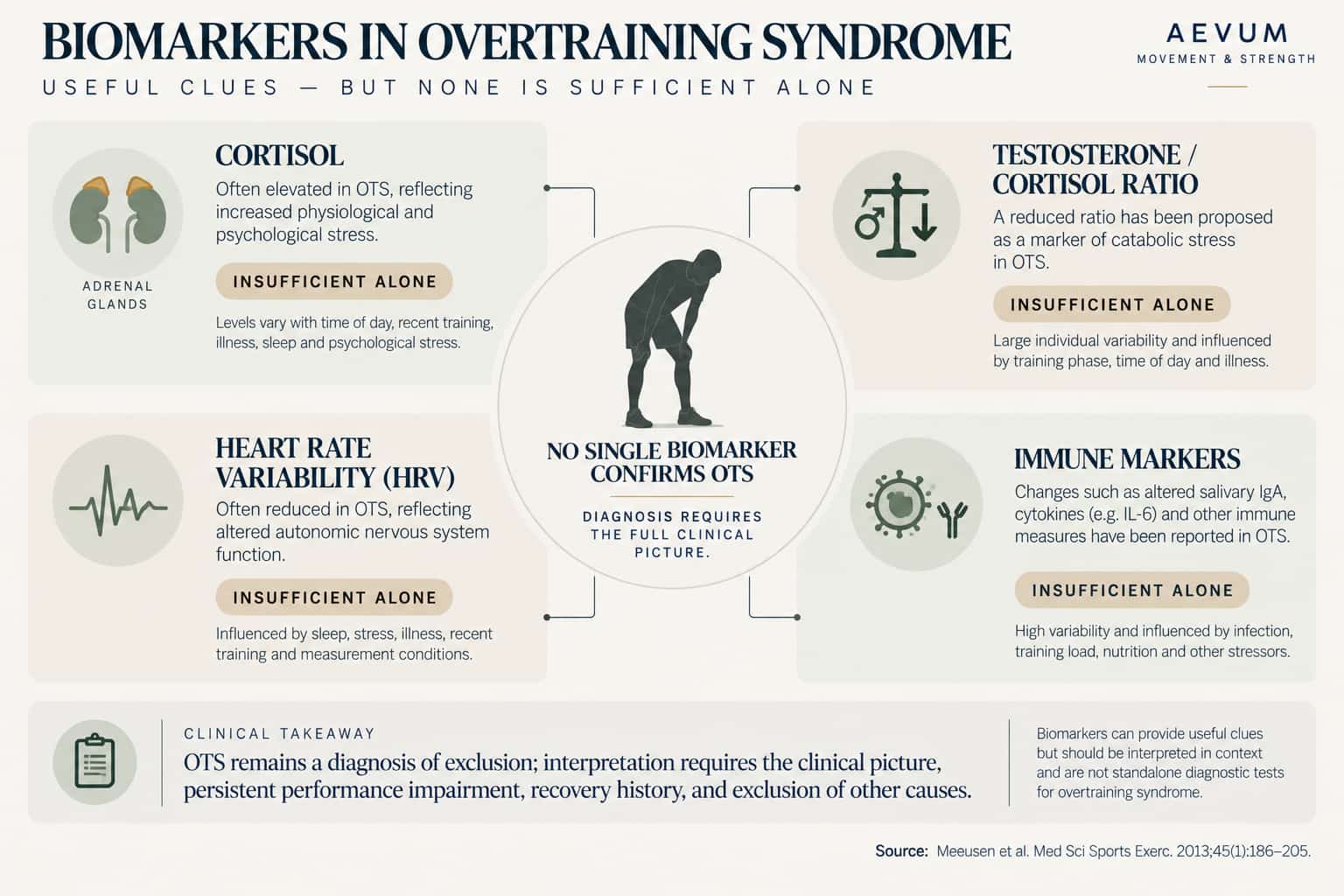
No single reliable marker exists. The ECSS/ACSM consensus statement is notably direct about this: none of the commonly proposed biomarkers meet the criteria for reliable OTS diagnosis on their own. Resting cortisol was specifically called out as "not a useful measurement" in isolation. The testosterone-to-cortisol ratio, once popularized as an overtraining marker, "cannot be used for diagnosis." And heart rate variability — despite being widely marketed as a recovery and readiness indicator (see the wearable HRV evidence discussion in our Resting Heart Rate and HRV article) — produces inconsistent changes across studies with high variability between individuals, meaning it can't reliably flag OTS on its own either.
What a systematic look at the research confirms. A 2022 scoping review examining the OTS diagnostic literature (39 studies, 952 subjects total, 328 with OTS) reached the same conclusion independently: individually, none of the markers tested — hormonal, psychological, immunological, or heart-rate-based — reliably distinguished athletes with OTS from healthy controls. The review noted that combined-score systems integrating multiple variables together show more promise than any single marker, but these composite tools still need larger-scale validation, including in female athlete populations specifically. The overall evidence quality was rated low, reflecting how much of the existing research relies on small samples and individual case reports rather than large, well-controlled studies.
Why this matters for anyone using a wearable's "training load" score
Given this, a wearable's automated overtraining or strain warning — however confidently presented — is working from the same limited, individually-unreliable inputs (HRV, resting heart rate, sometimes sleep data) that the research literature has already found insufficient on their own. This doesn't mean these tools are useless as one input among several, but treating a single "high strain" alert as a diagnosis is not supported by the underlying science. The honest position: OTS remains, in the research literature's own words, "a diagnosis of exclusion" — meaning it's identified by ruling other causes out and observing a genuinely prolonged, multi-system pattern over time, not flagged by any single number.
Recognizing the real pattern
Because no single marker works, what actually matters is the pattern over time, not any one data point.
- →Performance decline that doesn't respond to a few days or even a couple of weeks of reduced training — this is the core signal separating simple fatigue or functional overreaching from something that needs more attention
- →Persistent mood disturbance, unusual irritability, or loss of motivation for training alongside the performance decline, rather than either symptom in isolation
- →Disrupted sleep, appetite change, or recurrent minor illness/infection clustering together with the above, rather than any single symptom on its own
A single bad week, one poor night's sleep, or one high "strain score" reading is not evidence of overtraining syndrome — a sustained, multi-system pattern lasting weeks, resistant to normal recovery, is what the actual clinical picture looks like.
Recommendations
- 1Tired for a few days after a hard training block
This is very likely normal functional overreaching. Reduce load for a few days to a week and expect full recovery — often with a performance rebound.
- 2Performance decline and fatigue persisting for multiple weeks despite reduced training
This moves toward non-functional overreaching territory and is worth a genuine, extended recovery period (reduced volume/intensity for several weeks) rather than pushing through.
- 3Symptoms persisting for months and not responding to extended rest
This is the point to involve a doctor or sports medicine physician for a proper differential diagnosis — OTS is a diagnosis of exclusion, meaning other medical causes need to be ruled out first.
Practical notes
The evidence here reinforces a theme that runs through several articles in this series: the tools marketed as precise, quantified answers (readiness scores, single biomarkers) are often measuring real, useful signals — but the research consistently shows these signals are noisier and less individually diagnostic than the marketing suggests. Don't rely on a single wearable metric to self-diagnose or dismiss overtraining; use trends across multiple inputs — how you're performing, sleeping, and feeling, not just one number. For overtraining specifically, the pattern over weeks matters far more than any single reading.
Has a wearable ever flagged
your training load or strain as too high?
Take the free Aevum Protocol assessment to see how your movement & strength and 6 other longevity domains are performing — and get a personalised 90-day plan.
Take the Free Assessment →