Movement & Strength
Exercise Recovery:
Which Methods Are Actually Backed by Evidence
Recovery culture has exploded — ice baths, foam rollers, compression boots, massage guns — but these tools aren't interchangeable, and one of the most popular ones (cold water immersion) comes with a genuine trade-off for anyone trying to build muscle. This article separates recovery methods by what they're actually good for: some reduce soreness and perceived fatigue effectively, one can blunt the very adaptation you're training for, and none of them substitute for the two recovery inputs with the strongest evidence behind them — sleep and adequate protein.
Key numbers
| Finding | Detail |
|---|---|
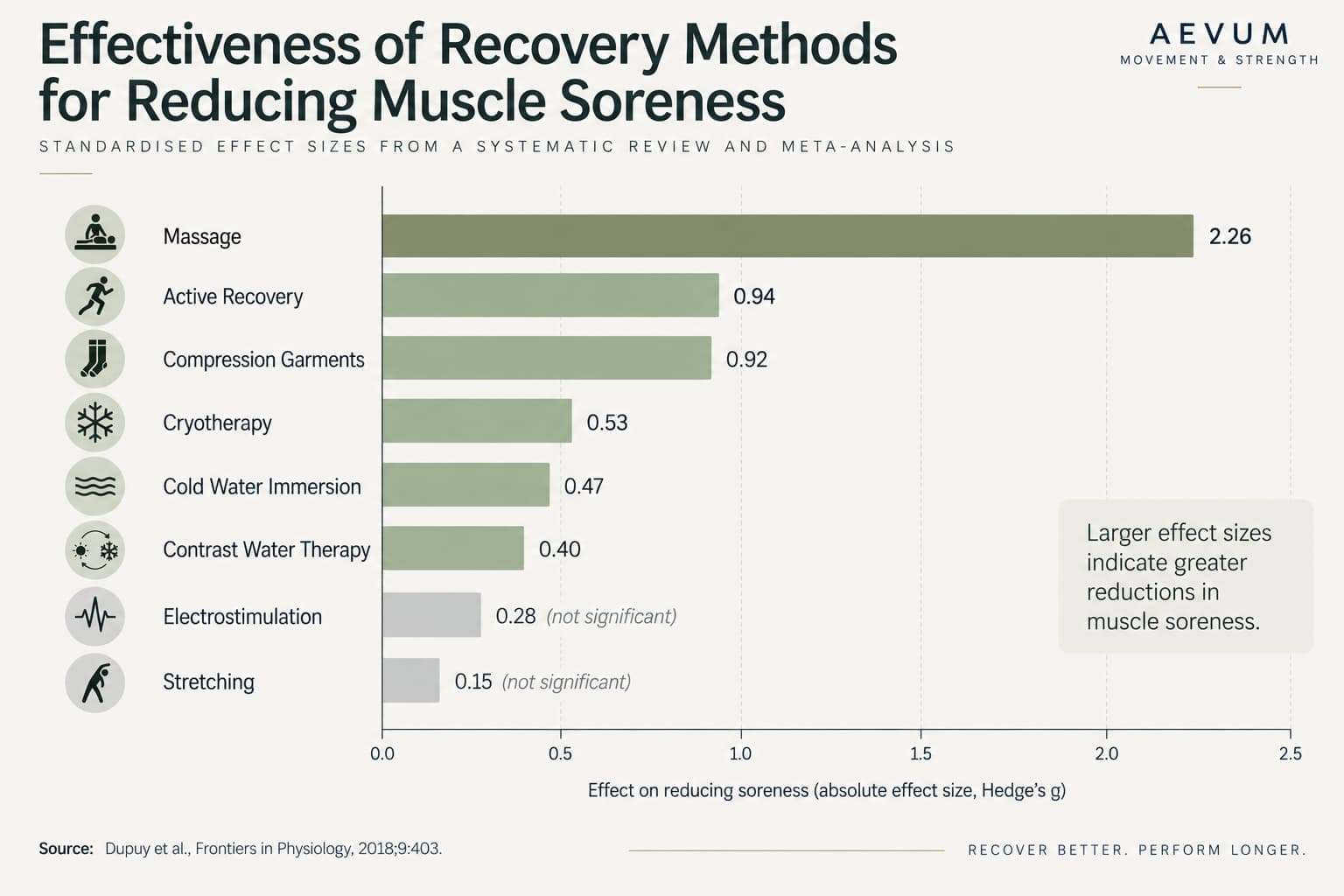
| Massage, effect on soreness (DOMS) | Largest effect of any method tested (g = -2.26) |
| Active recovery, effect on soreness | g = -0.94 |
| Compression garments, effect on soreness | g = -0.92 |
| Cold water immersion, effect on soreness | g = -0.47 (smaller than massage/compression/active recovery) |
| Static stretching for soreness | No significant benefit (g = 0.15) |
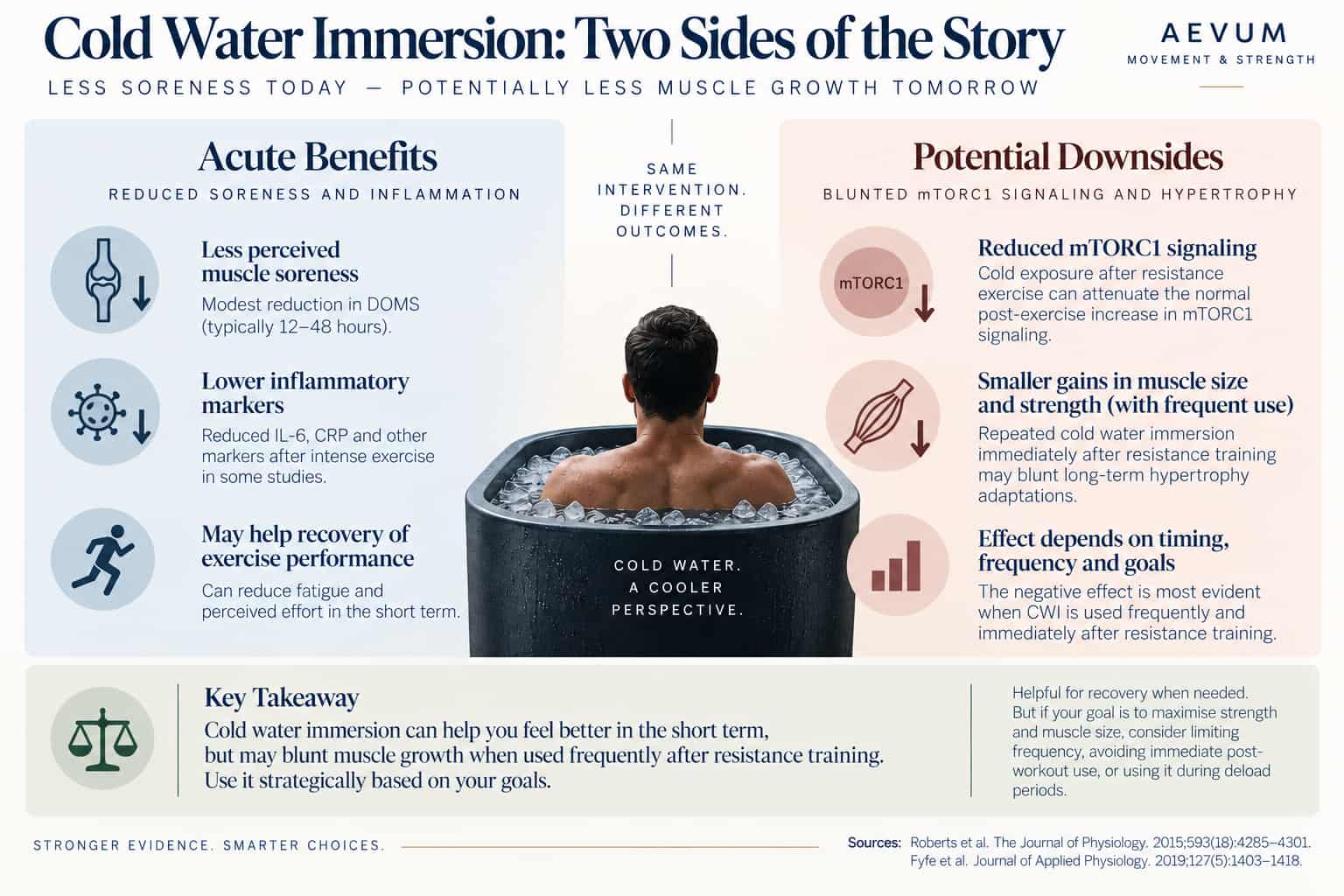
| Cold water immersion and hypertrophy | Meaningfully blunted Type II fibre growth vs. control over 7 weeks of resistance training; strength gains unaffected |
Evidence Strength: What Each Method Actually Does
Well-supported for soreness and perceived fatigue. A systematic review and meta-analysis pooling recovery-technique trials found massage to be the clear standout for reducing delayed-onset muscle soreness (DOMS), with by far the largest effect size of any method tested. Active recovery (light movement rather than complete rest) and compression garments both showed solid, moderate-to-large effects as well. Cryotherapy and cold water immersion showed smaller but still meaningful effects on soreness.
Static stretching, despite being one of the most commonly recommended post-workout recovery practices, showed no significant benefit for soreness in this pooled analysis — consistent with the expert-consensus finding covered in our Flexibility and Mobility article, which found no evidence supporting stretching for post-exercise recovery specifically.
The real trade-off: cold water immersion and muscle growth
Cold water immersion deserves a closer look because of a genuine, well-documented downside for anyone training specifically for hypertrophy. A controlled trial had participants perform whole-body resistance training over several weeks, applying cold water immersion after each session in one leg (or group) versus a passive-recovery control condition in the other. The cold water immersion condition showed meaningfully blunted Type II muscle fibre growth compared to control, alongside directly measured suppression of anabolic (mTORC1-related) signalling in the hours after exercise. Notably, strength gains were largely preserved despite the blunted hypertrophy — a genuinely interesting dissociation between the two outcomes.
The likely mechanism: cold exposure blunts the inflammatory and cellular signalling cascade that helps drive muscle protein synthesis and satellite cell activity — the same general remodeling process discussed in our Progressive Overload article. Suppressing that process may reduce soreness and perceived fatigue, but it appears to do so partly by dampening the adaptation signal itself.
The honest middle ground
None of this makes cold water immersion "bad" — it depends entirely on your goal. For an athlete needing to recover quickly for a competition or a second event the same week, blunting inflammation and soreness at some cost to long-term hypertrophy may be a reasonable trade. For someone whose primary goal is building muscle over a training block, using cold water immersion routinely after every session works somewhat against that specific goal.
Comparing recovery methods by goal
| Method | Best for | Trade-off |
|---|---|---|
| Massage | Soreness and perceived fatigue reduction (largest effect) | Cost/access; no evidence of harm to adaptation |
| Active recovery (light movement) | Soreness and fatigue reduction, moderate-large effect | Requires more effort than passive methods |
| Compression garments | Soreness and fatigue reduction, moderate-large effect | Minimal downside; passive, easy to use |
| Cold water immersion | Acute soreness/inflammation reduction, especially for rapid turnaround between events | Blunts hypertrophy signalling if used routinely during a muscle-building phase |
| Static stretching | Not well supported for recovery specifically | Better used for the separate goal of building range of motion (see our Flexibility and Mobility article) |
How to actually approach recovery
- →Use active recovery and compression as low-risk, broadly beneficial defaults. Both show solid evidence for reducing soreness and fatigue without a documented downside for adaptation
- →Reserve cold water immersion for genuine time-crunched situations — a tournament, a second training session the same day, a competition schedule — rather than a routine habit during a dedicated muscle-building block
- →Prioritize sleep and protein over any device or technique. Neither massage, cold plunges, nor compression boots come close to the evidence base behind adequate sleep and sufficient daily protein intake (see our Protein Timing article) for actual recovery and adaptation
- →Don't confuse feeling less sore with recovering better. Reduced soreness is a comfort outcome, not necessarily a marker of better physiological recovery or adaptation — cold water immersion is the clearest example of these two things pulling in different directions
Recommendations by goal
- 1Building muscle/strength as the primary goal
Favor active recovery, compression, and massage; use cold water immersion sparingly, if at all, during dedicated hypertrophy-focused training blocks.
- 2In-season athletes needing rapid turnaround between events
Cold water immersion's soreness and fatigue benefits may reasonably outweigh the hypertrophy trade-off during competition periods specifically.
- 3General fitness, no specific competitive demand
Active recovery and adequate sleep cover most of what's needed; specialized recovery tools are optional additions, not necessities.
Practical notes
The broader pattern across this series holds here too: the fundamentals — adequate sleep, sufficient protein, consistent progressive training — carry far more evidentiary weight than any single recovery technique or device, however popular. Recovery tools are worth using deliberately, matched to what you're actually training for, rather than applied as a blanket habit.
Do you use cold water immersion
during a dedicated muscle-building block?
Take the free Aevum Protocol assessment to see how your movement & strength and 6 other longevity domains are performing — and get a personalised 90-day plan.
Take the Free Assessment →