Movement & Strength
Flexibility and Mobility:
What Stretching Actually Does (and Doesn't Do)
Stretching is one of the most habitual parts of exercise culture — and also one of the most misunderstood. It doesn't reliably prevent injury the way it's often assumed to, static stretching before a heavy lift can genuinely reduce your strength output if held too long, and post-workout stretching has essentially no evidence behind it for soreness or recovery. What it does do well: build lasting range of motion, when done consistently and with the right parameters. This article separates the real evidence from the gym-locker-room wisdom.
Key numbers at a glance
| Finding | Detail |
|---|---|
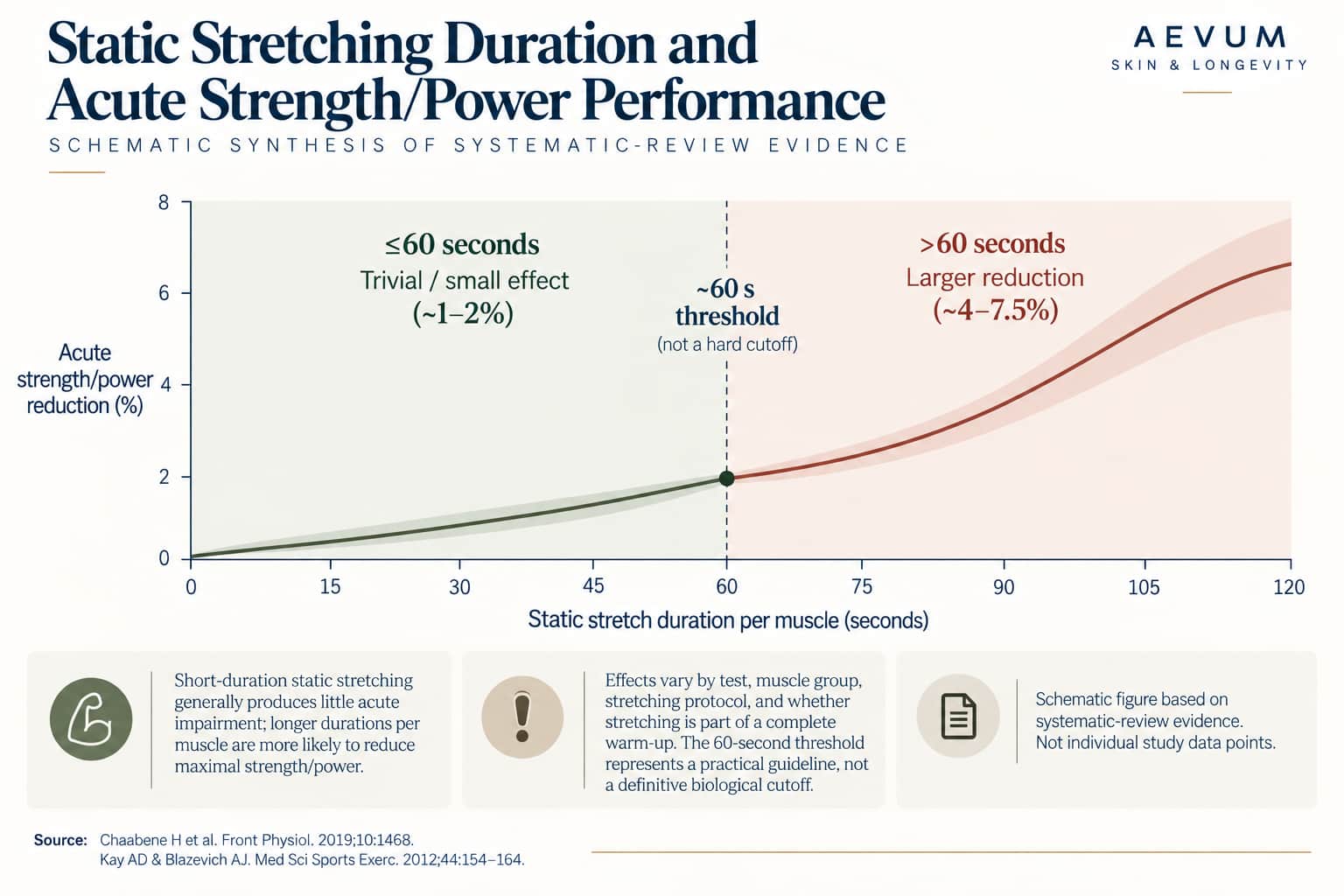
| Static stretching ≤60 sec/muscle before lifting | Trivial strength/power reduction (~1-2%) |
| Static stretching >60 sec/muscle before lifting | Substantial, practically relevant reduction (~4-7.5%) |
| Post-exercise stretching for soreness/recovery | 100% expert consensus agreement — no supporting evidence |
| Optimal chronic flexibility-building dose | 2-3 sets daily, 30-120 seconds per muscle/tissue, held per session, to accumulate the highest tolerable weekly volume |
| General injury prevention from stretching alone | Not supported as a standalone strategy — 85% expert consensus agreement |
How it works
Flexibility vs. mobility — a real distinction. "Flexibility" and "mobility" are often used interchangeably, but they describe different things. Flexibility refers to the passive range of motion available at a joint — how far a muscle-tendon unit can lengthen when an external force (gravity, a partner, your own hands) moves it there. Mobility refers to the active range of motion you can control and use — how far you can move a joint through its own strength and coordination, without external assistance. A gymnast doing the splits with someone pushing them down demonstrates flexibility; the same gymnast holding an active leg raise to that height demonstrates mobility. Both matter, but they're trained somewhat differently, and a mobility deficit isn't necessarily fixed by flexibility work alone.
Why stretch duration changes the effect. A stretch held briefly primarily produces a neurological effect — a temporary increase in stretch tolerance and reduced neuromuscular "stiffness" signal, which fades quickly and has minimal impact on subsequent force production. Held longer, the muscle-tendon unit itself begins to mechanically lengthen and its stiffness genuinely decreases — which is exactly why long-duration static stretching immediately before an explosive or maximal-strength effort can measurably reduce force output: a slightly "looser" muscle-tendon unit transmits force less efficiently in that immediate window.
What the evidence actually shows
Pre-exercise static stretching and performance. Static stretching held for 60 seconds or less per muscle group before training produces only a trivial reduction in subsequent strength and power (roughly 1-2%) — a negligible, likely inconsequential effect for most people. Held longer than 60 seconds per muscle group, the reduction becomes substantial and practically relevant (roughly 4-7.5%), a real consideration for anyone about to attempt a maximal lift or an explosive athletic effort. A 2025 expert Delphi consensus explicitly recommends against prolonged (>60 second) static stretching immediately before maximal or explosive contractions, while confirming that short-duration static stretching and dynamic stretching within a warm-up don't carry the same performance cost.
Injury prevention: weaker evidence than assumed. An international expert consensus statement found no support for stretching as a general, all-encompassing injury prevention strategy (85% panel agreement). There's a nuance worth keeping: static stretching may modestly reduce the incidence of muscle strain injuries specifically, but this appears to come with an increased risk of bone and joint injuries — meaning the overall risk-benefit picture isn't the clean "stretching prevents injury" story that's often assumed.
The same expert panel reached full agreement (100%) that stretching should not be relied on for post-exercise recovery — there's no supporting evidence for benefits on delayed-onset muscle soreness or strength recovery from stretching after a workout, despite how routinely it's still recommended for exactly this purpose.
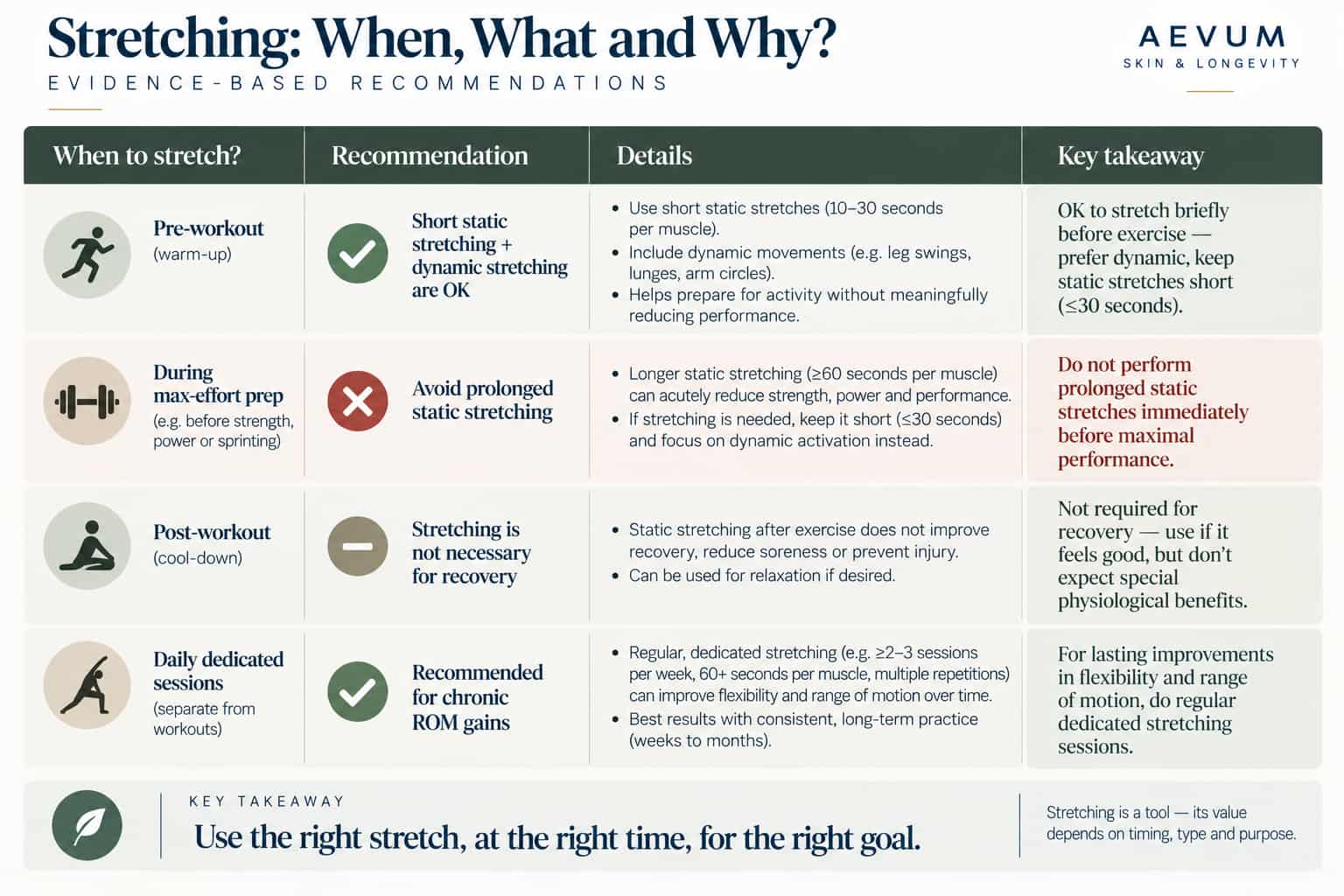
What actually builds lasting flexibility. For genuine, lasting range-of-motion improvement, the evidence points to a real, trainable dose: 2-3 sets daily, holding each stretch for 30-120 seconds per muscle or tissue, accumulating as much weekly volume as reasonably tolerable. Static and PNF (proprioceptive neuromuscular facilitation) stretching are the most consistently effective techniques for this chronic adaptation. Notably, this isn't the only route — resistance training performed through a full range of motion, and even foam rolling, have been found to produce comparable range-of-motion gains to dedicated stretching in some comparisons.
How to actually train
- →Save long static holds for after training, or standalone sessions — not immediately before a heavy or explosive set. If you want to stretch before training, keep static holds under 60 seconds per muscle, or favour dynamic movement-based stretching in your warm-up instead
- →Build a dedicated flexibility practice if range of motion is a real goal, separate from your regular training session — 2-3 sets of 30-120 second holds daily, on the muscles or joints where you actually want more range, is the evidence-backed dose
- →Don't rely on stretching alone for injury prevention. A well-rounded approach — adequate strength through full range of motion, a proper warm-up, and gradual load progression — carries more evidence behind it than stretching in isolation
- →Don't stretch for soreness relief and expect results. If post-workout recovery is the goal, time, adequate protein, and sleep have far more evidence behind them than a cool-down stretch routine
Recommendations by goal
- 1General strength/fitness training
A brief dynamic warm-up is sufficient before lifting; save any longer static stretching for a separate time or the very end of a session, not immediately pre-lift.
- 2Athletes needing genuine flexibility for their sport (dance, gymnastics, martial arts)
A dedicated daily flexibility practice, using the 2-3 sets / 30-120 second dosing above, is well supported for building real, lasting range of motion.
- 3Older adults or those with stiffness affecting daily function
Regular flexibility work is reasonable and safe, though it's worth pairing with strength and balance training (see our Balance and Fall Prevention article) rather than treated as a standalone solution to mobility limitations.
Practical notes
The honest summary: stretching is a genuinely useful tool for one specific goal — building lasting range of motion, done with adequate dose and consistency — and a poor tool for several goals it's commonly assigned to, including pre-lift performance priming (if held too long) and post-workout recovery. Matching the right tool to the right goal, rather than treating "stretching" as one undifferentiated practice, is the real takeaway.
How does your mobility
score on your longevity assessment?
Take the free Aevum Protocol assessment to see how your movement & strength and 6 other longevity domains are performing — and get a personalised 90-day plan.
Take the Free Assessment →