Movement & Strength
Zone 2 Training:
What It Actually Is, and What the Evidence Really Shows
Zone 2 training — low-intensity, conversational-pace cardio, sustainable for long durations — has become one of the most talked-about protocols in longevity fitness circles, often described as uniquely powerful for building mitochondrial density. That claim deserves a closer look: the popularized version of the mitochondrial story is stronger than what a careful read of the evidence actually supports. This article covers what Zone 2 physiologically is, what's genuinely well-supported versus overstated about its benefits, and how to actually determine and train in this zone.
Key numbers
| Finding | Detail |
|---|---|
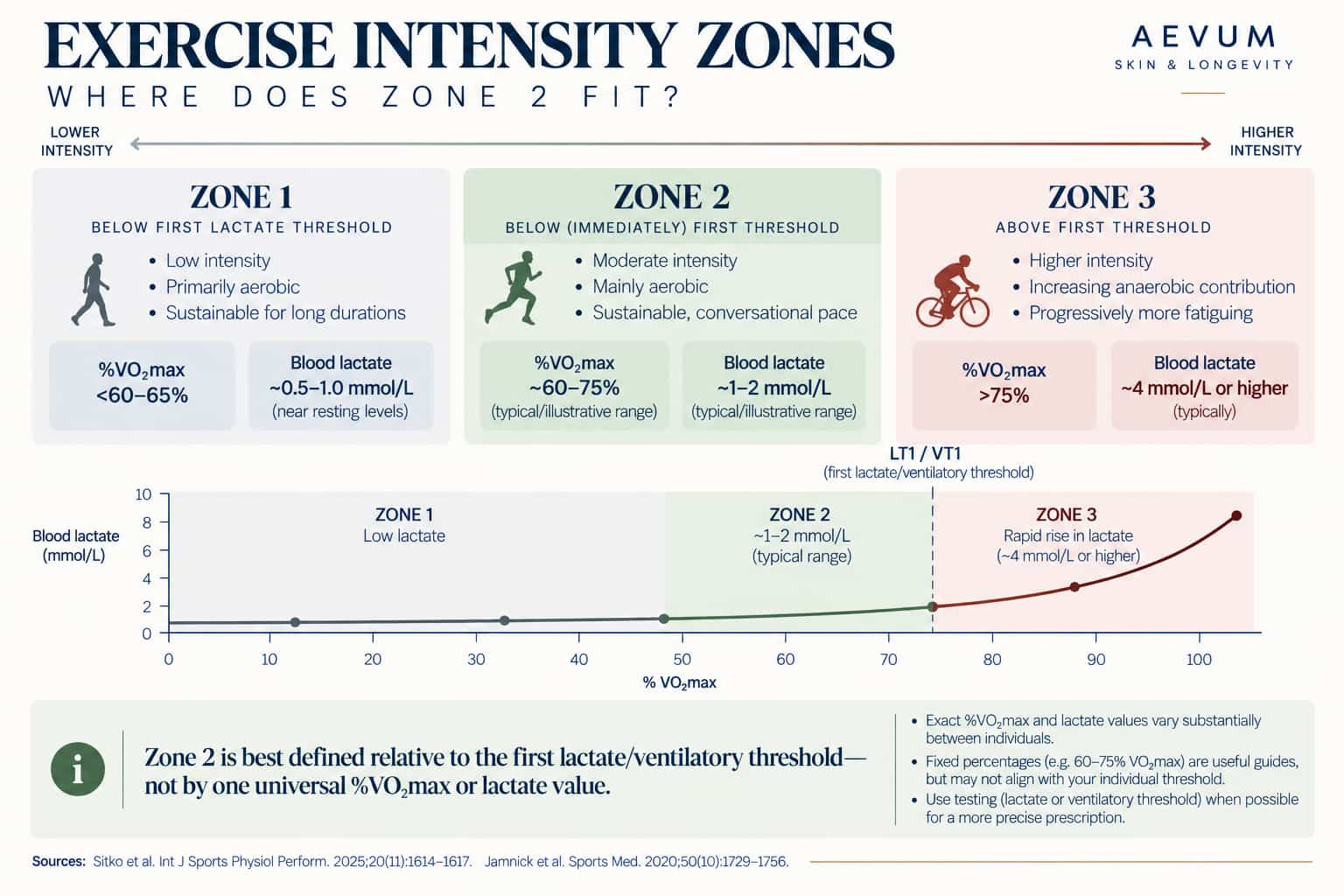
| Zone 2 lactate definition | Roughly 1.0-2.0 mmol/L blood lactate — below the first lactate threshold (LT1) |
| Zone 2 as %HRmax | Roughly 67-82% of max heart rate in one recent expert-consensus definition — varies meaningfully by individual and training status |
| Heart-rate approximation | Roughly 60-70% of max heart rate, or MAF formula: 180 minus age (adjusted for training history) |
| Mitochondrial signaling evidence | A 2025 narrative review found "small and inconsistent" activation of mitochondrial biogenesis signaling from Zone 2 specifically, and no clear superiority over higher intensities |
| Mitochondrial content gains, adjusted (2024 meta-regression) | Endurance training ~23%, HIIT ~27%, sprint-interval training ~27% — intervals more time-efficient per hour |
How it works
Defining Zone 2 physiologically. Zone 2 isn't a fixed heart rate or percentage — it's a physiological state, defined by blood lactate concentration sitting just below the first lactate threshold (LT1), the point at which lactate begins accumulating faster than it can be cleared. Below this threshold, the body relies heavily on fat oxidation for fuel; above it, a growing share of energy comes from carbohydrate metabolism via faster, less oxidatively efficient pathways. This is also close to the intensity at which fat oxidation is near its maximum rate (sometimes called "FatMax") — the point where you're burning the highest absolute amount of fat per minute, before that rate starts declining as intensity rises further.
Because it's defined by a physiological marker rather than a fixed percentage, Zone 2 in heart-rate or %VO2max terms varies meaningfully by individual: for a well-trained endurance athlete it may sit toward the higher end of the range, while for an untrained person it may be considerably lower.
Evidence check: the mitochondrial claim
What's claimed. Zone 2's popularization is largely credited to physiologist Iñigo San-Millán, whose work with elite cyclists (including Tour de France winners) has been widely cited in the longevity-fitness world. San-Millán's position is that training specifically in this lactate range produces mitochondrial biogenesis, denser mitochondrial cristae, higher oxidative enzyme concentrations, and upregulated lactate-clearing machinery — and that no other single intensity develops all of these systems simultaneously at a volume the body can sustainably recover from.
What a closer read of the evidence shows. A 2025 narrative review (Storoschuk et al., Sports Medicine) examining the broader body of Zone 2 research reached a notably more cautious conclusion. It found the activation of mitochondrial biogenesis signaling from Zone 2 exercise specifically to be "small and inconsistent," and concluded that current evidence does not support Zone 2 as the optimal intensity for improving mitochondrial or fatty-acid oxidative capacity — noting that higher-intensity exercise generally produces greater mitochondrial signaling and adaptations in comparative studies. A separate 2024 systematic review and meta-regression (Mølmen et al., Sports Medicine) pooling mitochondrial-content outcomes across training modalities found adjusted increases of roughly 23% with endurance training, 27% with HIIT, and 27% with sprint-interval training — with the interval approaches considerably more time-efficient per hour of training. Neither review found Zone 2 uniquely superior for mitochondrial adaptation.
Where this leaves the practical picture. This isn't a case of one side being simply wrong — it reflects a real, ongoing scientific disagreement between applied physiologists working with elite athletes and researchers conducting more controlled comparative reviews. What's not in dispute: building an aerobic base through sustained low-intensity work is a well-established, low-risk way to improve cardiorespiratory fitness over time, and cardiorespiratory fitness (VO2 max) itself has some of the strongest mortality-prediction data of any modifiable factor in longevity medicine (see our VO2 Max article). What's genuinely contested is whether Zone 2 specifically, as opposed to a well-rounded mix of intensities, is uniquely necessary to get there.

How to determine your Zone 2
| Method | How it works |
|---|---|
| Talk test | You should be able to hold a full conversation comfortably; noticeably laboured speech means you've exceeded Zone 2 |
| MAF formula | 180 minus age, adjusted: -10 if recovering from illness/injury, -5 if training inconsistently, no adjustment for up to 2 years of consistent training, +5 for 2+ years of consistent injury-free training |
| %HRmax | Roughly 60-70% of estimated max heart rate (220 minus age, a rough population estimate) |
| Karvonen (heart rate reserve) | (Max HR − Resting HR) × 0.60-0.70, then add resting HR back — more personalized than raw %HRmax |
| Lactate testing | The most precise method — a blood lactate meter used during a graded effort to directly identify the intensity just below LT1 |
How to actually train
- →Use the talk test as your everyday check. It's imprecise compared to lactate testing, but accessible, free, and reasonably reliable for staying roughly in the right intensity range session to session
- →Build up duration gradually, not just intensity. Zone 2's practical strength is that it's sustainable for long durations with low injury and overtraining risk — 30-60+ minute sessions are common, and duration is part of what makes the aerobic-base-building effect meaningful
- →Don't treat it as the only intensity that matters. Given the genuine uncertainty around Zone 2's unique physiological superiority, a training week that also includes some higher-intensity work is a reasonable, evidence-consistent approach rather than an either/or choice
Recommendations by goal
- 1General longevity/health-focused training
A few sessions per week of sustained Zone 2 work is a reasonable, low-risk way to build aerobic base and volume, alongside — not instead of — resistance training and some higher-intensity cardio work.
- 2Endurance athletes
Zone 2 forms the bulk of a well-established periodization approach (high-volume, low-intensity base building), independent of the specific mitochondrial-superiority debate.
- 3Time-constrained trainees
Given the uncertain evidence for Zone 2's unique mitochondrial advantage over higher intensities, prioritizing overall cardiorespiratory fitness — through whatever mix of intensities you'll actually sustain — is a reasonable, evidence-consistent alternative to rigidly protecting Zone 2 time specifically.
Practical notes
Zone 2 sits alongside VO2 max training as one of two commonly discussed cardiovascular approaches in longevity fitness, and the two aren't competitors — VO2 max improvements typically require some higher-intensity stimulus (see our HIIT vs. Steady-State Cardio article), while Zone 2 builds the aerobic base that supports sustained training volume overall. Given the genuinely mixed evidence on Zone 2's unique mitochondrial claims, the most defensible practical takeaway is that consistent aerobic training — including but not limited to Zone 2 — paired with resistance training, remains the best-supported approach to cardiovascular and metabolic longevity.
Do you currently train
at a low, conversational-pace intensity?
Take the free Aevum Protocol assessment to see how your movement & strength and 6 other longevity domains are performing — and get a personalised 90-day plan.
Take the Free Assessment →