Movement & Strength
Swimming and Water Exercise:
Low-Impact Fitness for Every Age
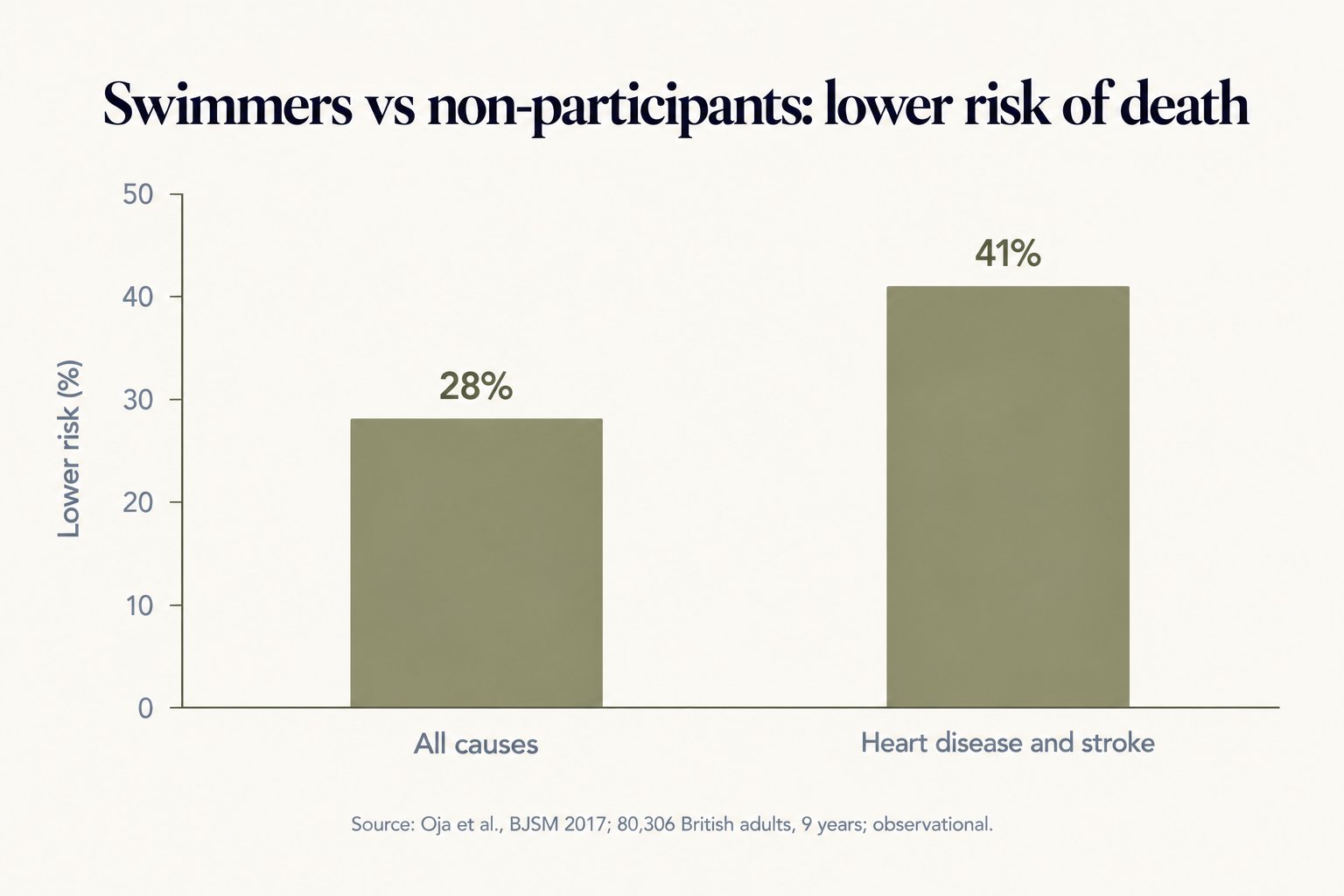
Swimming and other water exercise, such as aqua aerobics, water walking and deep-water running, build aerobic fitness while the water supports your body weight. That makes them ideal for people with joint pain, arthritis, back problems, overweight, pregnancy or recovery from injury, and for older adults at risk of falls. In a study of 80,306 British adults followed for 9 years, swimmers had a 28% lower risk of death from any cause and a 41% lower risk of death from heart disease and stroke than people who didn't take part in sport. A Cochrane review of 13 trials found that aquatic exercise slightly reduced pain and disability and improved quality of life in people with knee and hip arthritis, and a review in older adults found water exercise improved balance as much as land exercise. Swimming also works the upper body more than most cardio. Its main limitation is that, because water takes the load off the skeleton, it does little for bone density, so swimmers need some weight-bearing or strength training too. And because drowning is a leading cause of death among young people in Sri Lanka, learning to swim is itself a life-saving skill. This article covers the types of water exercise, the evidence, how to start and how to stay safe.
Key numbers
| Finding | Detail |
|---|---|
| Swimmers vs non-participants (80,306 adults, 9 years) | 28% lower risk of death; 41% lower heart disease and stroke death |
| Aquatic exercise for knee and hip arthritis (13 trials, 1,190 people) | Pain and disability 5 points lower; quality of life 7 points higher (0 to 100 scales) |
| Water vs land exercise for balance in over-65s (10 trials) | Similar improvements |
| Effect on bone density | Little, because water supports body weight |
| Drowning in Sri Lanka | 463 deaths recorded in 2023; third leading cause of death in people aged 15 to 29 |
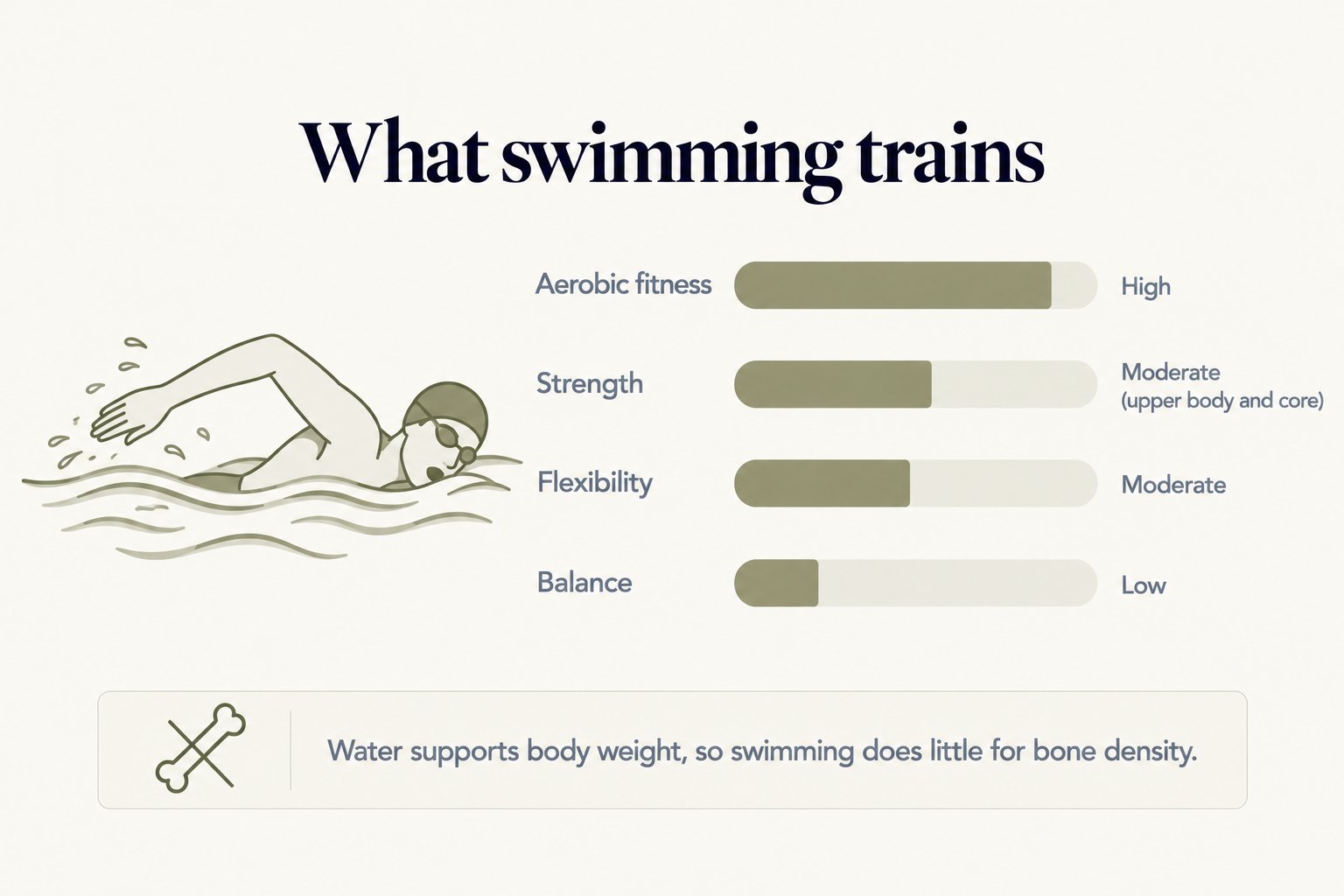
What swimming trains
- Aerobic fitness: high, from gentle laps to hard intervals.
- Strength: moderate, especially the shoulders, back, arms and core, with water providing resistance in every direction.
- Flexibility: moderate; strokes move the shoulders, hips and spine through a wide range.
- Balance: low for swimming itself; water walking and aqua exercise can train balance safely.
Types of water exercise.
- Lap swimming: freestyle (front crawl), breaststroke, backstroke and butterfly, at steady or interval pace.
- Aqua aerobics: group classes with music, often in waist- or chest-deep water.
- Water walking and jogging: walking or jogging across the shallow end, excellent for beginners and people with arthritis.
- Deep-water running: running motions in deep water with a flotation belt, often used for injury rehabilitation.
- Aquatic therapy (hydrotherapy): supervised exercises in warm water, often prescribed by physiotherapists.
- Open-water swimming: in the sea, lakes or rivers, which needs extra safety precautions.
What the research shows
Swimming and longevity. In a 2017 study in the British Journal of Sports Medicine, researchers followed 80,306 British adults over the age of 30 for an average of 9 years. Compared with people who didn't take part in that sport, swimmers had a 28% lower risk of death from any cause and a 41% lower risk of death from heart disease and stroke. This was one of the strongest associations of any sport studied, alongside racket sports and aerobics. The study was observational, relied on self-reported activity, and swimmers may differ from non-swimmers in other ways, so it can't prove cause and effect.
Arthritis and joint pain. A 2016 Cochrane review of 13 trials with 1,190 people, mostly women with an average age of 68, found that aquatic exercise for knee and hip osteoarthritis probably reduces pain and disability slightly, by about 5 points on a 100-point scale, and may improve quality of life by about 7 points, at the end of programmes of up to 12 weeks. No serious side effects were reported. The certainty of evidence was moderate. Water exercise is a particularly useful option for people who find land exercise too painful (see Exercise and Joint Health).
Balance in older adults. A 2020 meta-analysis in BMC Geriatrics of 10 trials in people aged 65 and over found that aquatic exercise improved dynamic balance as much as land-based exercise, making it a reasonable alternative, particularly for people who are nervous about falling (see Balance and Fall Prevention).
The bone gap. Because water supports your weight, swimming provides little of the impact loading that stimulates bone. Studies of swimmers generally show bone density similar to inactive people rather than the higher levels seen with running, jumping or weight training. People who mainly swim should add strength training and some weight-bearing activity, such as brisk walking or stair climbing (see Bone Density and Resistance Training).
How to start
If you can't swim yet. Learning to swim is never too late. Take lessons from a qualified instructor in a supervised pool, starting with floating, breathing and kicking in shallow water. In the meantime, water walking and aqua aerobics in shallow water need no swimming skills.
An 8-week plan for beginner swimmers
| Weeks | Each session (2 to 3 times a week) |
|---|---|
| 1 to 2 | 10 to 15 minutes: swim 1 length, rest 30 to 60 seconds, repeat; mix in water walking |
| 3 to 4 | 15 to 20 minutes: swim 2 lengths at a time with short rests |
| 5 to 6 | 20 to 30 minutes: swim 4 lengths at a time; try a second stroke |
| 7 to 8 | 30 minutes continuous, or intervals of faster and easier lengths |
Tips.
- Mix strokes: varying strokes works different muscles and reduces strain on the shoulders.
- Use equipment: a kickboard, pull buoy or fins can make sessions easier and build specific strength.
- Work on technique: relaxed breathing and good body position make swimming much less tiring. A few lessons can transform efficiency.
- Don't rely on heart rate zones from land: heart rate tends to be lower in water at the same effort, so use how hard it feels instead.
- Add land training: two strength sessions a week and some walking protect bones and balance the shoulder-heavy workload.
Who should be careful
- Shoulder pain: "swimmer's shoulder" is common with a lot of freestyle or butterfly; vary strokes, improve technique and strengthen the upper back.
- Neck or lower back pain: breaststroke with the head held up can strain the neck and back; backstroke or front crawl with good breathing technique may be more comfortable.
- Ear infections: dry the ears well after swimming, and consider earplugs if you're prone to swimmer's ear.
- Skin and eyes: chlorine can irritate the skin, eyes and airways; shower after swimming and moisturise.
- Heart disease, epilepsy or diabetes treated with insulin: swim where a lifeguard is present, and discuss precautions with your doctor.
- Pregnancy: swimming and aqua aerobics are generally safe and comfortable in pregnancy; avoid very hot pools and diving.
Swimming in Sri Lanka
- Learn to swim: drowning is a major cause of preventable death in Sri Lanka. In 2023, the national injury surveillance system recorded 463 drowning deaths, and drowning was the third leading cause of death among 15 to 29-year-olds. The WHO recommends teaching children basic swimming and water safety skills.
- Choose safe places: pools with lifeguards are safest. At the beach, swim only at guarded beaches, between flags if present, and avoid swimming during rough seas or monsoon conditions.
- Rip currents: if you're caught in one, don't swim against it. Float and swim parallel to the shore until you're out of the current, then swim back.
- Rivers, lakes and tanks: these can have hidden currents, sudden depth changes and cold patches. Never swim alone, after drinking alcohol, or in flooded water.
- Sun protection: in outdoor pools and at the beach, use water-resistant sunscreen and swim early or late in the day.
- Indoor and hotel pools: many hotels and clubs offer pool memberships, and aqua aerobics classes are increasingly available.
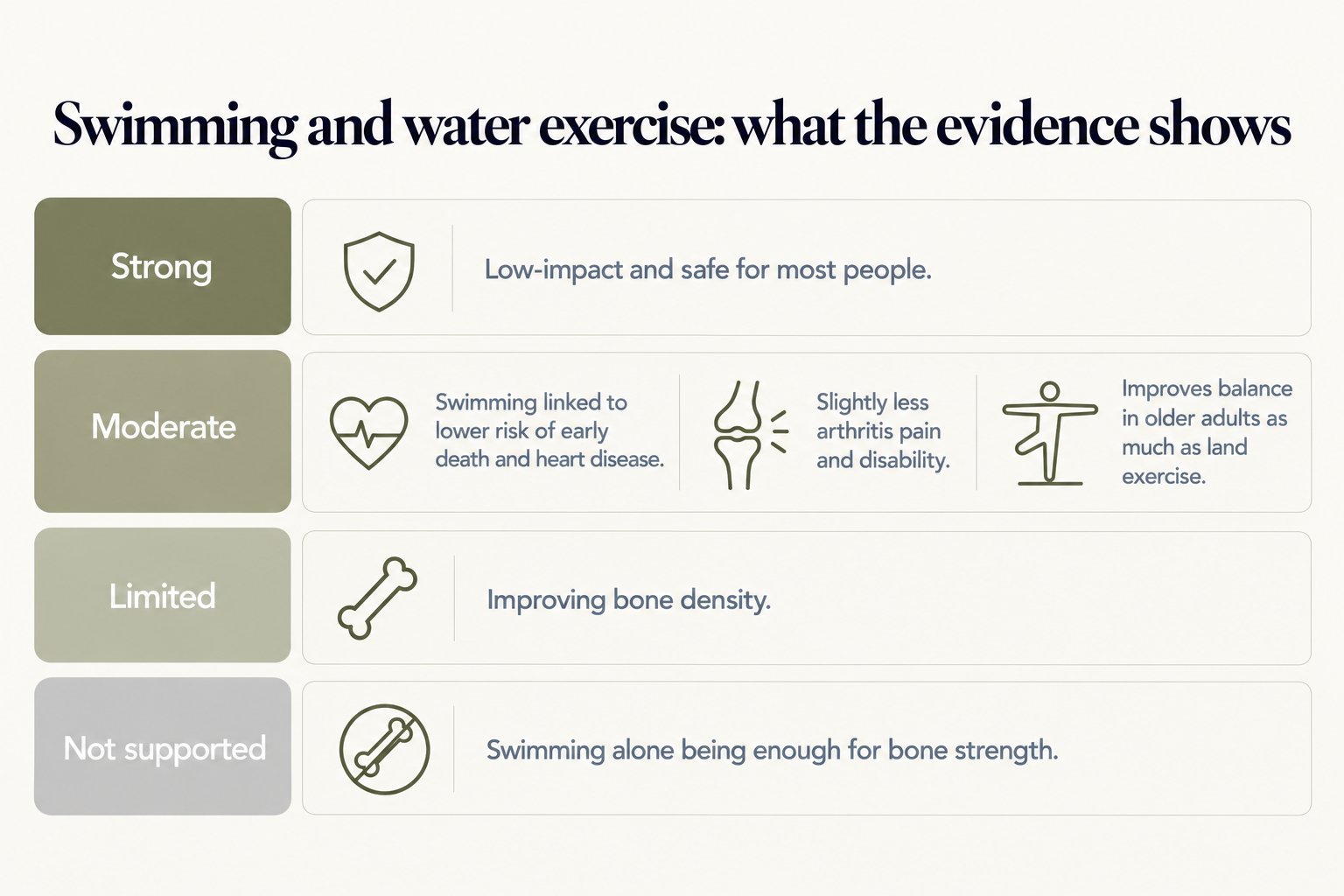
Evidence strength
- Swimming linked to lower risk of early death and heart disease: moderate, from a large observational study.
- Aquatic exercise reducing arthritis pain and disability: moderate; benefits are small but meaningful.
- Water exercise improving balance in older adults: moderate.
- Swimming improving bone density: limited; add weight-bearing exercise.
- Safety and suitability for people with joint problems: strong.
Why this matters for longevity
Water exercise lets almost anyone keep active, whatever their weight, joint health or fitness. For people with arthritis, back pain or a history of falls, it may be the activity that makes regular exercise possible. Combined with some strength and weight-bearing training to protect bones, swimming can support heart, lung and joint health for life, and the ability to swim can save a life.
Recommendations by situation
- People with knee or hip arthritis: water walking or aqua aerobics 2 to 3 times a week, ideally in warm water.
- Older adults and people at risk of falls: aqua aerobics or water walking for fitness and balance, plus land-based strength training.
- People with overweight: swimming and water exercise reduce joint stress while building fitness.
- Pregnant women: swimming and aqua aerobics are good options for staying active.
- Runners or cyclists: swimming adds upper-body fitness and helps recovery; deep-water running can maintain fitness during injury.
- Non-swimmers: take lessons, starting with water walking and floating.
Practical notes
Swimming and water exercise are some of the safest and most joint-friendly ways to stay fit at any age. If you can't swim, it's never too late to learn, and water walking or aqua aerobics need no swimming skills. Vary your strokes, work on technique, and add strength training and some walking to protect your bones. In Sri Lanka, swim in supervised pools or at guarded beaches, avoid rough seas and fast-flowing water, and make sure children learn to swim. Our Longevity Doctors can assess your joints, heart health and bone density, and help you combine swimming with the strength and balance training needed for complete fitness, starting with the free longevity assessment.
- Oja P, et al. Associations of specific types of sports and exercise with all-cause and cardiovascular-disease mortality: a cohort study of 80 306 British adults. British Journal of Sports Medicine, 2017;51(10):812-817.
- Bartels EM, et al. Aquatic exercise for the treatment of knee and hip osteoarthritis. Cochrane Database of Systematic Reviews, 2016;3:CD005523.
- Kim Y, et al. Systematic review and meta-analysis comparing aquatic and land exercise for dynamic balance in older adults. BMC Geriatrics, 2020;20:302.
- World Health Organization Sri Lanka. World Drowning Prevention Day, 25 July 2024: anyone can drown, no one should. Citing the National Injury Surveillance System.
Free longevity assessment
Looking for joint-friendly
exercise that suits you?
Take the free Aevum Protocol assessment to see how your movement & strength and 6 other longevity domains are performing — and get a personalised 90-day plan.
Take the free assessment