Movement & Strength
Cycling:
Outdoor, Indoor and Commuting for Heart, Joints and Longevity
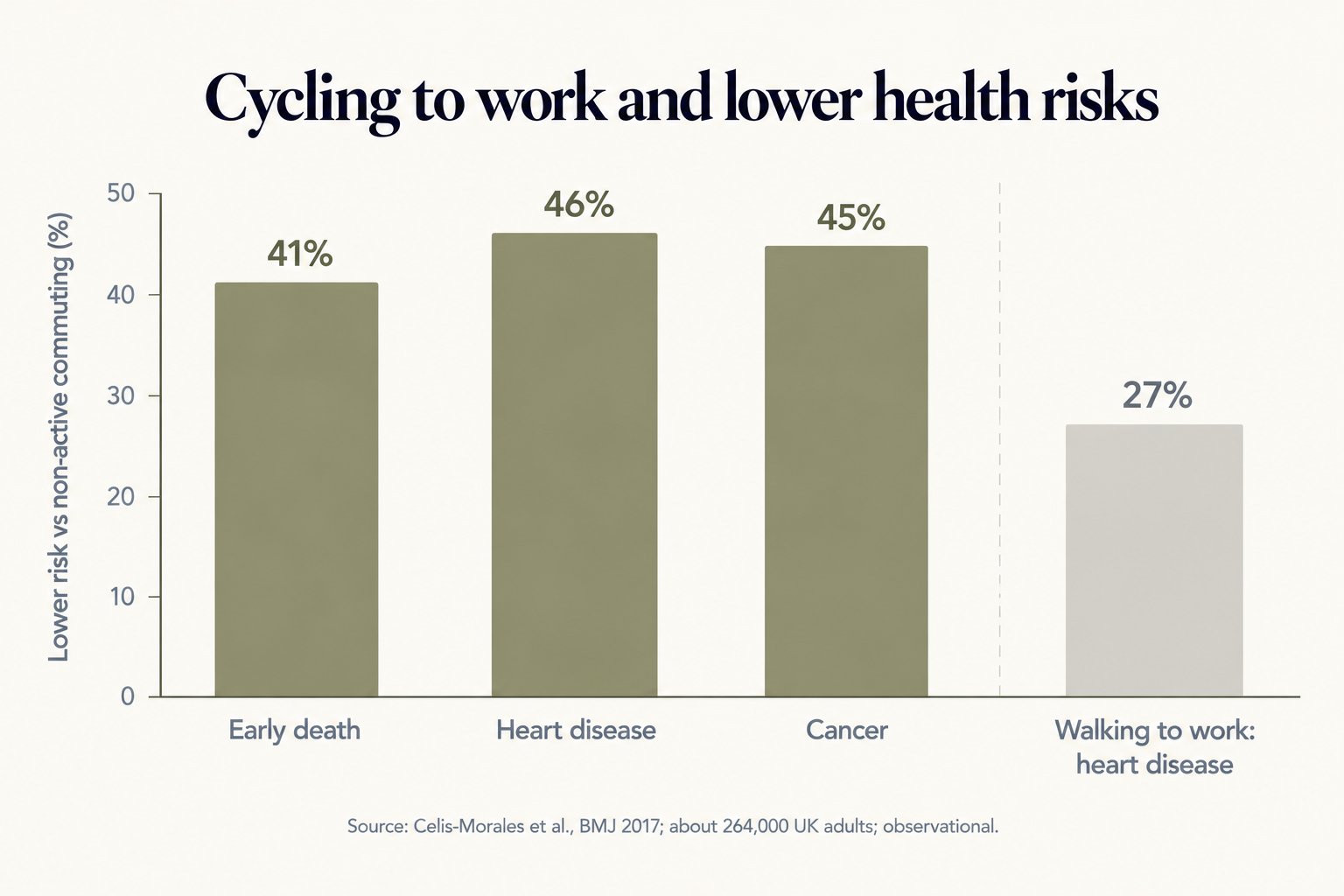
Cycling is an excellent aerobic exercise that's gentle on the joints, which makes it a good option for people who find running uncomfortable, are overweight, or have knee or hip problems. It can be done outdoors, on an indoor bike or as a way of getting around. In a UK study of about 264,000 people followed for 5 years, those who cycled to work had a 41% lower risk of early death, a 46% lower risk of heart disease and a 45% lower risk of cancer than those who commuted by car or public transport. Electric bikes count too: in a seven-city European study of over 10,000 people, e-bike users got as much weekly physical activity as conventional cyclists, because they rode further. A review of indoor cycling found it can improve aerobic fitness, blood pressure, body composition and cholesterol. Cycling has two main limitations. Because it's non-weight-bearing, it does little for bone density, so cyclists need some strength or impact training. And on the road, the risk of traffic injury is real, especially in Sri Lanka, where road crashes kill around 3,000 people a year. This article explains the types of cycling, the evidence, how to start and how to stay safe.
Key numbers
| Finding | Detail |
|---|---|
| Cycle commuting vs non-active commuting (about 264,000 adults, 5 years) | 41% lower risk of early death; 46% lower heart disease; 45% lower cancer |
| Walking commuting | 27% lower heart disease; no significant reduction in cancer or overall death |
| Typical weekly commuting distance | About 30 miles cycling vs 6 miles walking |
| E-bike vs conventional cyclists (over 10,000 people, 7 cities) | Similar weekly activity (4,463 vs 4,085 MET-minutes) |
| Bone density in road cyclists (31 studies) | Tends to be low, especially in the lower spine |
| Road deaths in Sri Lanka | About 3,000 a year; motorcyclists about one-third |
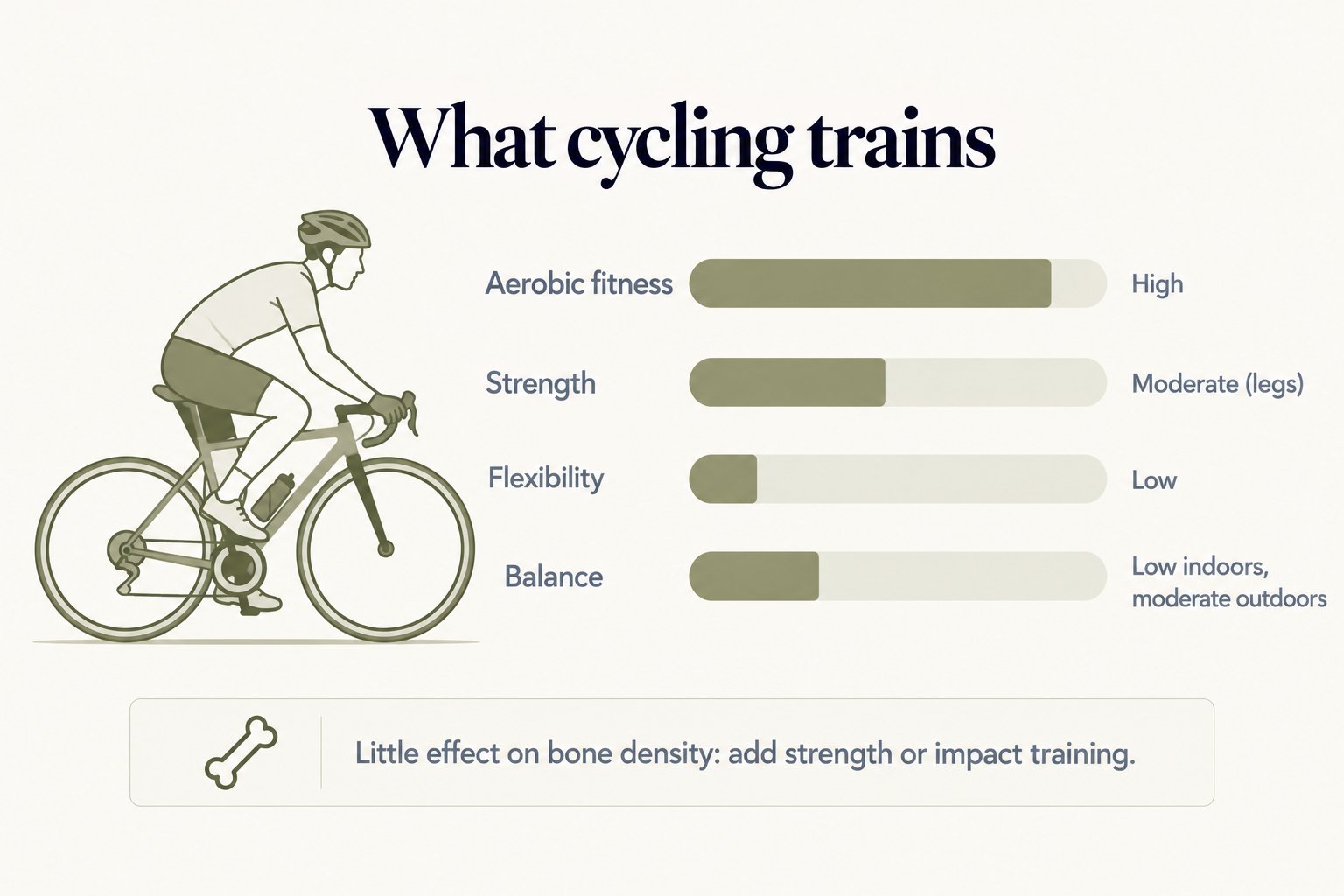
What cycling trains
- Aerobic fitness: high, from easy rides to hard intervals.
- Strength: moderate in the legs and glutes, especially with hills or high resistance; little upper-body or bone loading.
- Flexibility: low; long hours in a cycling position can tighten the hips and back.
- Balance: low on indoor bikes, moderate outdoors and higher on mountain bikes.
Types of cycling.
- Commuting and everyday cycling: building exercise into travel.
- Road cycling: longer rides at varied intensities.
- Mountain biking and trail riding: more strength, balance and skill.
- Indoor cycling: stationary bikes, group "spin" classes or smart trainers at home or in a gym.
- Electric bikes (e-bikes): pedal-assisted bikes that make hills and longer distances easier.
- Recumbent bikes: a reclined seat with back support, useful for older adults and people with back or balance problems.
What the research shows
Cycling to work. In a 2017 study in The BMJ, researchers followed about 264,000 UK Biobank participants for 5 years. Compared with people who commuted by car or public transport, those who cycled to work had a 41% lower risk of dying from any cause, a 46% lower risk of developing heart disease and a 45% lower risk of developing cancer. Walking to work was linked to a 27% lower risk of heart disease, but not to lower cancer or overall death. Cyclists typically covered about 30 miles a week, compared with 6 miles for walkers, which may explain much of the difference. As an observational study, it can't prove cause and effect, but the findings were adjusted for many lifestyle factors.
Indoor cycling. A 2019 systematic review of 13 studies with 372 participants found that indoor cycling may improve aerobic capacity, blood pressure, body composition and blood lipids, particularly when combined with a healthy diet. The authors cautioned that few of the studies were randomised controlled trials.
E-bikes. E-bikes are sometimes dismissed as "cheating", but the evidence suggests otherwise. In a 2019 survey of over 10,000 people across seven European cities, e-bike users had similar weekly physical activity to conventional cyclists (4,463 vs 4,085 MET-minutes) because they rode further: about 8 km a day, compared with 5 km. People who switched to e-bikes from cars or public transport substantially increased their activity. E-bikes can be a great way for older adults, people with heart or joint problems, or anyone facing hills or heat, to keep cycling.
Joints, bones and men's health.
- Joints: cycling's low-impact, smooth movement makes it a commonly recommended exercise for people with knee or hip arthritis (see Exercise and Joint Health).
- Bones: a 2012 systematic review of 31 studies found that adult road cyclists in regular training tend to have low bone mineral density, especially in the lower spine. Mountain biking or combining cycling with other sports may reduce this effect (see Bone Density and Resistance Training).
- Men's sexual and urinary health: in a 2018 study of 2,774 cyclists compared with swimmers and runners, cyclists had no worse sexual or urinary function, though they were more prone to urethral narrowing (stricture). Handlebars set lower than the saddle increased numbness and saddle sores, while standing on the pedals more than 20% of the time reduced numbness.
How to start
A simple 8-week plan for beginners
| Weeks | Plan |
|---|---|
| 1 to 2 | 15 to 20 minutes of easy cycling, 3 times a week |
| 3 to 4 | 25 to 30 minutes, including a few short harder efforts |
| 5 to 6 | 30 to 40 minutes, 3 to 4 times a week (about 150 minutes a week) |
| 7 to 8 | One longer ride of 60 minutes a week, plus 2 to 3 shorter rides, including intervals or hills |
Getting set up.
- Bike fit: set the saddle so your knee is slightly bent at the bottom of the pedal stroke. A saddle that's too low strains the knees; too high causes rocking hips. Handlebars should allow a comfortable, relaxed reach.
- Comfort: a well-fitting saddle, padded shorts and changing position regularly reduce numbness and soreness.
- Indoor bikes: adjust the seat and handlebar height the same way; use a fan and keep water nearby.
- Gears and cadence: use lower gears and a quicker pedal rate rather than pushing hard gears, which strain the knees.
Make it complete.
- Add strength and impact training, such as squats, lunges, stair climbing or brisk walking, to protect bone density.
- Stretch your hips, hamstrings and back if you spend long hours on the bike (see Flexibility and Mobility).
Who should be careful
- People with heart disease or risk factors: check with your doctor before hard rides or interval training.
- People with balance problems or at risk of falls: start on an indoor or recumbent bike.
- People with osteoporosis: cycling is good for fitness but avoid falls; prioritise indoor cycling, and add strength training to protect bones.
- People with back or neck pain: a more upright position or a recumbent bike may help.
- People with saddle numbness: review saddle type, height, handlebar position and riding posture; persistent numbness should be checked.
Cycling in Sri Lanka
- Road safety first: around 3,000 people die on Sri Lanka's roads each year, and vulnerable road users are at high risk. Always wear a helmet, use front and rear lights and reflective clothing, ride predictably, and avoid busy main roads where possible.
- Choose safer routes: quiet residential roads, park paths, lakeside routes and early-morning group rides are safer than heavy traffic.
- Beat the heat: ride early or in the evening, carry water, and use electrolytes on long rides.
- Indoor cycling: a stationary bike at home or in a gym, or a spin class, avoids traffic, heat, rain and air pollution entirely.
- E-bikes: increasingly available and helpful for hills, heat and longer commutes.
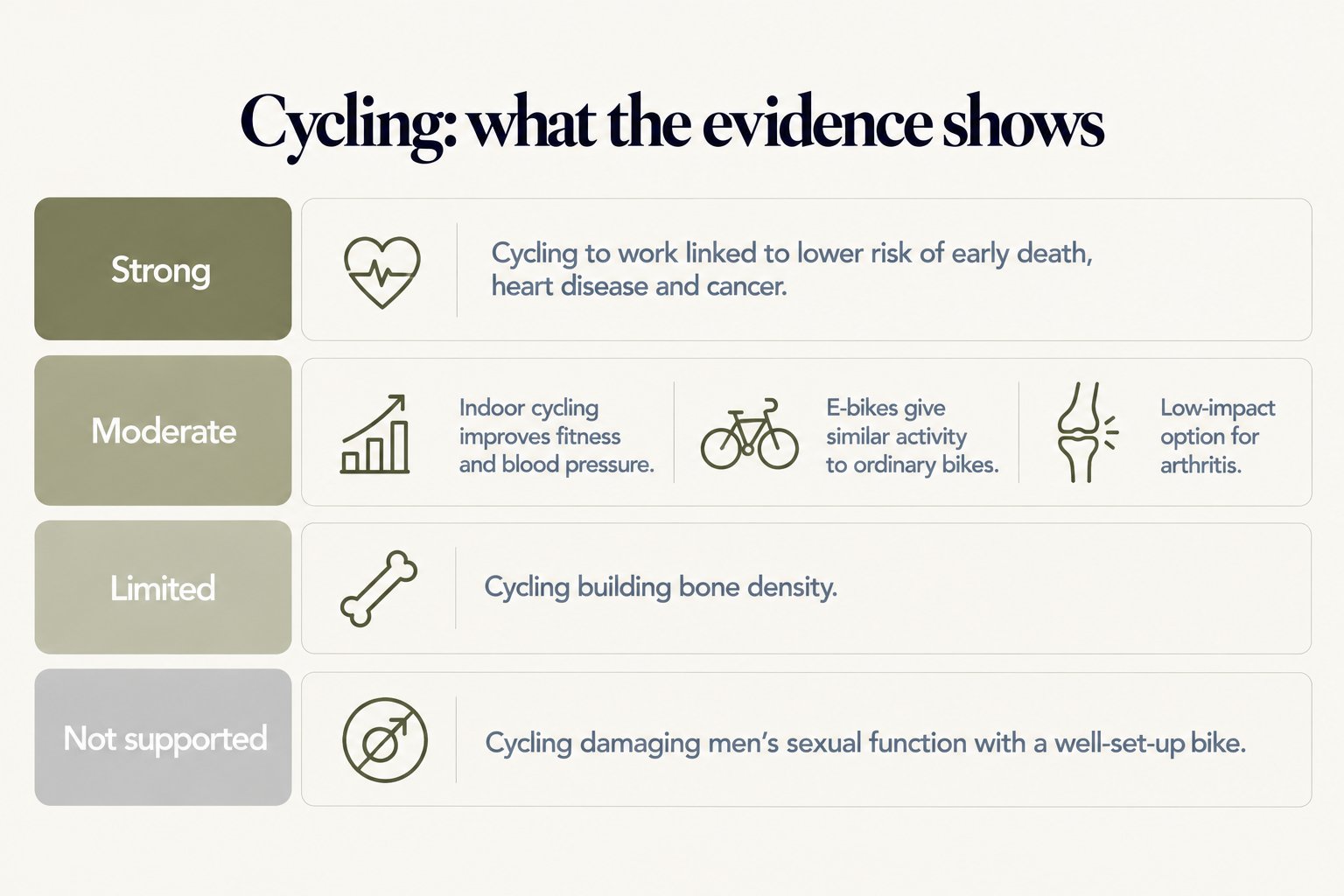
Evidence strength
- Cycling linked to lower risk of early death, heart disease and cancer: strong, from large cohort studies, though observational.
- Indoor cycling improving fitness, blood pressure and body composition: moderate.
- E-bikes providing meaningful physical activity: moderate.
- Cycling building bone density: limited; road cyclists tend to have lower bone density.
- Cycling harming men's sexual function: not supported in large comparative studies, provided the bike is set up well.
Why this matters for longevity
Cycling is one of the most sustainable ways to build aerobic fitness, because it's easy on the joints and can fit into daily life as transport. For people who can't run, or want to protect their knees, it's a powerful alternative. Combined with strength training to protect bones and muscles, and careful attention to road safety, cycling can be a lifelong activity.
Recommendations by situation
- Beginners or people with joint pain: start with indoor or recumbent cycling, 20 minutes, 3 times a week.
- Commuters: cycle all or part of the way if routes are safe; an e-bike can make longer distances practical.
- Older adults: indoor, recumbent or e-bikes reduce fall and traffic risks; add balance and strength training.
- Regular road cyclists: add 2 strength sessions a week and some weight-bearing exercise for bones.
- People with arthritis: cycling is often one of the most comfortable forms of cardio; keep resistance moderate.
Practical notes
Cycling is gentle on the joints and powerful for the heart. Indoor bikes and spin classes are a safe, convenient option in Sri Lanka's heat and traffic, while outdoor cycling needs a helmet, lights, reflective clothing and carefully chosen routes. Make sure your bike fits, keep resistance moderate, and add strength training and some walking or stair climbing to protect your bones. An e-bike can make cycling practical for longer distances or hills. Our Longevity Doctors can assess your heart health, joints and bone density, and help you combine cycling with the strength and balance training needed for complete fitness, starting with the free longevity assessment.
- Celis-Morales CA, et al. Association between active commuting and incident cardiovascular disease, cancer, and mortality: prospective cohort study. BMJ, 2017;357:j1456.
- Castro A, et al. Physical activity of electric bicycle users compared to conventional bicycle users and non-cyclists: insights based on health and transport data from an online survey in seven European cities. Transportation Research Interdisciplinary Perspectives, 2019;1:100017.
- Chavarrias M, et al. Health benefits of indoor cycling: a systematic review. Medicina, 2019;55(8):452.
- Olmedillas H, et al. Cycling and bone health: a systematic review. BMC Medicine, 2012;10:168.
- Breyer BN, et al. Sexual and urinary health in cyclists compared with swimmers and runners. Journal of Urology, 2018.
- Sri Lanka Police Traffic Headquarters road crash statistics, reported by Ada Derana, September 2023.
Free longevity assessment
Want to know if cycling
suits your heart and joints?
Take the free Aevum Protocol assessment to see how your movement & strength and 6 other longevity domains are performing — and get a personalised 90-day plan.
Take the free assessment