Movement & Strength
Calisthenics and Bodyweight Training:
Building Strength Without a Gym
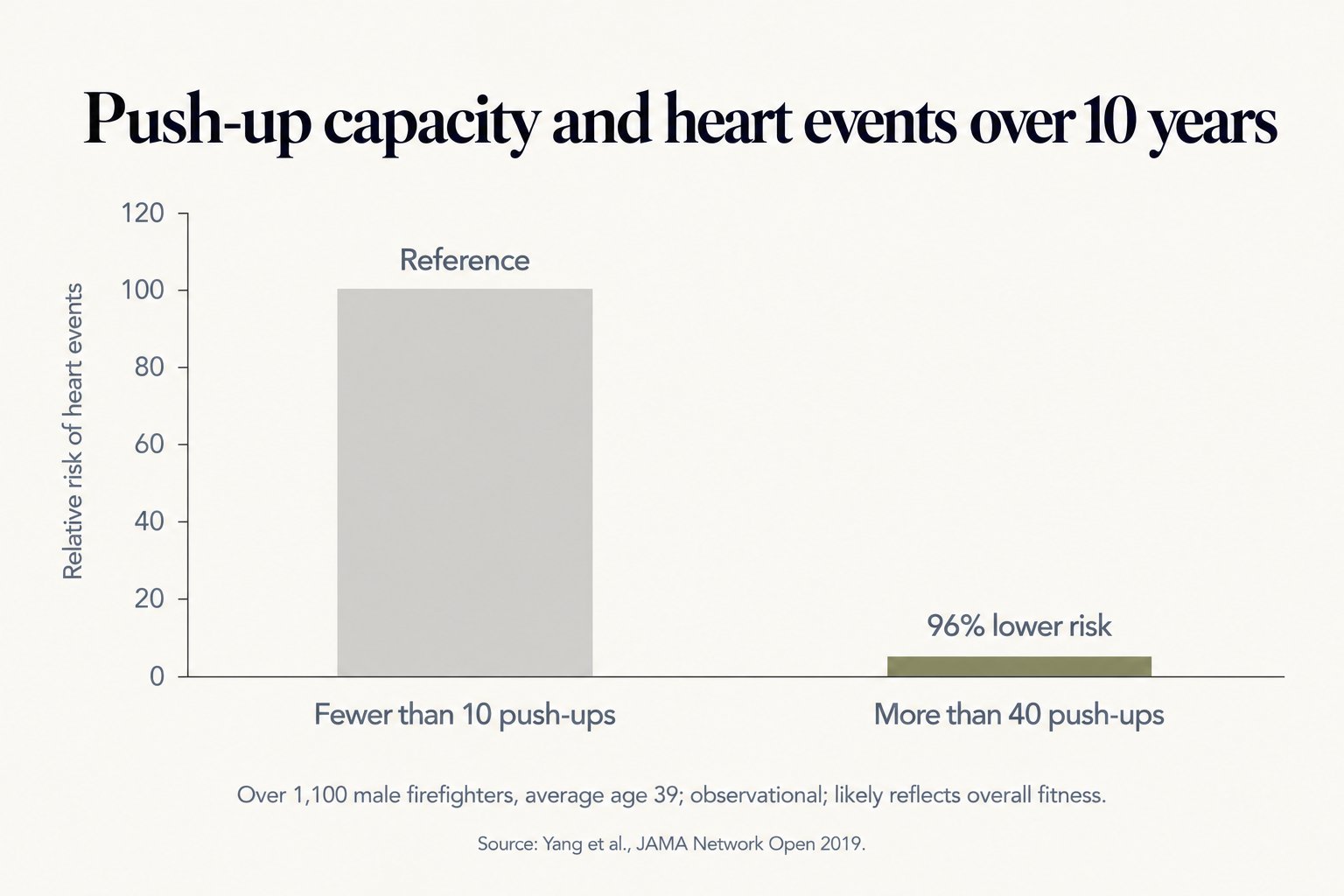
Calisthenics means training with your own body weight: push-ups, squats, lunges, pull-ups, dips, planks and their many variations. It needs little or no equipment, can be done almost anywhere, costs nothing, and builds real strength, control and mobility. The key is progression: making exercises harder over time by changing leverage, range of motion, tempo or the number of limbs supporting you, rather than adding weight. Studies show this works. In a 2017 trial, young men doing push-ups gained chest and triceps muscle and bench press strength similar to those doing an equivalent load on the bench press. In a 2018 trial, 4 weeks of progressive push-up training increased bench press strength as effectively as bench press training. Bodyweight strength is also a marker of health: in a 10-year study of over 1,100 male firefighters, those who could do more than 40 push-ups had a 96% lower risk of cardiovascular events than those who could do fewer than 10, although that reflects overall fitness rather than proof that push-ups prevent heart disease. Calisthenics suits beginners, busy people, travellers and anyone without gym access, but it's harder to progress some lower-body exercises without added load. This article explains the main movements, how to progress them and how to build a complete routine.
Key numbers
| Finding | Detail |
|---|---|
| Push-ups vs bench press at matched load (18 young men, 8 weeks) | Similar chest and triceps growth; bench press 1RM up about 3 to 5 kg in both |
| Progressive push-up training vs bench press (23 men, 4 weeks) | Both increased bench press strength significantly |
| Push-up capacity and heart events (over 1,100 male firefighters, 10 years) | More than 40 push-ups: 96% lower risk vs fewer than 10 |
| Sitting-rising test, lowest vs highest score (2,002 adults aged 51 to 80) | About 5 times higher risk of death |
| Equipment needed | None to minimal: a pull-up bar, a sturdy chair or bench, a mat |
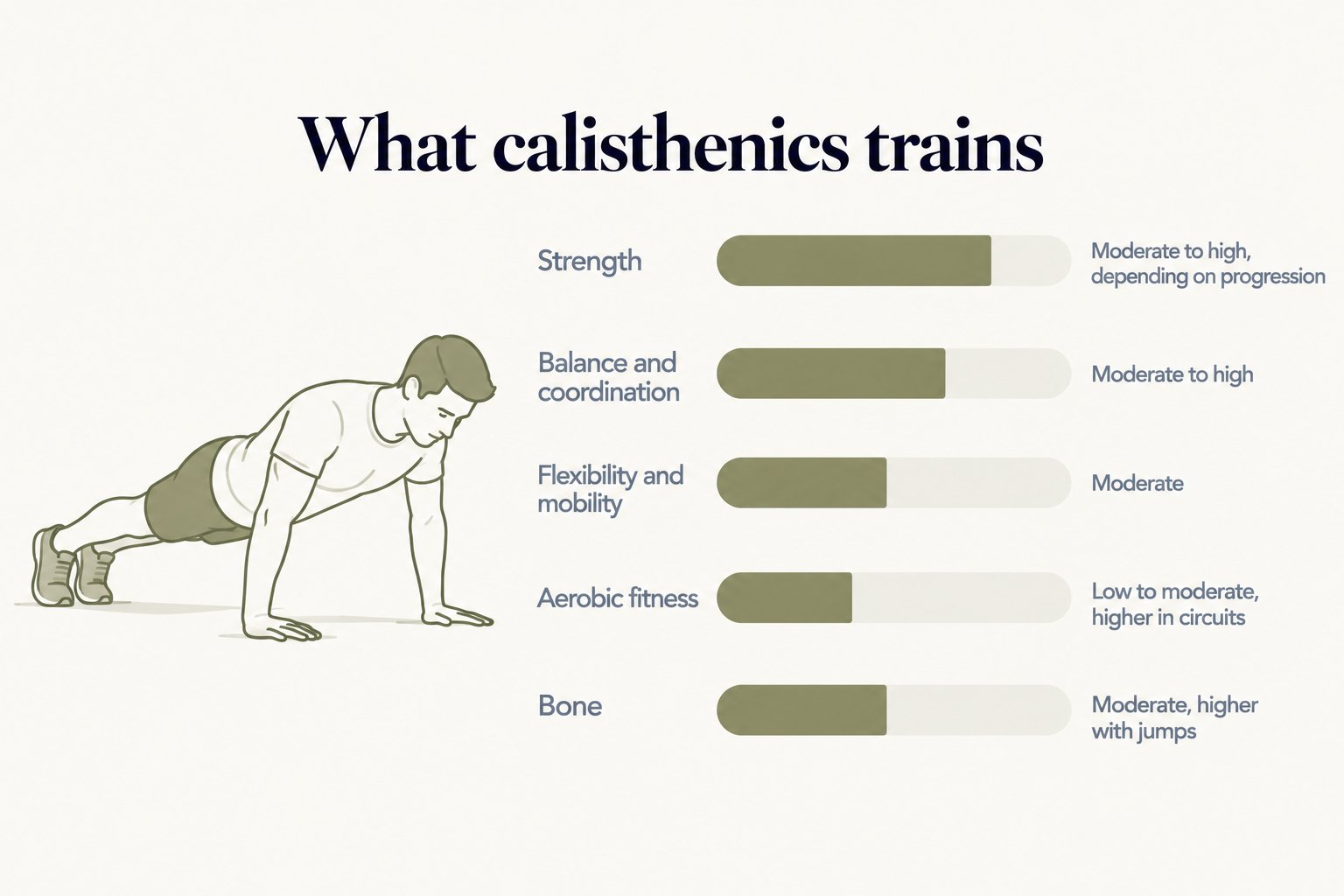
What calisthenics trains
- Strength: moderate to high, depending on how far exercises are progressed; especially upper body and core.
- Balance and coordination: moderate to high, from single-leg and unstable positions.
- Flexibility and mobility: moderate; full-range squats, lunges and bridges move joints through a wide range.
- Aerobic fitness: low to moderate; circuits with short rests can raise heart rate substantially.
- Bone: moderate, higher with jumping and impact variations.
Styles of bodyweight training.
- Basic bodyweight strength: push-ups, squats, lunges, glute bridges and planks.
- Progressive calisthenics: working towards harder skills such as pull-ups, dips, pistol (single-leg) squats and handstand push-ups.
- Bodyweight circuits and HIIT: exercises performed back-to-back for strength and cardio (see HIIT vs. Steady-State Cardio).
- Suspension training: straps anchored to a door or bar, letting you adjust difficulty by changing your body angle.
- Gymnastic and street workout skills: advanced skills on bars and rings.
What the research shows
Bodyweight training builds strength and muscle.
- Push-ups vs bench press: in a 2017 study in the Journal of Exercise Science & Fitness, 18 young men trained twice a week for 8 weeks, either with bench press at 40% of their maximum or with push-ups adjusted to the same relative load. Both groups gained chest and triceps muscle thickness, and bench press strength rose from 60.0 to 65.0 kg in the bench press group and from 61.1 to 64.2 kg in the push-up group.
- Progressive push-ups: in a 2018 trial in the Journal of Strength and Conditioning Research, 23 moderately trained men trained three times a week for 4 weeks with either progressively harder push-up variations or bench press. Both groups significantly increased their bench press maximum, and the push-up group improved more on push-up progressions.
These were small, short studies in young men, but they confirm the general principle: muscles respond to effort and tension, not to whether the resistance is a barbell or your body weight (see Weight Training).
Bodyweight strength as a health marker.
- Push-ups: in a 2019 study in JAMA Network Open, over 1,100 male firefighters with an average age of 39 took a push-up test and were followed for 10 years. Those who could complete more than 40 push-ups had a 96% lower risk of cardiovascular events than those who managed fewer than 10. Only 37 events occurred, the participants were all physically active men, and the result likely reflects overall fitness rather than push-ups themselves.
- Getting up from the floor: in a study of 2,002 adults aged 51 to 80, people who needed the most support to sit down on the floor and stand up again had about five times the risk of death over 6 years as those who could do it with little or no support (see Functional Fitness Training).
How progression works
Without adding weight, you make exercises harder by changing:
- Leverage: moving from wall push-ups to incline (hands on a bench), to floor, to feet elevated.
- Number of limbs: two-leg squats to split squats, to single-leg box squats, to pistol squats.
- Range of motion: shallow to full-depth squats; deficit push-ups with hands on books.
- Tempo: slow lowering (3 to 5 seconds) increases time under tension.
- Pauses: holding at the hardest point of the movement.
- Volume and density: more reps or sets, or shorter rest.
Aim to finish most sets with only 1 to 3 more reps possible, as with any strength training (see Progressive Overload). When an exercise feels easy for 15 to 20 reps, move to a harder variation.
Example progressions
| Movement | Easier | Standard | Harder |
|---|---|---|---|
| Push | Wall or incline push-up | Floor push-up | Feet-elevated or slow-tempo push-up |
| Squat | Sit-to-stand from a chair | Bodyweight squat | Split squat, then single-leg box squat |
| Hinge | Glute bridge | Single-leg glute bridge | Hip thrust from a bench, single-leg |
| Pull | Doorway or table row | Inverted row under a sturdy table or bar | Assisted, then full pull-up |
| Core | Kneeling plank | Front plank and side plank | Plank with leg lift; hollow hold |
| Lunge | Supported lunge holding a chair | Reverse lunge | Walking or jumping lunge |
How to start
A simple beginner routine. Do this 2 to 3 times a week on non-consecutive days. Choose the level of each exercise that lets you complete the reps with good form.
- Squat variation: 2 to 3 sets of 8 to 15
- Push-up variation: 2 to 3 sets of 6 to 15
- Row variation: 2 to 3 sets of 6 to 15
- Glute bridge variation: 2 to 3 sets of 10 to 15
- Reverse lunge: 2 sets of 8 to 12 per leg
- Plank: 2 to 3 holds of 20 to 45 seconds
Rest 60 to 90 seconds between sets, or perform the exercises as a circuit for extra cardiovascular benefit. A 20 to 30-minute session is enough.
Tips.
- Quality first: full range of motion, controlled movement and good alignment matter more than reps.
- Pull as much as you push: most people do plenty of pushing; rows and pull-ups balance the shoulders and posture.
- Train the legs hard: bodyweight squats quickly become easy; use single-leg variations, slow tempo or a backpack loaded with books to keep progressing.
- Add a pull-up bar: a doorway bar or a playground bar opens up the most effective upper-back exercises.
- Use small bouts: a few sets of squats or push-ups during the day add up (see Exercise Snacking).
Who should be careful
- Wrist pain: push-ups on fists, dumbbells or handles keep the wrists straight.
- Shoulder problems: start with incline push-ups and rows, and avoid deep dips until shoulders are strong.
- Knee pain: limit squat depth to a pain-free range and progress gradually; split squats and box squats are often more comfortable.
- Older adults or people with balance problems: start with chair-supported exercises such as sit-to-stands and supported lunges.
- High blood pressure: avoid long breath-holds during planks and hard efforts.
- Plyometrics (jumping): add only once you have a good base of strength, especially if you're older or heavier.
Calisthenics in Sri Lanka
- No cost and no commute: a mat and a sturdy chair at home are enough to start.
- Outdoor options: some parks and beaches have outdoor fitness stations with pull-up and parallel bars; train early in the morning or evening to avoid the heat.
- Heat: bodyweight circuits raise heart rate quickly, so take breaks, drink water and train in a shaded or ventilated space.
- Group training: bodyweight bootcamps and calisthenics groups are a sociable way to stay motivated.
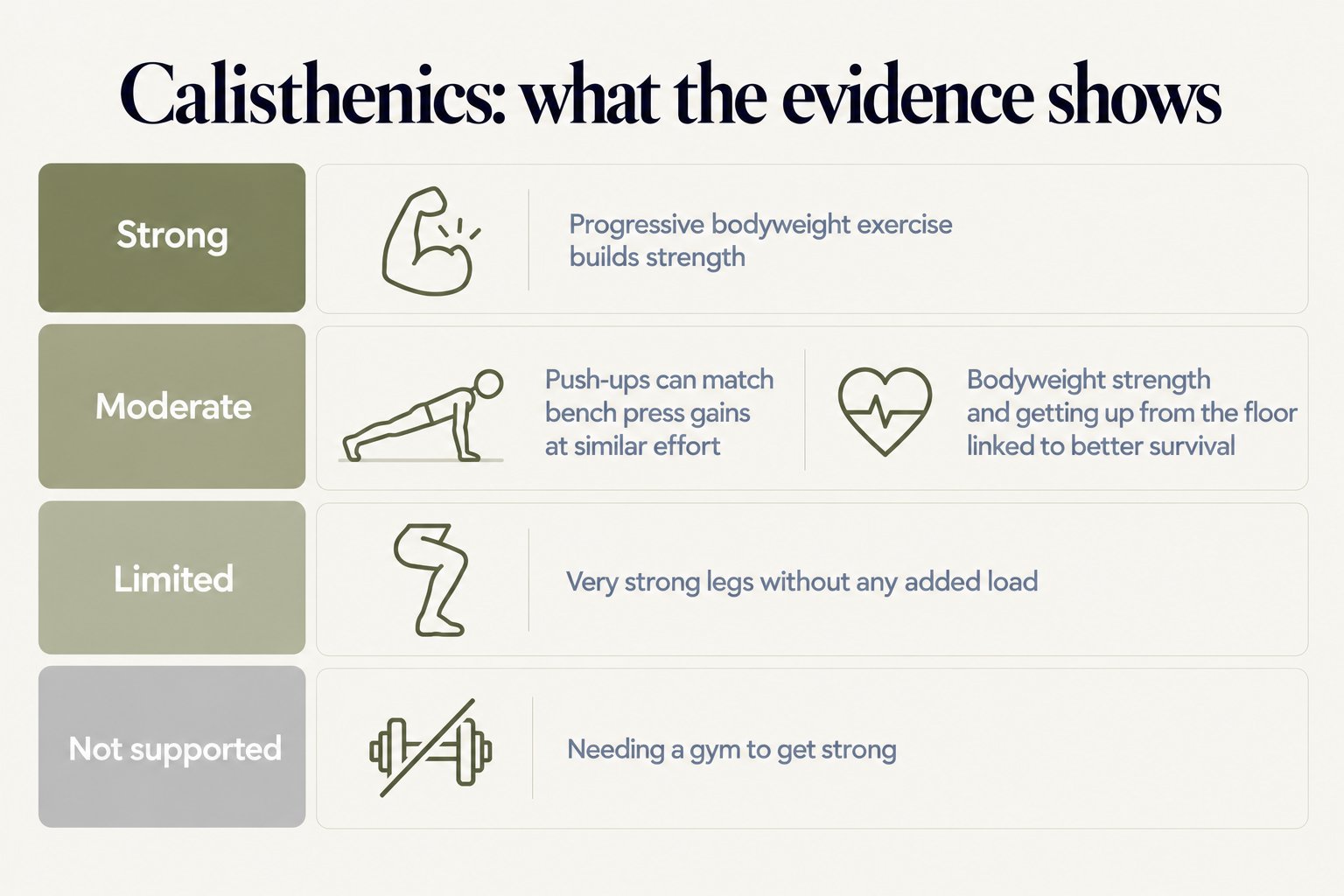
Evidence strength
- Progressive bodyweight training building strength: strong in principle, supported by small trials.
- Push-ups producing gains similar to bench press at matched effort: moderate.
- Push-up and floor-rise ability as markers of better health: moderate, observational.
- Bodyweight training building maximal leg strength without added load: limited; single-leg work and added load help.
- Needing a gym to get strong: not supported.
Why this matters for longevity
Bodyweight strength is the ability to move your own body: getting up from the floor, climbing stairs, carrying yourself and recovering from a trip. Those abilities decline with age but can be maintained and rebuilt with simple training. Because calisthenics needs no equipment, time travelling to a gym or money, it removes many of the barriers that stop people training. Done consistently and progressed sensibly, it can provide the strength training everyone needs for healthy ageing.
Recommendations by situation
- Beginners: start with wall or incline push-ups, chair sit-to-stands, bridges and table rows, 2 to 3 times a week.
- Busy people: a 20-minute bodyweight circuit twice a week, plus short "snacks" of squats or push-ups during the day.
- Travellers: a hotel-room routine of squats, push-ups, lunges, planks and a suspension strap or band.
- Older adults: chair-based strength, sit-to-stands and supported lunges, building towards getting up from the floor unaided.
- Experienced exercisers: progress to pull-ups, dips, single-leg squats and skills, or combine with weights.
Practical notes
You can get strong without a gym. Start with versions of push-ups, squats, rows, bridges and planks that you can do with good form, and make them gradually harder by changing leverage, range, tempo or the number of limbs. Include pulling movements, train your legs with single-leg variations, and keep most sets close to effort. Practise getting down to the floor and back up, a skill that matters more with age. In Sri Lanka's heat, train in a shaded or ventilated space and take breaks. Our Longevity Doctors can assess your strength, balance and functional fitness, and help you design a bodyweight programme suited to your age, goals and any health conditions, starting with the free longevity assessment.
- Kikuchi N, Nakazato K. Low-load bench press and push-up induce similar muscle hypertrophy and strength gain. Journal of Exercise Science & Fitness, 2017;15(1):37-42.
- Kotarsky CJ, et al. Effect of progressive calisthenic push-up training on muscle strength and thickness. Journal of Strength and Conditioning Research, 2018;32(3):651-659.
- Yang J, et al. Association between push-up exercise capacity and future cardiovascular events among active adult men. JAMA Network Open, 2019;2(2):e188341.
- Brito LB, et al. Ability to sit and rise from the floor as a predictor of all-cause mortality. European Journal of Preventive Cardiology, 2014;21(7):892-898.
Free longevity assessment
Want a bodyweight programme
matched to your fitness?
Take the free Aevum Protocol assessment to see how your movement & strength and 6 other longevity domains are performing — and get a personalised 90-day plan.
Take the free assessment