Movement & Strength
Weight Training:
Free Weights, Machines and Resistance Bands Compared
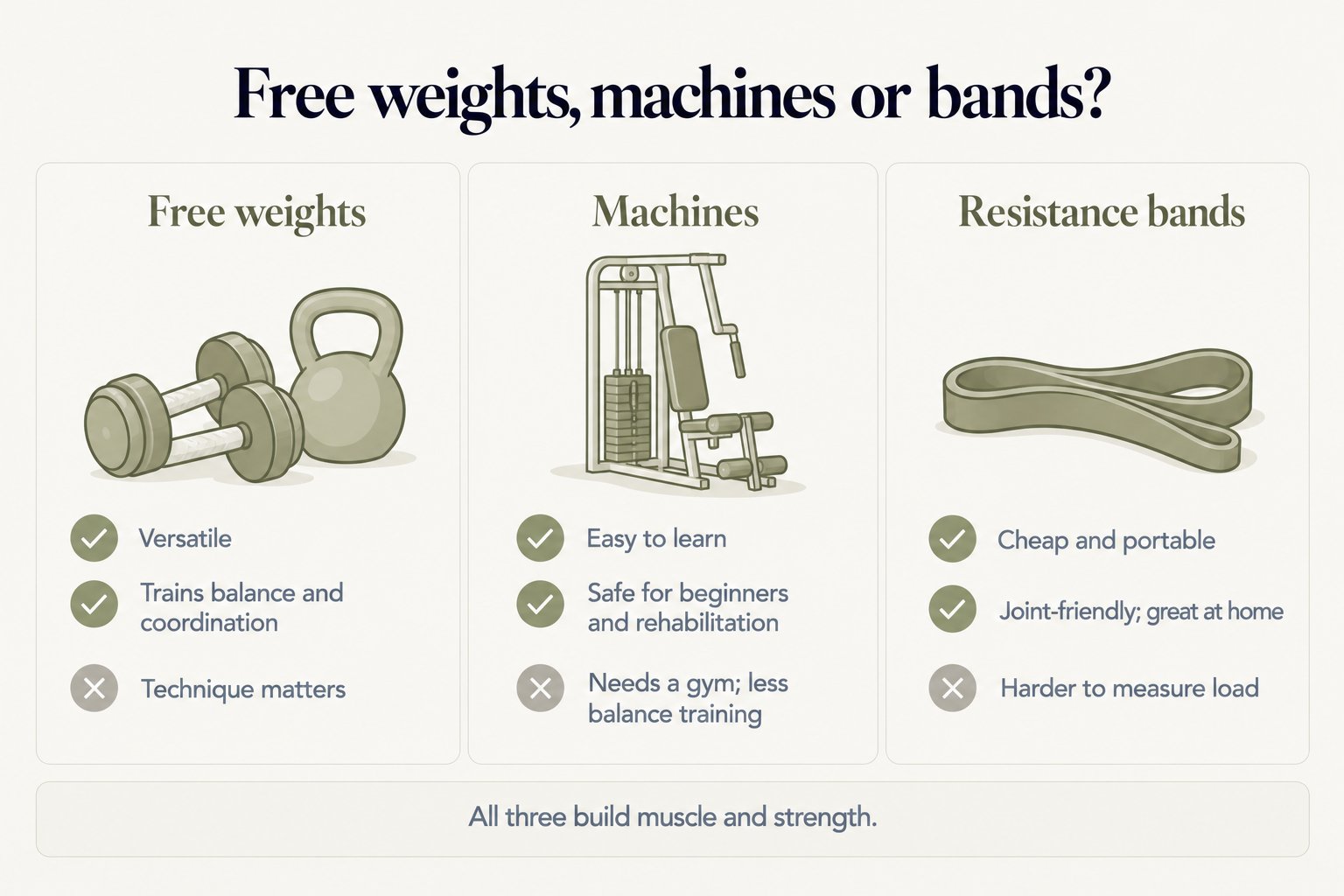
Weight training, also called resistance or strength training, is the most effective way to build and keep muscle, strength and bone, all of which decline with age and protect independence later in life. You can train with free weights (dumbbells, barbells and kettlebells), machines (weight-stack and cable machines) or resistance bands, and the research shows all three work. A 2023 meta-analysis of 13 studies with over 1,000 people found no difference in muscle growth between free weights and machines, and people simply got stronger at whichever equipment they trained with. A 2019 meta-analysis found resistance bands produced similar strength gains to conventional weights. So the best equipment is the one that suits your goals, your body and your situation, and that you'll keep using. Each has strengths: free weights train balance and coordination and are versatile; machines are easier to learn and good for beginners, older adults and rehabilitation; bands are cheap, portable and ideal for home training. Weight training is also safer than many people think: injury rates are low compared with common team sports. This article compares the options and explains how to train safely and effectively with each.
Key numbers
| Finding | Detail |
|---|---|
| Free weights vs machines (13 studies, 1,016 people) | No difference in muscle growth; strength gains specific to the equipment used |
| Free weights vs machines (36 trained adults, 8 weeks) | Arm muscle thickness up 3.9% vs 5.1%, both significant |
| Resistance bands vs conventional weights (8 studies) | Similar strength gains in upper and lower body |
| Strength training and risk of death (16 studies) | 10 to 20% lower, greatest at about 30 to 60 minutes a week |
| Injury rate, bodybuilding-style training | About 0.24 to 1 injury per 1,000 hours |
| WHO strength target | All major muscle groups on 2 or more days a week |
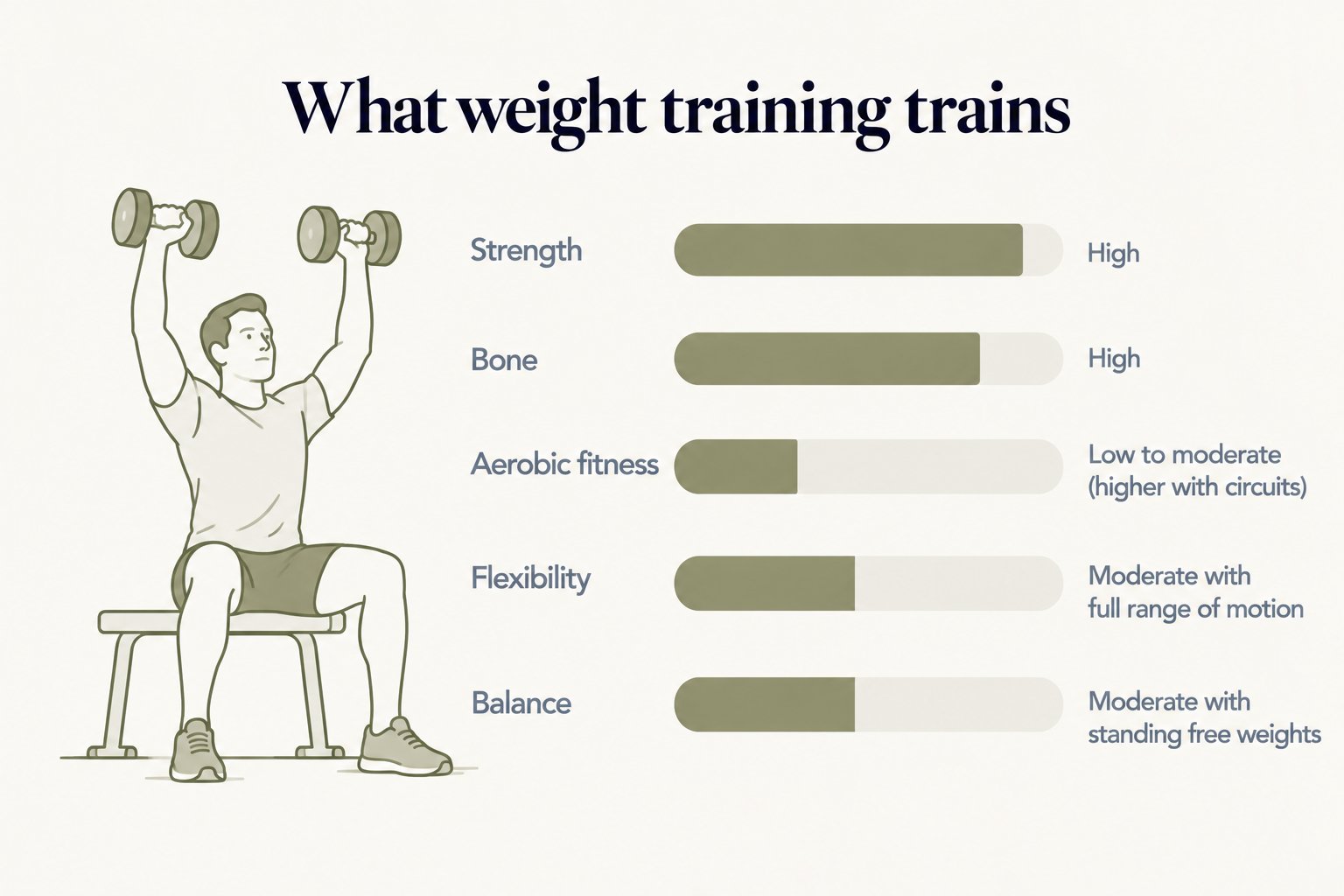
What weight training trains
- Strength: high; builds muscle size, strength and power.
- Bone: high, particularly with heavier, weight-bearing exercises (see Bone Density and Resistance Training).
- Aerobic fitness: low to moderate; circuit-style training with short rests raises the heart rate.
- Flexibility: moderate when exercises use a full range of motion.
- Balance: moderate with standing free-weight exercises; low on seated machines.
The equipment compared
| Feature | Free weights | Machines | Resistance bands |
|---|---|---|---|
| Examples | Dumbbells, barbells, kettlebells | Weight-stack machines, cable machines, leg press | Loop bands, tube bands with handles, mini-bands |
| Muscle and strength gains | Excellent | Excellent | Good to excellent |
| Learning curve | Higher; technique matters | Low; guided movement | Low to moderate |
| Balance and coordination | Trains stabilising muscles | Little; movement is guided | Some, especially standing exercises |
| Safety for beginners | Good with coaching and sensible loads | Very good | Very good |
| Cost and space | Moderate; gym or home set | Usually needs a gym | Very low; fits in a drawer |
| Best for | Most goals; functional strength | Beginners, older adults, rehabilitation, isolating muscles | Home training, travel, older adults, warm-ups |
| Limitations | Need for spotting with heavy loads | Fixed paths may not suit every body | Hard to measure load; less useful for very strong people |
Free weights. Free weights move freely in any direction, so your body has to stabilise the load. That trains coordination and the smaller stabilising muscles, and closely matches real-life tasks such as lifting shopping or children (see Functional Fitness Training). Key exercises include squats, deadlifts, presses, rows and lunges. They need good technique, and heavier lifts benefit from coaching and, for some exercises, a spotter.
Machines. Machines guide the movement along a fixed path, which makes them easier to learn and safer to push close to effort without a spotter. They're useful for beginners, older adults, people returning from injury and for targeting specific muscles. The fixed path may not fit everyone's body, and they train less balance.
Resistance bands. Bands provide resistance that increases as they stretch. They're inexpensive, portable and gentle on the joints, making them excellent for home workouts, travel and older adults. The main limitations are that it's harder to measure and progress the load precisely, and very strong people may outgrow them for leg exercises.
Other options.
- Kettlebells: free weights well suited to swings, carries and full-body conditioning.
- Suspension trainers: straps that use your body weight (see Calisthenics and Bodyweight Training).
- Medicine balls and sandbags: useful for power and functional training.
What the research shows
Free weights vs machines. A 2023 meta-analysis in BMC Sports Science, Medicine and Rehabilitation pooled 13 studies with 1,016 adults aged 18 to 60. Muscle growth was the same with free weights and machines. Strength gains were specific to the equipment: people who trained with free weights improved more on free-weight tests, and those who trained on machines tended to improve more on machine tests. When strength was compared directly, there was no difference. The authors concluded that the choice should depend on "individual preferences and goals". In a smaller 2020 study of 36 experienced young adults, 8 weeks of training with only free weights or only machines increased arm muscle thickness by 3.9% and 5.1% respectively, both significant.
Resistance bands. A 2019 meta-analysis in SAGE Open Medicine of 8 studies found that elastic resistance training produced similar strength gains to conventional weights in both the upper and lower body, across different populations and protocols.
Strength training and longevity. A 2022 meta-analysis in the British Journal of Sports Medicine of 16 cohort studies found that muscle-strengthening activities were linked to a 10 to 20% lower risk of death, heart disease and cancer, with the greatest benefit at about 30 to 60 minutes a week (see Types of Exercise Explained and Resistance Training for Longevity: How Much Do You Actually Need?).
Is it safe?. A 2017 review in Sports Medicine found that weight-training sports have relatively low injury rates compared with common team sports, with bodybuilding-style training at about 0.24 to 1 injury per 1,000 hours. The most commonly affected areas were the shoulder, lower back, knee, elbow and wrist, usually strains, tendon problems and sprains. Most injuries are linked to poor technique, lifting too heavy too soon or inadequate recovery.
How to start
A simple beginner programme. Train 2 to 3 times a week on non-consecutive days, working all major muscle groups:
| Movement | Free weights | Machine | Band |
|---|---|---|---|
| Squat or leg press | Goblet squat | Leg press | Band squat |
| Hip hinge | Dumbbell Romanian deadlift | Back extension machine | Band good morning |
| Push | Dumbbell bench or floor press | Chest press | Band chest press |
| Pull | One-arm dumbbell row | Seated row or lat pulldown | Band row |
| Overhead | Dumbbell shoulder press | Shoulder press | Band overhead press |
| Core | Farmer's carry | Cable woodchop | Band anti-rotation press |
- Sets and reps: 1 to 3 sets of 8 to 15 repetitions per exercise.
- Effort: finish each set with about 2 to 3 repetitions left "in the tank" while learning. Later, train closer to effort.
- Progression: when you can do the top of your rep range with good form, increase the weight, band tension or reps slightly (see Progressive Overload).
- Rest: 1 to 2 minutes between sets for most exercises.
Technique and safety tips.
- Learn the basics from a qualified trainer or physiotherapist, especially for squats, deadlifts and overhead presses.
- Warm up with light sets or band exercises before working sets.
- Control the movement: lift with control, lower slowly, and avoid bouncing or jerking.
- Breathe: exhale during the effort and avoid holding your breath for long, particularly if you have high blood pressure.
- Check bands for nicks or wear, and anchor them securely.
- Recover: muscles grow between sessions, so allow at least one rest day for each muscle group, and eat enough protein (see Protein Powders).
Who should be careful
- People with high blood pressure or heart disease: weight training is usually beneficial, but avoid very heavy lifts and long breath-holds, and get medical advice before starting.
- People with osteoporosis: strength training helps bones, but get guidance on safe exercises and avoid heavy loaded spinal flexion such as sit-ups with weights.
- People with joint pain or previous injuries: start with machines or bands and a pain-free range of motion; a physiotherapist can tailor exercises.
- Older adults: start light, focus on technique, and include leg and grip strength; muscle in older adults responds well but needs consistent training (see Anabolic Resistance: Why Older Muscle Needs More Stimulus to Grow).
- Pregnancy: strength training is generally safe for those already training; adapt as pregnancy progresses and avoid lying flat on the back for long periods later in pregnancy.
Weight training in Sri Lanka
- Gyms: many gyms offer both machines and free weights; look for qualified trainers and a clean, uncrowded environment, especially if you're a beginner.
- Home training: a pair of adjustable dumbbells and a set of resistance bands are enough for an effective home programme, and avoid travel time and heat.
- Heat: gyms without air conditioning can be very hot; drink water and train at cooler times of day.
- Women: strength training doesn't make women "bulky"; it builds strength, bone and metabolic health, and is particularly important around and after menopause.
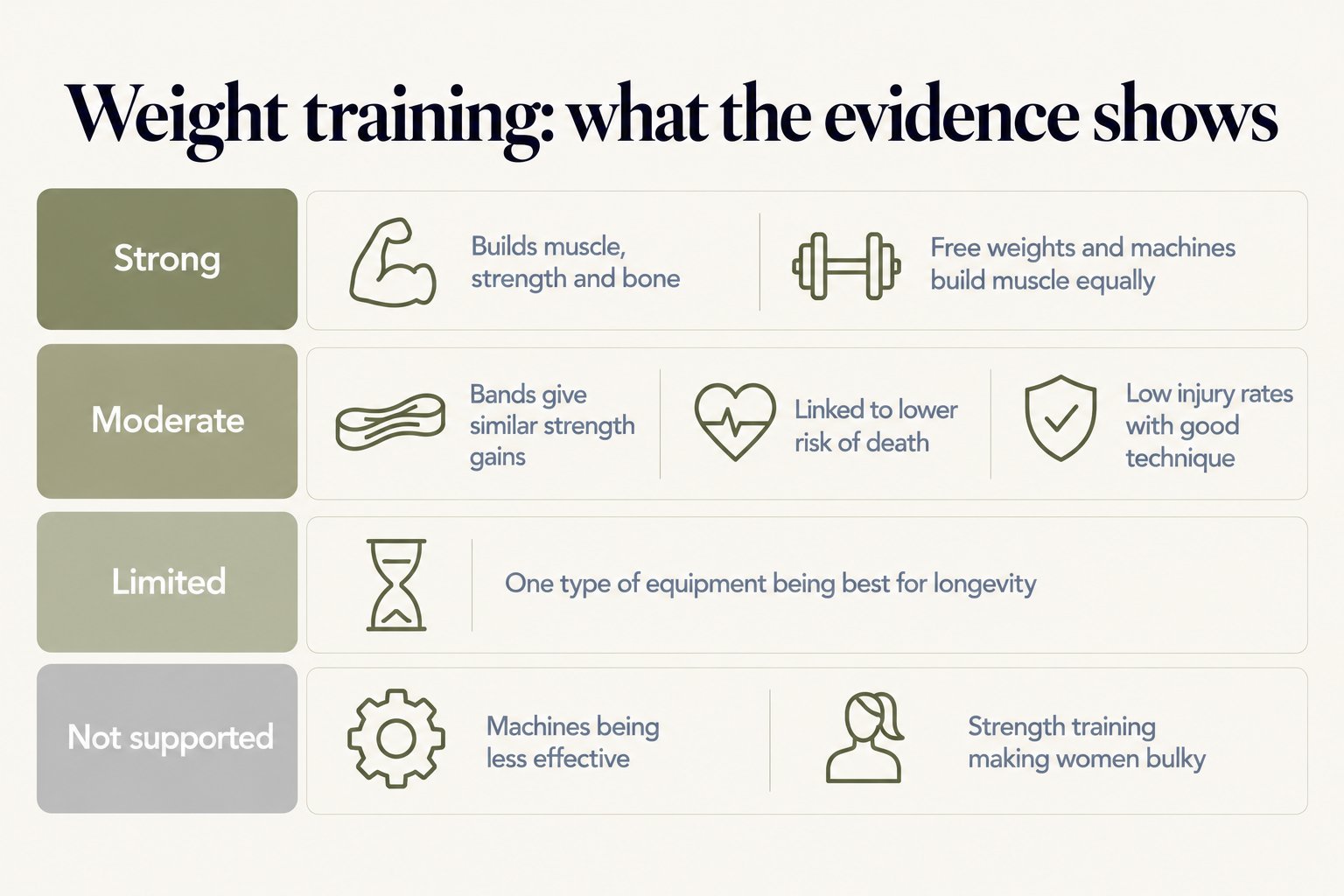
Evidence strength
- Strength training building muscle, strength and bone: strong.
- Free weights and machines producing similar muscle growth: strong to moderate.
- Resistance bands producing similar strength gains: moderate.
- Strength training linked to lower risk of death: moderate, observational.
- Low injury risk with sensible training: moderate.
- One type of equipment being best for health: limited; no type has been shown to be better for longevity, and consistency matters more.
Why this matters for longevity
Muscle and strength are some of the most important predictors of healthy ageing: they support metabolism, protect bones and joints, prevent falls and keep people independent. Strength declines steadily from mid-life unless it's trained. The good news is that it doesn't matter much whether you use dumbbells, machines or bands. What matters is training all major muscle groups at least twice a week, progressing gradually and keeping it up for life.
Recommendations by situation
- Complete beginners: start with machines or bands for 4 to 6 weeks, then add free weights.
- Older adults: machines and bands are safe starting points; include leg, hip and grip exercises and progress steadily.
- Home exercisers: bands plus adjustable dumbbells cover all major movements.
- People wanting functional strength: emphasise free-weight squats, hinges, carries and presses.
- People with injuries or pain: machines and bands with a physiotherapist's guidance.
- Busy people: two 30-minute full-body sessions a week deliver most of the longevity benefit.
Practical notes
You don't need a fancy gym to get strong. Free weights, machines and resistance bands all build muscle and strength; choose the option you can use safely and consistently. Train all major muscle groups two to three times a week, use good technique, progress gradually and rest between sessions. Start lighter than you think, and get coaching for the more technical lifts. In Sri Lanka, a home set of bands and dumbbells is an effective way to avoid traffic, heat and gym costs. Our Longevity Doctors can assess your strength, muscle mass and bone health, and help you plan a safe strength programme that suits your age, goals and health, starting with the free longevity assessment.
- Haugen ME, et al. Effect of free-weight vs. machine-based strength training on maximal strength, hypertrophy and jump performance: a systematic review and meta-analysis. BMC Sports Science, Medicine and Rehabilitation, 2023;15:103.
- Schwanbeck SR, et al. Effects of training with free weights versus machines on muscle mass, strength, free testosterone, and free cortisol levels. Journal of Strength and Conditioning Research, 2020;34(7):1851-1859.
- Lopes JSS, et al. Effects of training with elastic resistance versus conventional resistance on muscular strength: a systematic review and meta-analysis. SAGE Open Medicine, 2019;7:2050312119831116.
- Momma H, et al. Muscle-strengthening activities are associated with lower risk and mortality in major non-communicable diseases: a systematic review and meta-analysis of cohort studies. British Journal of Sports Medicine, 2022;56(13):755-763.
- Keogh JWL, Winwood PW. The epidemiology of injuries across the weight-training sports. Sports Medicine, 2017;47(3):479-501.
- Bull FC, et al. World Health Organization 2020 guidelines on physical activity and sedentary behaviour. British Journal of Sports Medicine, 2020;54(24):1451-1462.
Free longevity assessment
Want a safe strength
programme built for you?
Take the free Aevum Protocol assessment to see how your movement & strength and 6 other longevity domains are performing — and get a personalised 90-day plan.
Take the free assessment