Movement & Strength
Resistance Training for Longevity:
How Much Do You Actually Need?
Our Muscle Mass, Muscle Fibre Types, and Anabolic Resistance articles have all pointed to resistance training as the practical answer to age-related muscle loss — but none of them addressed the actual dose. This article answers that directly, and the finding genuinely contrasts with our VO2 max article's "no observed upper limit" result: resistance training's relationship with mortality risk isn't open-ended. There's a real, well-documented sweet spot for the mortality benefit specifically, and it's smaller than most people assume.
Key numbers
| Finding | Detail |
|---|---|
| All-cause mortality reduction, any resistance training vs. none | ~15% (one meta-analysis; a second independent meta-analysis found the same ~15%) |
| Cardiovascular and cancer mortality reduction, any vs. none | ~19% and ~14% respectively |
| Maximum mortality risk reduction observed (dose-response) | ~27%, at approximately 60 minutes per week — based on only 4 studies, so treated cautiously |
| Official minimum frequency guideline | ≥2 days/week of muscle-strengthening activity covering major muscle groups |
| Resistance training + meeting aerobic guidelines, combined vs. neither | ~40% lower all-cause mortality risk |
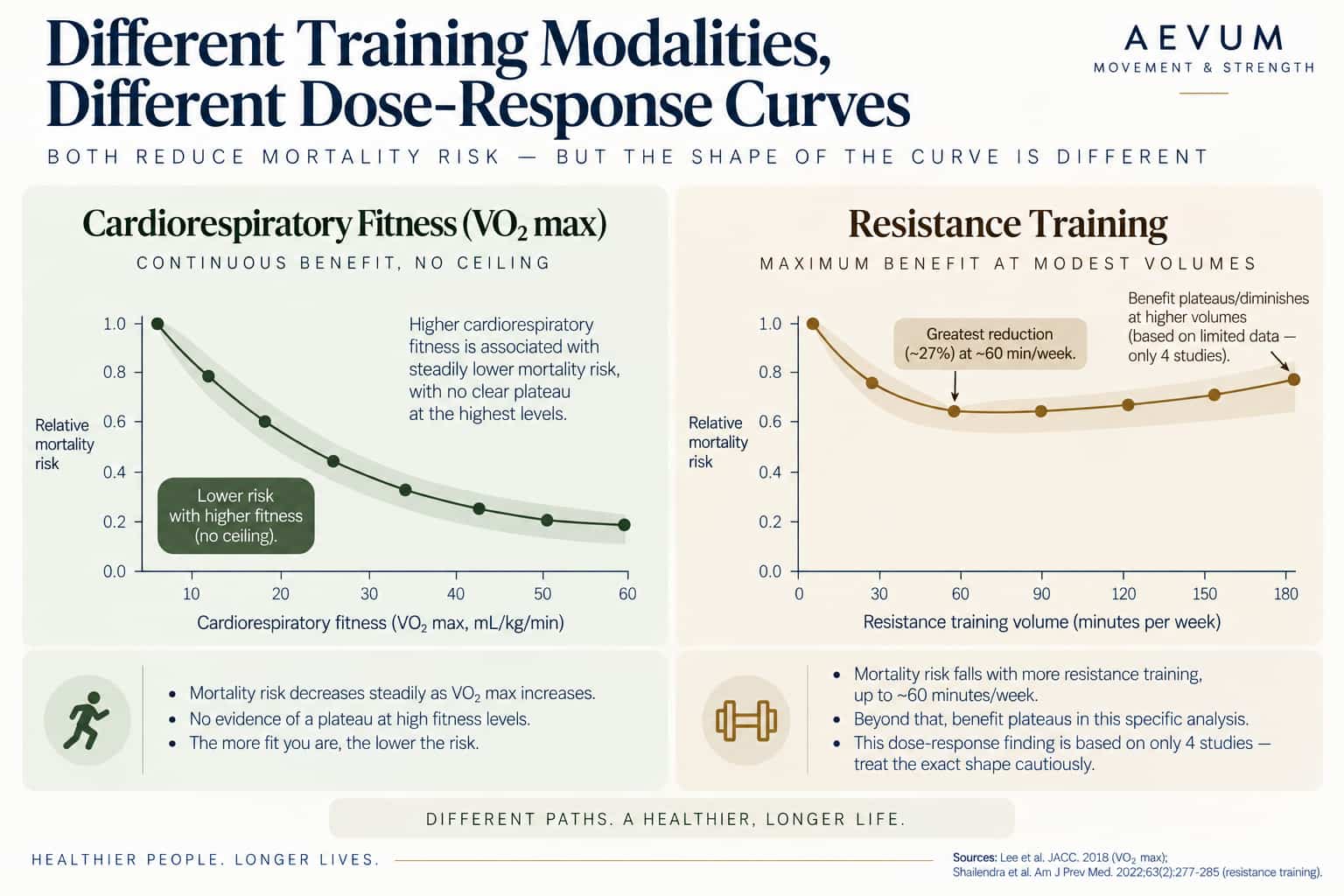
The dose-response data: a real ceiling, unlike cardiorespiratory fitness
This is worth contrasting directly with our VO2 max article, where a landmark study found no observed upper limit to the mortality benefit of cardiorespiratory fitness — more was consistently better, all the way to the extreme high end. Resistance training tells a genuinely different story for the specific outcome of all-cause mortality.
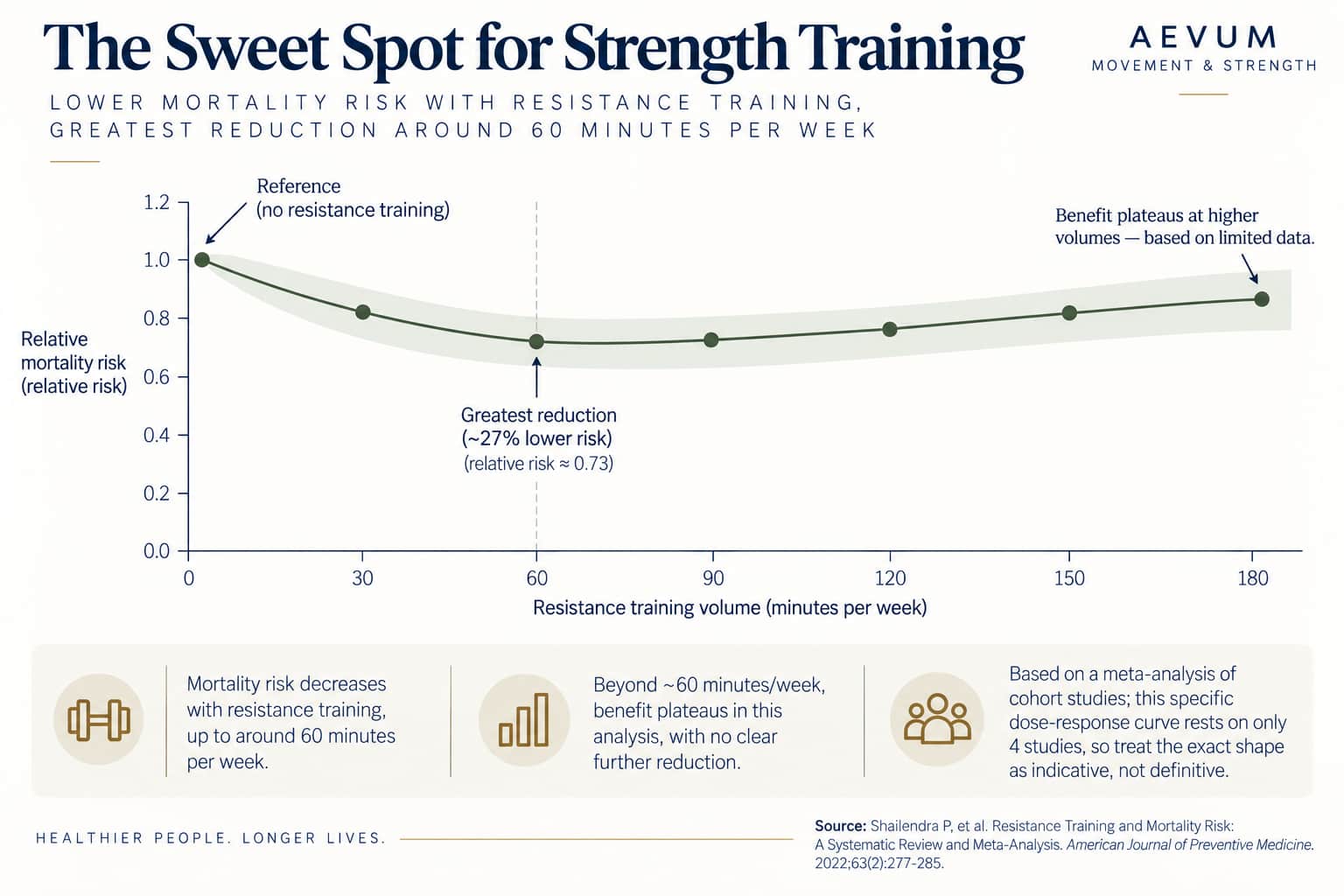
A 2022 systematic review and meta-analysis (Shailendra et al.) found that, compared with no resistance training, any amount reduced all-cause mortality by 15%, cardiovascular disease mortality by 19%, and cancer mortality by 14%. A separate 2022 meta-analysis (Momma et al.), pooling a different but overlapping set of cohort studies, found closely consistent figures — a 15% all-cause mortality reduction, 17% for cardiovascular disease, and 12% for cancer. When Shailendra and colleagues examined the dose-response relationship specifically, they found a nonlinear, U-shaped pattern: the maximum risk reduction, approximately 27%, occurred at around 60 minutes of resistance training per week, with reductions diminishing at higher weekly volumes. The authors were explicit that this particular dose-response finding rests on only 4 studies and should be treated cautiously rather than as a settled number.
A separate large cohort study offers a related but not identical picture. An analysis of the Prostate, Lung, Colorectal and Ovarian Cancer Screening Trial (PLCO) looked at weightlifting frequency (rather than weekly minutes, which it didn't collect) and found a straightforward inverse trend, not a U-shape: risk fell as weightlifting frequency increased from none to several times a week, with no evidence of the benefit reversing at high frequency, though the size of the additional benefit beyond roughly 1-2 sessions a week was modest. So the "more isn't always better" finding above is specific to the Shailendra minutes-per-week analysis and shouldn't be read as a universally replicated law across every dataset — different studies measuring the exposure differently (minutes vs. sessions) have found somewhat different shapes to the curve, and the honest summary is that resistance training's dose-response relationship is flatter and more forgiving than aerobic fitness's, without a single number every study agrees on.
Frequency alone also predicts benefit, though not as consistently as the meta-analyses above. Official physical activity guidelines recommend muscle-strengthening activity on at least 2 days per week, covering the major muscle groups. It's worth being transparent that the evidence behind this specific frequency threshold is mixed — while the broader body of cohort and meta-analytic evidence above supports resistance training's mortality benefit generally, at least one recent NHANES-based analysis (1999-2006 cohort, tracked through 2019) did not find a statistically significant association between meeting the ≥2-days/week guideline specifically and all-cause mortality once other factors were adjusted for. This doesn't overturn the broader case for resistance training made above; it's a reminder that any single study, including this one, can disagree with the pooled picture, and guideline-level frequency thresholds are a reasonable practical target even where the mortality data for that exact threshold isn't unanimous.
Combining resistance training with aerobic activity produces a larger effect than either alone. The same Shailendra meta-analysis found resistance training alone reduced all-cause mortality risk by 18% and meeting aerobic activity guidelines alone by 25%, while doing both was associated with a 40% lower risk compared to neither — a genuine case for reading this article alongside our VO2 max article rather than treating strength and cardiovascular training as competing uses of limited time.
How to actually train
- →Aim for at least 2 sessions per week, covering the major muscle groups (legs, back, chest, shoulders, core) — the guideline-recommended frequency, even though the mortality evidence for this exact threshold is mixed across studies
- →Roughly 60 minutes of total weekly resistance training appears to capture the large majority of the mortality benefit in the best-characterized dose-response analysis available — genuinely encouraging news for anyone assuming meaningful benefit requires hours in the gym each week
- →Favour compound, multi-joint movements (squats, deadlifts, presses, rows) over single-joint isolation exercises where possible — these engage more muscle mass per session, aligning efficiently with the modest time commitment the mortality data supports
- →Don't assume more is always worse. The U-shaped 60-minute ceiling comes from a small, specific dose-response analysis; other large cohort data doesn't show the same reversal at higher volumes, so someone training beyond 60 minutes a week for strength or performance reasons isn't working against the mortality evidence, just past the point where the average study still shows additional mortality-specific benefit
Recommendations by starting point
- 1Anyone currently doing no resistance training
The data here is genuinely encouraging — any amount of resistance training captures a substantial share of the total mortality benefit, meaning starting somewhere, even modestly, is a high-value decision rather than something to delay until a "proper" programme can be arranged.
- 2Anyone time-constrained, assuming meaningful benefit requires a large weekly commitment
The roughly 60-minute weekly figure from the best dose-response analysis available is a realistic, achievable amount for most schedules, not an aspirational target requiring major lifestyle reorganisation.
- 3Anyone training specifically for strength, muscle size, or athletic performance, not mortality risk alone
The mortality-specific dose-response ceiling described here doesn't argue against training beyond it; those goals reasonably call for more volume, and doing so isn't in tension with the evidence above.
- 4Anyone balancing resistance training against cardiovascular training, given limited time
The joint-analysis research supports doing both rather than choosing one — the combination outperforms either training type alone, making this less a trade-off than it might initially seem, especially given how modest the resistance-training time commitment can be.
Practical notes
Resistance training's dose-response relationship with mortality is genuinely more forgiving than most people assume — meaningful benefit from a modest, achievable weekly commitment. Exactly how flat or U-shaped the curve is above that point varies by study and by how the exposure was measured, so it's worth holding the specific numbers (27% at 60 minutes, in particular) a little more loosely than the well-replicated "any resistance training beats none" finding. For the muscle physiology this training addresses, see our Muscle Mass, Muscle Fibre Types, and Anabolic Resistance articles, and for the training principle that determines whether this time is actually well spent, see our Progressive Overload article.
How many days a week
are you currently strength training?
Take the free Aevum Protocol assessment to see how your movement & strength and 6 other longevity domains are performing — and get a personalised 90-day plan.
Take the Free Assessment →