Movement & Strength
Yoga for Health:
Flexibility, Strength, Balance and What the Evidence Shows
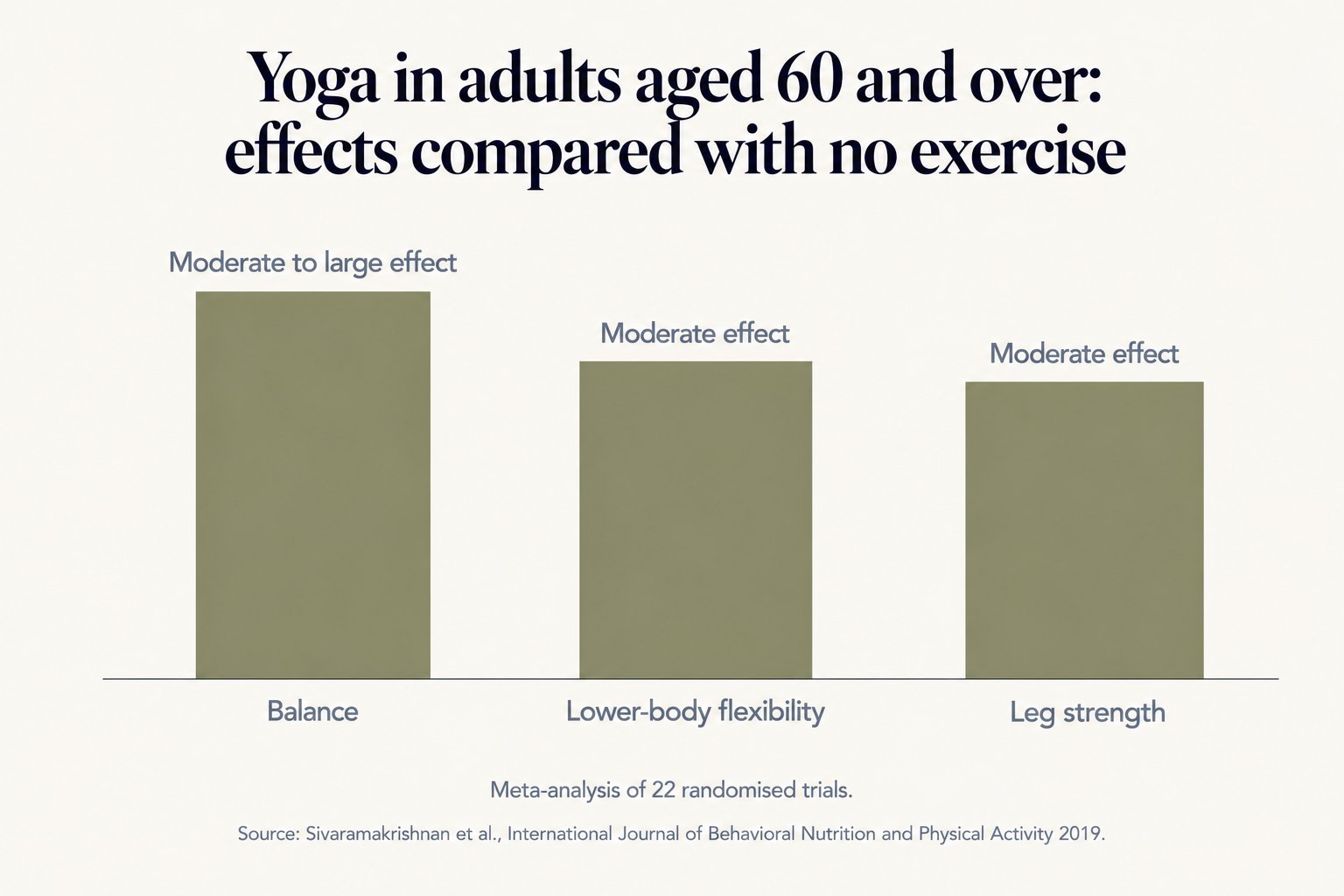
Yoga combines physical postures (asanas), breathing and focused attention. It has its roots in South Asia, and today it's practised in almost every country, in styles that range from slow, restorative classes to fast, sweaty flows. As exercise, yoga's main strengths are flexibility, balance and muscular endurance, with some gains in leg strength. A 2019 meta-analysis of 22 trials in adults aged 60 and over found that yoga improved balance, lower-body flexibility and leg strength compared with doing nothing, and improved leg strength and flexibility even compared with other forms of exercise. An earlier meta-analysis found yoga improved balance and mobility in people aged 60 and over. Yoga is also well studied for blood pressure, back pain and mood (covered in our article on yoga, tai chi and breathwork). What yoga does less well is aerobic fitness: a typical gentle hatha class averages about 2.5 METs, a light intensity similar to slow walking, so most people need other activity for their heart and lungs. Yoga is about as safe as other exercise, although injuries do happen, especially in older adults and in forced or extreme postures. Hot yoga adds a real heat-stress risk, which matters in Sri Lanka's climate. This article explains the main styles, what yoga trains, what the research shows and how to fit it into a balanced exercise routine.
Key numbers
| Finding | Detail |
|---|---|
| Yoga in adults aged 60 and over vs no exercise (22 trials) | Improved balance, lower-body flexibility and leg strength (moderate effects) |
| Yoga in adults aged 60 and over vs other exercise | Still improved leg strength and flexibility, and depression |
| Yoga and balance in adults aged 60 and over (6 trials, 307 people) | Small improvement in balance; medium improvement in mobility |
| Intensity of a gentle hatha yoga session (20 practitioners) | About 2.5 METs: light, similar to slow walking |
| Safety (94 trials, 8,430 people) | Adverse events no more common than with usual care |
| Yoga participation and death (55,023 US adults, observational) | 27% lower risk, likely partly due to healthier people practising yoga |
What yoga trains
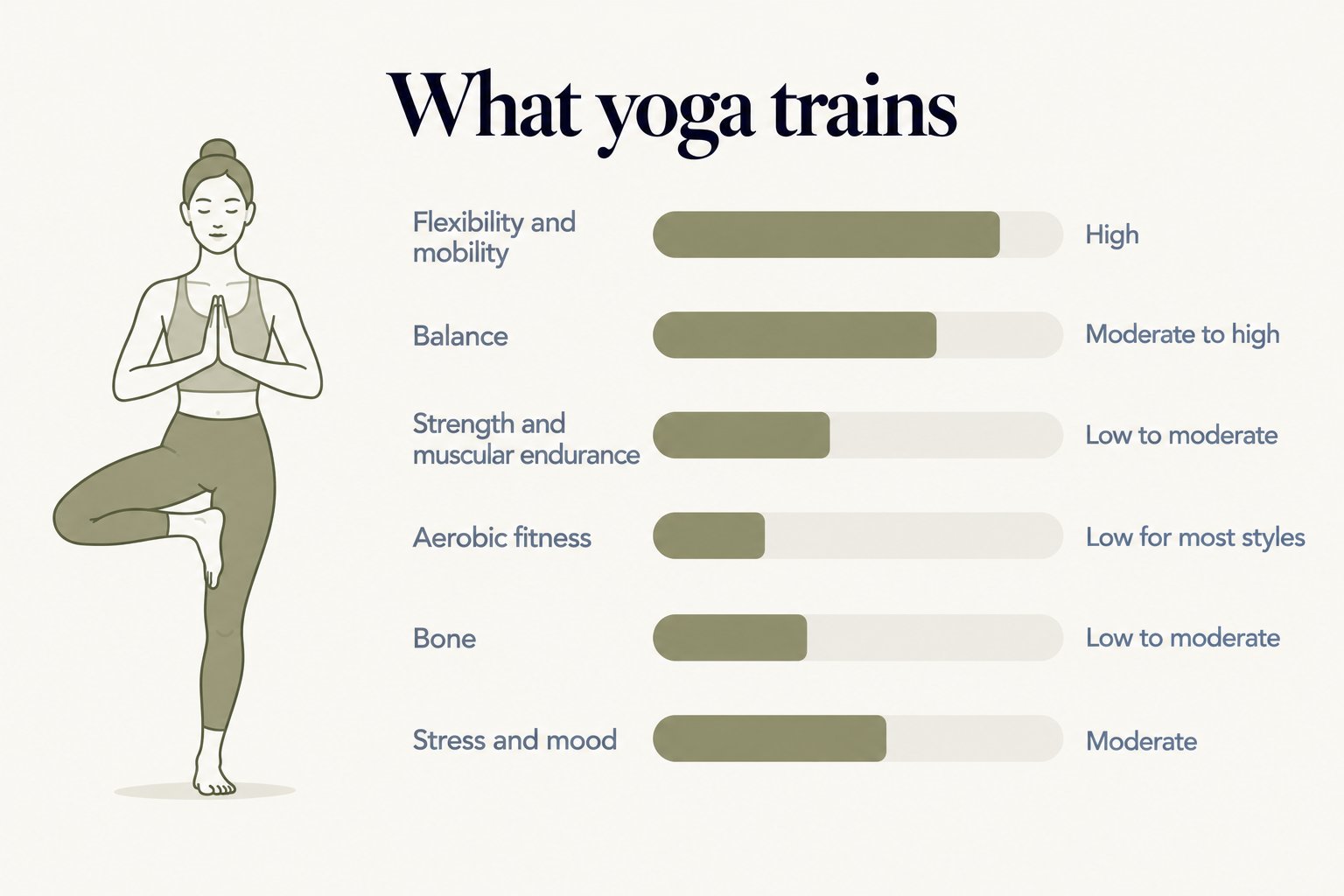
- Flexibility and mobility: high; most styles move the hips, spine and shoulders through a wide range.
- Balance: moderate to high, from standing and single-leg postures.
- Strength and muscular endurance: low to moderate; holding postures and flowing sequences build endurance, especially in the legs, core and shoulders, but there's no easy way to add progressive load.
- Aerobic fitness: low for most styles; moderate in vigorous flowing styles.
- Bone: low to moderate; weight-bearing postures load the bones gently but provide little impact.
- Stress and mood: moderate; the breathing and relaxation elements are part of what makes yoga different from other exercise.
Common styles.
- Hatha: a broad term for classes that teach postures and breathing at a steady pace; a good starting point.
- Iyengar: precise alignment, longer holds and props such as blocks, straps and chairs; well suited to beginners and people with injuries.
- Vinyasa and power yoga: postures linked into continuous flowing sequences; more vigorous, with a higher heart rate.
- Ashtanga: a set, demanding sequence practised at a brisk pace.
- Yin and restorative: long, passive holds and supported relaxation; very gentle.
- Chair yoga: postures adapted to sitting or holding a chair; useful for older adults and people with limited mobility.
- Hot yoga: practised in a heated room; covered under safety below.
What the research shows
Physical function in older adults.
- Balance, flexibility and strength: in a 2019 meta-analysis in the International Journal of Behavioral Nutrition and Physical Activity, researchers from Edinburgh analysed 22 randomised trials of yoga in adults aged 60 and over without a specific disease. Compared with no exercise, yoga moderately improved balance, lower-body flexibility and leg strength, as well as depression, sleep quality and perceived mental and physical health. Compared with other active programmes such as walking or general exercise, yoga still produced greater gains in leg strength and lower-body flexibility, and in depression.
- Balance and mobility: in a 2016 meta-analysis in Age and Ageing, Australian researchers analysed 6 trials with 307 people aged 60 and over. Yoga produced a small improvement in balance and a medium improvement in mobility. Because no trial had measured falls, the authors couldn't say whether yoga prevents falls (see Balance and Fall Prevention).
Knee osteoarthritis. In a 2022 trial in Annals of Internal Medicine, Kim Bennell and colleagues at the University of Melbourne randomised 212 adults with knee osteoarthritis to online education alone or with 12 weeks of unsupervised yoga using prerecorded videos. The yoga group improved physical function, stiffness and quality of life more than the education group at 12 weeks, although the improvement in function was below the threshold usually considered clinically meaningful. Knee pain during walking didn't differ, and the benefits had faded by 24 weeks, suggesting yoga needs to be continued to keep working (see Exercise and Joint Health).
Blood pressure, back pain and mood. Yoga's best-studied benefits go beyond fitness. Yoga that combines postures with breathing and relaxation lowers blood pressure in people with hypertension, yoga works about as well as other exercise for chronic low back pain, and yoga is among the more effective forms of exercise for depression. These findings are covered in detail in Yoga, Tai Chi and Breathwork.
Yoga and lifespan.
- Observational evidence: in a 2026 analysis in the American Journal of Preventive Medicine using the US National Health Interview Survey, researchers followed 55,023 adults through 2019. People who practised yoga had a 27% lower risk of death than those who didn't, after adjusting for income, education, smoking, body weight, other exercise and self-rated health.
- Caution: people who practise yoga tend to be younger, wealthier, more educated and healthier, and people who are very ill are less likely to attend classes. The result can't show that yoga itself extends life, and the benefit is likely shared with other regular physical activity.
How intense is yoga?
In a 2007 study in BMC Complementary and Alternative Medicine, 20 experienced practitioners did a 56-minute beginner hatha yoga session while their oxygen use was measured. The session averaged about 2.5 METs (metabolic equivalents), with heart rate around half of predicted maximum: a light intensity similar to walking slowly. The authors concluded that this type of session doesn't meet recommendations for improving cardiovascular fitness, although sustained sequences of sun salutations raised intensity enough to help people who are unfit or sedentary.
This means:
- Gentle styles count as flexibility, balance and relaxation training, not as aerobic exercise.
- Vigorous flowing styles (vinyasa, power, ashtanga) can reach moderate intensity, especially with continuous sun salutations.
- Most people need other activity such as walking, cycling or swimming for their heart and lungs, and progressive strength training for maximal strength (see Types of Exercise Explained).
How to start
A simple beginner approach.
- Choose a gentle style: hatha, Iyengar or a class labelled "beginners".
- Start with a qualified teacher: an instructor can adjust postures and offer props, which is safer than learning from videos alone at first.
- Frequency: 2 to 3 sessions of 30 to 60 minutes a week, or 10 to 20 minutes most days at home.
- Use props: blocks, straps, cushions and a chair make postures accessible and reduce strain.
- Give it time: most trials ran for 8 to 12 weeks or longer, and benefits fade if practice stops.
Tips.
- Work within a comfortable range: stretch to mild tension, never pain, and don't force a posture to match someone else's.
- Breathe steadily: don't hold your breath in difficult postures.
- Build strength elsewhere too: add 2 sessions of progressive strength training a week (see Weight Training).
- Add aerobic activity: pair yoga with brisk walking or another activity (see Walking for Longevity).
- Use it for flexibility: yoga is one of the most enjoyable ways to meet flexibility recommendations (see Flexibility and Mobility).
Who should be careful
Is yoga safe?.
- Overall: in a 2015 meta-analysis in the American Journal of Epidemiology, researchers analysed 94 randomised trials with 8,430 participants. Adverse events were no more common with yoga than with usual care or no treatment, and serious events were rare. However, only about a third of trials reported adverse events, so the figures are approximate.
- Injuries: a 2016 study in the Orthopaedic Journal of Sports Medicine found 29,590 yoga-related injuries treated in US emergency departments from 2001 to 2014. The injury rate rose from 10 to 17 per 100,000 participants over that period, and was highest in people aged 65 and over (58 per 100,000). Nearly half the injuries affected the trunk, and sprains and strains were the most common type.
Take extra care if you have.
- Osteoporosis: avoid deep forward bends, forceful twisting and loaded spinal flexion; choose a teacher experienced with bone health.
- Neck or back problems: avoid headstands, shoulder stands and plough pose, and don't force twists or backbends.
- Glaucoma or eye conditions: ask your eye doctor before doing head-down postures.
- Uncontrolled high blood pressure: avoid long head-down postures and breath-holding.
- Hip or knee replacements: avoid positions your surgeon has restricted, such as deep hip flexion or crossing the legs.
- Pregnancy: choose prenatal classes with a qualified teacher, and avoid hot yoga, deep twists and lying flat on your back for long periods later in pregnancy.
- Very flexible joints (hypermobility): focus on control and strength rather than pushing further into the range.
Hot yoga. Hot yoga is practised in a room heated to around 40°C, often with added humidity. In a study sponsored by the American Council on Exercise, participants' core temperature rose to an average of about 39.6°C during a class, and the highest reading was just over 40°C, approaching the level at which heat illness can occur. People with heart disease, high blood pressure, diabetes, a history of fainting or heat illness, and pregnant women should avoid it. Anyone who tries it should drink water before, during and after, and stop at the first sign of dizziness, nausea or headache.
Yoga in Sri Lanka
- Easy to find: yoga classes are widely available in Colombo and other cities, and many teachers also offer online sessions.
- International Day of Yoga: the UN recognised 21 June as the International Day of Yoga in 2014, and free community sessions are often held around that date.
- Heat: Sri Lanka's heat and humidity already make vigorous classes feel harder. Practise in a ventilated or air-conditioned space, drink water, and take extra care with hot yoga.
- Low cost: a mat and online classes are enough to practise at home; a folded towel or sturdy cushion can replace a block.
- For older adults: chair yoga and gentle classes are a sociable way to work on balance and flexibility.
Evidence strength
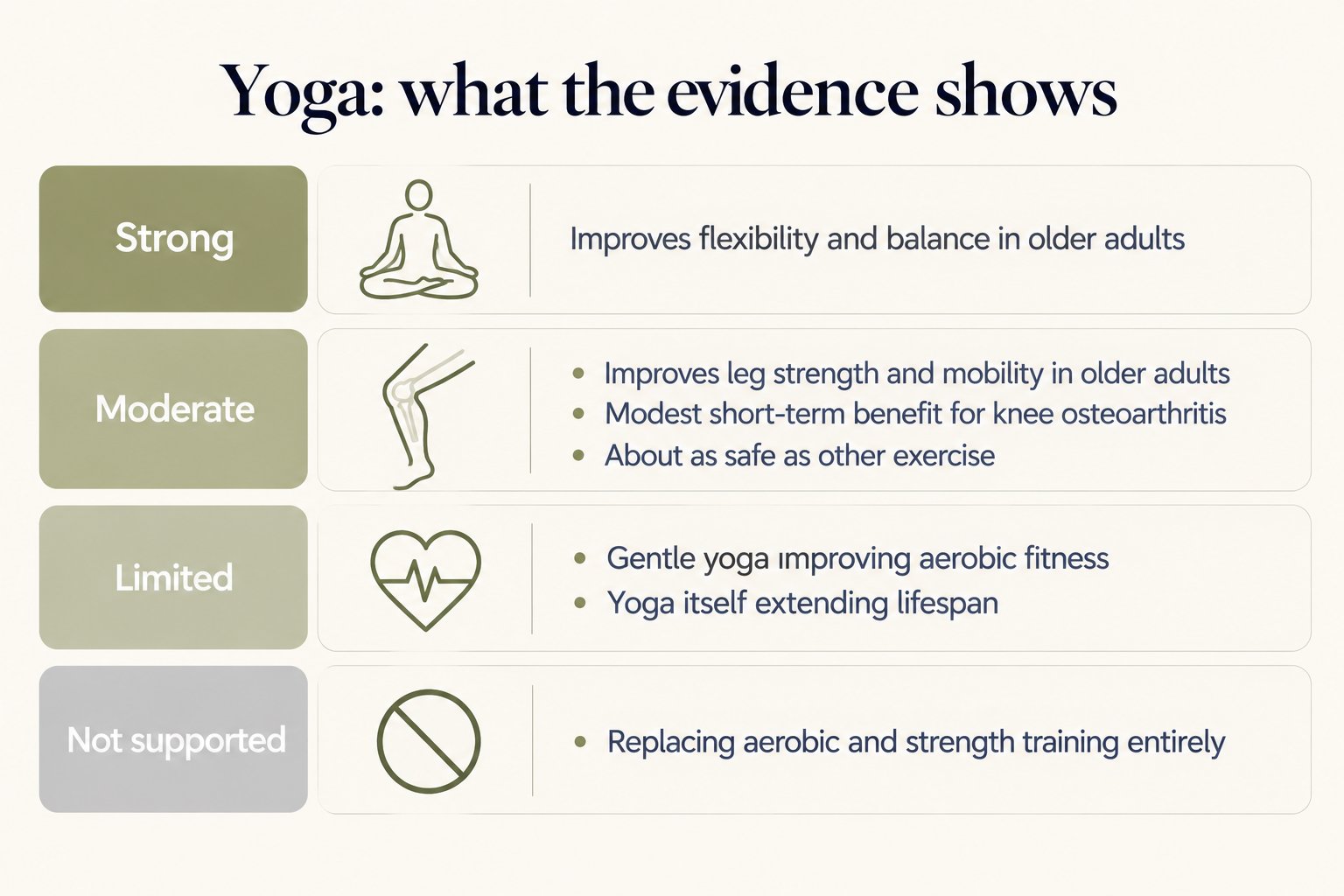
- Yoga improving flexibility and balance in older adults: strong, from multiple meta-analyses of randomised trials.
- Yoga improving leg strength and mobility in older adults: moderate.
- Yoga improving function in knee osteoarthritis: moderate, short-term and modest.
- Yoga being about as safe as other exercise: moderate; adverse event reporting in trials is incomplete.
- Gentle yoga improving aerobic fitness: limited.
- Yoga itself extending lifespan: limited; observational and likely confounded.
- Yoga replacing aerobic and strength training entirely: not supported.
Why this matters for longevity
As we age, flexibility, balance and leg strength decline, and with them the ability to move freely, get up from the floor and avoid falls. Yoga trains all three in a way many people enjoy and keep doing, and it adds breathing and relaxation that help with stress, sleep and mood. Its limits matter too: most styles don't challenge the heart and lungs or build maximal strength. Yoga is most valuable as one part of a balanced routine that also includes aerobic activity and progressive strength training.
Recommendations by situation
- Beginners: a gentle hatha or Iyengar class 2 to 3 times a week with a qualified teacher.
- Older adults: gentle or chair yoga for balance and flexibility, combined with strength training and walking.
- People with knee osteoarthritis or back pain: gentle yoga can help function; keep it going long term and avoid painful positions.
- Runners, cyclists and gym-goers: one or two sessions a week for mobility and recovery.
- People who want a vigorous workout: vinyasa, power or ashtanga yoga, still combined with strength training.
- People with stress or poor sleep: restorative or yin yoga, or slower classes with more breathing and relaxation.
Practical notes
Yoga is one of the best ways to build flexibility and balance, with useful gains in leg strength and mood, but it isn't a complete exercise programme. Start with a gentle style and a qualified teacher, use props, work within a comfortable range and keep practising, because the benefits fade when you stop. Add brisk walking or other aerobic activity and 2 sessions of strength training a week. If you have osteoporosis, glaucoma, neck or back problems, a joint replacement or high blood pressure, or are pregnant, ask for modifications and avoid hot yoga unless your doctor agrees. Our Longevity Doctors can assess your flexibility, balance, strength and cardiovascular fitness, and help you decide how yoga fits into your routine, starting with the free longevity assessment.
- Sivaramakrishnan D, et al. The effects of yoga compared to active and inactive controls on physical function and health related quality of life in older adults: systematic review and meta-analysis of randomised controlled trials. International Journal of Behavioral Nutrition and Physical Activity, 2019;16:33.
- Youkhana S, et al. Yoga-based exercise improves balance and mobility in people aged 60 and over: a systematic review and meta-analysis. Age and Ageing, 2016;45(1):21-29.
- Bennell KL, et al. Effects of an unsupervised online yoga program on pain and function in people with knee osteoarthritis: a randomized clinical trial. Annals of Internal Medicine, 2022;175(10):1345-1355.
- Complementary health approaches and all-cause mortality among US adults (National Health Interview Survey 2007 and 2012 cohort). American Journal of Preventive Medicine, 2026.
- Rundle A, Moore W, Hagins M. Does practicing hatha yoga satisfy recommendations for intensity of physical activity which improves and maintains health and cardiovascular fitness? BMC Complementary and Alternative Medicine, 2007;7:40.
- Cramer H, et al. The safety of yoga: a systematic review and meta-analysis of randomized controlled trials. American Journal of Epidemiology, 2015;182(4):281-293.
- Swain TA, McGwin G. Yoga-related injuries in the United States from 2001 to 2014. Orthopaedic Journal of Sports Medicine, 2016;4(11):2325967116671703.
- American Council on Exercise. ACE-sponsored research: what effect does Bikram yoga have on core body temperatures? ACE ProSource, 2015.
Free longevity assessment
Wondering how yoga fits
into your exercise routine?
Take the free Aevum Protocol assessment to see how your movement & strength and 6 other longevity domains are performing — and get a personalised 90-day plan.
Take the free assessment