Stress & Mental Wellbeing
Yoga, Tai Chi and Breathwork:
Evidence for Mind-Body Practices
Yoga, tai chi and breathwork combine movement or breathing with focused attention, and they've moved from ancient traditions into hospitals, gyms and phone apps. Yoga has deep roots in South Asia, tai chi comes from China, and controlled breathing (pranayama) is part of many traditional practices. What does the evidence show? For yoga, the clearest benefits are for blood pressure, back pain and mood. A meta-analysis of 49 studies found that yoga combining postures, breathing and relaxation lowered blood pressure in people with hypertension by up to 11/6 mmHg, about twice as much as yoga without the breathing and relaxation elements. A Cochrane review of 21 trials found small improvements in back pain and function compared with no exercise, similar to other back exercises. Yoga was also one of the most effective forms of exercise for depression in a 2024 analysis of 218 trials. For tai chi, a Cochrane review found it may reduce falls in older adults by 19%, alongside improving balance. For breathwork, a 2023 meta-analysis of randomised trials found small-to-medium reductions in stress, anxiety and depression, though the studies were small and the authors warned against "a miscalibration between hype and evidence". None of these practices is magic, and none replaces medical treatment, but they're safe for most people, adaptable to all ages, and among the most accessible ways to combine physical activity with stress relief.
Key numbers
| Finding | Detail |
|---|---|
| Yoga and blood pressure (49 studies) | Up to 11/6 mmHg lower with breathing and relaxation; about 6/3 mmHg without |
| Yoga and low back pain (21 trials, 2,223 people) | Small improvements in pain and function vs no exercise; similar to other back exercise |
| Yoga for depression (218 trials) | Among the most effective exercise types; easy to stick with |
| Tai chi and falls (7 trials, 2,655 older adults) | May reduce the rate of falls by 19% |
| Breathwork (randomised trials, 785 adults) | Small-to-medium reductions in stress, anxiety and depression |
What these practices are
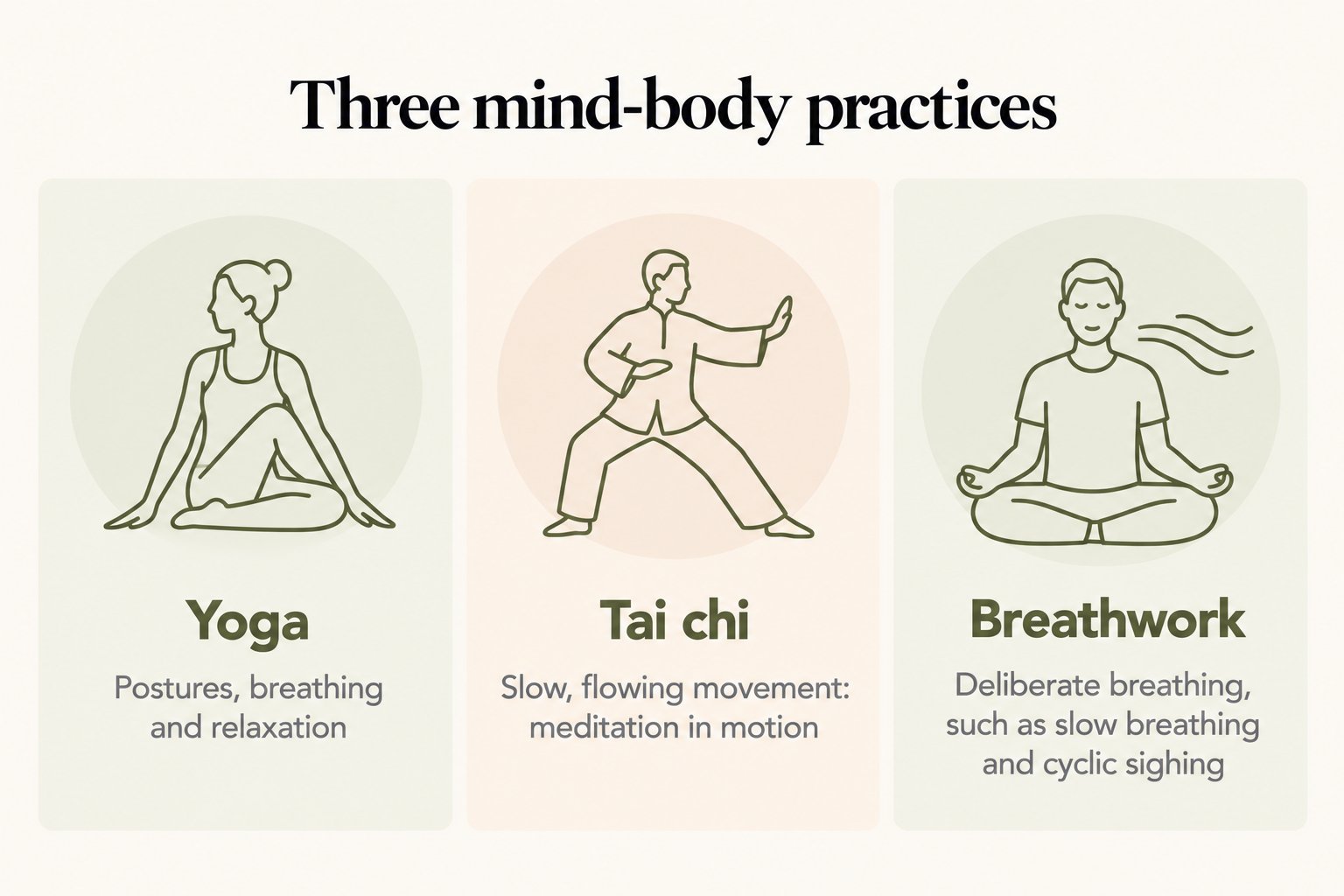
Yoga combines physical postures (asanas), breathing techniques (pranayama) and relaxation or meditation. Styles range from gentle and restorative to vigorous and athletic.
Tai chi is a Chinese practice of slow, flowing, continuous movements performed with deep breathing and focused attention. It's often described as "meditation in motion", and it's particularly suited to older adults. Qigong is a related practice.
Breathwork is a broad term for deliberately controlling the breath. Slow techniques, such as diaphragmatic breathing, resonance breathing at about six breaths a minute and cyclic sighing (a double inhale followed by a long exhale), aim to calm the nervous system. Fast techniques involve rapid or forceful breathing and are more intense.
Evidence strength
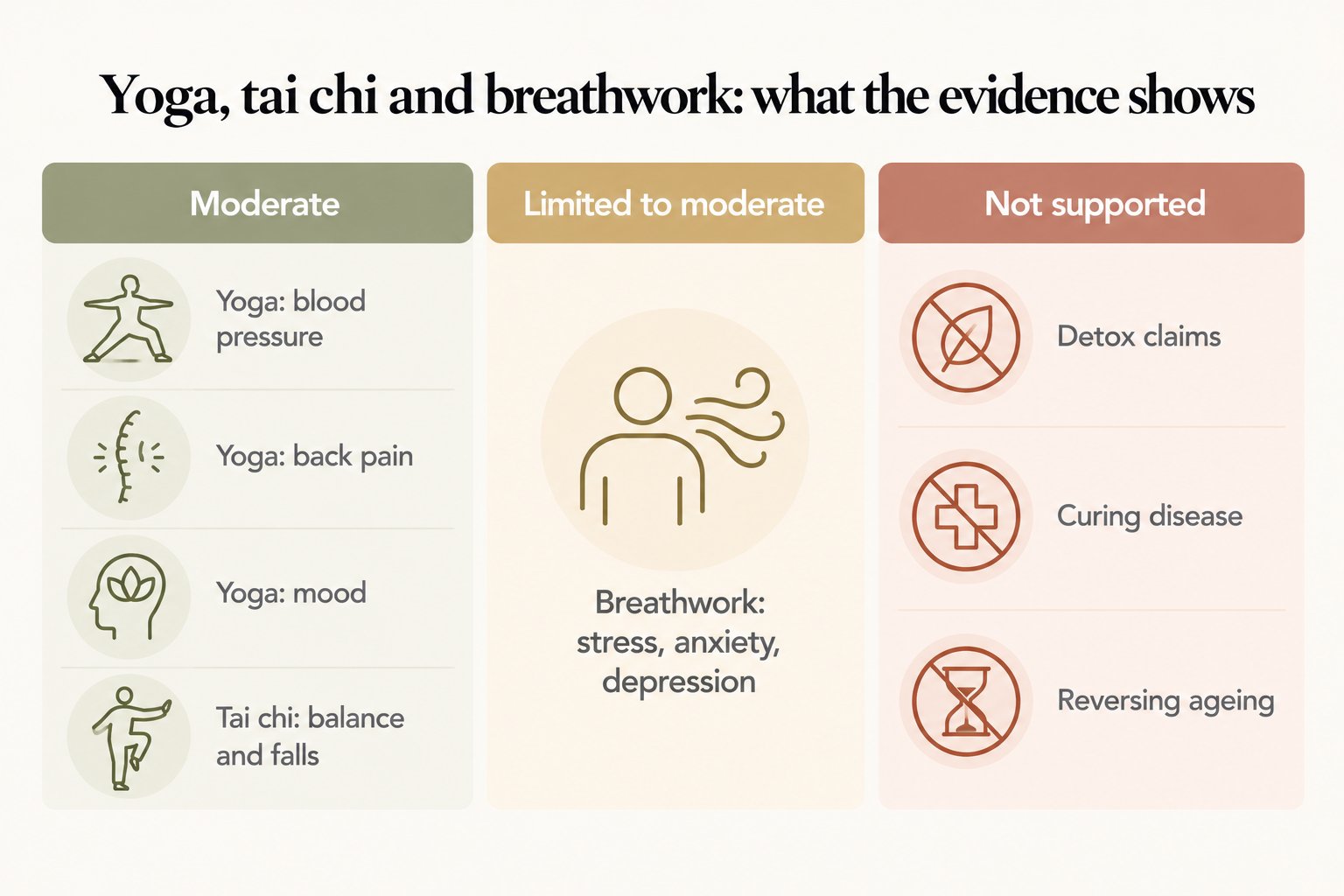
Moderate: yoga lowers blood pressure. In a 2019 meta-analysis of 49 studies in Mayo Clinic Proceedings, Yin Wu and colleagues at the University of Connecticut found that yoga lowered blood pressure in people with hypertension. Yoga that combined postures with breathing techniques and mental relaxation produced the largest reductions, up to 11/6 mmHg, "equal to or exceeds those reported for aerobic exercise". Yoga without breathing and relaxation produced about 6/3 mmHg. The authors suggested yoga as an option for people who can't or won't do aerobic exercise, rather than a replacement for it (see Lowering Blood Pressure Without Medication).
Moderate: yoga for back pain and mood
Back pain. A 2022 Cochrane review of 21 trials with 2,223 adults found that yoga probably improves pain and back-related function slightly more than no exercise after three months, and works about as well as other back-focused exercise. Back pain itself was the most common side effect, but serious harms weren't reported.
Depression. In a 2024 network meta-analysis of 218 trials, yoga was among the most effective exercise types for depression, about as effective as cognitive behavioural therapy, and one of the forms people were most likely to stick with (see Depression and Physical Health).
Moderate: tai chi for balance and falls. Falls are a leading cause of injury and loss of independence in older age. A Cochrane review of exercise to prevent falls in community-dwelling adults aged 60 and over, led by Catherine Sherrington, found that exercise overall reduced the rate of falls by 23%, and balance and functional exercise by 24% (high-certainty evidence). Tai chi specifically may reduce falls by 19%, based on 7 trials with 2,655 participants (low-certainty evidence). Its slow, controlled weight shifts train balance, leg strength and body awareness (see Balance and Fall Prevention).
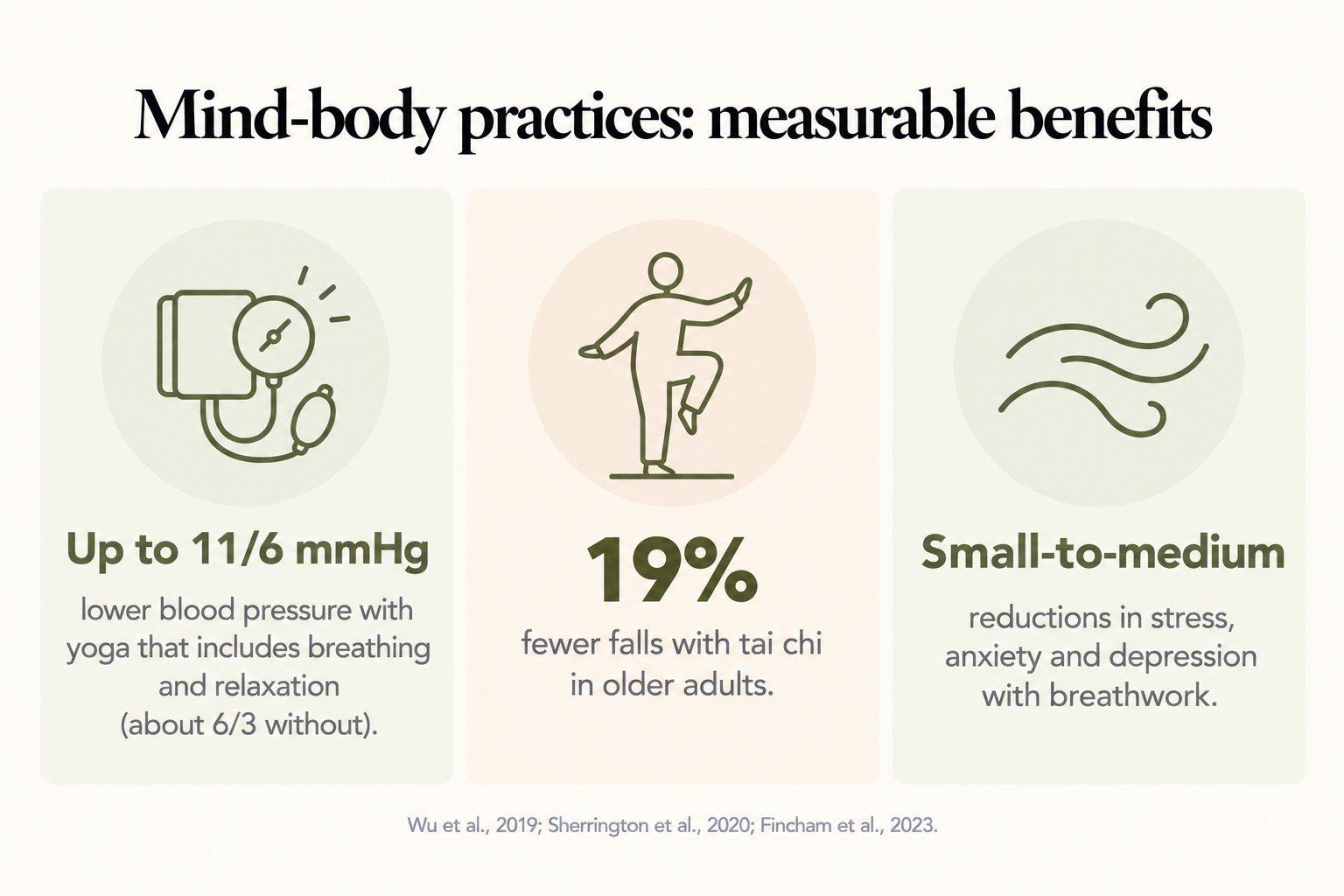
Limited to moderate: breathwork for stress and mood. In a 2023 meta-analysis in Scientific Reports, Guy Fincham and colleagues at the University of Sussex analysed randomised trials with a total of 785 adults. Breathwork produced significant small-to-medium reductions in stress (12 trials), anxiety (20 trials) and depressive symptoms (18 trials) compared with control conditions. Techniques included slow resonance breathing, diaphragmatic and pursed-lip breathing and Sudarshan Kriya Yoga. However, most studies had a moderate risk of bias and small samples, and it wasn't clear whether the benefits came from breathing itself or from the focused attention it shares with meditation. As Fincham said: "Breathwork may help some but not others."
A 2023 Stanford study of 111 volunteers found that five minutes a day of cyclic sighing for a month improved mood more than mindfulness meditation and lowered resting breathing rate (see Stress-Reduction Techniques That Work).
Not supported: extreme claims. Claims that particular breathing methods "detox" the body, cure disease, dramatically boost immunity or reverse ageing aren't supported by good evidence. Fast or forced breathing techniques can cause light-headedness, tingling and fainting, and breath-holding practices should never be done in or near water or while driving.
Important limitations.
- No blinding: participants know they're doing yoga, tai chi or breathwork, which may influence self-reported results.
- Small, varied studies: practices differ widely in style, intensity and duration.
- Unclear active ingredient: benefits may come from physical activity, relaxation, attention or social contact in group classes.
- Mild side effects: muscle strains, back pain or dizziness can occur, especially with vigorous styles or fast breathing.
Recommendations by situation
| Situation | What the evidence supports |
|---|---|
| High blood pressure | Yoga with breathing and relaxation, alongside other lifestyle measures and medicines if needed |
| Chronic low back pain | Yoga or other back-focused exercise, adapted to your ability |
| Low mood or depression | Yoga as part of treatment, ideally a structured class |
| Older adult worried about falls | Tai chi or other balance training, at least two to three times a week |
| Everyday stress | Short daily slow breathing, such as cyclic sighing or six breaths a minute |
| Heart, lung or eye conditions, pregnancy or recent surgery | Choose gentle styles and check with your doctor; avoid inversions and fast breathing |
| Fainting or seizure history | Avoid fast or forced breathing and breath-holding techniques |
Why this matters for longevity
Mind-body practices offer something few other activities do: physical activity, balance training and stress relief in one. They can be done at almost any age and fitness level, require little or no equipment, and are deeply rooted in South Asian tradition. The evidence supports their use for blood pressure, back pain, mood, balance and stress, with modest but meaningful effects. They work best as part of an active lifestyle, not as a replacement for aerobic and strength training or medical care.
Practical notes
Choose the practice you'll enjoy and keep doing. For yoga, start with a beginners' or gentle class taught by a qualified teacher, tell them about any health conditions, and look for classes that include breathing and relaxation, not just postures. For tai chi, a class designed for older adults is a good way to learn safely; aim for at least two or three sessions a week. For breathwork, start with slow breathing: breathe in gently through the nose for about four seconds and out slowly for about six seconds, for five minutes a day. Avoid forceful or fast breathing techniques unless you're well supervised and healthy. Our Longevity Doctors can help you choose mind-body practices that suit your health, starting with the free longevity assessment.
- Wu Y, et al. Yoga as antihypertensive lifestyle therapy: a systematic review and meta-analysis. Mayo Clinic Proceedings, 2019;94(3):432-446.
- Wieland LS, et al. Yoga for chronic non-specific low back pain. Cochrane Database of Systematic Reviews, 2022;(11):CD010671.
- Noetel M, et al. Effect of exercise for depression: systematic review and network meta-analysis of randomised controlled trials. BMJ, 2024;384:e075847.
- Sherrington C, et al. Exercise for preventing falls in older people living in the community: an abridged Cochrane systematic review. British Journal of Sports Medicine, 2020;54(15):885-891.
- Fincham GW, et al. Effect of breathwork on stress and mental health: a meta-analysis of randomised-controlled trials. Scientific Reports, 2023;13:432.
- Balban MY, et al. Brief structured respiration practices enhance mood and reduce physiological arousal. Cell Reports Medicine, 2023;4(1):100895.
Free longevity assessment
Which mind-body practice
suits your health?
Take the free Aevum Protocol assessment to see how your stress & mental wellbeing and 6 other longevity domains are performing — and get a personalised 90-day plan.
Take the free assessmentKeep reading