Stress & Mental Wellbeing
Meditation and Mindfulness:
What the Evidence Really Shows
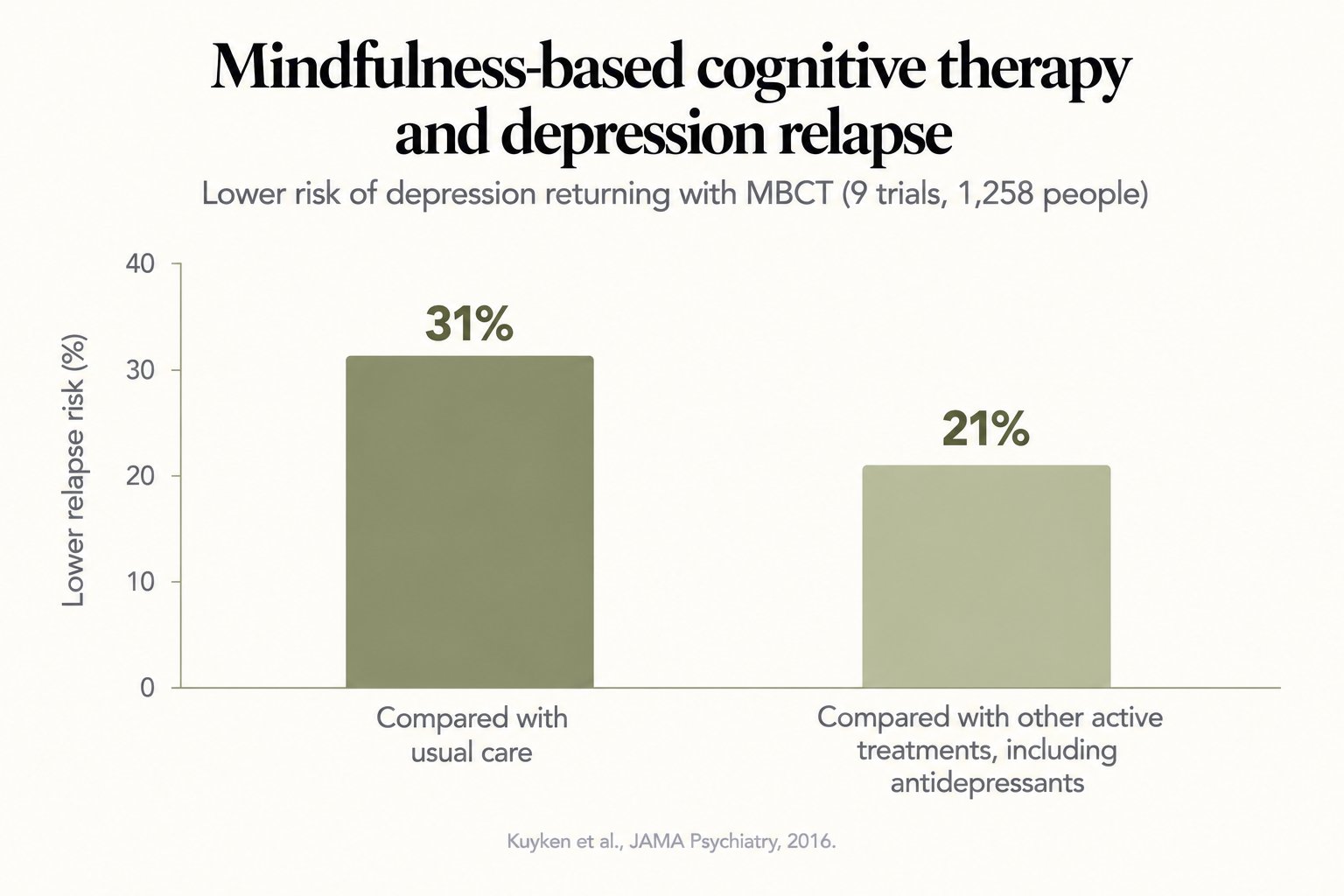
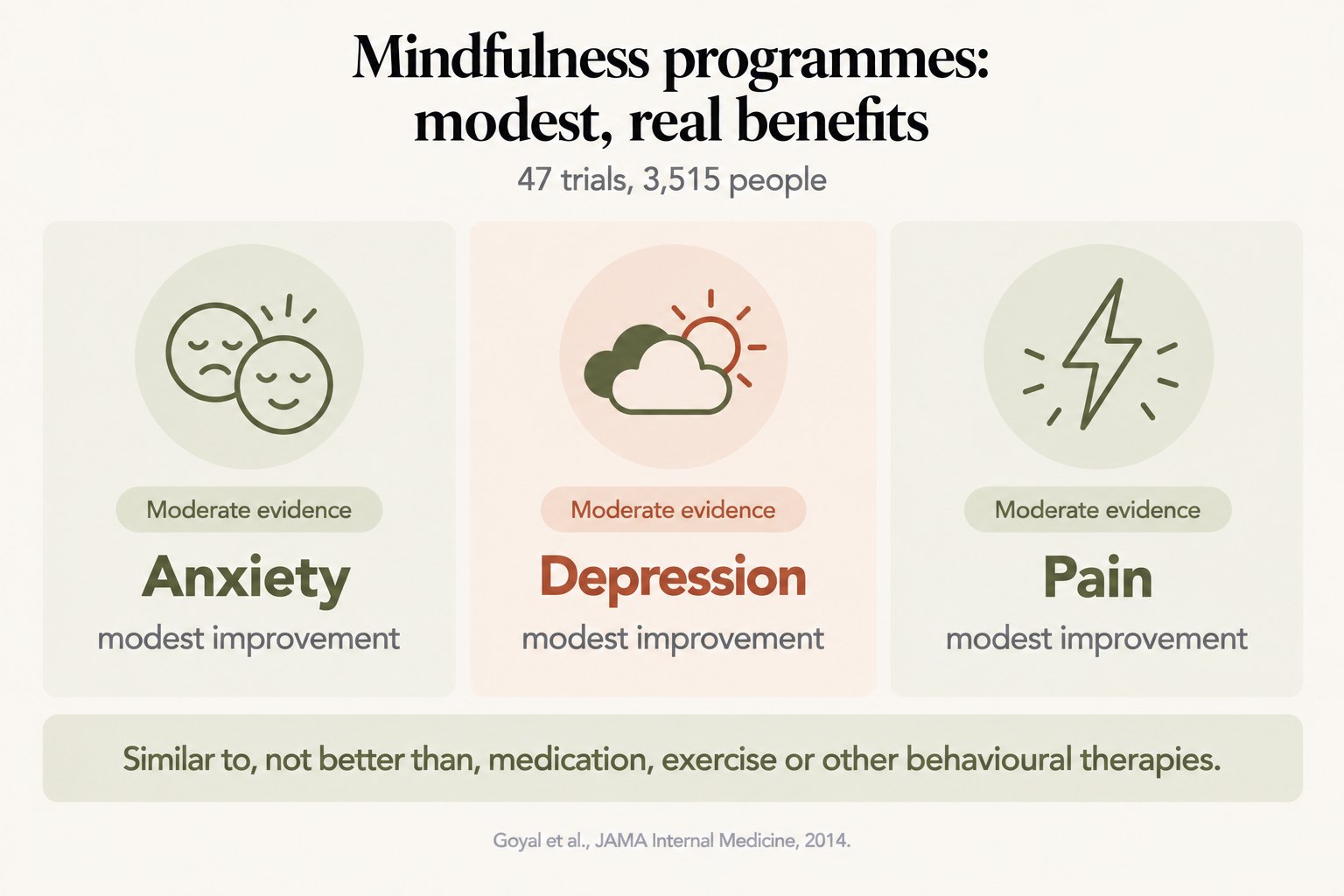
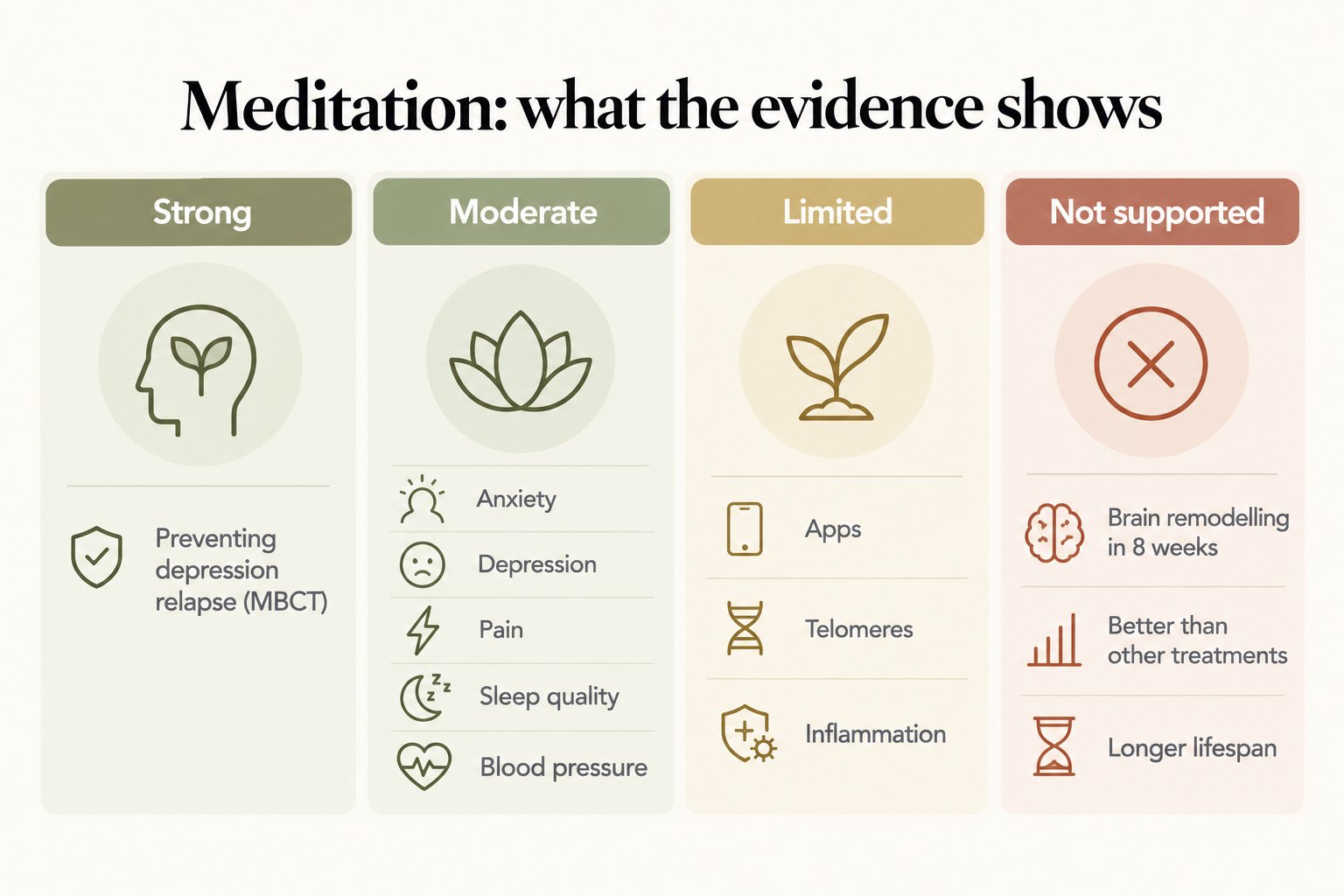
Meditation and mindfulness are promoted for almost everything: stress, anxiety, sleep, focus, blood pressure, pain, even slowing ageing. Some of these claims are well supported, some are promising, and some go well beyond the evidence. The strongest evidence is for preventing depression from coming back: in an analysis of 9 trials with 1,258 people, mindfulness-based cognitive therapy (MBCT) reduced the risk of relapse by 31% compared with usual care, and by 21% compared with other active treatments, including antidepressants. A major 2014 review of 47 trials with 3,515 participants found moderate evidence that mindfulness programmes modestly reduce anxiety, depression and pain, but no evidence that they were better than other active treatments such as medication or exercise. In a 2022 trial, an eight-week mindfulness course was as effective as an antidepressant for anxiety disorders, and meditation also modestly lowers blood pressure and improves sleep quality compared with general wellness programmes. Evidence is weaker for mindfulness apps, which have small short-term effects, and for claims about telomeres and biological ageing, which rest on a handful of small trials. Claims that eight weeks of meditation physically reshape the brain weren't confirmed in a larger trial, and there are no studies showing meditation extends lifespan. Meditation is also not risk-free: about 8% of people experience unwanted effects such as anxiety. Overall, meditation is a useful, low-cost tool, comparable to other good options rather than superior to them.
Key numbers
| Finding | Detail |
|---|---|
| Preventing depression relapse (9 trials, 1,258 people) | MBCT: 31% lower relapse risk vs usual care; 21% lower vs other active treatments |
| Mindfulness programmes (47 trials, 3,515 people) | Moderate evidence of modest improvement in anxiety, depression and pain; not better than other active treatments |
| Anxiety disorders (276 adults, 8 weeks) | Mindfulness course as effective as escitalopram |
| Sleep quality (18 trials, 1,654 people) | Improved vs general wellness programmes; no better than established sleep treatments |
| Mindfulness apps (43 trials) | Small short-term reductions in depression and anxiety |
| Unwanted effects (83 studies, 6,703 people) | About 8% experienced adverse effects |
What's being claimed
Meditation is often presented as a near-universal remedy. The questions this article answers are: for which problems does it work, how much does it help, how does it compare with other treatments, and what remains unproven? The biology of how meditation affects the brain and body is covered in How Meditation Affects the Brain and Body.
Evidence strength
Strong: preventing depression from returning. Depression often recurs, and mindfulness-based cognitive therapy (MBCT) was designed specifically to prevent relapse. It combines mindfulness practice with elements of cognitive therapy, usually delivered as an eight-week group course. In a 2016 individual patient data meta-analysis in JAMA Psychiatry, Willem Kuyken and colleagues pooled 9 randomised trials with 1,258 people with recurrent depression. Over 60 weeks, MBCT reduced the risk of relapse by 31% compared with usual care or no MBCT, and by 21% compared with other active treatments, which included maintenance antidepressants. The benefit was largest in people with more residual symptoms at the start. MBCT is now a recommended option for people with recurrent depression who are currently well.
Moderate: modest benefits for anxiety, depression and pain. In a 2014 systematic review and meta-analysis in JAMA Internal Medicine, Madhav Goyal and colleagues at Johns Hopkins examined 47 randomised trials with 3,515 participants, most involving about 20-27 hours of mindfulness training over eight weeks. They found moderate evidence that mindfulness programmes improved anxiety, depression and pain, with small-to-moderate effects that persisted, though smaller, at three to six months. However, they found "no evidence that meditation programs were better than any active treatment", such as medication, exercise or other behavioural therapies. In other words, meditation works about as well as other good options, not better.
Moderate: anxiety disorders. In a 2022 randomised trial published in JAMA Psychiatry, 276 adults with generalised anxiety, social anxiety or panic disorder received either an eight-week Mindfulness-Based Stress Reduction course or the antidepressant escitalopram. Symptoms improved by a similar amount in both groups, showing that mindfulness was non-inferior to a first-line medicine (see Anxiety and Physical Health). This was a single well-designed trial and needs replication.
Moderate: sleep quality and blood pressure. In a 2019 meta-analysis of 18 trials with 1,654 participants, Heather Rusch and colleagues found moderate-strength evidence that mindfulness meditation improved sleep quality compared with general wellness or attention-matched programmes. But compared with established sleep treatments, such as cognitive behavioural therapy for insomnia, there was no difference, suggesting it isn't a replacement for proven insomnia treatment (see Sleep Hygiene).
For blood pressure, meta-analyses show reductions of about 5 mmHg systolic in clinic readings, with smaller and less consistent effects on 24-hour monitoring. The American Heart Association says meditation "may be considered" alongside proven lifestyle changes.
Limited: apps, telomeres and biological ageing
Mindfulness apps. A 2023 meta-analysis by Jake Linardon and colleagues of 43 trials found that mindfulness apps produced small reductions in depression and anxiety compared with control groups. Most studies were in non-clinical groups, had a considerable risk of bias and short follow-up, and only a handful compared apps with other active treatments. Apps are a reasonable, low-cost starting point, but not a substitute for treatment of a mental health condition.
Telomeres. A 2014 meta-analysis by Nicola Schutte and John Malouff of just 4 randomised trials with 190 participants found that mindfulness meditation increased the activity of telomerase, an enzyme that maintains telomeres. The finding is interesting but based on very small studies, and higher telomerase activity hasn't been shown to translate into longer life (see Telomeres and Ageing).
Inflammation and immune function. A 2016 systematic review found possible but tentative effects on inflammatory markers and immune ageing, requiring replication.
Not supported: brain remodelling in weeks and longer lifespan
Structural brain changes after short courses. An early study of 16 people suggested grey matter changes after eight weeks of mindfulness training, but a 2022 randomised trial of more than 200 adults found no structural brain changes compared with control groups.
Superiority over other treatments. Despite popular claims, the 2014 review found no evidence that meditation outperforms medication, exercise or other behavioural therapies.
Attention, weight and eating. The 2014 review found low or insufficient evidence for effects on positive mood, attention, substance use, eating habits and weight in the trials it examined. (Its findings on sleep were also inconclusive, but the later sleep meta-analysis described above found a modest benefit.)
Longer life. There are no randomised trials showing that meditation extends lifespan or reverses biological ageing (see Can You Reverse Your Biological Age?).
Important limitations.
- Blinding is impossible: participants know they're meditating, so expectations can influence self-reported outcomes.
- Many trials are small and short, with limited long-term follow-up.
- Enrolment bias: people who choose meditation courses may differ from those who don't.
- "Meditation" covers many practices, so results from one type may not apply to another.
- Adverse effects: a 2020 review of 83 studies with 6,703 people found that about 8.3% experienced unwanted effects, most often anxiety, low mood and unusual perceptions, sometimes in people with no previous mental health problems.
Recommendations by situation
| Situation | What the evidence supports |
|---|---|
| Everyday stress, wanting better wellbeing | Reasonable to try; benefits are modest but real, and it's low cost |
| Recurrent depression, currently well | MBCT is an evidence-based option to reduce relapse; discuss with your doctor |
| Current moderate or severe depression | Seek treatment first; meditation can be an add-on, not a replacement |
| Anxiety disorder | An 8-week mindfulness course is a reasonable option alongside or instead of medication, with guidance |
| Insomnia | Try CBT for insomnia first; meditation can help with sleep quality |
| High blood pressure | Use as an add-on to salt reduction, exercise, weight loss and medicines if needed |
| History of trauma, psychosis or bipolar disorder | Practise only with a trained teacher or clinician |
| Hoping to reverse ageing | Not supported by evidence; focus on proven measures |
Why this matters for longevity
Meditation is neither a miracle cure nor a fad. The best evidence shows it can prevent depression from returning, ease anxiety, modestly reduce pain and blood pressure, and improve sleep quality, with effects similar to other good treatments. That makes it a valuable addition to a longevity plan, particularly for people who enjoy it and practise regularly. What it can't do, based on current evidence, is replace proven treatments or turn back the biological clock.
Practical notes
If you want to try meditation, a structured eight-week course such as MBSR or MBCT, or a guided app, is a good starting point; temples and meditation centres in Sri Lanka also offer traditional instruction. Regular short practice matters more than occasional long sessions. Judge it by how you feel after a few weeks, not by promises of brain transformation or anti-ageing effects. If you have a mental health condition, use meditation alongside treatment, not instead of it, and stop or seek guidance if it brings up distressing experiences. A practical beginner's guide is covered in How to Start Meditating. Our Longevity Doctors can help you decide where meditation fits in your overall plan, starting with the free longevity assessment.
- Kuyken W, et al. Efficacy of mindfulness-based cognitive therapy in prevention of depressive relapse: an individual patient data meta-analysis from randomized trials. JAMA Psychiatry, 2016;73(6):565-574.
- Goyal M, et al. Meditation programs for psychological stress and well-being: a systematic review and meta-analysis. JAMA Internal Medicine, 2014;174(3):357-368.
- Hoge EA, et al. Mindfulness-based stress reduction vs escitalopram for the treatment of adults with anxiety disorders: a randomized clinical trial. JAMA Psychiatry, 2023;80(1):13-21.
- Rusch HL, et al. The effect of mindfulness meditation on sleep quality: a systematic review and meta-analysis of randomized controlled trials. Annals of the New York Academy of Sciences, 2019;1445(1):5-16.
- Linardon J, et al. The efficacy of mindfulness apps on symptoms of depression and anxiety: an updated meta-analysis of randomized controlled trials. Clinical Psychology Review, 2024;107:102370.
- Schutte NS, Malouff JM. A meta-analytic review of the effects of mindfulness meditation on telomerase activity. Psychoneuroendocrinology, 2014;42:45-48.
- Kral TRA, et al. Absence of structural brain changes from mindfulness-based stress reduction: two combined randomized controlled trials. Science Advances, 2022;8(20):eabk3316.
- Farias M, et al. Adverse events in meditation practices and meditation-based therapies: a systematic review. Acta Psychiatrica Scandinavica, 2020;142(5):374-393.
- Levine GN, et al. Meditation and cardiovascular risk reduction: a scientific statement from the American Heart Association. Journal of the American Heart Association, 2017;6(10):e002218.
Free longevity assessment
Wondering where meditation
fits in your plan?
Take the free Aevum Protocol assessment to see how your stress & mental wellbeing and 6 other longevity domains are performing — and get a personalised 90-day plan.
Take the free assessment