Stress & Mental Wellbeing
How Meditation Affects
the Brain and Body
Meditation is a set of practices for training attention and awareness, with roots in contemplative traditions that are thousands of years old, including the Buddhist breath meditation (anapanasati) and loving-kindness (metta) practices that are part of daily life for many Sri Lankans. Today it's also taught in secular forms, such as Mindfulness-Based Stress Reduction (MBSR). Scientists have studied what meditation does to the brain and body for decades, and the picture is promising but more nuanced than headlines suggest. Brain imaging shows that experienced meditators have quieter activity in the "default mode network", the brain system active during mind-wandering and self-focused rumination. An early study of 16 people found grey matter changes after an eight-week course, but a larger 2022 trial of more than 200 people found no structural brain changes compared with control groups, suggesting such changes may need much longer practice. In the body, meta-analyses show modest reductions in blood pressure (about 5 mmHg systolic in clinic readings) and in the stress hormone cortisol, with tentative evidence of lower inflammation. The American Heart Association concluded in 2017 that meditation "may be considered" as an addition to proven lifestyle changes, because it's low cost and low risk, while stressing that its cardiovascular benefits remain to be established. Meditation isn't risk-free: a review of 83 studies found that 8.3% of people experienced unwanted effects, most often anxiety. This article explains the main types of meditation and what research shows about how they affect the brain and body.
Key numbers
| Finding | Detail |
|---|---|
| Brain activity in experienced meditators | Quieter default mode network (linked to mind-wandering and rumination) |
| Brain structure after 8 weeks of MBSR (2022, more than 200 adults) | No significant structural changes compared with control groups |
| Blood pressure (meta-analysis of randomised trials) | About 5 mmHg lower systolic and 2.6-2.9 mmHg lower diastolic in clinic readings |
| Cortisol (5 trials, 190 healthy adults) | Small-to-moderate reduction after mindfulness training |
| Unwanted effects (83 studies, 6,703 people) | 8.3% experienced adverse effects, most often anxiety |
| American Heart Association (2017) | Meditation "may be considered" alongside proven lifestyle measures |
The main types of meditation
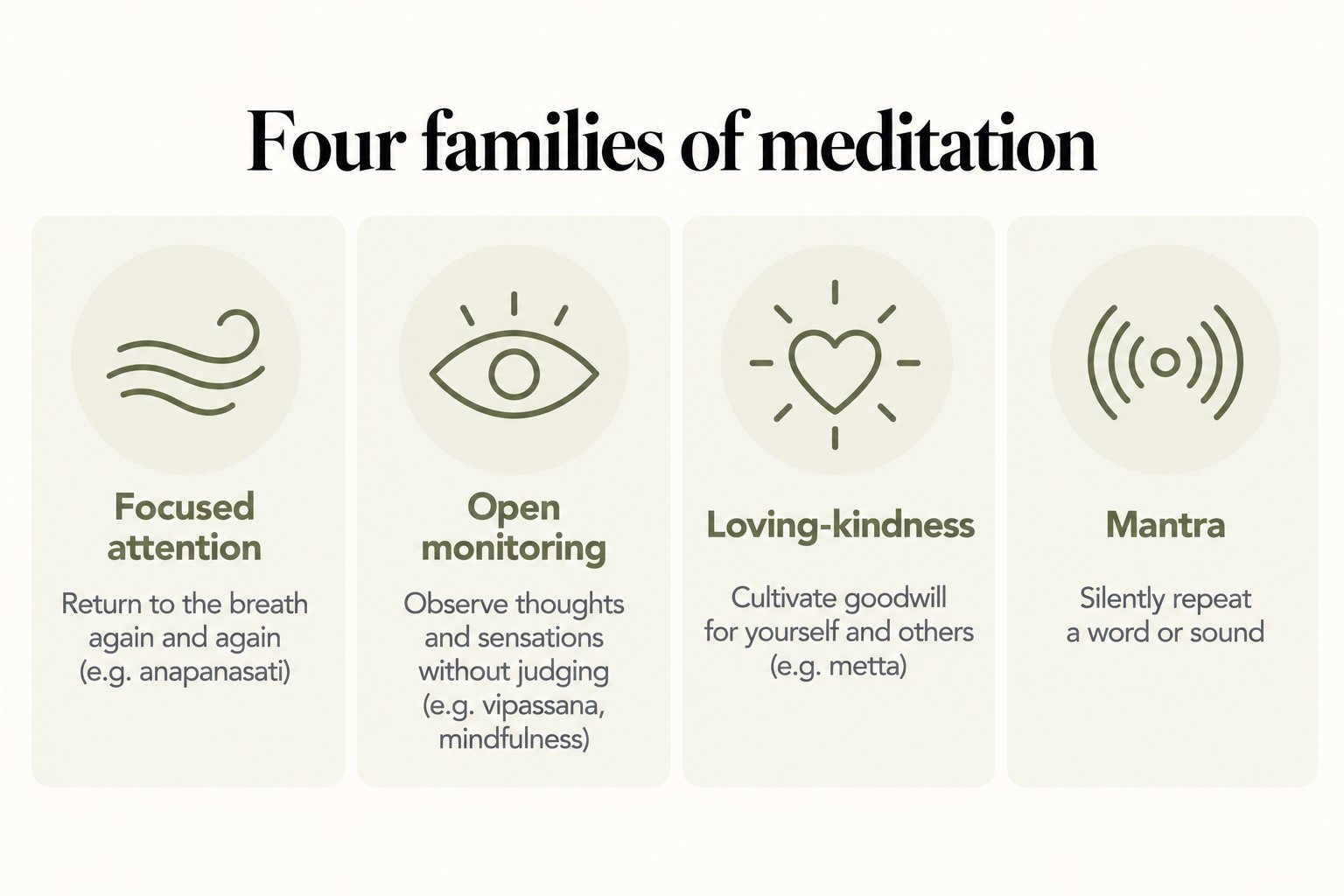
There are many forms of meditation, but researchers usually group them into a few families based on what you do with your attention.
Focused attention. You concentrate on a single object, most often the breath, and gently bring your attention back each time it wanders. Breath meditation (anapanasati), counting breaths and focusing on a candle flame or a sound are examples. This is usually where beginners start.
Open monitoring. Instead of focusing on one thing, you observe whatever arises in your experience, such as thoughts, sounds, sensations and emotions, without judging or holding on to it. Insight meditation (vipassana) and much of modern mindfulness practice belong here.
Loving-kindness and compassion. You deliberately cultivate warmth and goodwill, starting with yourself and gradually extending it to loved ones, strangers and even people you find difficult. The Buddhist metta practice is the best-known example.
Mantra meditation. You silently repeat a word, phrase or sound. Transcendental Meditation and many prayer and chanting traditions across faiths work in a similar way.
Many programmes combine several types. MBSR, for example, is an eight-week course that includes breath awareness, body scanning, gentle yoga and open awareness. Prayer, chanting and contemplative reading in religious traditions share some features with meditation (see Spirituality, Religion and Health).
What meditation does to the brain
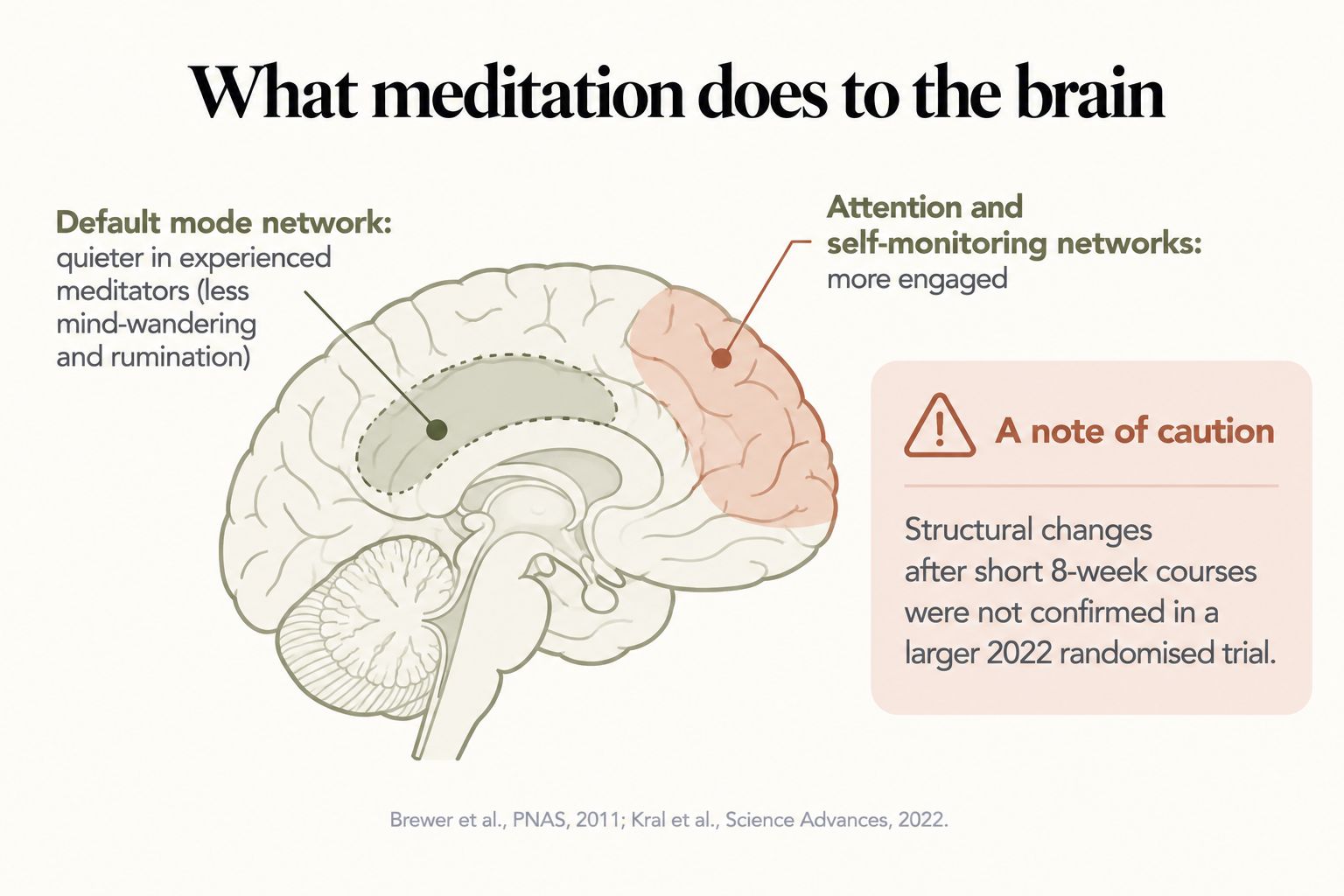
Quieting the wandering mind. When we're not focused on a task, the brain tends to drift into the default mode network, a set of regions active during daydreaming, worrying about the future, replaying the past and thinking about ourselves. Excessive activity in this network has been linked to rumination, anxiety and low mood.
In a 2011 study at Yale, Judson Brewer and colleagues used brain scans to compare experienced meditators with beginners across three different meditation techniques. The experienced meditators showed reduced activity in key parts of the default mode network during all three practices. They also showed stronger links between this network and brain regions involved in self-monitoring and attention, and the pattern was present even at rest, suggesting a shift towards a more present-focused default state. As Brewer noted, one of the hallmarks of many forms of mental illness "is a preoccupation with one's own thoughts."
Attention and emotional regulation. Meditation is, at its core, attention training. Each time the mind wanders and you bring it back, you exercise the brain networks that control attention. Many studies link meditation practice with better attention and with calmer responses to emotional challenges, although the size of these effects varies.
Does meditation change brain structure? A cautionary tale. In 2011, Britta Hölzel, Sara Lazar and colleagues at Massachusetts General Hospital scanned 16 people before and after an eight-week MBSR course, in which they practised for an average of about 27 minutes a day. They reported increased grey matter density in the hippocampus, a region involved in learning and memory, and found that reductions in stress were linked to decreased grey matter density in the amygdala, a region involved in fear and stress. The study was widely reported as proof that "meditation rebuilds the brain".
But a much larger study told a different story. In 2022, Tammi Kral, Richard Davidson and colleagues at the University of Wisconsin-Madison randomly assigned more than 200 healthy adults with no meditation experience to MBSR, a comparison programme of exercise, music and nutrition, or no training. After eight weeks, there were no significant differences in brain structure between the MBSR group and either control group. The authors suggested that structural changes, if they occur, may require "much longer duration of training", and that people who choose to enrol in meditation courses may differ from those randomly assigned. As Davidson put it: "We are still in the early stages of research on the effects of meditation training on the brain."
The lesson is that short courses of meditation can change how you feel and how your brain functions, but claims that they visibly reshape the brain should be treated with caution.
What meditation does to the body
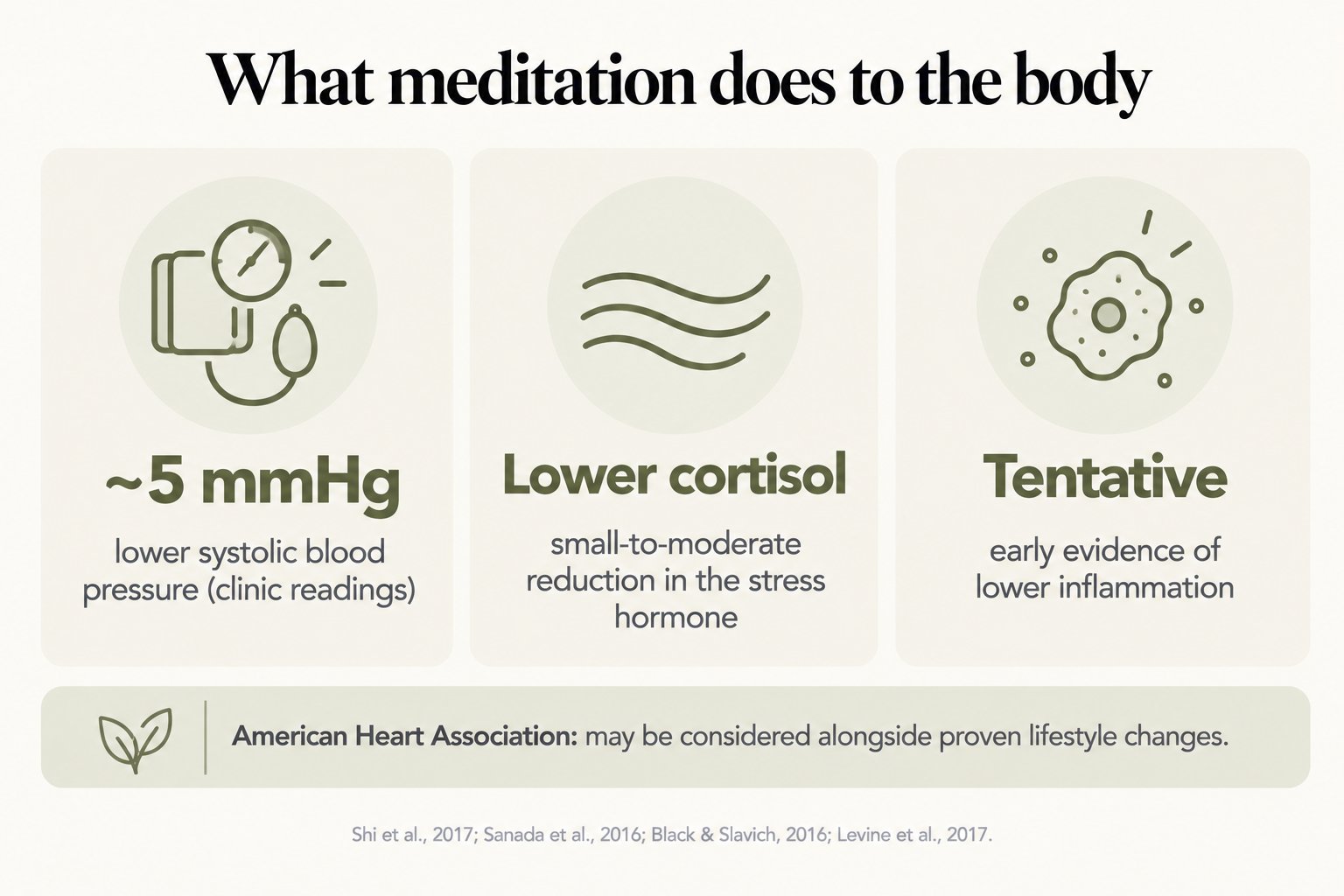
The stress response. Meditation appears to calm the body's stress system. In a meta-analysis of five randomised trials in 190 healthy adults, mindfulness training produced a small-to-moderate reduction in salivary cortisol, the main stress hormone. Slower breathing during many forms of meditation also shifts the nervous system towards its "rest and digest" mode, which can be measured as higher heart rate variability (see Heart Rate Variability). Over time, a calmer stress response may reduce the wear and tear of chronic stress (see Allostatic Load).
Blood pressure and the heart. A meta-analysis of randomised trials published in the Journal of Hypertension found that meditation lowered clinic blood pressure by about 5 mmHg systolic and 2.6-2.9 mmHg diastolic, with similar results for Transcendental Meditation and other forms. Effects measured by 24-hour monitoring were smaller and less consistent. That's a meaningful but modest effect, smaller than reducing salt or losing weight (see Lowering Blood Pressure Without Medication).
In 2017, the American Heart Association reviewed the evidence on meditation and heart disease. It found some evidence for lower blood pressure and help with quitting smoking, and modest evidence of benefit after heart disease, but no firm conclusions on outcomes such as heart attacks. It concluded that, because meditation is low cost and low risk, it "may be considered" alongside established lifestyle changes, but that "the benefits of meditation remain to be established."
Inflammation and immune function. A 2016 systematic review of randomised trials by David Black and George Slavich found possible effects of mindfulness meditation on specific markers of inflammation, immune cell function and biological ageing, but described the findings as tentative and in need of replication. Claims that meditation reliably lengthens telomeres or reverses biological ageing go beyond the current evidence (see Can You Reverse Your Biological Age?).
Meditation isn't always calming
Meditation is generally safe, but it's not risk-free. In a 2020 review of 83 studies with 6,703 participants, Miguel Farias and colleagues found that 8.3% of people experienced adverse effects during or after meditation. The most common were anxiety, low mood and unusual thoughts or perceptions, and they sometimes occurred in people with no history of mental health problems. Adverse effects were reported less often in controlled trials (3.7%) than in observational studies (33.2%).
People with a history of trauma, psychosis, severe depression or bipolar disorder should start meditation with guidance from a trained teacher or clinician. Intensive retreats with many hours of daily practice carry more risk than short daily sessions. If meditation brings up distressing feelings, it's fine to stop, shorten sessions, open your eyes or switch to a gentler practice such as walking meditation.
Why this matters for longevity
Chronic stress, rumination and poor emotional regulation affect sleep, blood pressure, habits and mental health, all of which shape how we age. Meditation offers a practical, inexpensive way to train attention and calm the stress response, with modest but real benefits for blood pressure and stress hormones, and a long history in Sri Lankan culture. The evidence doesn't support claims that it dramatically reshapes the brain or reverses ageing in weeks, but as part of a healthy lifestyle it's a worthwhile tool. Whether meditation improves mental health outcomes, and how it compares with other treatments, is examined in Meditation and Mindfulness: What the Evidence Really Shows.
Practical notes
You don't need special equipment or beliefs to start. A simple breath meditation is a good beginning: sit comfortably, close your eyes or lower your gaze, and follow the sensation of breathing. When your mind wanders, which it will, notice where it went and gently return to the breath. Start with 5-10 minutes a day; consistency matters more than length. Guided recordings, classes, temples and meditation centres can help you learn, and loving-kindness practice is a good complement if you tend towards self-criticism or resentment. Meditation works best alongside other healthy habits, not as a replacement for treatment of high blood pressure, depression or anxiety. A step-by-step beginner's guide is covered in How to Start Meditating. Our Longevity Doctors can help you include stress management in your overall plan, starting with the free longevity assessment.
- Lutz A, et al. Attention regulation and monitoring in meditation. Trends in Cognitive Sciences, 2008;12(4):163-169.
- Brewer JA, et al. Meditation experience is associated with differences in default mode network activity and connectivity. Proceedings of the National Academy of Sciences, 2011;108(50):20254-20259.
- Hölzel, B.K. et al. Mindfulness practice leads to increases in regional brain gray matter density. Psychiatry Research: Neuroimaging, 2011;191(1):36-43.
- Kral TRA, et al. Absence of structural brain changes from mindfulness-based stress reduction: two combined randomized controlled trials. Science Advances, 2022;8(20):eabk3316.
- Sanada K, et al. Effects of mindfulness-based interventions on salivary cortisol in healthy adults: a meta-analytical review. Frontiers in Physiology, 2016;7:471.
- Shi L, et al. Meditation and blood pressure: a meta-analysis of randomized clinical trials. Journal of Hypertension, 2017;35(4):696-706.
- Levine GN, et al. Meditation and cardiovascular risk reduction: a scientific statement from the American Heart Association. Journal of the American Heart Association, 2017;6(10):e002218.
- Black DS, Slavich GM. Mindfulness meditation and the immune system: a systematic review of randomized controlled trials. Annals of the New York Academy of Sciences, 2016;1373(1):13-24.
- Farias M, et al. Adverse events in meditation practices and meditation-based therapies: a systematic review. Acta Psychiatrica Scandinavica, 2020;142(5):374-393.
Free longevity assessment
Want help building
a daily practice?
Take the free Aevum Protocol assessment to see how your stress & mental wellbeing and 6 other longevity domains are performing — and get a personalised 90-day plan.
Take the free assessmentKeep reading
Related articles
Stress & Mental Wellbeing
Spirituality, Religion and Health: What Research Shows Across Faiths and None
Stress & Mental Wellbeing
Heart Rate Variability: A Window Into Stress and Recovery, and How to Use It
Stress & Mental Wellbeing