Stress & Mental Wellbeing
Spirituality, Religion and Health:
What Research Shows Across Faiths and None
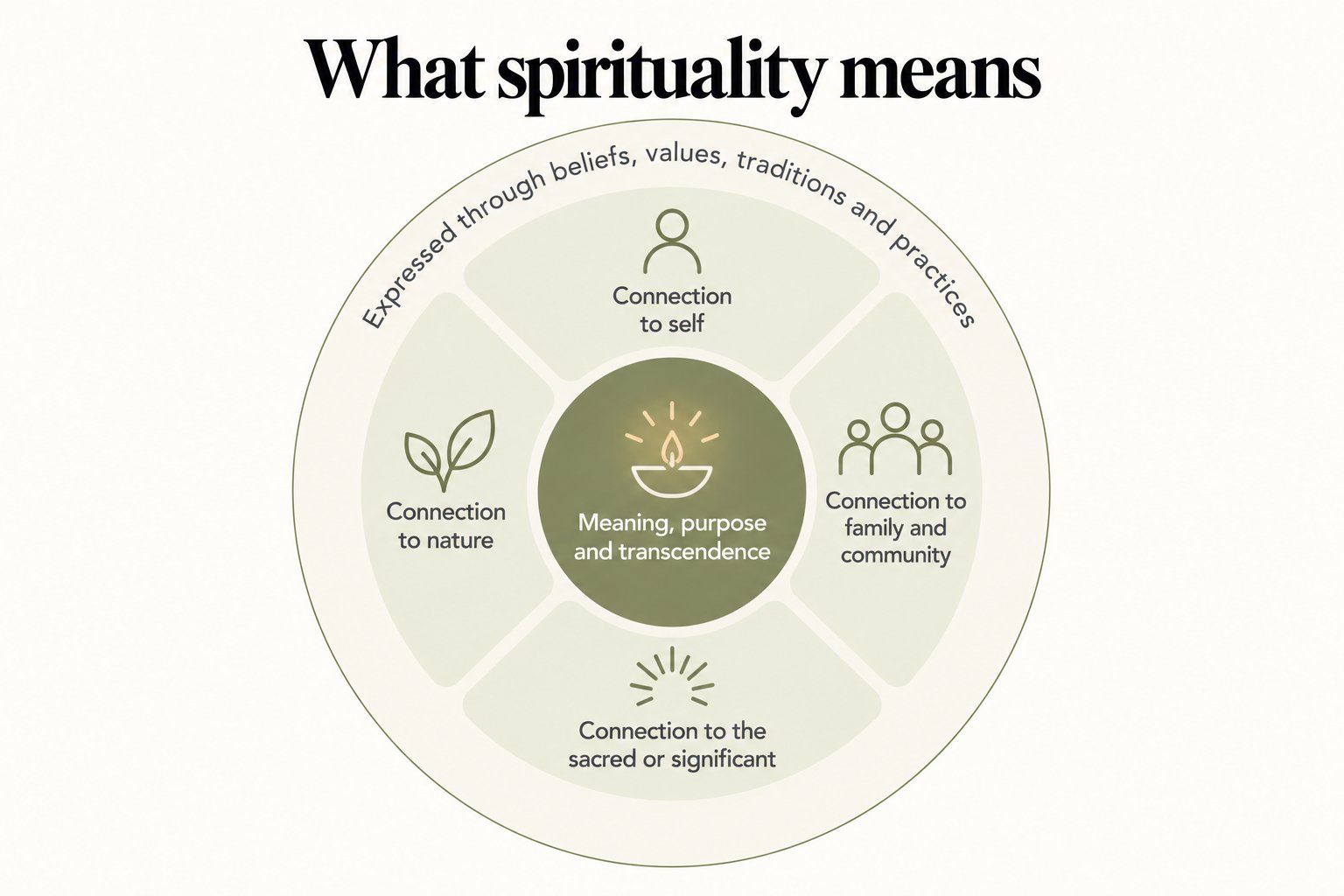
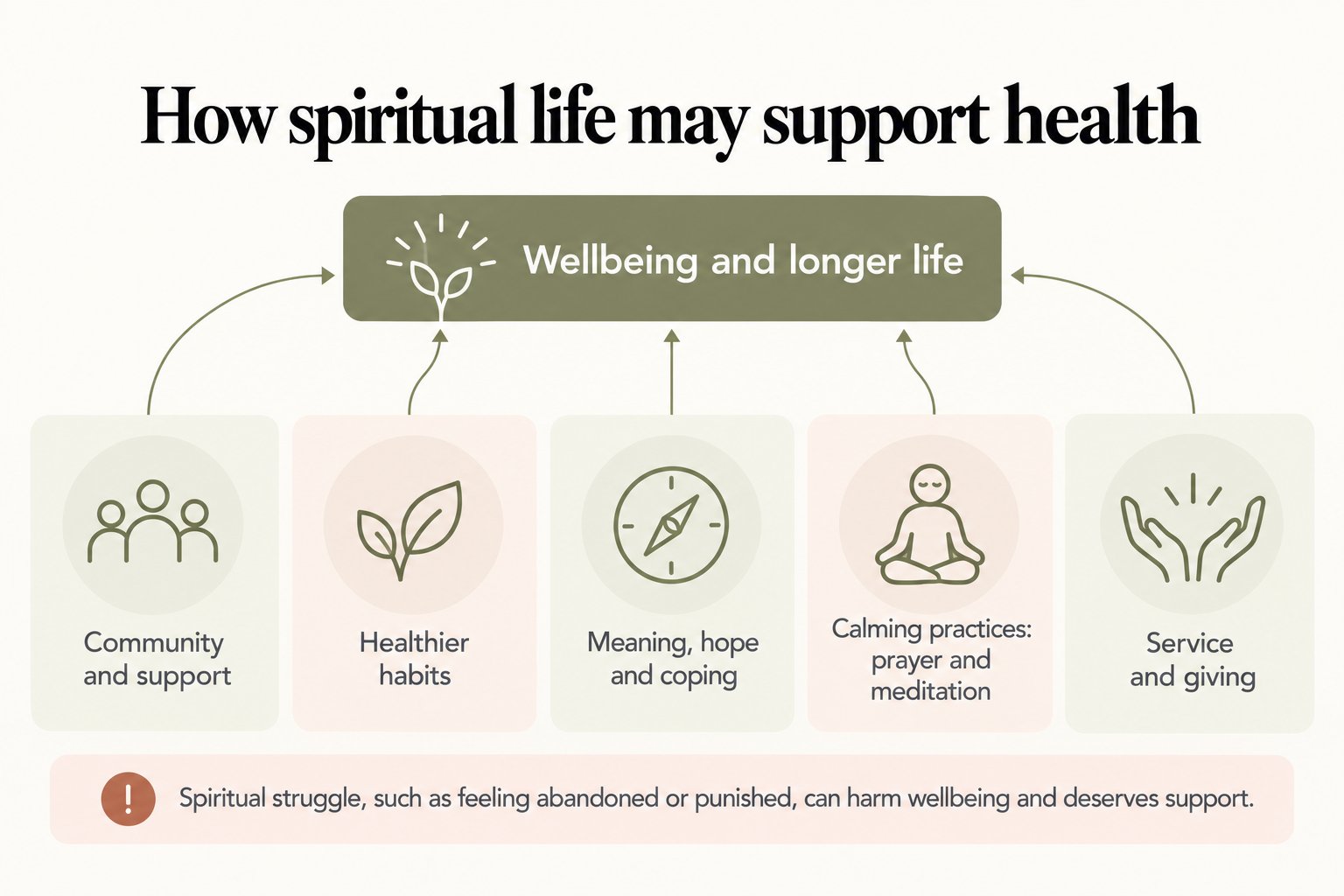
For most people in the world, and the great majority of Sri Lankans, spiritual or religious life is a central source of meaning, community and comfort. Spirituality is broader than religion: an international consensus defines it as the way people "seek ultimate meaning, purpose, and transcendence" and experience connection to themselves, others, nature and "the significant or sacred". Religion is one of the most common ways it's expressed, but people without a religious faith also have spiritual lives. Research links spiritual and religious involvement to better health. A review of 69 studies of initially healthy people found that religiosity and spirituality were associated with 18% lower mortality, even after accounting for smoking, drinking, exercise, socioeconomic status and social support. In 74,534 US nurses followed for 16 years, women who attended religious services more than once a week had 33% lower mortality than those who never attended. Weekly attendance was also linked to 68% fewer "deaths of despair" from suicide, drugs and alcohol in women, and 33% fewer in men. The likely reasons include community and social support, healthier habits, a sense of meaning, hope, and calming practices such as prayer and meditation. But faith can also be a source of distress: in older hospital patients, feeling abandoned or punished by God was linked to 19-28% higher mortality. Most research comes from Western, mainly Christian populations, and it can't prove cause and effect. This article explains what's known, for people of every faith and none, and how spiritual wellbeing can be part of a healthy, long life.
Key numbers
| Finding | Detail |
|---|---|
| Review of 69 studies in healthy populations | Religiosity and spirituality linked to 18% lower mortality |
| US women nurses (74,534, 16 years) | Attending services more than once a week: 33% lower mortality |
| Deaths of despair (suicide, drugs, alcohol) | Weekly attendance: 68% lower in women, 33% lower in men |
| Religious struggle in older hospital patients (595) | Feeling abandoned or punished by God: 19-28% higher mortality |
| Sri Lanka (2012 census) | Buddhist 70.2%, Hindu 12.6%, Muslim 9.7%, Christian 7.4% |
Spirituality and religion: what's the difference?
Spirituality is the broader idea. A 2013 international consensus of health professionals defined it as "a dynamic and intrinsic aspect of humanity through which persons seek ultimate meaning, purpose, and transcendence, and experience relationship to self, family, others, community, society, nature, and the significant or sacred." It's "expressed through beliefs, values, traditions, and practices."
Religion is an organised way of expressing spirituality, with shared beliefs, teachings, rituals and community. In Sri Lanka, this includes the Buddhist, Hindu, Islamic and Christian traditions that shape daily life for most families: visiting temples, kovils, mosques and churches, observing Poya days, festivals and fasts, prayer and meditation, and acts of giving and service.
Some people are deeply religious, some describe themselves as spiritual but not religious, and others find meaning through philosophy, nature, art, service or relationships. This article is intended for all of them.
What the research shows
Religious and spiritual involvement and longer life. In 2009, Yoichi Chida, Andrew Steptoe and Lynda Powell combined 69 studies of initially healthy people and 22 studies of people with existing illness. In healthy populations, religiosity and spirituality were associated with 18% lower mortality. Organised religious activity, such as attending services, was particularly linked to survival, and the link remained after controlling for smoking, drinking, exercise, socioeconomic status, negative emotions and social support. In people who were already ill, there was no clear effect. The authors noted that publication bias means the results should be interpreted with caution.
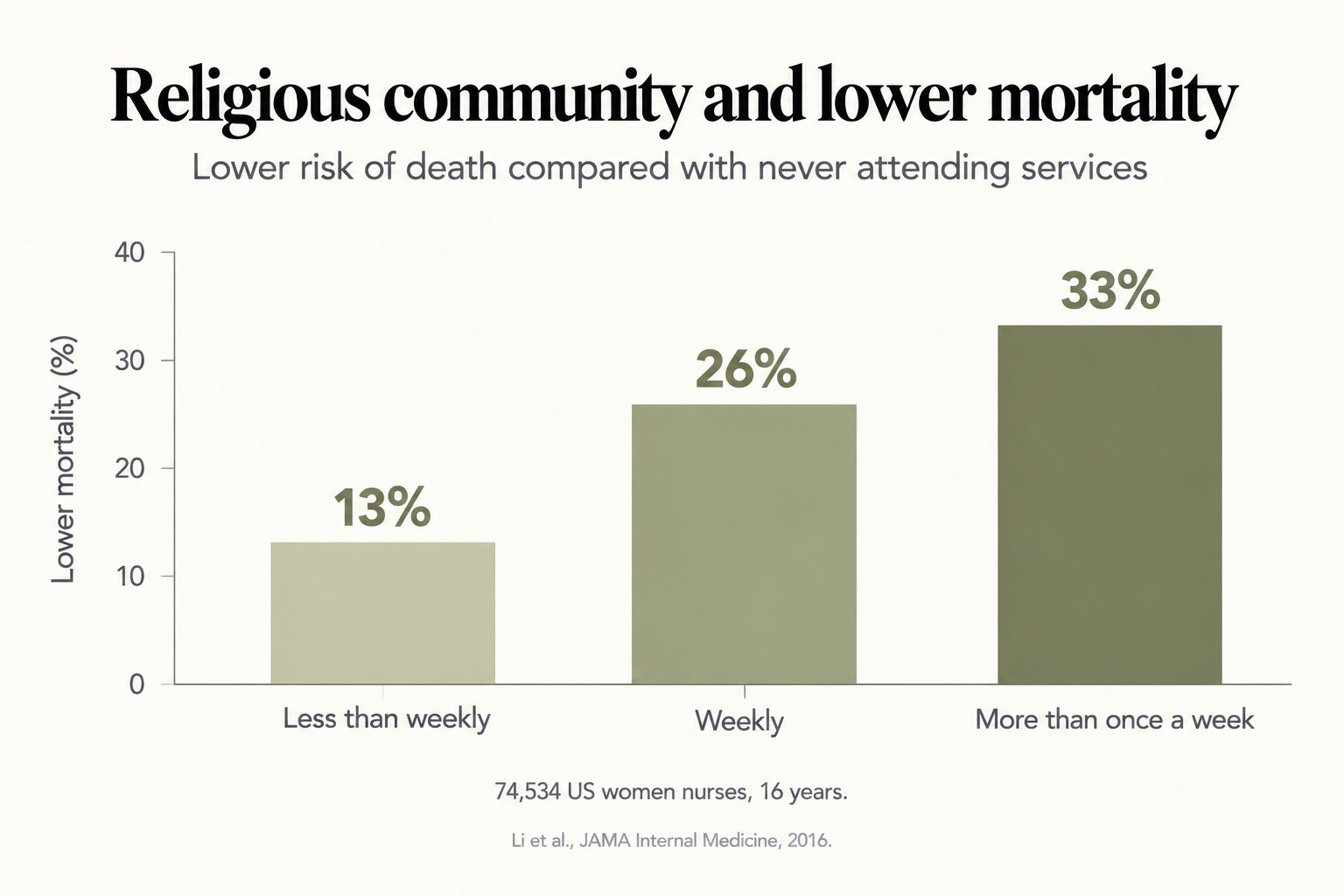
Attending services: the Nurses' Health Study. In a 2016 study in JAMA Internal Medicine, Shanshan Li, Tyler VanderWeele and colleagues followed 74,534 US women nurses from 1992 to 2012. Compared with women who never attended religious services:
- Attending more than once a week was linked to 33% lower mortality.
- Attending weekly was linked to 26% lower mortality.
- Attending less than weekly was linked to 13% lower mortality.
Women who attended at least weekly also had 27% lower cardiovascular mortality and 21% lower cancer mortality. VanderWeele suggested that "attending religious services increases social support, discourages smoking, decreases depression," and that "there may be something important about religious service attendance beyond solitary spirituality." The participants were mostly white Christian nurses, so the results may not apply equally to other populations.
Deaths of despair. In a follow-up study of 66,492 women nurses and 43,141 men health professionals followed for about 16 years, attending religious services at least weekly was associated with a 68% lower risk of "deaths of despair" (suicide, drug overdose and alcohol-related deaths) in women and 33% lower in men. Community, hope and a sense of meaning may protect against despair (see Burnout).
When faith becomes a struggle. Spirituality isn't always comforting. In a 2001 study led by Kenneth Pargament, 595 hospital patients aged 55 and over were followed for about two years. Those who felt abandoned or punished by God, or felt abandoned by their faith community, had 19-28% higher mortality; factors such as their diagnosis, depressed mood and quality of life didn't explain the link. Pargament noted that religion "can, at times, be a source of problems in itself", and that people who "stay stuck" in such struggles may be more vulnerable. Spiritual distress deserves the same care as emotional distress, including support from religious leaders, counsellors or doctors.
How spirituality and religion may support health
Community and support. Religious communities offer belonging, friendship, practical help in hard times and regular contact with others, all of which protect against loneliness and its health effects (see Social Connection and Cognitive Decline).
Healthier habits. Many traditions discourage smoking, alcohol and excess, and encourage moderation, fasting, restraint and care for the body.
Meaning, hope and coping. Faith and spiritual beliefs can provide a framework for understanding suffering, loss and illness, and a sense of hope and purpose (see Purpose in Life and Longevity).
Calming practices. Prayer, chanting, meditation, ritual and reflection can calm the stress response and may reduce anxiety. Meditation is covered in detail in How Meditation Affects the Brain and Body.
Service and giving. Many traditions emphasise generosity, compassion and helping others, which bring their own benefits for wellbeing.
Important limitations
- Observational evidence: people can't be randomly assigned to a faith, so these studies show associations, not proof of cause and effect.
- Healthy-attender effect: people who are already healthy are better able to attend services, which can exaggerate the apparent benefit, although several studies tried to account for this.
- Western, mainly Christian populations: most large studies are from the US and Europe. Fewer studies have examined Buddhist, Hindu or Muslim populations, or countries like Sri Lanka where religion is part of everyday life for nearly everyone.
- Not a reason to adopt a faith for health: beliefs are personal, and the benefits seem to come from genuine meaning, community and practice, not from attendance alone.
- Not a replacement for medical care: faith and medicine work best together. Delaying treatment in favour of prayer or ritual alone can be harmful.
Why this matters for longevity
Spiritual and religious life is one of the most widespread sources of meaning, community and resilience, and it's consistently linked to longer life, fewer deaths of despair and better coping with illness. For people of faith, it may be one of the most powerful wellbeing resources they already have. For people without a religious faith, the same underlying ingredients, community, meaning, regular reflection and service to others, are available through other routes. Either way, spiritual wellbeing deserves a place in a complete picture of healthy ageing.
Practical notes
If faith is part of your life, the research suggests that regular participation in a community, not just private belief, is most strongly linked to health. Stay connected to your temple, kovil, mosque, church or community group, and to the people you meet there. If you're not religious, look for the same ingredients elsewhere: a regular community, time for reflection or meditation, time in nature, and ways to serve others. If you're struggling with your faith, feeling abandoned, guilty or punished, talk to someone you trust, such as a religious leader, counsellor or doctor. Tell your doctor about any religious practices that affect your health care, such as fasting during Ramadan, Lent or religious observances, dietary rules or beliefs about treatment, so your care can respect them safely. Our Longevity Doctors respect every patient's beliefs and include spiritual wellbeing in a whole-person assessment, starting with the free longevity assessment.
- Puchalski CM, et al. Improving the spiritual dimension of whole person care: reaching national and international consensus. Journal of Palliative Medicine, 2014;17(6):642-656.
- Chida Y, Steptoe A, Powell LH. Religiosity/spirituality and mortality: a systematic quantitative review. Psychotherapy and Psychosomatics, 2009;78(2):81-90.
- Li S, et al. Association of religious service attendance with mortality among women. JAMA Internal Medicine, 2016;176(6):777-785.
- Chen Y, et al. Religious service attendance and deaths related to drugs, alcohol, and suicide among US health care professionals. JAMA Psychiatry, 2020;77(7):737-744.
- Pargament KI, et al. Religious struggle as a predictor of mortality among medically ill elderly patients: a 2-year longitudinal study. Archives of Internal Medicine, 2001;161(15):1881-1885.
- Department of Census and Statistics, Sri Lanka. Census of Population and Housing 2012.
Free longevity assessment
Want a whole-person view
of your wellbeing?
Take the free Aevum Protocol assessment to see how your stress & mental wellbeing and 6 other longevity domains are performing — and get a personalised 90-day plan.
Take the free assessmentKeep reading