Stress & Hormones
Burnout:
What It Is, How It Differs From Depression, and What Helps
Burnout is more than being tired or stressed. The World Health Organization describes it as a syndrome resulting from chronic workplace stress that hasn't been successfully managed, with three features: exhaustion, growing mental distance or cynicism about one's job, and reduced effectiveness at work. It isn't classified as a medical condition, but it has real health consequences: long-term studies have linked it to type 2 diabetes, heart disease, insomnia, depression and even earlier death in people under 45. Burnout overlaps with depression, but research suggests they're distinct, which matters because the approach to each is different. The good news is that burnout can be reduced: in a review of 52 studies of doctors, both individual approaches (such as mindfulness and stress management) and changes to how work is organised cut burnout rates from 54% to 44%. This article explains how to recognise burnout, what drives it, and what helps.
Key numbers
| Finding | Detail |
|---|---|
| WHO definition (ICD-11) | Syndrome from chronic workplace stress not successfully managed; an occupational phenomenon, not a medical condition |
| Health consequences (review of 36 high-quality prospective studies) | Linked to type 2 diabetes, heart disease, high cholesterol, insomnia, depressive symptoms, and death before 45, among others |
| Overlap with depression (meta-analysis, 69 studies) | Moderate correlation (r = 0.52); related but distinct |
| Overlap with anxiety (36 studies) | Moderate correlation (r = 0.46) |
| Interventions for doctors' burnout (15 trials and 37 cohort studies, 3,630 doctors) | Overall burnout fell from 54% to 44%; high emotional exhaustion from 38% to 24% |
What burnout is
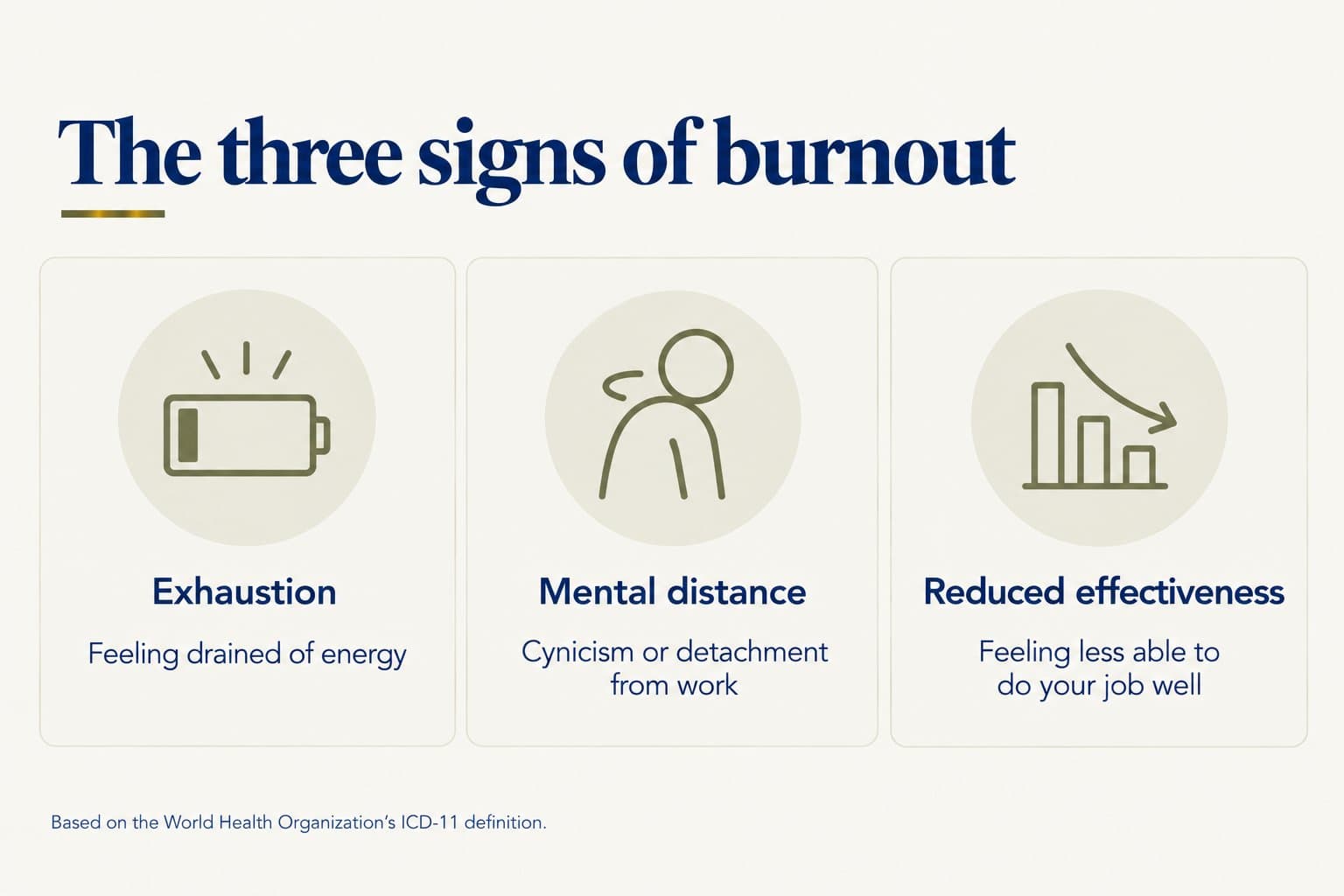
The World Health Organization's International Classification of Diseases (ICD-11) defines burnout as "a syndrome conceptualized as resulting from chronic workplace stress that has not been successfully managed." It has three dimensions:
- →Exhaustion: feelings of energy depletion.
- →Mental distance: increased detachment from one's job, or negativity and cynicism about it.
- →Reduced professional efficacy: feeling less effective or accomplished at work.
The WHO classifies burnout as an occupational phenomenon, a factor influencing health, not a medical condition. It also states that the term refers specifically to work and shouldn't be used for other areas of life. In practice, many people use "burnout" more broadly, for example for exhaustion from caregiving, but the research is mostly about work.
Burnout vs. depression
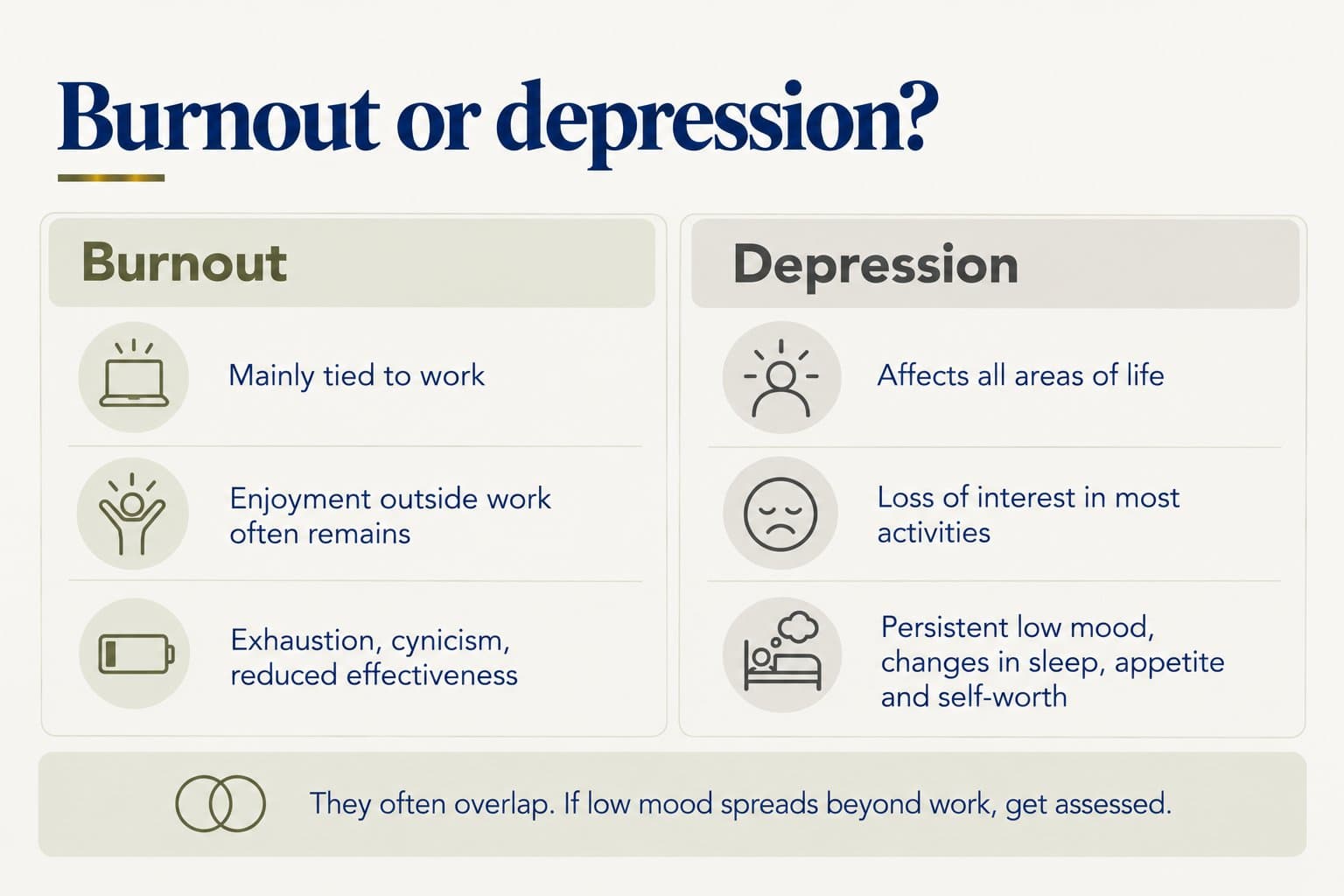
Burnout and depression share features, including exhaustion, low mood and poor concentration, and they often occur together. A 2019 meta-analysis found a moderate correlation between burnout and depression (r = 0.52, from 69 studies) and between burnout and anxiety (r = 0.46, from 36 studies). The authors concluded that the overlap wasn't large enough to treat them as the same condition: they're related but distinct.
| Burnout | Depression | |
|---|---|---|
| Scope | Mainly tied to work | Affects all areas of life |
| Pleasure outside work | Often still present | Often lost across all activities |
| Main features | Exhaustion, cynicism about work, reduced effectiveness | Persistent low mood or loss of interest, plus other symptoms such as changes in sleep, appetite and self-worth |
| Classification | Occupational phenomenon, not a medical diagnosis | Medical condition |
The distinction matters because depression is a treatable medical condition that needs proper assessment, while burnout is addressed mainly by changing the work situation and recovering. But untreated burnout can lead to depression, and someone who feels burnt out may in fact be depressed. If low mood spreads beyond work, persists, or involves thoughts of self-harm, it needs a professional assessment (see Depression and Cognitive Decline).
Risk factor table: what burnout is linked to
| Outcome | Association | Preventable / modifiable? | Evidence strength |
|---|---|---|---|
| Type 2 diabetes, high cholesterol, coronary heart disease | Predicted by burnout in prospective studies | Yes, by addressing burnout and its drivers | Moderate (systematic review of prospective studies) |
| Insomnia and depressive symptoms | Predicted by burnout | Yes | Moderate |
| Musculoskeletal pain, headaches, gut and breathing problems | Predicted by burnout | Yes | Moderate, with some conflicting findings |
| Death before age 45 | Predicted by burnout | Yes | Limited |
| Absenteeism, "presenteeism", job dissatisfaction, disability pensions | Predicted by burnout | Yes | Moderate |
What the research shows
Burnout affects physical as well as mental health. A 2017 systematic review looked only at prospective studies, which follow people over time and so give stronger evidence than one-off surveys. Of 61 studies, 36 were rated high quality. Burnout predicted a wide range of physical problems, including high cholesterol, type 2 diabetes, coronary heart disease, hospitalisation for cardiovascular disease, musculoskeletal pain, prolonged fatigue, headaches, gut and breathing problems, severe injuries, and death before the age of 45. It also predicted insomnia, depressive symptoms, use of antidepressants and hospitalisation for mental health problems, as well as absenteeism and disability pensions. Some findings were inconsistent between studies.
These links fit with what's known about chronic stress more broadly: raised stress hormones, disturbed sleep, inflammation and unhealthy coping behaviours all affect the body (see Allostatic Load and Chronic Stress and Heart Disease).
What drives burnout. Burnout research points to mismatches between people and their work, commonly grouped into six areas:
- →Workload: too much work, too little time or recovery.
- →Control: little say over how work is done.
- →Reward: effort not recognised or rewarded.
- →Community: poor relationships or support at work.
- →Fairness: perceived unfairness or lack of respect.
- →Values: conflict between personal values and what the job requires.
This matters because burnout is often a problem of the work environment, not just the individual. Resilience training alone can't fix an impossible workload.
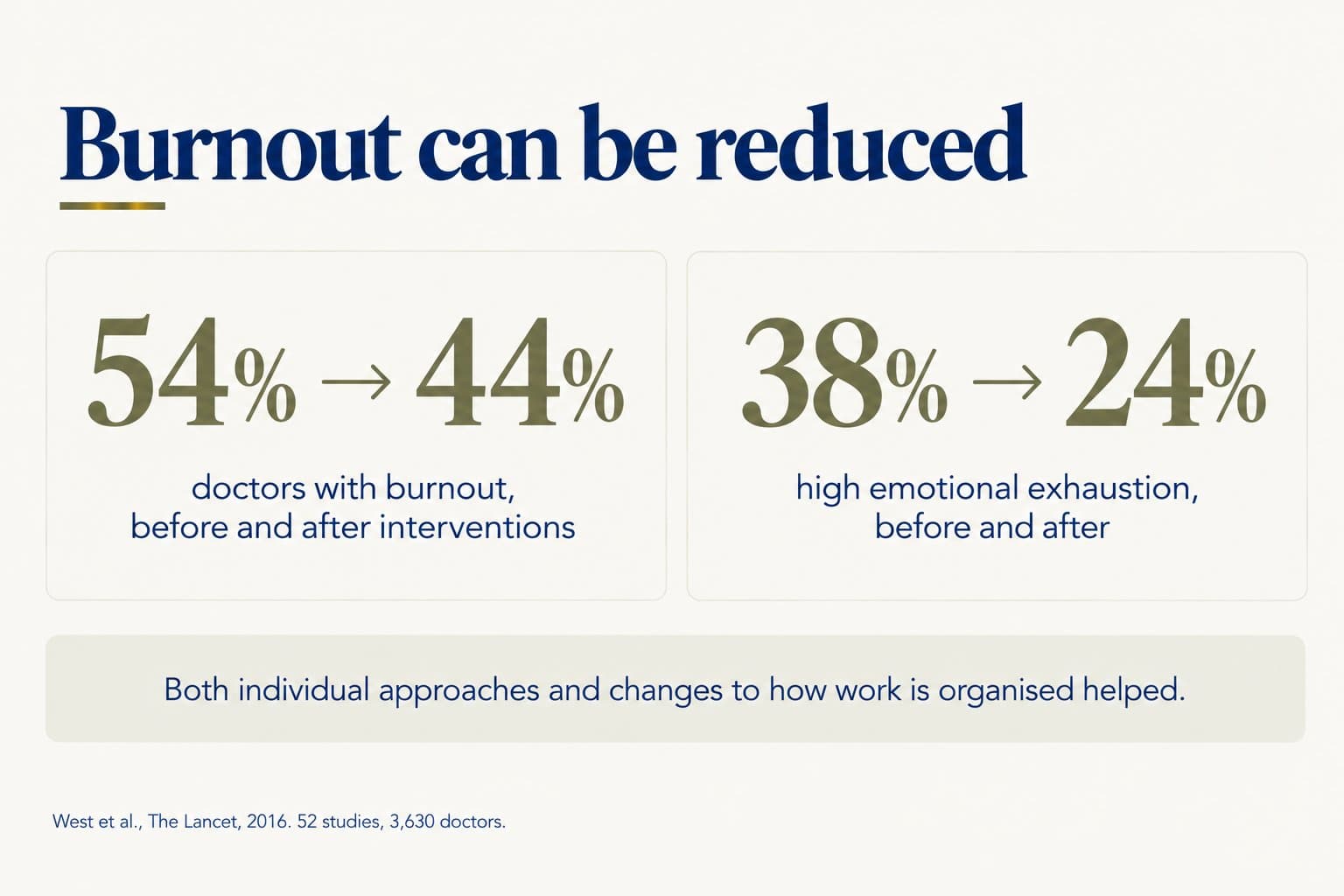
Both individual and organisational changes help. A 2016 systematic review and meta-analysis in The Lancet looked at interventions to reduce burnout among doctors, a group with high rates. It included 15 randomised trials and 37 cohort studies with 3,630 doctors. Overall burnout fell from 54% to 44%, and high emotional exhaustion from 38% to 24%. Effective approaches included individual strategies, such as mindfulness, stress management and small-group discussions, and structural changes, such as limits on working hours. The authors concluded that both individual and organisational approaches can reduce burnout.
What you can actually change
1. Recognise the signs early. Persistent exhaustion, growing cynicism about work, and feeling less effective are the core warning signs. Other clues include dreading work, irritability, poor sleep and needing more time to recover from ordinary workdays.
2. Address the workload and control you can. Talk to managers about priorities, workload and flexibility. Set boundaries around working hours and availability where possible. Even small increases in control over how you work can help.
3. Protect recovery time. Recovery is the opposite of burnout. Regular breaks, time off, sleep, exercise and time away from screens and work messages help the stress system switch off (see How the Stress Response Works).
4. Use evidence-based stress management. Mindfulness, stress management training and peer support groups reduced burnout in trials. Practical techniques are covered in Stress-Reduction Techniques That Work.
5. Reconnect with meaning and people. Supportive relationships at work and outside it, and reconnecting with the parts of work that feel meaningful, can buffer burnout.
6. Get help if it's more than burnout. If low mood spreads beyond work, persists for weeks, or includes thoughts of self-harm, seek professional help. Depression and anxiety are treatable.
Recommendations
- →Take burnout seriously. It's linked to real physical and mental health problems.
- →Look at the work, not just yourself. Workload, control, fairness and support are often the main drivers.
- →Build recovery into daily and weekly routines, not just holidays.
- →Try evidence-based approaches such as mindfulness and stress management, ideally alongside workplace changes.
- →Know the difference from depression, and seek professional help if symptoms go beyond work or don't improve.
- →For employers and leaders: reasonable workloads, fair treatment, recognition and staff control over their work are key to preventing burnout.
Practical notes
Burnout is the result of chronic work stress that hasn't been managed, marked by exhaustion, cynicism and reduced effectiveness. It isn't a medical diagnosis, but it predicts diabetes, heart disease, insomnia and depression, and it overlaps with but is distinct from depression. Its roots usually lie in the work environment as much as the individual, so the most effective solutions combine personal strategies, such as recovery, boundaries and stress management, with changes to workload, control and support at work.
- World Health Organization. Burn-out an "occupational phenomenon": International Classification of Diseases. 2019. who.int.
- Salvagioni DAJ, et al. Physical, psychological and occupational consequences of job burnout: A systematic review of prospective studies. PLOS ONE, 2017;12(10):e0185781.
- Koutsimani P, Montgomery A, Georganta K. The relationship between burnout, depression, and anxiety: a systematic review and meta-analysis. Frontiers in Psychology, 2019;10:284.
- West CP, et al. Interventions to prevent and reduce physician burnout: a systematic review and meta-analysis. The Lancet, 2016;388:2272-2281.
- Maslach C, Leiter MP. Understanding the burnout experience: recent research and its implications for psychiatry. World Psychiatry, 2016.
Does work leave you drained,
detached or less effective?
Take the free Aevum Protocol assessment to see how your stress & hormones and 6 other longevity domains are performing — and get a personalised 90-day plan.
Take the Free Assessment →