Stress & Hormones
Chronic Stress and Heart Disease:
How the Mind Affects the Heart
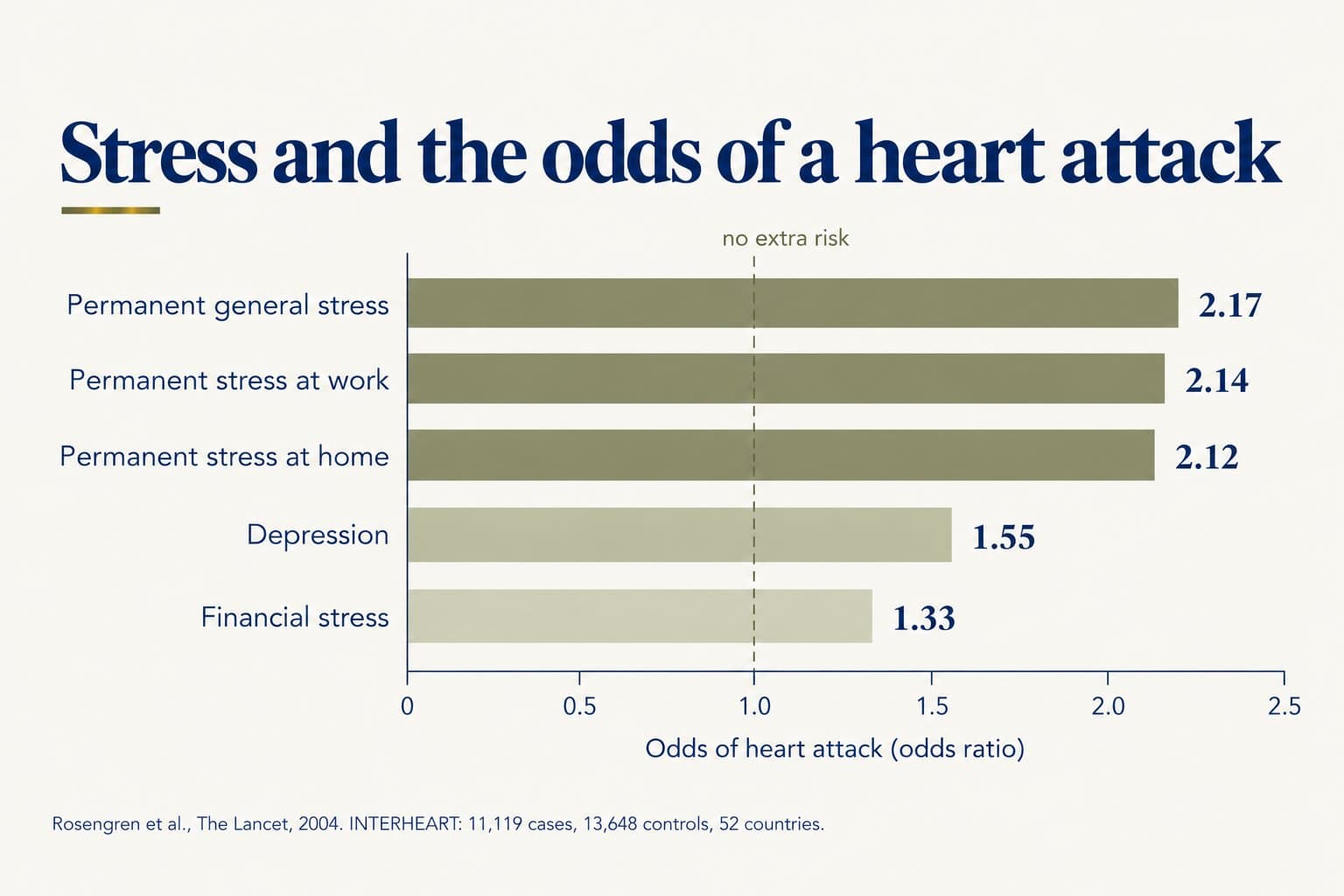
People have long suspected that stress is bad for the heart, and the research backs this up. In INTERHEART, a study of more than 11,000 heart attack patients across 52 countries, people who reported constant stress at work or at home had about twice the odds of a heart attack, and psychosocial factors together accounted for about a third of heart attack risk. Brain-imaging research has traced a possible pathway: activity in the brain's fear centre is linked to inflammation in the arteries and later heart attacks and strokes. But stress needs to be kept in perspective. In a large analysis of European workers, job strain raised heart disease risk by 23%, a real but modest effect compared with smoking or abdominal fat. And psychological treatments for people with heart disease reduced cardiac deaths in trials, though the evidence is of limited quality. This article explains how stress affects the heart, how big the effect is, and what you can do.
Key numbers
| Finding | Detail |
|---|---|
| Permanent general stress (INTERHEART, 11,119 heart attack patients and 13,648 controls, 52 countries) | About twice the odds of a heart attack (OR 2.17) |
| All psychosocial factors combined (INTERHEART) | About 33% of heart attack risk in the population |
| Job strain (13 European cohorts, 197,473 workers) | 23% higher risk of coronary heart disease (HR 1.23) |
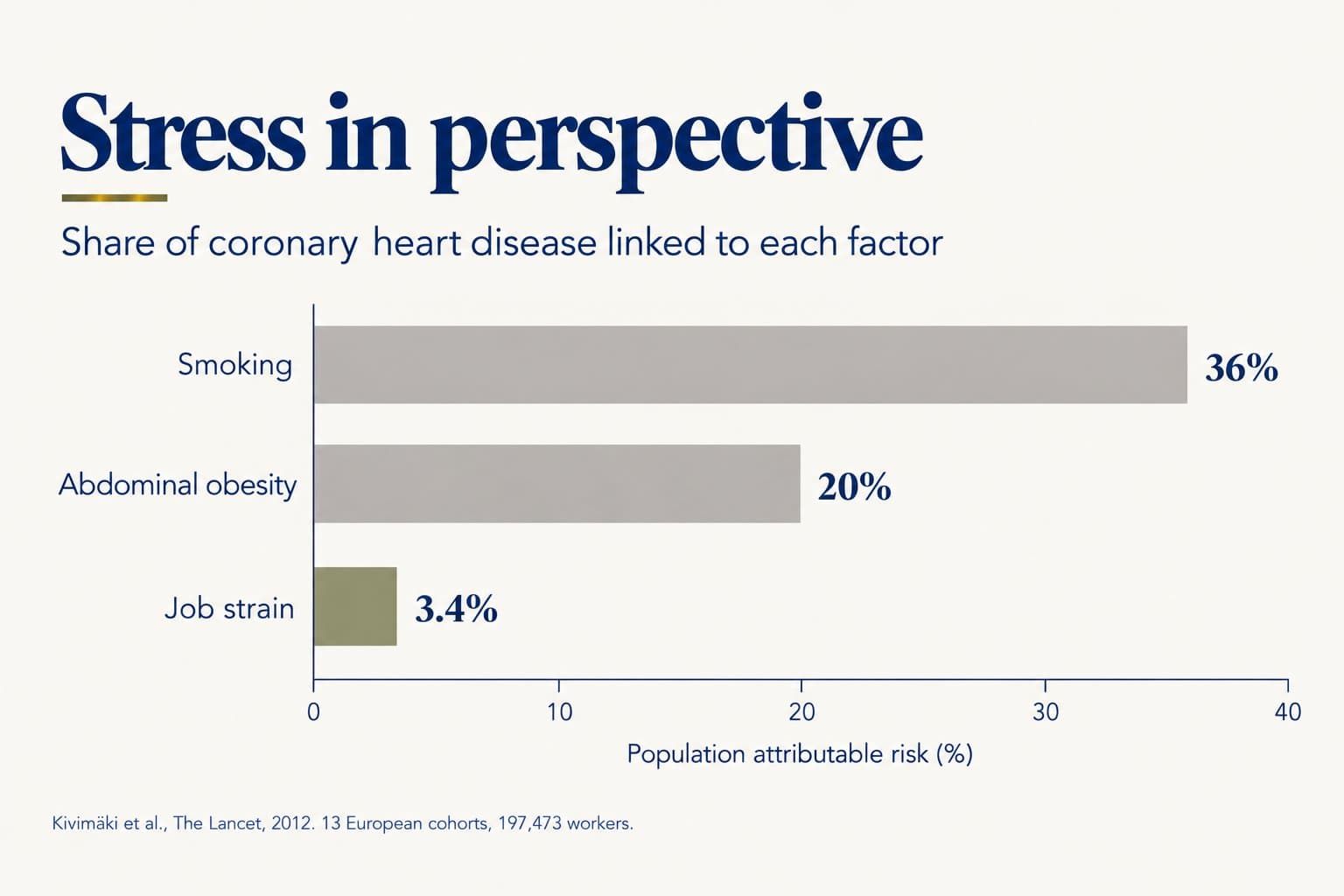
| Share of heart disease attributable to job strain vs. other factors | Job strain 3.4%; by comparison, smoking 36% and abdominal obesity 20% (earlier estimates cited by the same researchers) |
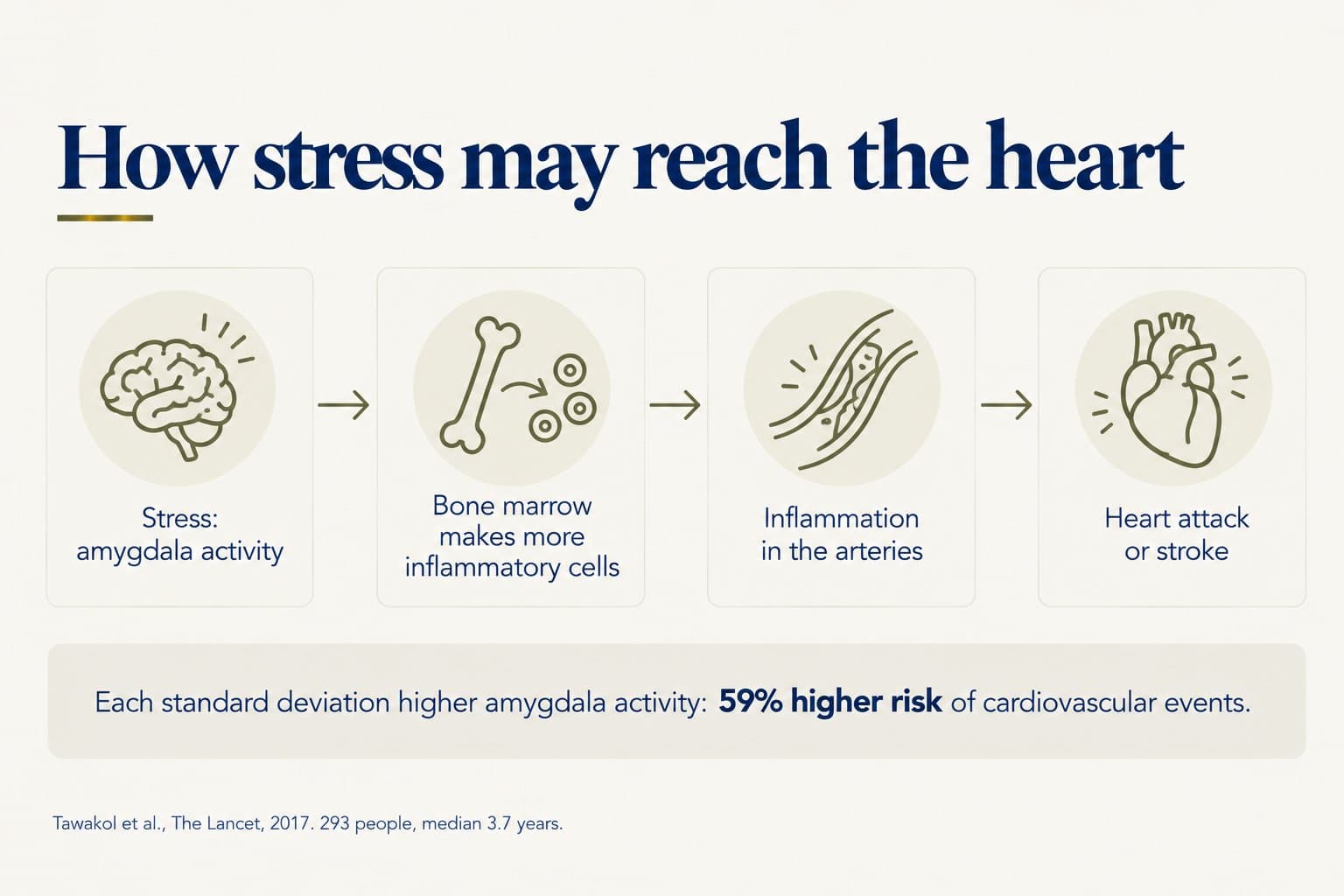
| Activity in the brain's fear centre (amygdala) and later cardiovascular events (293 people, median 3.7 years) | 59% higher risk per standard deviation higher activity (HR 1.59) |
| Psychological treatments in people with heart disease (35 trials, 10,703 people) | 21% fewer cardiac deaths (RR 0.79); no clear effect on overall deaths; low-quality evidence |
Risk factor table: psychosocial stress and heart attack
| Factor | Association (INTERHEART odds of heart attack, unless stated) | Modifiable? | Evidence strength |
|---|---|---|---|
| Permanent stress at work | OR 2.14 | Partly | Moderate (large case-control study) |
| Permanent stress at home | OR 2.12 | Partly | Moderate (large case-control study) |
| Depression | OR 1.55 | Yes: treatable | Moderate |
| Major stressful life events in the past year | OR 1.48 | Rarely, but support helps | Moderate |
| Financial stress | OR 1.33 | Partly | Moderate |
| Job strain (high demands, low control) | HR 1.23 for coronary heart disease | Partly | Strong (large pooled cohort analysis) |
How stress affects the heart
Stress can affect the heart through several pathways, directly and indirectly.
Direct effects
- →Blood pressure and heart rate: the stress response raises both, and repeated surges strain blood vessels (see How the Stress Response Works).
- →Inflammation: chronic stress is linked to higher levels of inflammation, which drives the build-up and instability of plaque in the arteries.
- →Blood clotting: stress hormones make blood more likely to clot.
- →Heart rhythm: intense stress can trigger rhythm disturbances in vulnerable people.
- →Acute stress and the heart muscle: in rare cases, sudden severe emotional stress can cause a temporary weakening of the heart muscle, known as stress cardiomyopathy or "broken heart syndrome".
A brain-to-heart pathway. A 2017 study used brain and body scans to follow 293 people for a median of 3.7 years. People with higher resting activity in the amygdala, the brain region involved in fear and stress, were more likely to have a heart attack, stroke or other cardiovascular event: a 59% higher risk for each standard deviation of higher activity. The researchers traced a chain linking amygdala activity to increased activity in the bone marrow, which produces inflammatory cells, and to inflammation in the arteries, which in turn was linked to later cardiovascular events. In a smaller group of 13 people, higher perceived stress went with higher amygdala activity and arterial inflammation.
This is one of the clearest pictures yet of how stress in the brain might translate into disease in the arteries, though it was a relatively small study with 22 cardiovascular events.
Indirect effects. Stress also affects the heart through behaviour. People under chronic stress are more likely to smoke, drink more, eat less healthily, sleep poorly, skip exercise and miss medicines. Stress also contributes to abdominal fat and insulin resistance (see Insulin Resistance and Allostatic Load).
What the research shows
Stress is a global heart risk factor. INTERHEART compared 11,119 people who'd had a first heart attack with 13,648 people who hadn't, from 262 centres in Asia, Europe, the Middle East, Africa, Australia and the Americas. People who reported permanent stress, whether at work, at home or in general, had about twice the odds of a heart attack. Financial stress, major life events and depression also raised risk, while a stronger sense of control over one's life was protective. Together, psychosocial factors accounted for an estimated 33% of heart attack risk in the population.
INTERHEART was a case-control study, meaning people reported their stress after their heart attack. That can exaggerate associations, so the true effect may be somewhat smaller.
Work stress: real but modest. A 2012 analysis pooled individual data from 13 European cohort studies with 197,473 workers followed for an average of 7.5 years. About 15% reported job strain, meaning high demands combined with little control. Job strain was linked to a 23% higher risk of coronary heart disease. The researchers estimated that job strain accounted for 3.4% of heart disease cases, far less than the shares previously estimated for smoking (36%) and abdominal obesity (20%).
This matters for perspective. Stress is a genuine heart risk factor, but for most people, not smoking, controlling blood pressure and cholesterol, keeping a healthy waist and staying active have larger effects.
Treating psychological stress may help, but the evidence is limited. A 2017 Cochrane review of 35 trials with 10,703 people with coronary heart disease looked at psychological treatments such as stress management, counselling and cognitive behavioural therapy. These treatments reduced cardiac deaths by 21% (RR 0.79) and improved depression, anxiety and stress. However, they didn't clearly reduce overall deaths, heart attacks or the need for heart procedures, and much of the evidence was rated low quality.
What you can actually change
1. Address the conventional risk factors first. Because smoking, high blood pressure, cholesterol, diabetes and abdominal fat have larger effects than stress, they remain the priority. Managing stress often makes these easier to control.
2. Reduce ongoing stress where you can. Look for sources of chronic, uncontrollable stress, at work, at home or financially, and consider what practical changes, support or boundaries might help. A sense of control is protective.
3. Treat depression and anxiety. Depression is a heart risk factor in its own right, and effective treatments exist (see Depression and Cognitive Decline).
4. Build recovery into daily life. Regular exercise, good sleep, time outdoors and relaxation practices help the stress system switch off (see How the Stress Response Works and Stress-Reduction Techniques That Work).
5. Stay connected. Social support buffers stress and is linked to better heart health (see Social Connection and Cognitive Decline).
6. If you have heart disease, ask about cardiac rehabilitation. Cardiac rehabilitation programmes often include exercise, education and psychological support, which can improve mood and quality of life.
Recommendations
- →Take chronic stress seriously as a heart risk factor, but don't let it distract from blood pressure, cholesterol, blood sugar, weight and smoking.
- →Pay attention to constant, uncontrollable stress, which carries the most risk.
- →Get help for depression, anxiety or persistent stress. These are treatable.
- →Seek urgent care for chest pain, breathlessness or collapse, especially during or after intense emotional stress. Don't dismiss it as "just stress".
- →Use exercise as a double benefit: it lowers both stress and cardiovascular risk.
Practical notes
Chronic stress contributes to heart disease through raised blood pressure, inflammation, blood clotting, and unhealthy behaviours, and brain-imaging research suggests a direct pathway from the brain's stress centre to inflammation in the arteries. In a global study, constant stress was linked to about twice the odds of a heart attack. At the same time, work stress on its own accounts for a smaller share of heart disease than smoking or abdominal fat. The most effective approach is to manage stress as part of a complete heart-health plan: control the conventional risk factors, reduce ongoing stress, treat depression, stay active and connected, and build daily recovery.
- Rosengren A, et al. Association of psychosocial risk factors with risk of acute myocardial infarction in 11 119 cases and 13 648 controls from 52 countries (the INTERHEART study): case-control study. The Lancet, 2004;364(9438):953-962.
- Kivimäki M, et al. Job strain as a risk factor for coronary heart disease: a collaborative meta-analysis of individual participant data. The Lancet, 2012;380(9852):1491-1497.
- Tawakol A, et al. Relation between resting amygdalar activity and cardiovascular events: a longitudinal and cohort study. The Lancet, 2017;389(10071):834-845.
- Richards SH, et al. Psychological interventions for coronary heart disease. Cochrane Database of Systematic Reviews, 2017.
Is constant stress part of
your everyday life right now?
Take the free Aevum Protocol assessment to see how your stress & hormones and 6 other longevity domains are performing — and get a personalised 90-day plan.
Take the Free Assessment →