Stress & Hormones
How the Stress Response Works:
Cortisol, Adrenaline and the Body's Alarm System
The stress response is one of the body's oldest survival systems. When the brain senses a threat, it triggers two waves of change: a fast one, driven by adrenaline, that takes seconds, and a slower one, driven by the hormone cortisol, that builds over the next half-hour. Together they raise heart rate, blood pressure and blood sugar, sharpen attention, and prepare the body to act. Then, when the threat passes, the system is designed to switch off. Short bursts of stress are normal and often helpful. The problems come when the alarm keeps ringing: long-term stress is linked to faster biological ageing and a range of health problems. This article explains how the system works, what makes it fire hardest, and why the difference between short-term and long-term stress matters so much for longevity.
Key numbers
| Finding | Detail |
|---|---|
| Adrenaline (fast response) | Released within seconds of a perceived threat |
| Cortisol (slower response), meta-analysis of laboratory stress studies | Levels highest about 21-40 minutes after a stressor starts |
| Stressors that trigger the largest cortisol response | Those that are uncontrollable or involve being judged by others |
| Chronic caregiving stress (58 mothers) | Highest-stress women had telomeres shorter by the equivalent of at least a decade of ageing |
| High stress plus the belief that stress harms health (28,753 US adults, 8 years) | 43% higher risk of premature death (HR 1.43) |
How it works
Step 1: The brain detects a threat. The stress response starts in the brain. The amygdala, which processes threat and emotion, signals to the hypothalamus, the brain's hormone control centre. What counts as a "threat" isn't just physical danger. A work deadline, an argument, money worries, or even a worrying thought can switch on the same system.
Step 2: The fast wave — adrenaline. Within seconds, the hypothalamus activates the sympathetic nervous system, which signals the inner part of the adrenal glands (the adrenal medulla), sitting on top of the kidneys, to release adrenaline and noradrenaline. This is the classic "fight or flight" response:
- →Heart rate and blood pressure rise.
- →Breathing quickens.
- →Blood is redirected to the muscles.
- →Stored sugar and fat are released for energy.
- →Attention narrows onto the threat.
This wave is fast but short-lived.
Step 3: The slower wave — cortisol. At the same time, the hypothalamus starts a hormone chain reaction known as the HPA axis (hypothalamus-pituitary-adrenal):
- →1. The hypothalamus releases corticotropin-releasing hormone (CRH).
- →2. CRH signals the pituitary gland to release adrenocorticotropic hormone (ACTH) into the blood.
- →3. ACTH signals the outer layer of the adrenal glands (the adrenal cortex) to release cortisol.
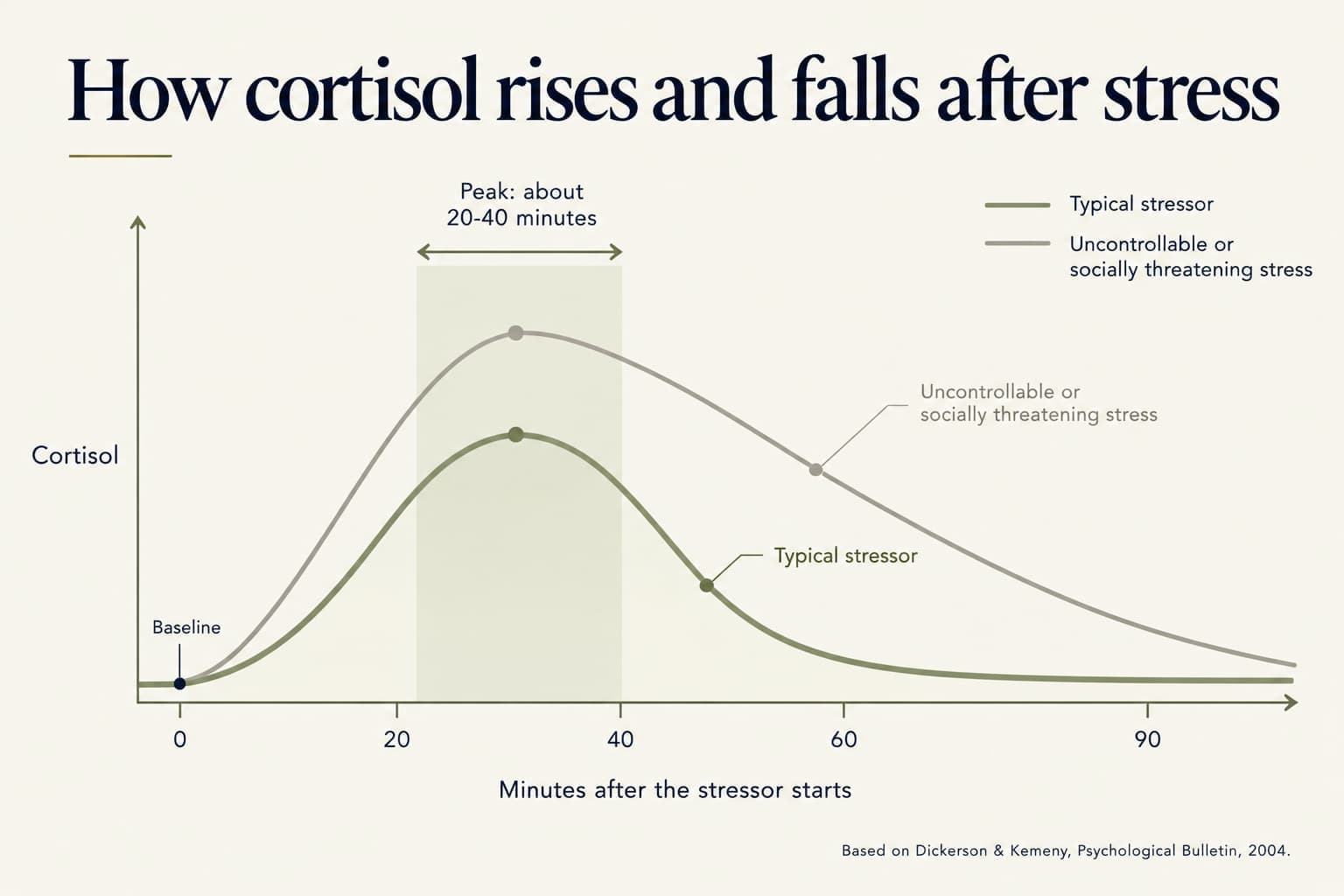
Because it depends on hormones travelling through the blood, this wave is slower. In a large analysis of laboratory stress studies, cortisol levels were highest about 21 to 40 minutes after a stressor began.
Cortisol keeps the body supplied with energy by raising blood sugar, supports blood pressure, and adjusts the immune system. It also affects the brain, including memory and mood.
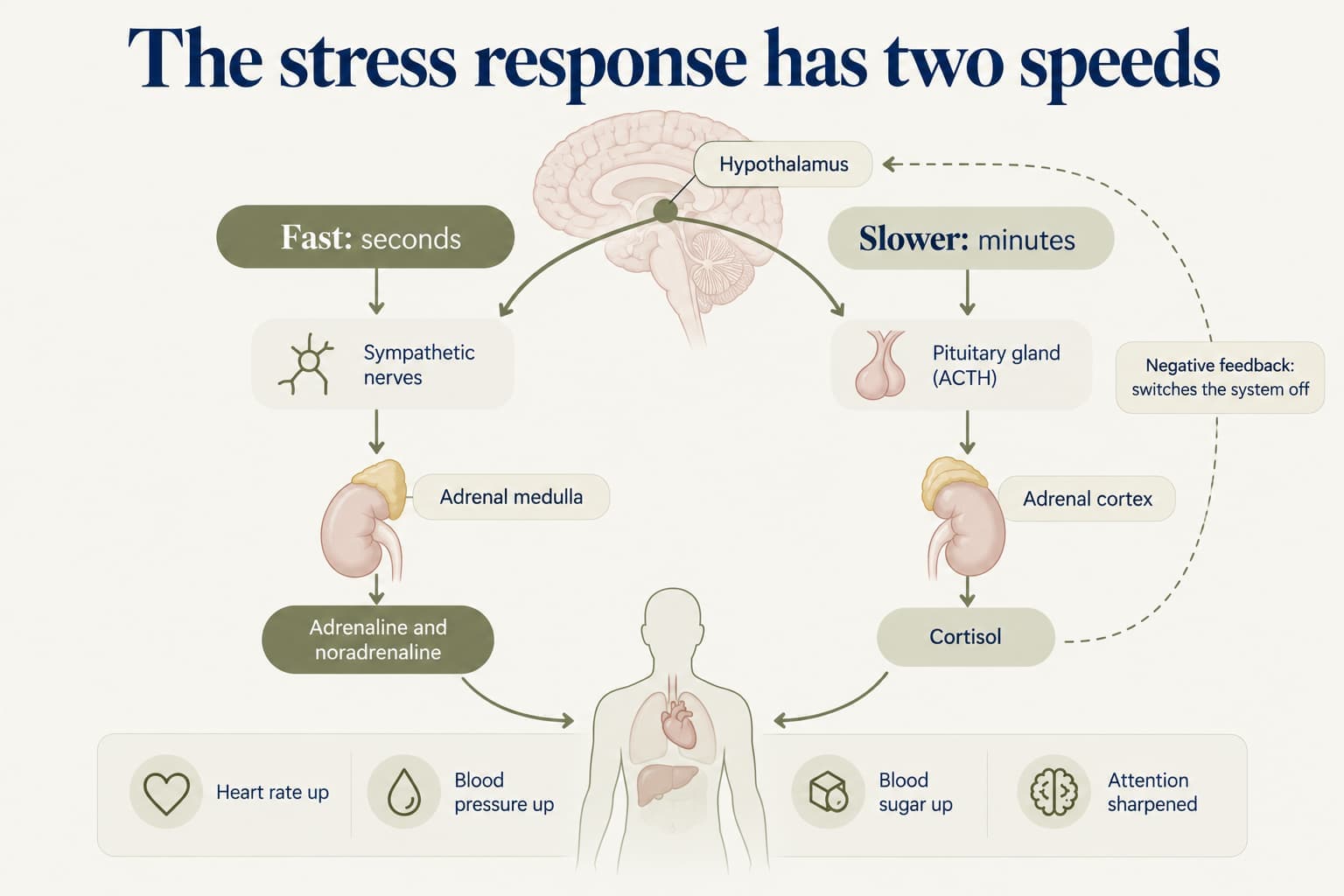
Step 4: Switching off. The system has a built-in brake. Rising cortisol signals back to the hypothalamus and pituitary to reduce CRH and ACTH, a process called negative feedback. At the same time, the parasympathetic nervous system, the "rest and digest" side of the nervous system, largely through the vagus nerve, slows the heart and returns the body to baseline. In a healthy stress response, cortisol rises, does its job and falls again.
What makes the stress response fire hardest
Not all stressors are equal. A major review of laboratory studies, published in 2004, looked at which kinds of stress produce the largest cortisol responses. Two features stood out:
- →Uncontrollability: situations where your actions don't change the outcome.
- →Social-evaluative threat: situations where you might be judged negatively by others, such as public speaking or being assessed.
Tasks with both features produced the largest cortisol responses and the slowest recovery. This helps explain why chronic stressors like job insecurity, caring for a sick family member, or feeling constantly judged can be so draining: they're often both uncontrollable and personally threatening.
What the research shows
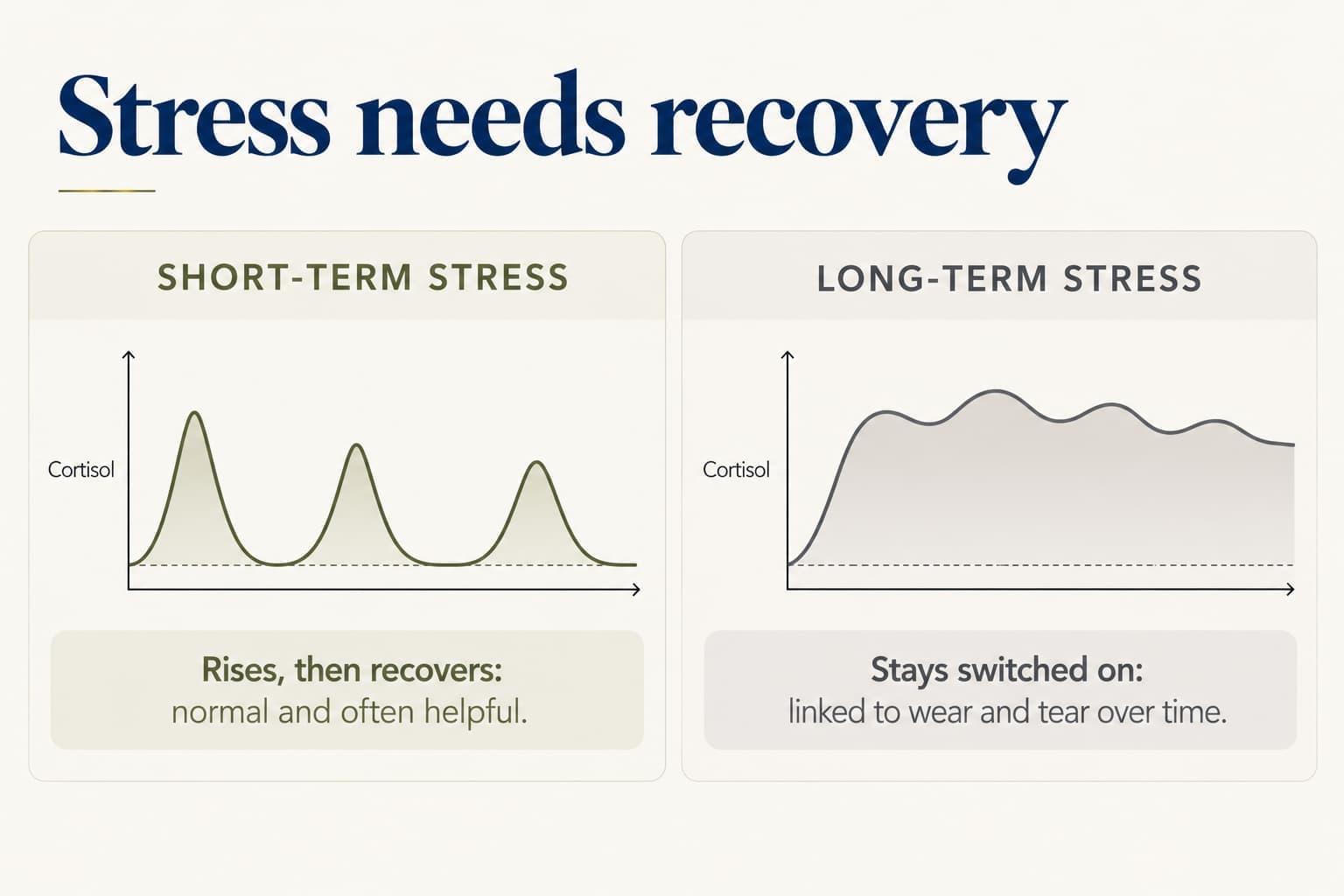
Short-term stress is normal and often useful. The stress response evolved to help us survive. In the short term, it improves alertness, mobilises energy and helps the body respond to injury and challenge. Exercise is itself a stressor that triggers this system, and the body adapts to it and becomes stronger. Short, manageable stress followed by recovery is part of normal, healthy life.
Long-term stress is a different story. Problems arise when the stress response is switched on too often, too long, or fails to switch off. Over time, repeated or constant activation can disrupt the normal daily rhythm of cortisol and wear down multiple body systems, an idea researchers call allostatic load (see Allostatic Load). The daily rhythm itself is covered in The Cortisol Rhythm and Health.
One of the best-known studies of stress and biological ageing, published in 2004, studied 58 healthy premenopausal mothers, some caring for a chronically ill child. Women with the highest perceived stress had shorter telomeres, the protective caps on the ends of chromosomes that shorten with age. The difference was equivalent to at least a decade of additional ageing compared with low-stress women. Higher stress was also linked to lower activity of telomerase, the enzyme that maintains telomeres, and to higher oxidative stress. This was a small, observational study, so it can't prove that stress caused the changes, but it was one of the first to link psychological stress to a marker of cellular ageing.
Long-term stress is also linked to heart disease, weight gain around the abdomen, poor sleep, depression and changes in the brain. Heart disease has its own article (see Chronic Stress and Heart Disease), belly fat in Stress, Cortisol and Belly Fat, and the brain in Chronic Stress and the Brain.
How you view stress may matter too. A study of 28,753 US adults, followed for eight years, found that people who reported both a lot of stress and a belief that stress affected their health a lot had a 43% higher risk of premature death. The raised risk was tied to the combination of high stress and the belief that it was harmful, not to the amount of stress alone.
This finding is often quoted, but it needs care. The study was observational, and the authors themselves noted that it couldn't establish cause and effect. People who were already in poor health may simply have been more likely to say that stress affected their health. It doesn't mean stress is harmless if you ignore it. But it fits a broader idea that how people interpret stress, as a challenge they can manage or as a threat they can't, may affect how the body responds.
Stress isn't only "fight or flight". Researchers have also described a "tend-and-befriend" response, in which people under stress seek out and protect others and draw on social connections. Social support is one of the most consistent buffers against the harmful effects of stress (see Social Connection and Cognitive Decline).
Recommendations
- →Don't aim for a stress-free life. Short-term stress with good recovery is normal and healthy. The goal is recovery, not avoidance.
- →Build recovery into every day. Sleep, physical activity, time outdoors and social contact all help the stress system switch off.
- →Notice what keeps your alarm ringing. Ongoing stressors that feel uncontrollable or involve constant judgment are the most taxing. Where you can, increase your sense of control or seek support.
- →Use exercise as "good stress". Regular physical activity trains the stress system to respond and recover efficiently (see Exercise and Brain Health).
- →Lean on others. Social support buffers stress.
- →Seek help if stress is persistent. Ongoing stress that affects sleep, mood, work or relationships is worth discussing with a doctor or mental health professional. Practical techniques are covered in Stress-Reduction Techniques That Work.
Practical notes
The stress response is a survival system with two speeds: adrenaline in seconds, cortisol in minutes. It's designed to switch on, do its job and switch off again. For long-term health, the question isn't whether you experience stress, but whether your body gets the chance to recover. The rest of this section looks at what happens when it doesn't, how hormones change with age, and which approaches to stress and hormone health have good evidence behind them.
- Dickerson SS, Kemeny ME. Acute stressors and cortisol responses: a theoretical integration and synthesis of laboratory research. Psychological Bulletin, 2004;130(3):355-391.
- Epel ES, et al. Accelerated telomere shortening in response to life stress. PNAS, 2004;101(49):17312-17315.
- Keller A, et al. Does the perception that stress affects health matter? The association with health and mortality. Health Psychology, 2012;31(5):677-684.
- Taylor SE, et al. Biobehavioral responses to stress in females: tend-and-befriend, not fight-or-flight. Psychological Review, 2000;107(3):411-429.
When stress hits,
how long does it take you to recover?
Take the free Aevum Protocol assessment to see how your stress & hormones and 6 other longevity domains are performing — and get a personalised 90-day plan.
Take the Free Assessment →