Stress & Hormones
How Hormones Change With Age:
What's Normal and What Isn't
Hormones change throughout life, and some of the biggest shifts happen from midlife onwards. In women, menopause brings a sharp fall in oestrogen and progesterone, usually around the early 50s. In men, testosterone declines gradually, by around 1-2% a year from middle age. Both sexes see a steady fall in DHEA, an adrenal hormone, and in growth hormone, while the normal range for thyroid tests shifts upward with age. Some of these changes are normal parts of ageing, and some signal conditions worth treating. Knowing the difference matters, because "anti-ageing" hormone treatments are widely marketed, and replacing a hormone just because it has fallen with age isn't always helpful or safe. This article gives an overview of the main changes; later articles in this section look at each one in more depth.
Key numbers
| Hormone | What happens with age |
|---|---|
| Oestrogen and progesterone (women) | Fall sharply at menopause; average age of menopause in the US is 52, with the transition usually starting between 45 and 55 |
| Testosterone (men, Massachusetts Male Aging Study) | Total testosterone fell about 1.6% a year; bioavailable testosterone about 2-3% a year |
| Low testosterone with symptoms (European Male Ageing Study, men 40-79) | About 2% of men met the criteria for late-onset hypogonadism |
| DHEA and DHEA-S | Peak in the 20s, then fall about 2-5% a year, down 80-90% from peak by the 80s-90s |
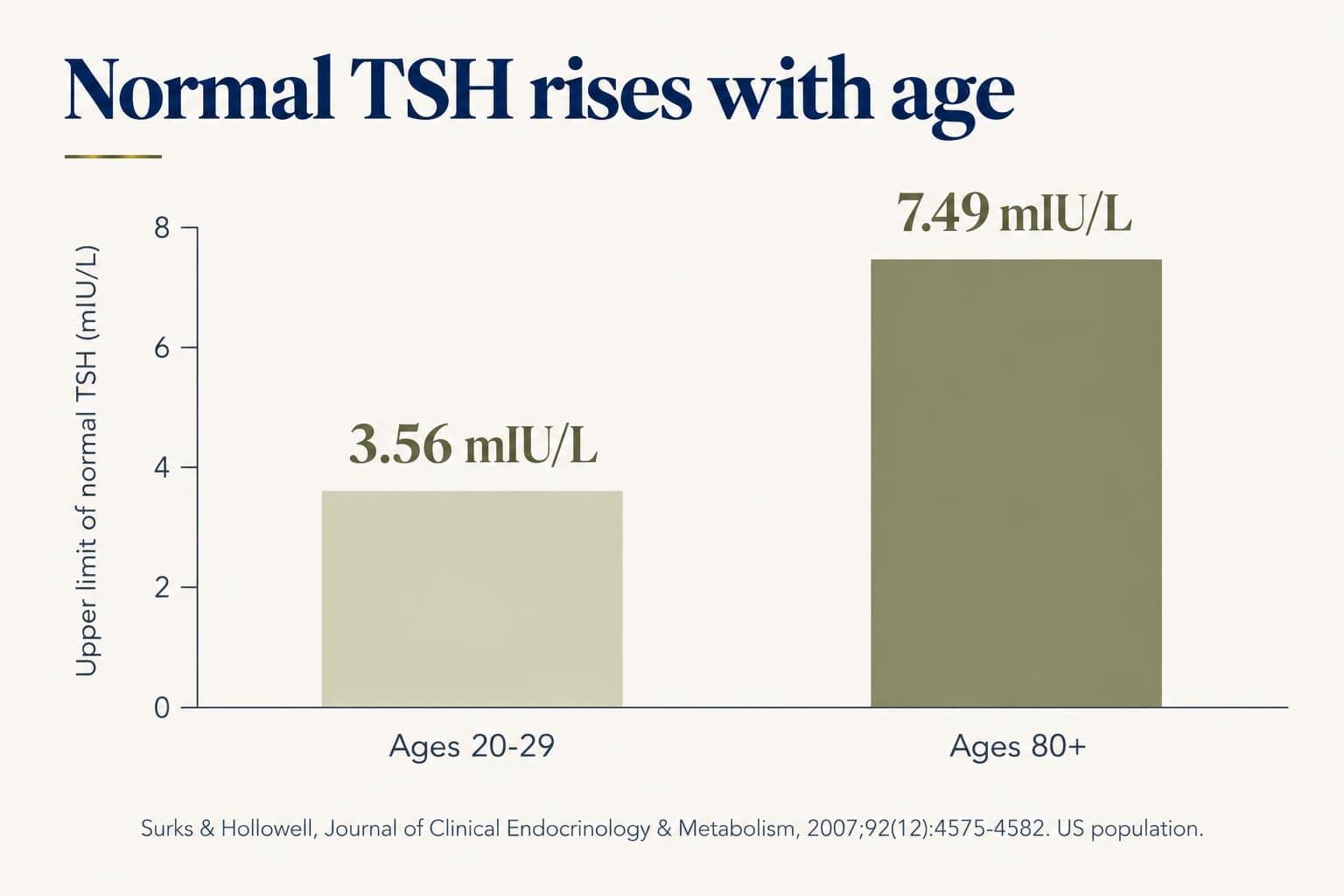
| TSH, the main thyroid test (US population) | Upper normal limit rises from 3.56 mIU/L at ages 20-29 to 7.49 mIU/L at 80+ |
| Growth hormone | Declines gradually with age ("somatopause") |
How it works
Hormones are chemical messengers made by glands such as the ovaries, testes, adrenals, thyroid and pituitary. They're controlled by feedback loops with the brain: when a hormone falls, the brain signals the gland to make more. With age, both the glands and these control loops change.
In women: menopause. Menopause is the most dramatic hormonal change of adult life. The ovaries gradually stop releasing eggs, and production of oestrogen and progesterone falls sharply. Most women begin the menopausal transition, called perimenopause, between 45 and 55, and in the US the average age of menopause (12 months without a period) is 52. Symptoms can last for several years.
Because oestrogen affects many tissues, menopause has effects beyond the reproductive system: on bone density, blood vessels, cholesterol, body fat distribution, sleep and mood. These are covered in Menopause and Long-Term Health, and in Perimenopause: Recognising the Signs and Symptoms.
In men: a gradual testosterone decline. Men don't have a sudden equivalent of menopause. Instead, testosterone falls slowly. In the Massachusetts Male Aging Study, which followed 1,156 men aged 40-70 for 7-10 years, total testosterone fell by about 1.6% a year and bioavailable testosterone (the portion available to tissues) by about 2-3% a year. At the same time, the protein that binds testosterone in the blood (SHBG) rises, which is why free or bioavailable testosterone falls faster than total testosterone.
Most men's testosterone stays within the normal range as they age. The European Male Ageing Study of 3,369 men aged 40-79 found that low testosterone was specifically linked to three sexual symptoms: poor morning erections, low sexual desire and erectile dysfunction. Only about 2% of men met the full criteria for late-onset hypogonadism: all three sexual symptoms together with low testosterone. Testosterone decline has its own article: see Testosterone Decline in Men.
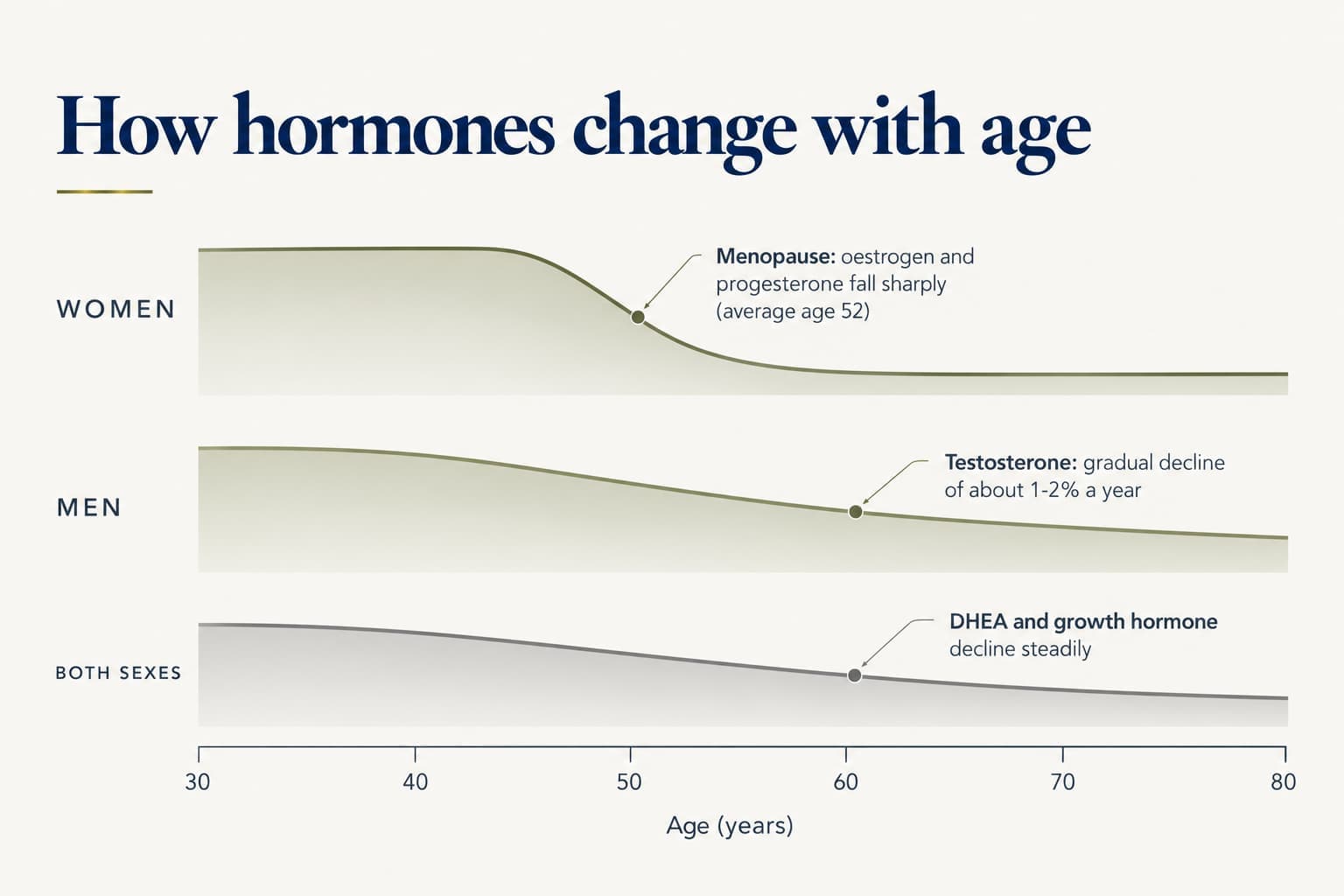
In both sexes: DHEA. DHEA and its stored form, DHEA-S, are made by the adrenal glands and can be converted into sex hormones. Levels peak in the 20s and then fall steadily, by about 2-5% a year, so that by the 80s or 90s they're 80-90% lower than at their peak. This striking decline made DHEA a popular "anti-ageing" supplement, but trials have been disappointing: reviews have found little evidence that low DHEA causes age-related problems or that supplements prevent them. DHEA, growth hormone and other "anti-ageing" hormones are examined in an Evidence Check (see Growth Hormone, DHEA and Other Anti-Ageing Hormones).
In both sexes: growth hormone. Growth hormone, made by the pituitary gland, drives growth in childhood and helps maintain muscle, bone and metabolism in adults. Its secretion declines gradually with age, a process called somatopause. Growth hormone treatment can change body composition in older adults, but reviews caution against using it for anti-ageing purposes in healthy people: its long-term safety and benefits remain uncertain, with concerns including diabetes and cardiovascular risk.
In both sexes: thyroid. The thyroid gland controls metabolism. Thyroid function tests change with age: TSH, the main screening test, tends to drift upwards. In a large US study, the upper limit of normal TSH was 3.56 mIU/L in people aged 20-29 but 7.49 mIU/L in people aged 80 and over. The authors estimated that about 70% of older people with a TSH above 4.5 mIU/L, often labelled as mildly underactive thyroid, were actually within the normal range for their age. Thyroid function and ageing has its own article: see Thyroid Function and Ageing.
Metabolic hormones and cortisol. Insulin sensitivity tends to fall with age, especially with weight gain and inactivity, raising the risk of type 2 diabetes (see Insulin and the Metabolic Hormones and Insulin Resistance). Cortisol, by contrast, doesn't simply rise or fall with age; what matters more is its daily rhythm (see The Cortisol Rhythm and Health).
What the research shows
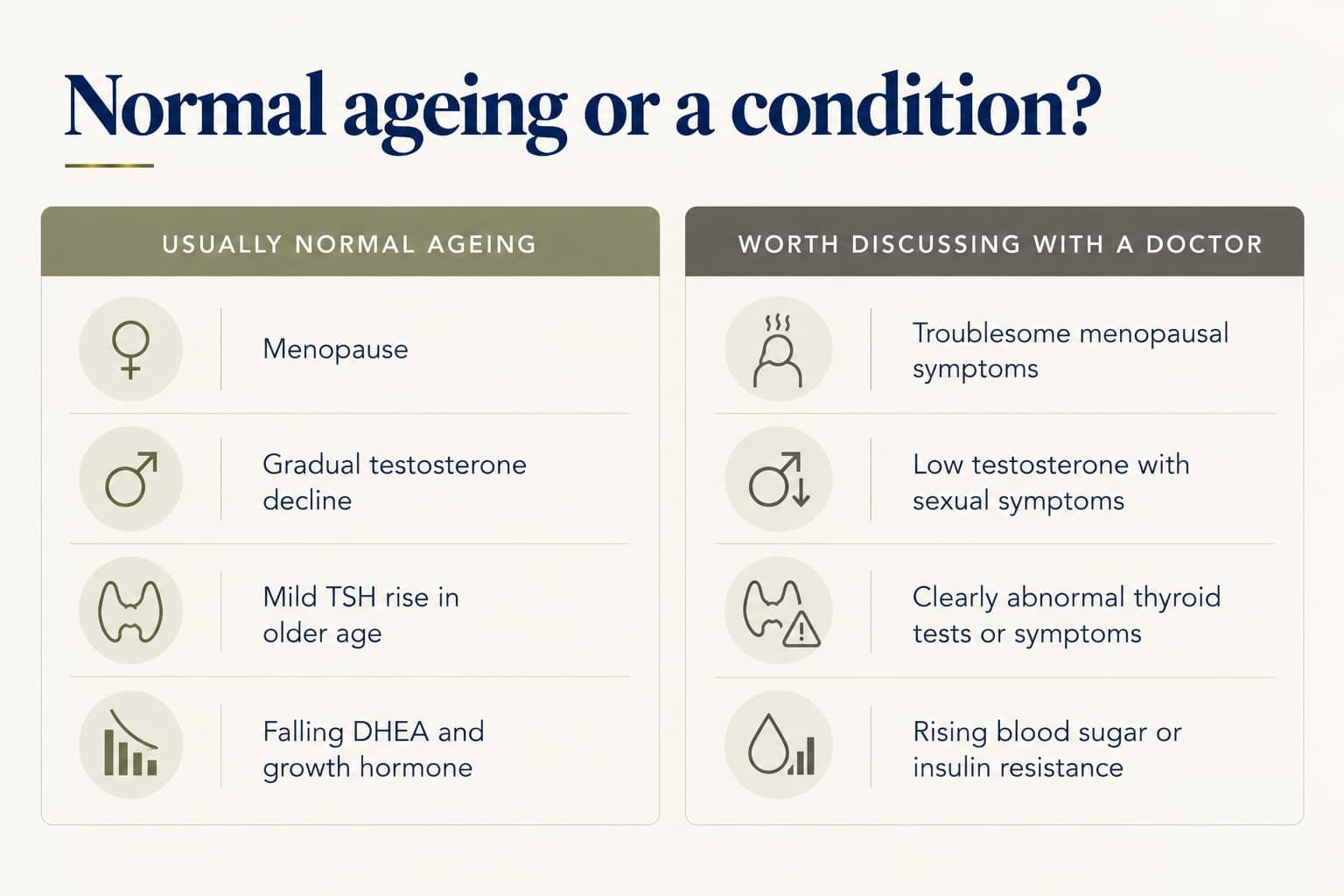
Some changes are normal, some are conditions. A key theme across hormone research is the difference between a normal age-related change and a condition that benefits from treatment:
- →Menopause is normal, but its symptoms can be severe enough to warrant treatment, and it changes long-term health risks.
- →Gradual testosterone decline is normal, but true hypogonadism, low testosterone with clear symptoms, is a medical condition.
- →An age-related rise in TSH is often normal, and using young adults' reference ranges can wrongly label older people as having thyroid disease.
- →Falling DHEA and growth hormone are normal, and replacing them in healthy people hasn't been shown to be beneficial.
Replacing a hormone isn't automatically helpful. It's tempting to assume that if a hormone falls with age, restoring it will reverse ageing. The evidence doesn't generally support that. Some hormone treatments have clear benefits in the right people, such as menopausal hormone therapy for troublesome symptoms or testosterone for genuine hypogonadism. Others, such as DHEA and growth hormone for general anti-ageing, haven't shown worthwhile benefits and may carry risks. These are examined in the Evidence Checks in this section, including Menopausal Hormone Therapy, Testosterone Therapy and Growth Hormone, DHEA and Other Anti-Ageing Hormones.
Lifestyle affects hormones too. Many hormone changes linked with age are also influenced by weight, activity, sleep and chronic illness. In the Massachusetts Male Aging Study, men in good health had androgen levels 10-15% higher than those in poorer health. Weight gain and inactivity worsen insulin resistance, and poor sleep and chronic stress disrupt the cortisol rhythm.
Recommendations
- →Know what's normal for your age. Hormone levels change naturally, and reference ranges designed for young adults can be misleading for older people.
- →Focus on symptoms, not just numbers. Hormone tests are most useful when they're done to explain specific symptoms.
- →Talk to a doctor about troublesome menopausal symptoms. Effective treatments are available.
- →Men with sexual symptoms, fatigue or low mood should get a proper assessment, including correctly timed testosterone tests, before considering treatment.
- →Be cautious about "anti-ageing" hormones. DHEA, growth hormone and compounded "bioidentical" products are widely marketed but have limited evidence and potential risks (see Bioidentical and Compounded Hormones).
- →Support your hormones with lifestyle: a healthy weight, regular exercise, good sleep and stress management all influence hormone health.
Practical notes
Hormones change with age in predictable ways: a sharp fall in oestrogen and progesterone at menopause, a slow decline in testosterone in men, a steady fall in DHEA and growth hormone in both sexes, and an upward shift in thyroid test results. Many of these changes are normal. The key questions are whether a change is causing symptoms or health risks, and whether treating it has good evidence behind it. The rest of this section looks at each area in detail, from menopause and testosterone to thyroid, insulin and the claims made for anti-ageing hormones.
- National Institute on Aging. What Is Menopause? nia.nih.gov.
- Feldman HA, et al. Age trends in the level of serum testosterone and other hormones in middle-aged men: longitudinal results from the Massachusetts Male Aging Study. Journal of Clinical Endocrinology & Metabolism, 2002;87(2):589-598.
- Wu FCW, et al. Identification of late-onset hypogonadism in middle-aged and elderly men. New England Journal of Medicine, 2010;363(2):123-135.
- Surks MI, Hollowell JG. Age-specific distribution of serum thyrotropin and antithyroid antibodies in the U.S. population: implications for the prevalence of subclinical hypothyroidism. Journal of Clinical Endocrinology & Metabolism, 2007;92(12):4575-4582.
- Adrenal Androgens and Aging. Endotext (NCBI Bookshelf).
- Fernández-Garza LE, et al. Growth hormone and aging: a clinical review. Frontiers in Aging, 2025;6:1549453.
Have you noticed changes that
you think might be hormonal?
Take the free Aevum Protocol assessment to see how your stress & hormones and 6 other longevity domains are performing — and get a personalised 90-day plan.
Take the Free Assessment →