Stress & Hormones
Testosterone Therapy:
Who Benefits, What It Does and What the Risks Are
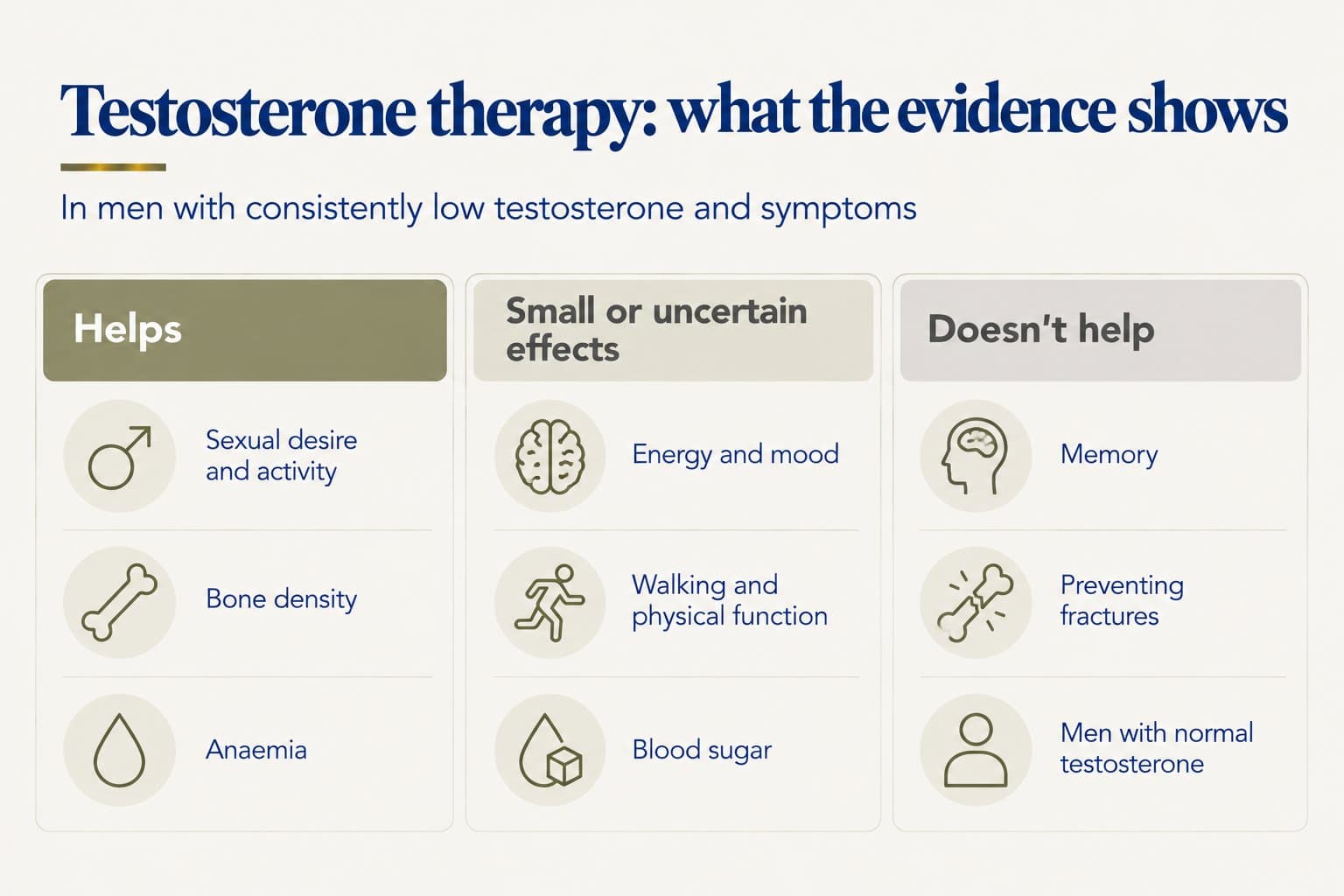
Testosterone therapy is increasingly marketed to men as a fix for low energy, weight gain and ageing. The evidence supports a narrower role. In men with genuinely and consistently low testosterone and symptoms (hypogonadism), treatment improves sexual desire and activity, bone density and anaemia, and modestly improves mood. It doesn't reliably improve energy, physical function or memory, and in a large trial it didn't prevent fractures. The biggest recent study, TRAVERSE, eased long-standing concerns about heart attacks and strokes in 5,204 men at high cardiovascular risk, but found more atrial fibrillation, kidney injury and lung clots. Testosterone also raises red blood cell counts and suppresses fertility. For men with normal testosterone, there's no good evidence of benefit. This article sets out what testosterone therapy can and can't do, and who is likely to benefit.
Key numbers
| Finding | Detail |
|---|---|
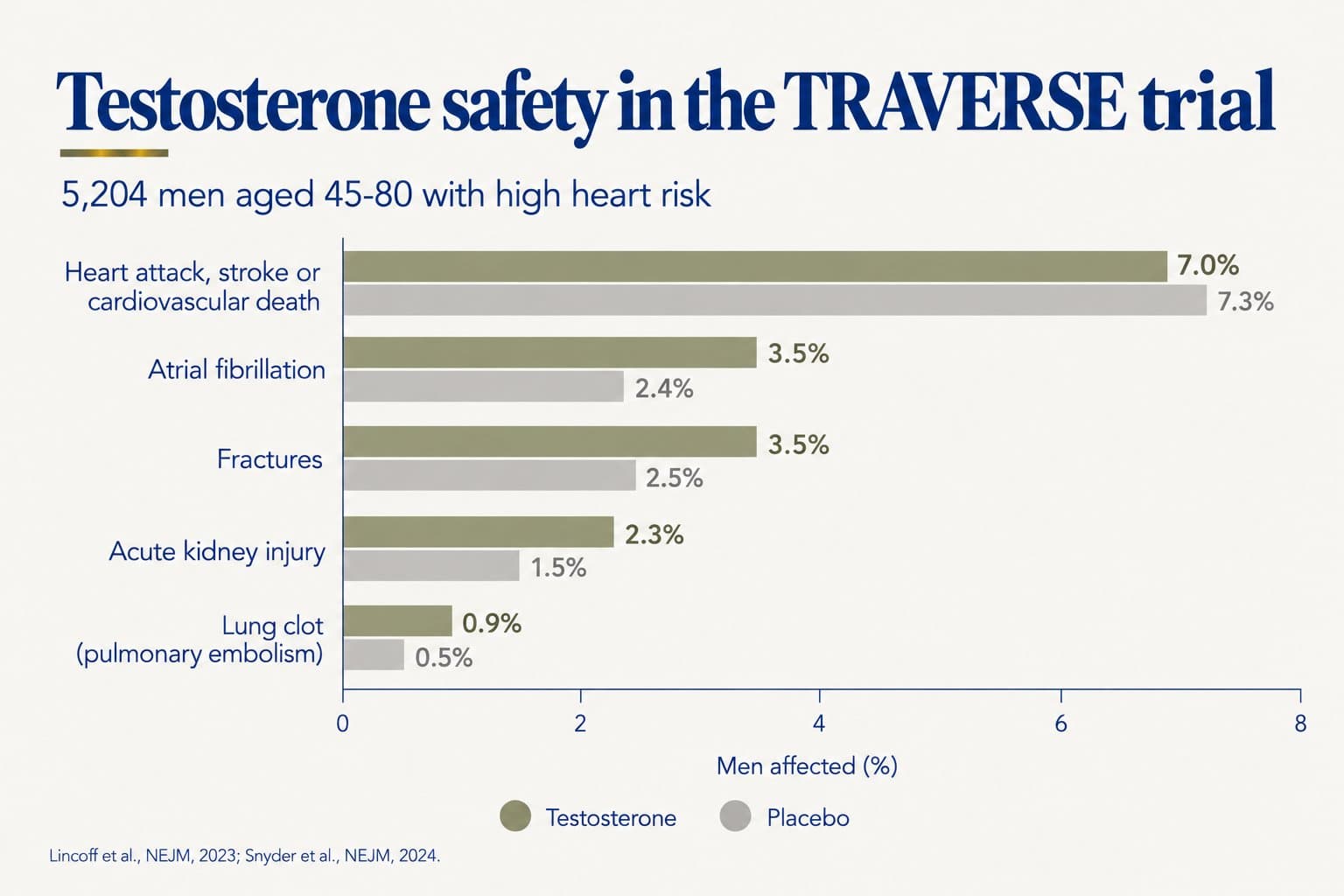
| Heart attack, stroke and cardiovascular death (TRAVERSE, 5,204 men aged 45-80 with high heart risk) | 7.0% with testosterone vs 7.3% with placebo (HR 0.96): no increase |
| Other safety findings (TRAVERSE) | More atrial fibrillation (3.5% vs 2.4%), acute kidney injury (2.3% vs 1.5%) and lung clots (0.9% vs 0.5%) |
| Fractures (TRAVERSE, 3.2 years) | 3.5% with testosterone vs 2.5% with placebo (HR 1.43): no protection |
| Sexual function (TRAVERSE, 1,161 men with low libido) | Improved sexual activity and desire over 2 years; no improvement in erectile function |
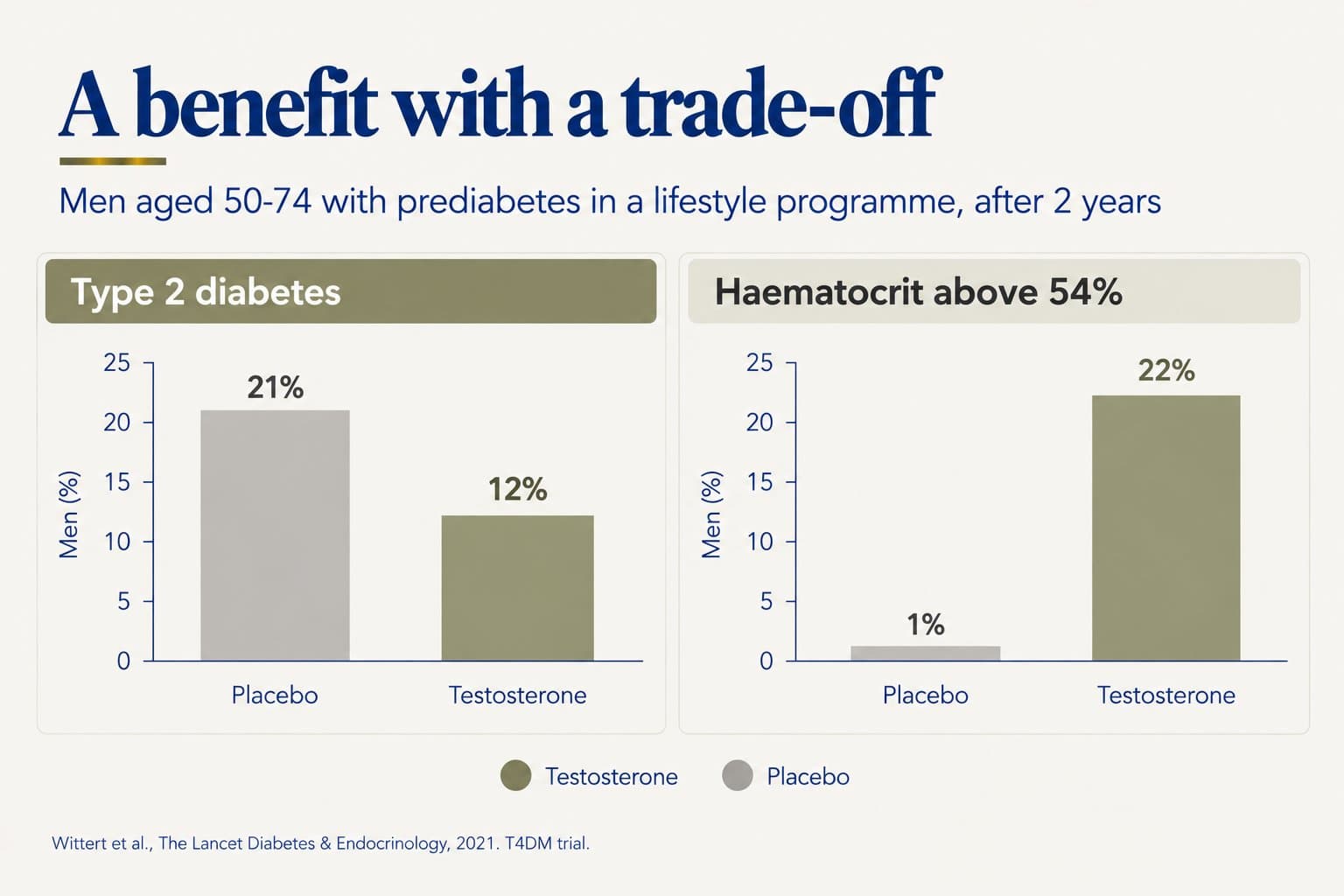
| Type 2 diabetes (T4DM, men 50-74 with prediabetes or new diabetes, in a lifestyle programme) | 12% had diabetes after 2 years with testosterone vs 21% with placebo |
| High red blood cell levels (T4DM) | Haematocrit above 54% in 22% with testosterone vs 1% with placebo |
What testosterone therapy is
Testosterone therapy replaces testosterone in men whose bodies don't make enough. It's given as skin gels, injections or, less often, patches, implants or tablets. Its accepted use is for hypogonadism: consistently low testosterone together with symptoms, especially low sexual desire, fewer morning erections and erectile problems (see Testosterone Decline in Men).
The Endocrine Society's 2018 guideline recommends treatment only for men with symptoms and testosterone that is "unequivocally and consistently low", confirmed by repeat morning tests. It recommends against routinely prescribing testosterone to all men over 65 with low levels, and says decisions in older men should be individual.
The major trials enrolled men with testosterone below about 275-300 ng/dL (roughly 9.5-10.4 nmol/L) on repeat tests, plus symptoms. Their results don't apply to men with normal levels, or to the much higher doses used for bodybuilding.
Evidence strength
Well established: sexual function in men with low testosterone. In the Testosterone Trials, 790 men aged 65 and older with low testosterone used a testosterone or placebo gel for a year. Testosterone improved sexual activity, sexual desire and erectile function. The larger TRAVERSE sexual function study followed 1,161 men with hypogonadism and low libido for up to two years. Testosterone improved sexual activity, desire and hypogonadal symptoms, and the benefit lasted, but erectile function didn't improve. For erectile problems alone, other treatments are often more effective.
Well established: bone density and anaemia. In the Testosterone Trials, testosterone increased bone density and bone strength, especially in the spine. More than half of the 126 men with anaemia had a meaningful rise in red blood cell levels, compared with 15% or fewer on placebo.
Moderate: modest effects on mood and energy. In the Testosterone Trials, testosterone didn't significantly improve fatigue, the main vitality measure, but men reported slightly better energy and mood. Walking distance improved modestly across all participants, but not significantly in the men enrolled specifically for walking problems. These are real but small effects.
Moderate: blood sugar, with caveats. The T4DM trial enrolled men aged 50-74 with a large waist, testosterone in the lower part of the range and prediabetes or newly diagnosed diabetes, all in a lifestyle programme. After two years, 12% of those on testosterone had type 2 diabetes compared with 21% on placebo. But 22% of men on testosterone developed a haematocrit above 54%, which the authors said "might be treatment limiting", and longer-term safety wasn't known. Lifestyle change remains the foundation for preventing diabetes (see Insulin Resistance).
Reassuring but not risk-free: heart and prostate. For years, testosterone was suspected of raising heart attack and stroke risk. TRAVERSE tested this in 5,204 men aged 45-80 with hypogonadism and existing cardiovascular disease or high risk. Over an average of 33 months, major cardiovascular events occurred in 7.0% on testosterone and 7.3% on placebo (HR 0.96, 95% CI 0.78-1.17). But the testosterone group had more atrial fibrillation (3.5% vs 2.4%), acute kidney injury (2.3% vs 1.5%) and pulmonary embolism (0.9% vs 0.5%).
In the same trial, high-grade prostate cancer was rare in both groups (0.19% vs 0.12%), with no significant difference, among men who were screened and monitored carefully. Men with prostate cancer or high PSA were excluded.
Not supported
- →Memory: in 493 older men with age-related memory problems, testosterone didn't improve memory or other thinking skills.
- →Fracture prevention: in a TRAVERSE substudy, testosterone didn't reduce fractures. Fractures were more common with testosterone (3.5% vs 2.5%, HR 1.43), despite the gains in bone density seen in earlier studies.
- →Men with normal testosterone: there's no good evidence of benefit, and the same risks apply.
- →"Anti-ageing" use: testosterone isn't recommended to treat age-related changes in men without true hypogonadism.
A further caution came from the Testosterone Trials' cardiovascular study: in 170 men, coronary plaque volume increased significantly more with testosterone than placebo. The clinical meaning of this is uncertain, especially given TRAVERSE's reassuring results.
Important side effects
- →High red blood cell levels (erythrocytosis): common, especially with injections. It thickens the blood and needs regular monitoring.
- →Suppressed fertility: testosterone from outside the body signals the testes to stop making sperm. Men who want children should discuss alternatives before starting.
- →Other effects: acne, breast tenderness or enlargement, fluid retention, and worsening of untreated sleep apnoea.
- →Monitoring: guidelines recommend checking testosterone levels, haematocrit and, in appropriate men, PSA after starting treatment and regularly afterwards.
Recommendations by situation
- →You have symptoms and consistently low morning testosterone: testosterone therapy may help, especially with sexual desire and activity. Discuss the expected benefits, side effects and monitoring with your doctor.
- →You're overweight or have poor sleep and borderline testosterone: start with weight loss, better sleep and exercise, which raise testosterone and improve health in their own right (see Testosterone Decline in Men).
- →You want to have children, now or in the future: testosterone suppresses sperm production; discuss other options first.
- →You have heart disease or high cardiovascular risk: TRAVERSE is reassuring about heart attacks and strokes, but ask about atrial fibrillation, kidney function and clot risk.
- →You have prostate cancer, a high PSA, a high haematocrit, untreated severe sleep apnoea or uncontrolled heart failure: testosterone therapy is generally not appropriate without specialist advice.
- →Your testosterone is normal and you want more energy or muscle: there's no good evidence it will help, and the risks remain.
- →You're offered testosterone without repeat morning testing and monitoring: that falls short of guideline standards.
Other hormones marketed for ageing, such as growth hormone and DHEA, are covered in Growth Hormone, DHEA and Other Anti-Ageing Hormones.
Practical notes
Testosterone therapy is a legitimate treatment for men with true hypogonadism, not a general anti-ageing therapy. In men with consistently low levels and symptoms, it improves sexual desire and activity, bone density and anaemia, with smaller effects on mood and energy. The TRAVERSE trial showed it doesn't raise heart attack or stroke risk in men at high cardiovascular risk, but it does increase atrial fibrillation, kidney injury, lung clots and red blood cell levels, didn't prevent fractures, and suppresses fertility. The right approach is careful diagnosis, a clear goal for treatment, and regular monitoring.
- Bhasin S, et al. Testosterone Therapy in Men With Hypogonadism: An Endocrine Society Clinical Practice Guideline. Journal of Clinical Endocrinology & Metabolism, 2018;103(5):1715-1744.
- Lincoff AM, et al. Cardiovascular Safety of Testosterone-Replacement Therapy. New England Journal of Medicine, 2023;389(2):107-117.
- Snyder PJ, et al. Effects of Testosterone Treatment in Older Men. New England Journal of Medicine, 2016;374(7):611-624.
- Pencina KM, et al. Effect of Testosterone Replacement Therapy on Sexual Function and Hypogonadal Symptoms in Men with Hypogonadism. Journal of Clinical Endocrinology & Metabolism, 2024;109(2):569-580.
- Snyder PJ, et al. Testosterone Treatment and Fractures in Men with Hypogonadism. New England Journal of Medicine, 2024;390(3):203-211.
- Bhasin S, et al. Prostate Safety Events During Testosterone Replacement Therapy in Men With Hypogonadism: A Randomized Clinical Trial. JAMA Network Open, 2023;6(12):e2348692.
- Wittert G, et al. Testosterone treatment to prevent or revert type 2 diabetes in men enrolled in a lifestyle programme (T4DM): a randomised, double-blind, placebo-controlled, 2-year, phase 3b trial. The Lancet Diabetes & Endocrinology, 2021;9(1):32-45.
- Snyder PJ, et al. Lessons From the Testosterone Trials. Endocrine Reviews, 2018;39(3):369-386.
- Budoff MJ, et al. Testosterone Treatment and Coronary Artery Plaque Volume in Older Men With Low Testosterone. JAMA, 2017;317(7):708-716.
Has anyone offered you testosterone
without repeat morning testing?
Take the free Aevum Protocol assessment to see how your stress & hormones and 6 other longevity domains are performing — and get a personalised 90-day plan.
Take the Free Assessment →