Stress & Hormones
Hormone Testing:
Which Tests Are Useful, When, and How to Prepare
Hormone tests can be genuinely useful, but only when they answer a specific question. Hormone levels rise and fall through the day, the month and the years, reference ranges change with age, and a single abnormal result is often normal when repeated: about 30% of men with one low testosterone reading are normal on retesting. Some tests are the right first step, such as a thyroid-stimulating hormone (TSH) test for suspected thyroid problems or an HbA1c for diabetes. Others are often unnecessary, such as hormone tests to diagnose menopause in women over 45. And some, including saliva hormone panels and tests for "adrenal fatigue", aren't recommended at all. Preparation matters too: biotin supplements can make thyroid tests falsely suggest an overactive thyroid. This guide explains which tests are worth doing for common concerns, how to prepare, and how to avoid being misled by the results.
Key numbers
| Finding | Detail |
|---|---|
| Men with one low testosterone reading (Endocrine Society) | About 30% are normal when retested |
| Upper limit of normal TSH (US population data) | 3.56 mIU/L at ages 20-29 vs 7.49 mIU/L at age 80 and over |
| Menopause in women over 45 (NICE guideline) | Diagnose from symptoms; hormone blood tests not needed |
| Biotin supplements and thyroid tests (American Thyroid Association) | Can falsely raise T4 and T3 and lower TSH; stop at least 2 days before testing |
| Tests for "adrenal fatigue" (review of 58 studies) | No consistent test result identified the condition |
Why hormone testing is tricky
- →Hormones fluctuate. Cortisol and testosterone are highest in the morning; oestrogen and progesterone change across the menstrual cycle and swing widely in perimenopause.
- →"Normal" changes with age. TSH naturally rises with age, and testosterone and DHEA fall. A result flagged as abnormal against young-adult ranges may be normal for your age (see How Hormones Change With Age).
- →Single results can mislead. Illness, poor sleep, medicines, supplements and the time of day all affect results, so abnormal results often need repeating.
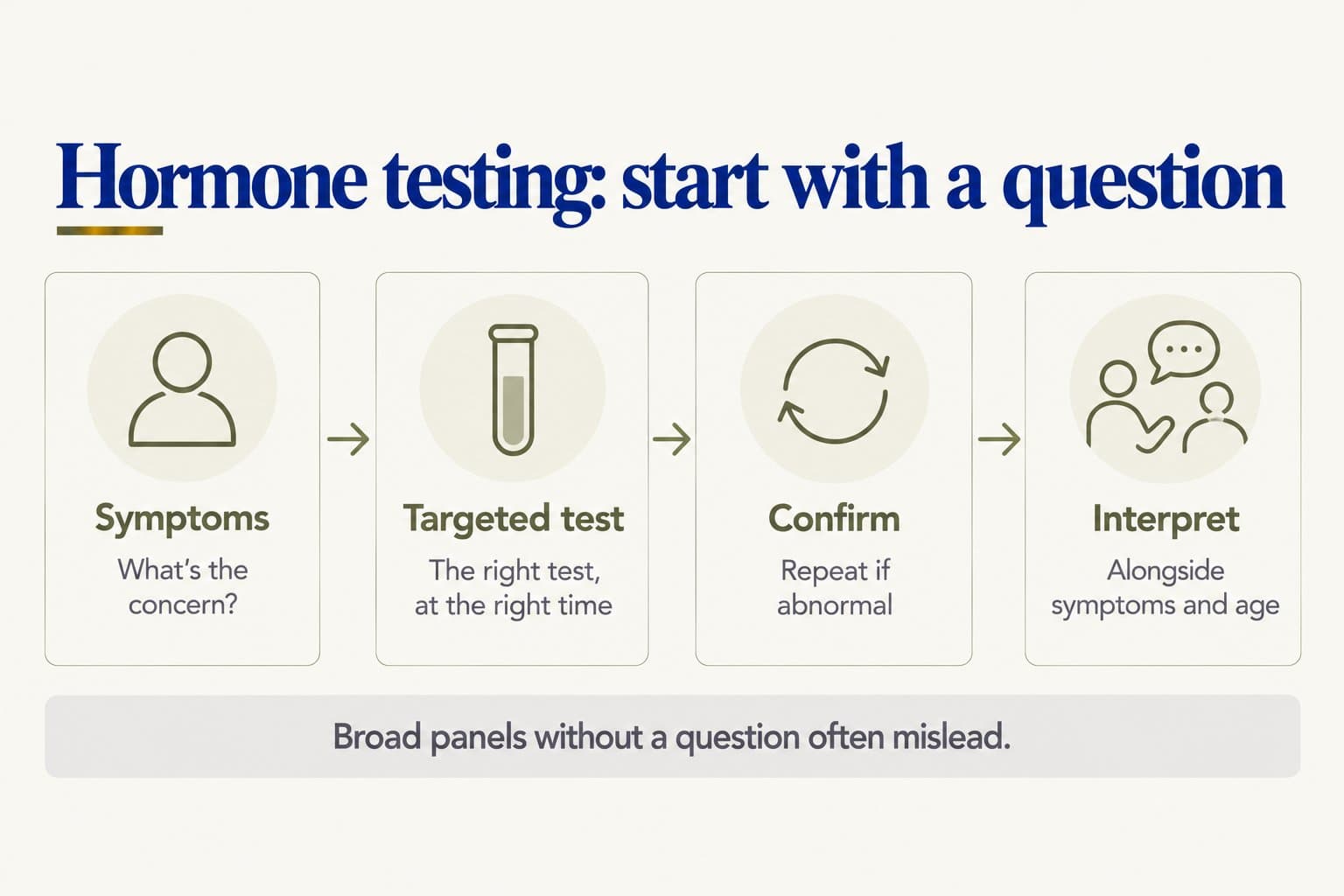
- →Numbers aren't diagnoses. A result only means something alongside symptoms and an examination. Testing without a clear question tends to produce "abnormal" findings that lead to worry, more tests and unnecessary treatment.
The best approach is to start with the symptom or question, then choose the test that answers it.
A test-by-test guide for common concerns
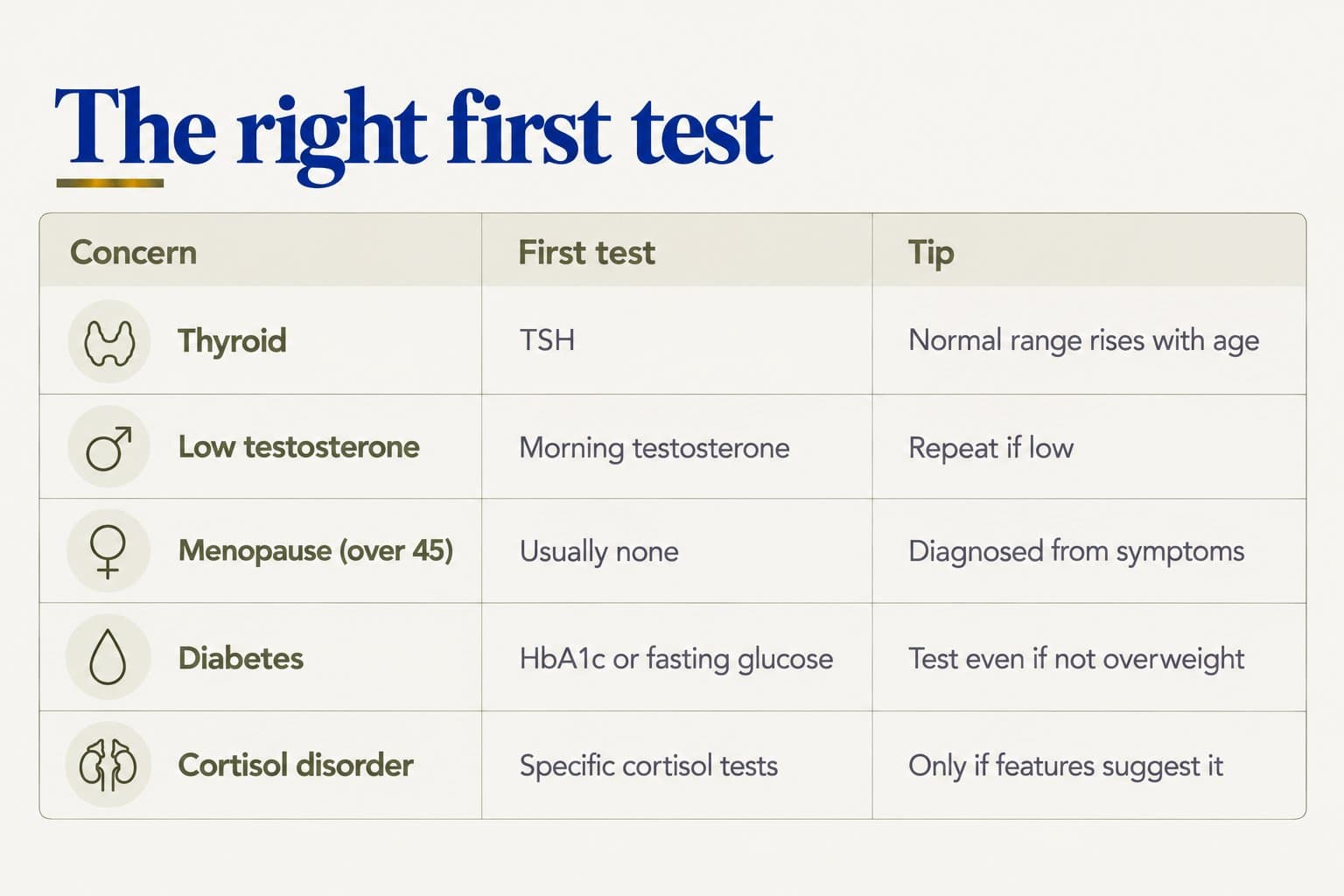
Thyroid: start with TSH. For suspected thyroid problems, such as unexplained tiredness, weight change, feeling cold or hot, or palpitations, the first test is TSH, often with free T4 if TSH is abnormal. TSH rises naturally with age: in US population data, the upper limit of normal was 3.56 mIU/L at ages 20-29 but 7.49 mIU/L at age 80 and over. A mildly raised TSH in an older person often doesn't need treatment and should be rechecked (see Thyroid Function and Ageing).
The Endocrine Society advises against measuring T3 to adjust levothyroxine doses in people treated for an underactive thyroid. "Reverse T3" tests aren't needed for routine thyroid assessment.
Testosterone (men): morning, fasting, and repeated. Testosterone should only be tested when there are symptoms, especially low sexual desire, fewer morning erections or erectile problems. The Endocrine Society recommends diagnosing low testosterone only when levels are "unequivocally and consistently low", with testing in the morning, repeated if low, because about 30% of men with a low first result are normal on retesting. It advises against screening men without symptoms (see Testosterone Decline in Men).
Menopause: usually no test needed. The UK's NICE guideline advises diagnosing perimenopause and menopause in women over 45 based on symptoms alone, without hormone blood tests. FSH testing is only suggested for women aged 40-45 with symptoms, or under 40 when early menopause is suspected. Tests such as AMH or oestradiol aren't recommended for diagnosing menopause, because levels swing widely during perimenopause (see Perimenopause: Signs and Symptoms).
If you're on menopausal hormone therapy, treatment is usually adjusted according to symptoms, not blood levels (see Menopausal Hormone Therapy).
Diabetes and insulin resistance: HbA1c and fasting glucose. HbA1c and fasting blood glucose are the standard tests for diabetes and prediabetes. In Sri Lanka's national survey, nearly 4 in 10 adults with diabetes didn't know they had it, so testing is worthwhile for adults with risk factors, including those who aren't overweight, because South Asians develop diabetes at lower body weights (see Insulin Resistance). Fasting insulin and HOMA-IR scores aren't standardised and aren't needed for diagnosis.
Cortisol: only when a cortisol disorder is suspected. Cortisol tests are for diagnosing specific conditions, not for measuring everyday stress.
- →Too much cortisol (Cushing's syndrome): the Endocrine Society recommends testing only people with multiple, progressive features of the condition, such as easy bruising, purple stretch marks, muscle weakness and rapid central weight gain, using late-night saliva cortisol, 24-hour urine cortisol or a dexamethasone suppression test.
- →Too little cortisol (adrenal insufficiency): a morning blood cortisol, with ACTH, followed by an ACTH (Synacthen) stimulation test if needed.
Saliva cortisol "rhythm" panels for stress or "adrenal fatigue" aren't validated (see Adrenal Fatigue and The Cortisol Rhythm and Health).
Tests that usually don't help
- →Saliva hormone panels: the American College of Obstetricians and Gynecologists says hormone testing for prescribing or dosing menopausal hormones "is not recommended" (see Bioidentical and Compounded Hormones).
- →"Adrenal fatigue" tests: a review of 58 studies found no consistent pattern identifying the condition.
- →Broad "hormone balance" panels without symptoms: they often produce borderline results that lead to more testing and unnecessary treatment.
- →DHEA, growth hormone or IGF-1 levels to guide "anti-ageing" treatment: falling levels are normal with age, and replacing them hasn't been shown to help (see Growth Hormone, DHEA and Other Anti-Ageing Hormones).
Before your test
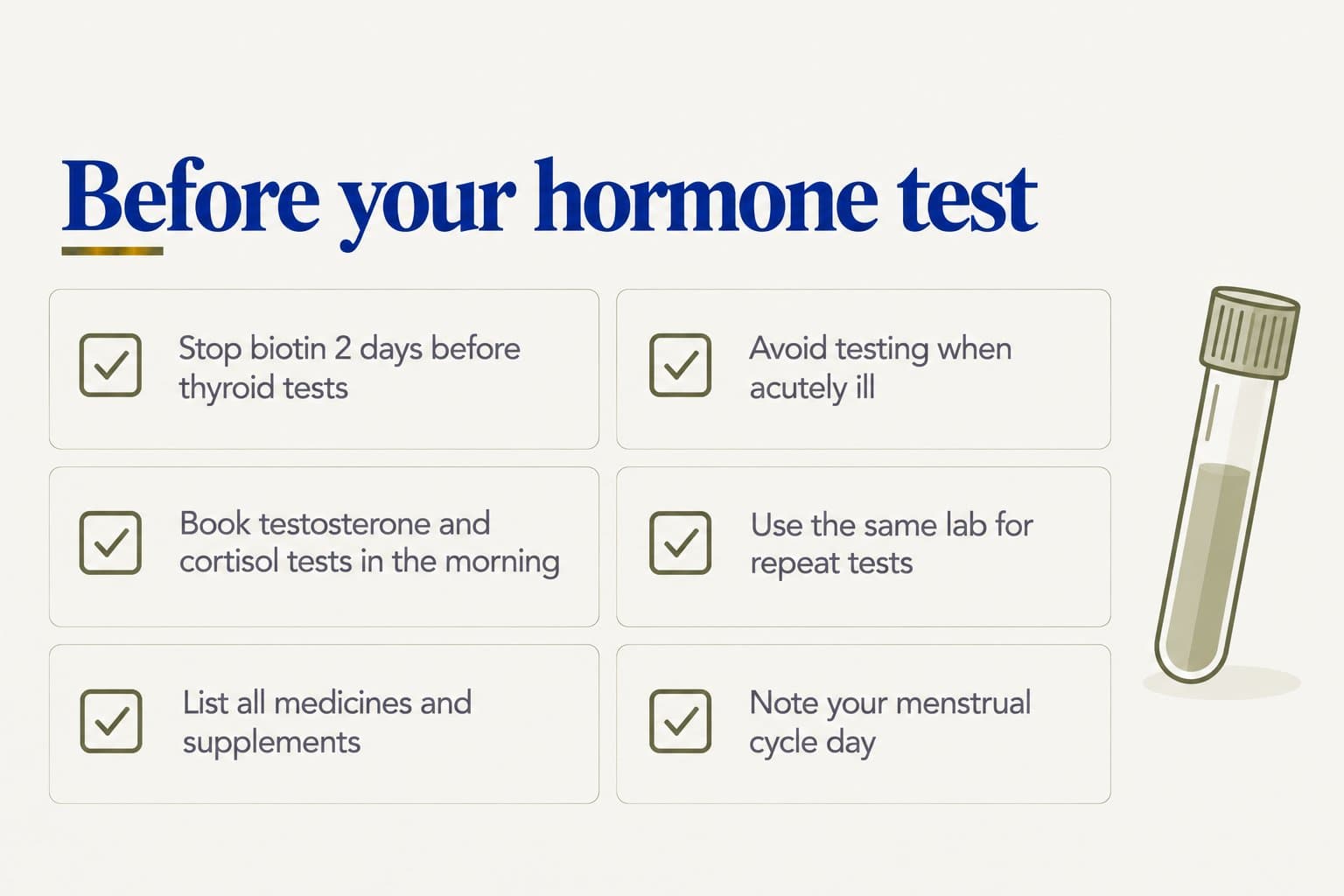
- →Stop biotin supplements (often in hair, skin and nail products) for at least 2 days before thyroid tests, as advised by the American Thyroid Association. High-dose biotin can make results falsely suggest an overactive thyroid, and can affect other laboratory tests too.
- →Book testosterone and cortisol tests in the morning, ideally fasting for testosterone.
- →Tell your doctor about all medicines and supplements, including hormones, steroids, biotin and the contraceptive pill.
- →Avoid testing during an acute illness or right after a night of very poor sleep, unless your doctor needs it.
- →Use the same laboratory for repeat tests where possible, since methods and ranges differ.
- →Note where you are in your menstrual cycle if you still have periods.
Recommendations by scenario
- →You're tired all the time: a doctor's review, with basic tests such as a full blood count, TSH, blood glucose or HbA1c and, where relevant, iron and vitamin B12, is more useful than a hormone panel.
- →You're a woman over 45 with hot flushes or irregular periods: you usually don't need hormone tests to confirm perimenopause.
- →You're a man with low sexual desire or erectile problems: ask for a morning testosterone test, repeated if low, plus checks for diabetes and other causes.
- →You have risk factors for diabetes: get an HbA1c or fasting glucose, even if you're not overweight.
- →You've been offered a saliva, urine or "complete hormone" panel without clear symptoms: ask what question it will answer and how the result would change your treatment.
- →You take thyroid medication: your dose is usually guided by TSH, not T3.
- →Your result is slightly outside the range: ask whether it should be repeated and whether it's normal for your age before starting any treatment.
Practical notes
Hormone tests are most useful when they're targeted: TSH for thyroid symptoms, repeated morning testosterone for symptoms of low testosterone, HbA1c for diabetes risk, and specific cortisol tests when a cortisol disorder is suspected. Many other tests, including menopause blood tests in women over 45, saliva panels and "adrenal fatigue" tests, add little or can mislead. Prepare properly, especially by stopping biotin and booking morning appointments where needed, and interpret every result alongside your symptoms, your age and, when needed, a repeat test.
- Bhasin S, et al. Testosterone Therapy in Men With Hypogonadism: An Endocrine Society Clinical Practice Guideline. Journal of Clinical Endocrinology & Metabolism, 2018;103(5):1715-1744.
- Surks MI, Hollowell JG. Age-specific distribution of serum thyrotropin and antithyroid antibodies in the US population: implications for the prevalence of subclinical hypothyroidism. Journal of Clinical Endocrinology & Metabolism, 2007;92(12):4575-4582.
- National Institute for Health and Care Excellence. Menopause: identification and management (NG23).
- Nieman LK, et al. The diagnosis of Cushing's syndrome: an Endocrine Society Clinical Practice Guideline. Journal of Clinical Endocrinology & Metabolism, 2008;93(5):1526-1540.
- Endocrine Society. Choosing Wisely: Five Things Physicians and Patients Should Question.
- American Thyroid Association. Biotin interference with thyroid function tests. Clinical Thyroidology for the Public, 2018;11(12).
- American College of Obstetricians and Gynecologists. Compounded Bioidentical Menopausal Hormone Therapy. Clinical Consensus No. 6, 2023.
- Cadegiani FA, Kater CE. Adrenal fatigue does not exist: a systematic review. BMC Endocrine Disorders, 2016;16(1):48.
What question do you want
your hormone test to answer?
Take the free Aevum Protocol assessment to see how your stress & hormones and 6 other longevity domains are performing — and get a personalised 90-day plan.
Take the Free Assessment →