Stress & Hormones
Thyroid Function and Ageing:
When a Test Result Matters and When It Doesn't
The thyroid gland sets the pace of the body's metabolism, and thyroid problems become more common with age, especially in women. But ageing also changes what "normal" looks like: TSH, the main thyroid screening test, naturally drifts upwards in older people. That creates a real risk of over-diagnosis. Many older adults are told they have "borderline" or subclinical hypothyroidism when their result is actually normal for their age. In a large trial of adults over 65 with mildly raised TSH, thyroid hormone tablets didn't improve symptoms or tiredness. At the same time, clearly abnormal thyroid function matters: a TSH of 10 or more is linked to a higher risk of heart disease, and a TSH that's too low, often from taking too much thyroid medication, is linked to about twice the risk of atrial fibrillation. This article explains how thyroid tests change with age, when results matter, and what that means in practice.
Key numbers
| Finding | Detail |
|---|---|
| Upper limit of normal TSH by age (US population) | 3.56 mIU/L at ages 20-29; 7.49 mIU/L at age 80+ |
| Older people with TSH above 4.5 who are within their age-specific range | About 70% |
| Levothyroxine for subclinical hypothyroidism in adults 65+ (TRUST trial, 737 people, average age 74) | No improvement in thyroid-related symptoms or tiredness after 1 year |
| Subclinical hypothyroidism with TSH 10-19.9 (11 cohorts, 55,287 people) | 89% higher risk of coronary heart disease events (HR 1.89) |
| Subclinical hypothyroidism with TSH 4.5-6.9 | No increase in coronary heart disease events (HR 1.00) |
| Subclinical hyperthyroidism (low TSH) and atrial fibrillation (meta-analysis, 5 studies) | About twice the risk (RR 1.99) |
How the thyroid works
The thyroid, a small gland in the neck, makes two hormones, T4 and T3, that regulate metabolism, heart rate, body temperature, energy and many other functions. It's controlled by the pituitary gland, which releases TSH (thyroid-stimulating hormone):
- →When thyroid hormone is low, TSH rises to push the thyroid to make more.
- →When thyroid hormone is high, TSH falls.
Because of this feedback, TSH is a sensitive early indicator of thyroid problems, and it's usually the first test done. Doctors then check free T4 to see whether thyroid hormone itself is abnormal.
Key terms:
- →Overt hypothyroidism: high TSH and low free T4. The thyroid is clearly underactive.
- →Subclinical hypothyroidism: high TSH, but free T4 still normal.
- →Overt hyperthyroidism: low TSH and high free T4. The thyroid is clearly overactive.
- →Subclinical hyperthyroidism: low TSH, with normal free T4.
Risk factor table: thyroid findings in older adults
| Finding | Association | Treatable / modifiable? | Evidence strength |
|---|---|---|---|
| Mild TSH rise with age | Upper limit of normal roughly doubles by 80+; often normal for age | Usually doesn't need treatment | Strong (large population study) |
| Subclinical hypothyroidism, TSH below 10 | No increase in heart events at 4.5-6.9; treatment didn't improve symptoms in over-65s | Usually monitor rather than treat | Strong (large trial and pooled cohorts) |
| Subclinical hypothyroidism, TSH 10 or higher | Higher risk of heart disease events (HR 1.89) and heart disease death (HR 1.58) | Treatment often considered; benefit on heart outcomes unproven | Moderate (pooled cohorts) |
| Low TSH (subclinical hyperthyroidism) | About twice the risk of atrial fibrillation | Yes: often from too much thyroid medication; dose adjustment | Moderate to strong (meta-analysis) |
| Overt hypothyroidism or hyperthyroidism | Wide-ranging effects on heart, bone, mood and metabolism | Yes: established treatments | Strong |
What the research shows
"Normal" TSH changes with age. A large US population study found that TSH shifts upwards with age. The upper limit of normal was 3.56 mIU/L in people aged 20-29, but 7.49 mIU/L in those aged 80 and over. The authors estimated that about 70% of older people with a TSH above 4.5 mIU/L were actually within the normal range for their age, and warned that subclinical hypothyroidism may be substantially over-diagnosed unless age-specific ranges are used (see How Hormones Change With Age).
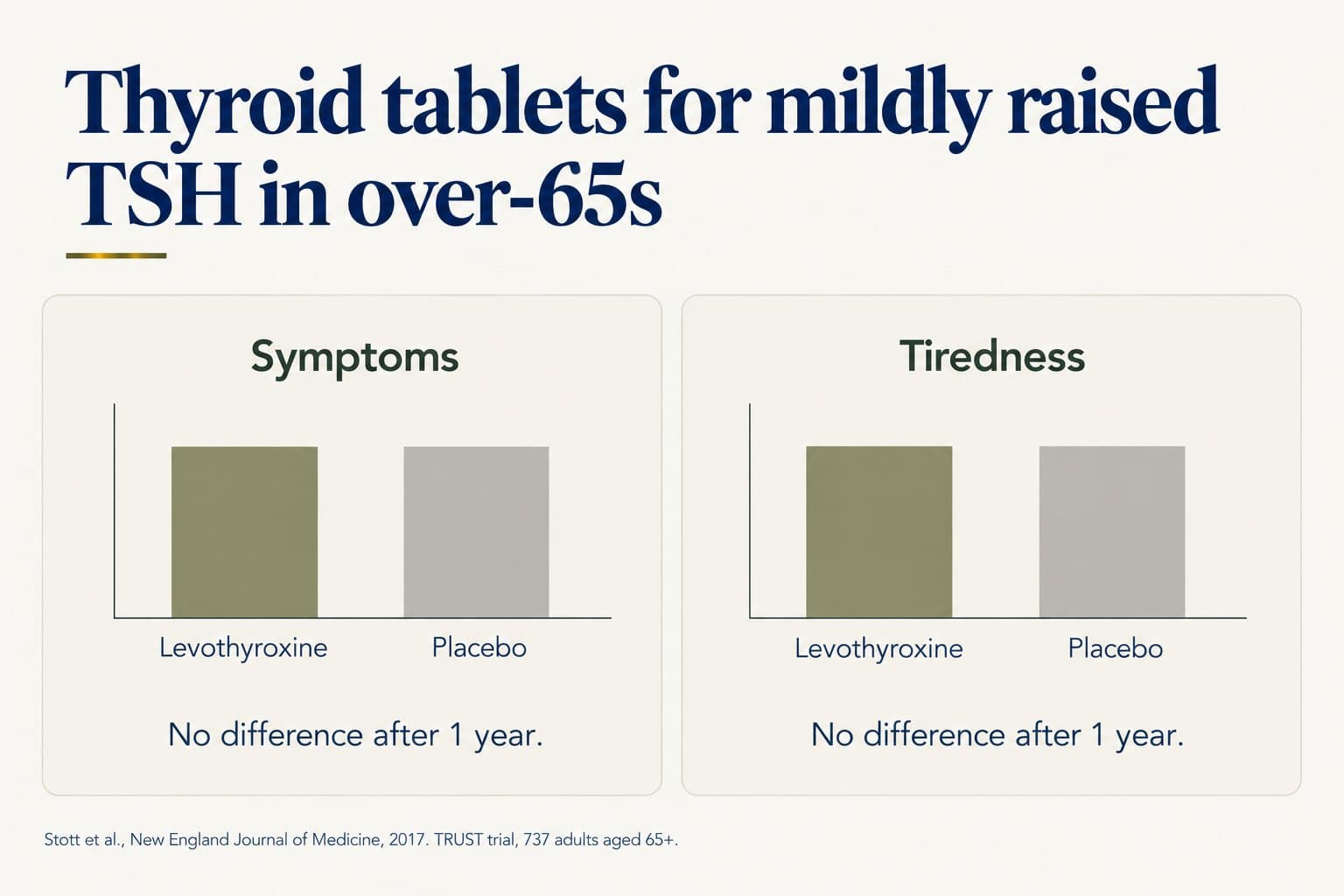
Treating mild subclinical hypothyroidism in older adults didn't help. The TRUST trial randomised 737 adults aged 65 and over (average age 74) with subclinical hypothyroidism, a TSH of 4.6-19.99 mIU/L with normal free T4, to levothyroxine or placebo. After one year, there was no difference between groups in thyroid-related symptoms or tiredness. The researchers concluded that levothyroxine provided no apparent benefit in older people with subclinical hypothyroidism. Most participants had only mildly raised TSH, so the results apply most clearly to that group.
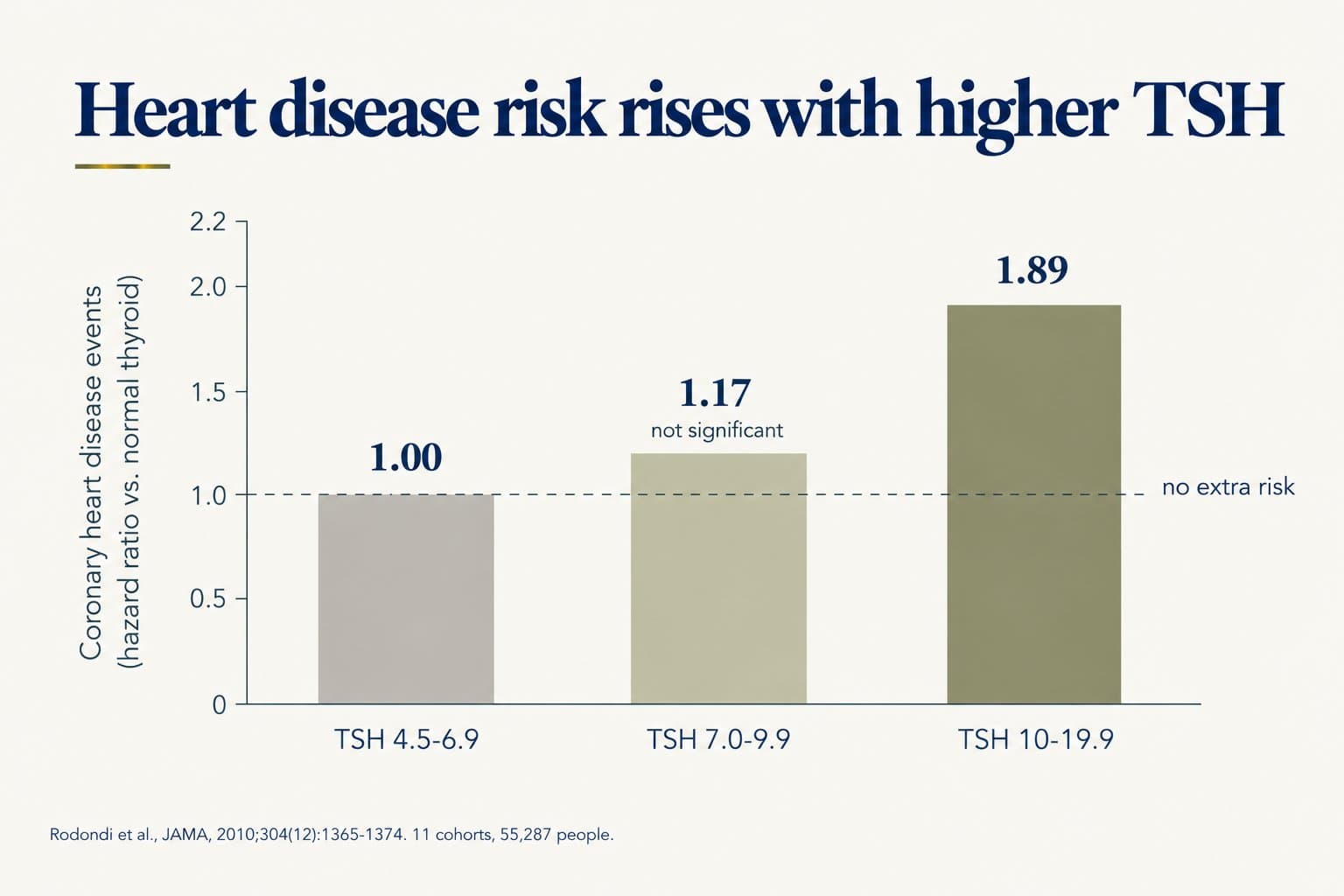
Higher TSH levels are linked to heart disease. A 2010 analysis pooled 11 cohort studies with 55,287 people to look at subclinical hypothyroidism and heart disease. The risk depended on how high TSH was:
- →TSH 4.5-6.9: no increase in coronary heart disease events (HR 1.00).
- →TSH 7.0-9.9: a small, non-significant increase in events (HR 1.17), though heart disease deaths were higher (HR 1.42).
- →TSH 10-19.9: 89% higher risk of heart disease events (HR 1.89) and 58% higher risk of heart disease death (HR 1.58).
Overall deaths weren't increased. This is one reason many guidelines treat a TSH of 10 or more differently from milder rises. However, these are observational findings, and trials haven't shown that treatment reduces heart disease in this group.
Too much thyroid hormone is a risk too. A low TSH, which is often caused by taking a higher dose of thyroid medication than needed, carries its own risks. A 2024 meta-analysis found that subclinical hyperthyroidism was linked to about twice the risk of atrial fibrillation (RR 1.99), an irregular heart rhythm that raises stroke risk. Too much thyroid hormone can also speed up bone loss. For older adults on thyroid medication, getting the dose right, and not over-treating, is important.
What you can actually change
1. Interpret results in context. A mildly raised TSH in an older person is often normal for their age. Ask whether your result is outside the age-appropriate range and whether free T4 is normal.
2. Repeat before acting. TSH can fluctuate, and a single abnormal result is often repeated after a few weeks or months before any decision about treatment.
3. Don't treat numbers alone. For mildly raised TSH without clear symptoms, monitoring is often better than treatment, especially in older adults. Symptoms such as tiredness, weight gain or low mood have many other causes.
4. If you take thyroid medication, get your dose checked. Regular monitoring helps avoid both under- and over-treatment. Over-treatment raises the risk of atrial fibrillation and bone loss.
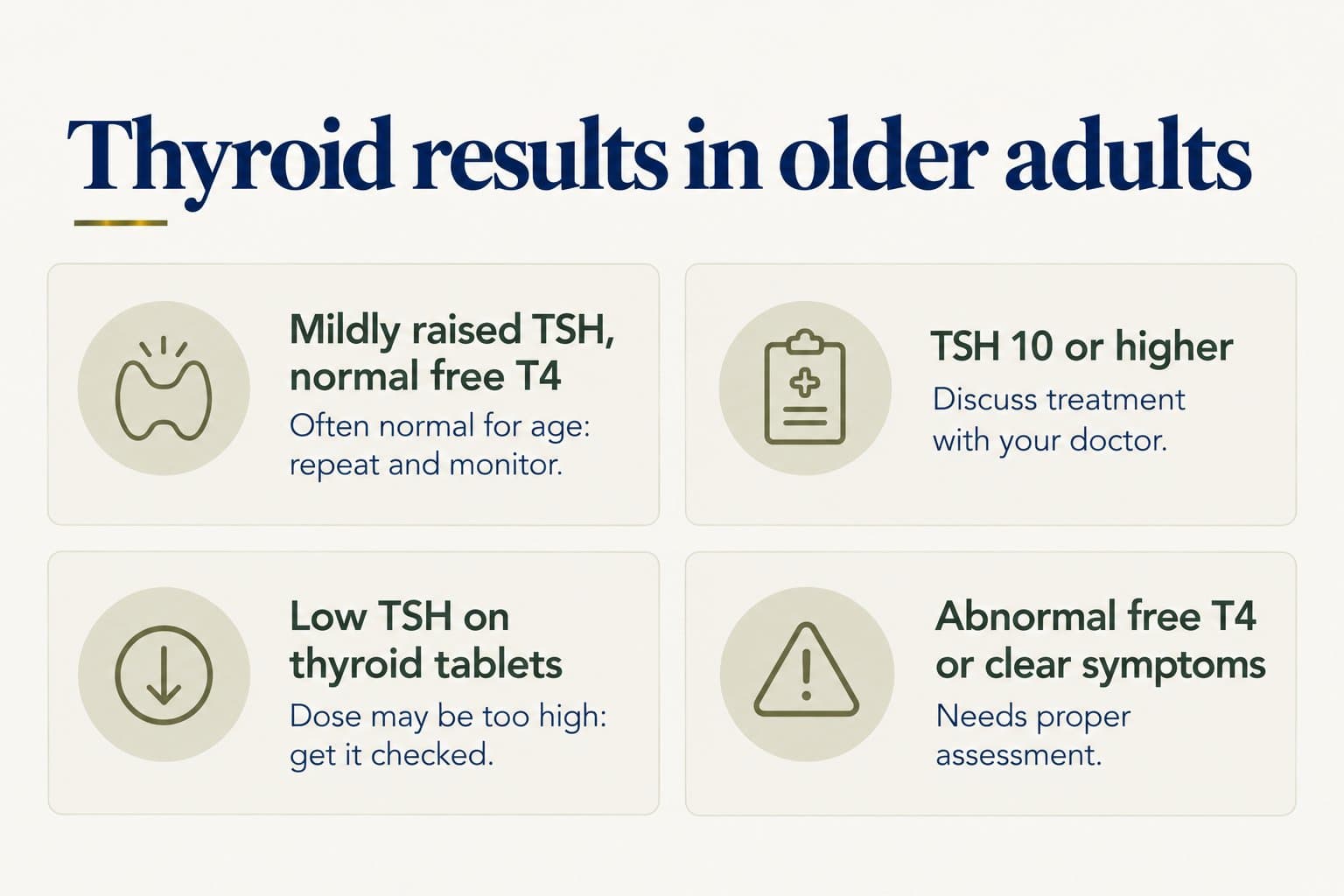
5. Know when to take it seriously. A TSH of 10 or more, a low free T4, a low TSH with a high free T4, or clear symptoms of an under- or overactive thyroid need proper medical assessment and often treatment.
Recommendations
- →Don't panic about a "borderline" TSH. In older adults, mild rises are common and often normal for age.
- →Ask for free T4 alongside TSH to separate subclinical from overt thyroid disease.
- →Repeat abnormal tests before starting treatment.
- →Take a TSH of 10 or more seriously, and discuss the pros and cons of treatment with your doctor.
- →If you're on thyroid medication, have your levels checked regularly to avoid over-treatment.
- →Look for other causes of tiredness and low mood, such as poor sleep, anaemia, depression or medications, rather than assuming a mildly raised TSH is to blame.
Practical notes
Thyroid disease is common with age, but so is over-diagnosis. TSH naturally rises as people get older, and many "borderline" results are normal for age. In older adults with mildly raised TSH, thyroid hormone tablets haven't improved symptoms. Higher TSH levels, of 10 or more, are linked to heart disease and deserve closer attention, while too much thyroid hormone raises the risk of atrial fibrillation. The practical message is to interpret thyroid tests in the context of age, symptoms and repeat results, and to avoid both under- and over-treatment.
- Surks MI, Hollowell JG. Age-specific distribution of serum thyrotropin and antithyroid antibodies in the U.S. population: implications for the prevalence of subclinical hypothyroidism. Journal of Clinical Endocrinology & Metabolism, 2007;92(12):4575-4582.
- Stott DJ, et al. Thyroid Hormone Therapy for Older Adults with Subclinical Hypothyroidism (TRUST). New England Journal of Medicine, 2017;376(26):2534-2544.
- Rodondi N, et al. Subclinical hypothyroidism and the risk of coronary heart disease and mortality. JAMA, 2010;304(12):1365-1374.
- Singh, et al. Subclinical thyroid dysfunction and the risk of incident atrial fibrillation: a systematic review and meta-analysis. PLOS ONE, 2024.
Have you been told your thyroid
result is "borderline"?
Take the free Aevum Protocol assessment to see how your stress & hormones and 6 other longevity domains are performing — and get a personalised 90-day plan.
Take the Free Assessment →