Stress & Hormones
Menopausal Hormone Therapy:
What the Evidence Shows About Benefits and Risks
Menopausal hormone therapy (MHT, also called HRT) has had a turbulent reputation. In 2002, a major trial, the Women's Health Initiative (WHI), was stopped early after combined oestrogen and progestin raised the risk of breast cancer, heart disease, stroke and blood clots. Use fell sharply around the world. Two decades of further analysis have produced a more nuanced picture. MHT is the most effective treatment for hot flushes and night sweats, cutting their frequency by about 75% in trials, and it prevents bone loss and fractures. Its risks depend heavily on age, timing, type and route: for most healthy women under 60 or within 10 years of menopause who have troublesome symptoms, the benefits outweigh the risks. After 18 years of follow-up, the WHI found no increase in deaths overall. But MHT isn't recommended to prevent heart disease or dementia, and combined therapy carries a small increase in breast cancer risk. This article sets out what's well established, what's less certain, and how to weigh it up.
Key numbers
| Finding | Detail |
|---|---|
| Hot flushes (Cochrane review, 24 trials, 3,329 women) | Oral hormone therapy reduced weekly hot flush frequency by 75% compared with placebo |
| WHI oestrogen plus progestin (16,608 women aged 50-79, stopped after 5.2 years) | Per 10,000 women a year: 7 more heart events, 8 more strokes, 8 more lung clots and 8 more invasive breast cancers; 6 fewer bowel cancers and 5 fewer hip fractures |
| Long-term deaths (WHI, 27,347 women, 18 years' follow-up) | No difference in deaths from any cause (HR 0.99) |
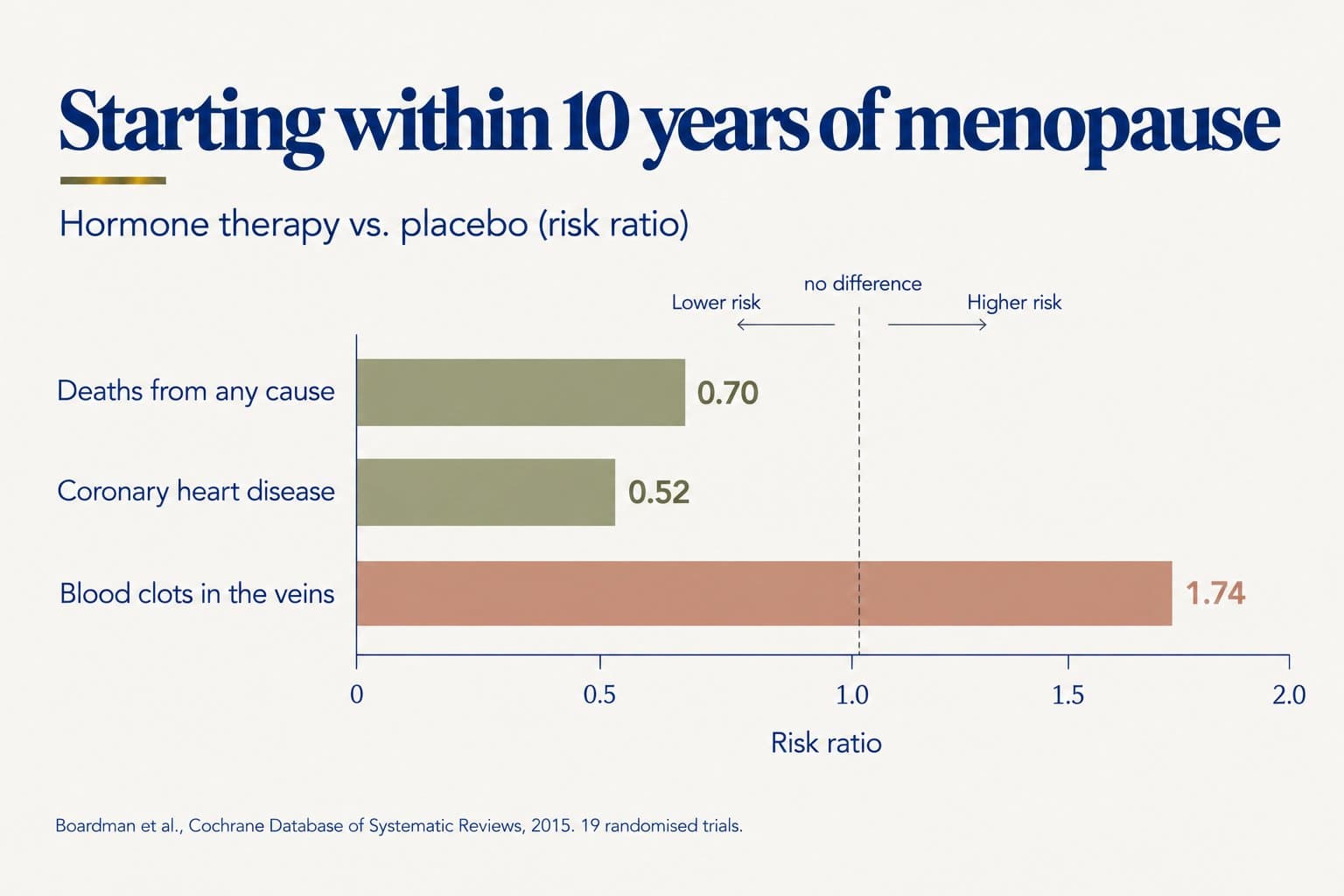
| Starting within 10 years of menopause (Cochrane review of 19 trials) | Lower death rate (RR 0.70) and less heart disease (RR 0.52), but more blood clots (RR 1.74) |
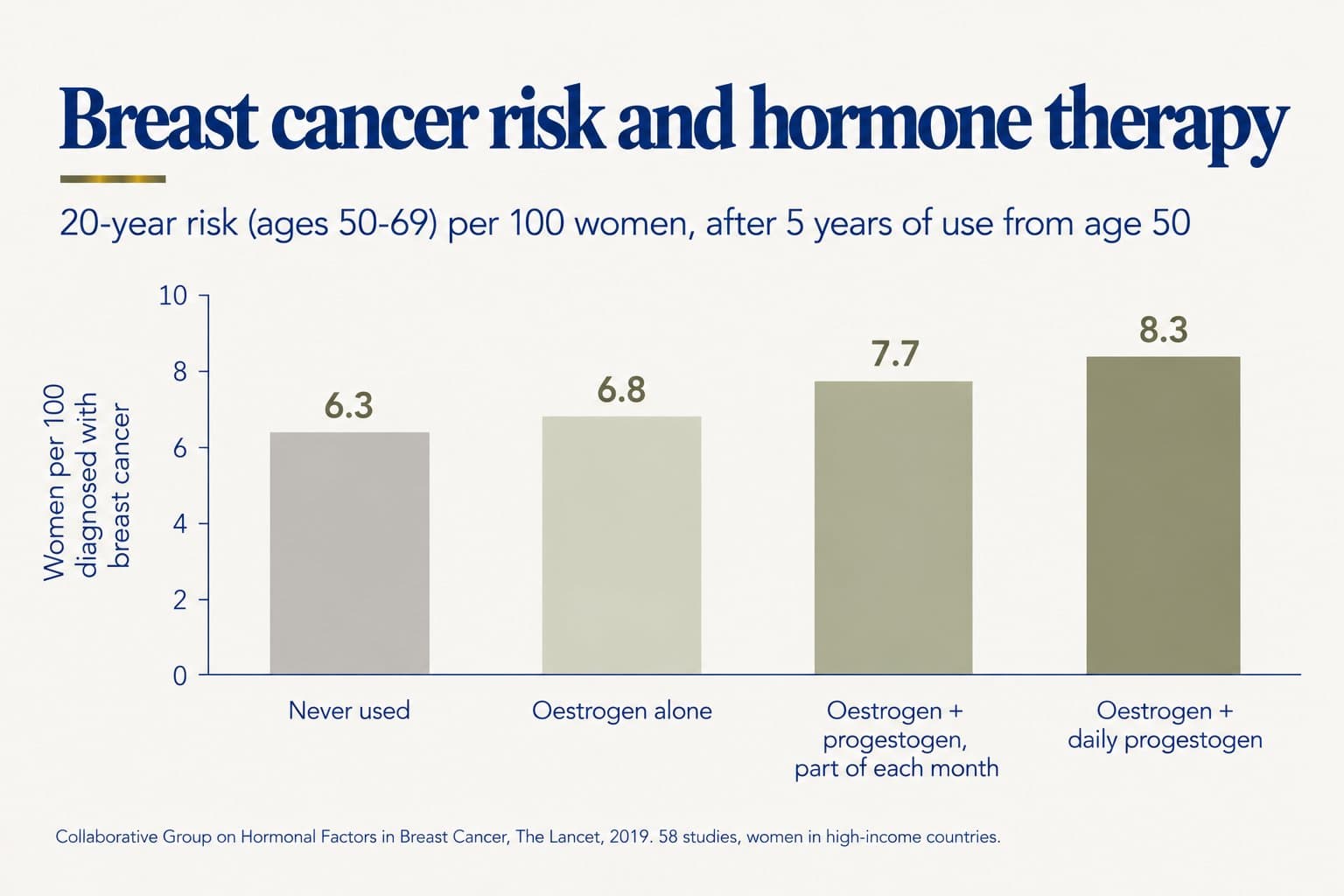
| Breast cancer, 5 years of use from age 50 (58 studies) | 20-year risk rose from 6.3 in 100 women (never users) to 8.3 with daily combined therapy and 6.8 with oestrogen alone |
| Blood clots by route (UK study, 5,795 cases) | Oral HRT raised the odds (OR 1.58); skin patches and gels did not (OR 0.93) |
What menopausal hormone therapy is
MHT replaces the oestrogen the ovaries stop making at menopause (see Menopause and Long-Term Health). The main types are:
- →Oestrogen alone: for women who have had a hysterectomy.
- →Oestrogen plus a progestogen: for women who still have a uterus. The progestogen protects the lining of the womb, because oestrogen alone raises the risk of womb (endometrial) cancer. It can be taken every day or for part of each month.
- →Systemic vs. local: systemic MHT (tablets, patches, gels or sprays) treats whole-body symptoms such as hot flushes. Low-dose vaginal oestrogen treats vaginal dryness and urinary symptoms and is absorbed in very small amounts.
The route matters. Oestrogen taken by mouth passes through the liver first, which affects clotting factors. Oestrogen absorbed through the skin (patches, gels, sprays) largely avoids this.
Why the picture changed after 2002
The WHI tested one oral regimen, conjugated equine oestrogen with medroxyprogesterone acetate, in women aged 50-79 with an average age of 63. Most were many years past menopause, and the aim was to see whether MHT prevented chronic disease, not to treat symptoms. The combined therapy trial was stopped after 5.2 years because the overall risks exceeded the benefits, and the researchers advised against starting this regimen to prevent disease.
Later analyses, looking at age and time since menopause, found that risks were lower, and some outcomes better, in women who started MHT closer to menopause. This became known as the "timing hypothesis". Current guidance reflects both lessons: MHT is appropriate for treating symptoms in suitable women, but not for disease prevention.
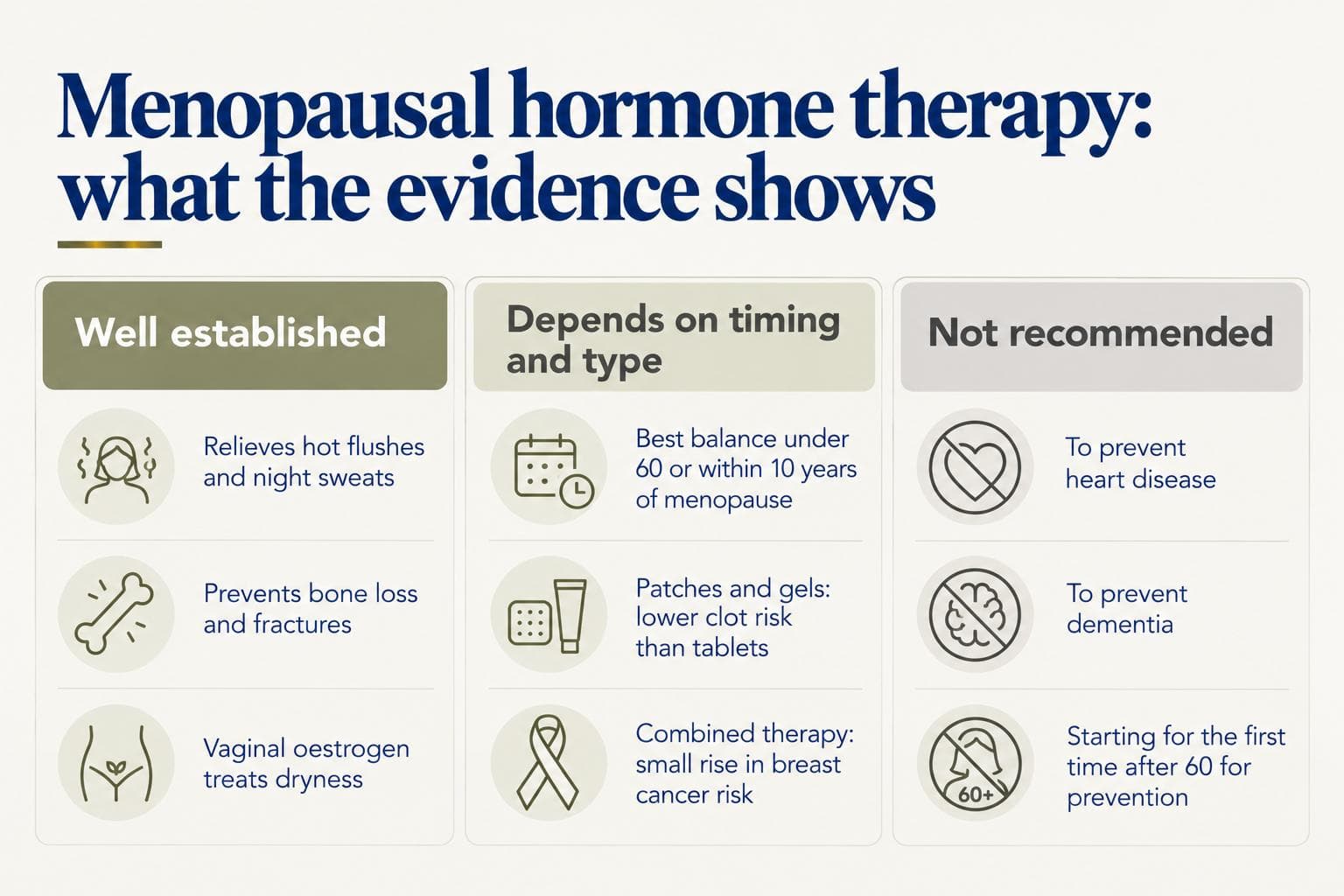
Evidence strength
Well established: symptom relief. A Cochrane review of 24 randomised trials with 3,329 women found that oral hormone therapy cut the weekly frequency of hot flushes by 75% compared with placebo, and substantially reduced their severity. The placebo groups also improved by about 58%, which is worth knowing: hot flushes tend to ease over time, and any treatment should be judged against that.
MHT also improves night sweats and the sleep disruption that comes with them. Vaginal oestrogen is highly effective for the genitourinary syndrome of menopause (vaginal dryness, pain during sex and urinary symptoms), as covered in Perimenopause: Signs and Symptoms.
Well established: bone protection. In the WHI, combined therapy reduced hip fractures by about a third (HR 0.66). The North American Menopause Society's 2022 position statement notes that hormone therapy "has been shown to prevent bone loss and fracture". The protection fades after stopping, so bone health still depends on exercise, protein, calcium and vitamin D (see Bone Density and Resistance Training).
Well established: some risks are real.
- →Blood clots and stroke: across 19 trials with 40,410 women, hormone therapy increased stroke (RR 1.24) and blood clots in the veins (RR 1.92). In the WHI, combined therapy doubled the risk of a clot in the lungs (HR 2.13).
- →Breast cancer with combined therapy: in the WHI, combined therapy raised breast cancer risk (HR 1.26 during the trial, 1.28 after about 20 years of follow-up).
- →Dementia when started late: in the WHI Memory Study of about 4,500 women aged 65 and older, combined therapy doubled the risk of probable dementia (HR 2.05) over about four years.
Moderate: timing changes the balance. A Cochrane review of 19 trials found no overall protection against heart disease or death. But in women who started within 10 years of menopause, hormone therapy was linked to lower death rates (RR 0.70) and less coronary heart disease (RR 0.52), though blood clots were still more common (RR 1.74). The WHI's 18-year follow-up of 27,347 women found no overall difference in deaths from any cause (HR 0.99), and during the treatment period, women aged 50-59 had a lower death rate (HR 0.69).
These findings support starting MHT, when it's needed, closer to menopause. They don't show that MHT prevents heart disease, and subgroup results like these are less reliable than a trial's main result.
Moderate: breast cancer risk depends on type and duration. The largest analysis, pooling 58 studies and 108,647 women with breast cancer, found that all types of systemic MHT were linked to higher breast cancer risk, with greater risk for combined therapy than for oestrogen alone. For women in high-income countries taking MHT for 5 years from age 50, the 20-year risk of breast cancer (ages 50-69) was:
- →6.3 in 100 for women who never used MHT
- →6.8 in 100 with oestrogen alone (about 1 extra case per 200 users)
- →7.7 in 100 with oestrogen plus a progestogen taken part of each month (about 1 in 70)
- →8.3 in 100 with oestrogen plus a daily progestogen (about 1 in 50)
Ten years of use roughly doubled the excess risk, use for less than a year added little, and some excess risk persisted for more than 10 years after stopping. Vaginal oestrogen was not linked to higher risk.
The evidence isn't entirely consistent. This analysis was observational, while in the WHI's randomised trial, oestrogen alone actually lowered breast cancer risk (HR 0.78) and breast cancer deaths over 20 years. The clearest message is that combined therapy carries a small, duration-dependent increase in risk, and oestrogen alone carries little or none.
Moderate: route and type matter. In a UK study of 5,795 women with blood clots, oral HRT was linked to higher odds of a clot (OR 1.58), about 9 extra cases per 10,000 women a year, while patches and gels were not (OR 0.93). Estradiol carried lower risk than conjugated equine oestrogen. The 2022 NAMS statement says transdermal routes and lower doses "may decrease risk of venous thromboembolism and stroke". This comes mainly from observational data rather than head-to-head trials.
Not supported: disease prevention. MHT isn't recommended to prevent heart disease, dementia or other chronic diseases in women without symptoms. Starting it for the first time after 60, or more than 10 years after menopause, carries more risk and less benefit.
Recommendations by situation
- →You're under 60 or within 10 years of menopause, with troublesome hot flushes or night sweats: MHT is the most effective option, and for most healthy women the benefits outweigh the risks. Discuss your personal risk factors, the type and the route with your doctor.
- →You still have a uterus: you'll need a progestogen with oestrogen to protect the womb lining.
- →You have a higher risk of blood clots, or are overweight: ask whether a patch or gel is suitable rather than tablets.
- →You mainly have vaginal dryness or urinary symptoms: low-dose vaginal oestrogen is highly effective and absorbed in very small amounts.
- →You're over 60 or more than 10 years past menopause and haven't used MHT: the balance is less favourable; non-hormonal options are usually considered first.
- →You're already on MHT and turning 60 or 65: there's no automatic stopping age. The 2022 NAMS statement says MHT "does not need to be routinely discontinued" and can continue for persistent symptoms or bone protection after individual review.
- →You've had breast cancer, a blood clot, a stroke, heart disease or liver disease: systemic MHT is usually not appropriate, and specialist advice is needed.
- →You're hoping MHT will prevent heart disease or dementia: it isn't recommended for that purpose.
Custom-compounded "bioidentical" hormones are covered in Bioidentical and Compounded Hormones, and hormone level testing in Hormone Testing.
Practical notes
Menopausal hormone therapy is neither the danger it was portrayed as after 2002 nor a general anti-ageing treatment. For healthy women with troublesome symptoms who start it before 60 or within 10 years of menopause, it's the most effective treatment available, protects bone, and, on long-term follow-up, hasn't increased deaths. Its risks, especially blood clots, stroke and a small increase in breast cancer with combined therapy, depend on age, timing, type, route and duration. The best decisions are individual: based on your symptoms, your personal and family history, and a regular review of whether MHT is still needed.
- Rossouw JE, et al. Risks and benefits of estrogen plus progestin in healthy postmenopausal women: principal results from the Women's Health Initiative randomized controlled trial. JAMA, 2002;288(3):321-333.
- MacLennan AH, Broadbent JL, Lester S, Moore V. Oral oestrogen and combined oestrogen/progestogen therapy versus placebo for hot flushes. Cochrane Database of Systematic Reviews, 2004.
- Manson JE, et al. Menopausal hormone therapy and long-term all-cause and cause-specific mortality: the Women's Health Initiative randomized trials. JAMA, 2017;318(10):927-938.
- Boardman HMP, et al. Hormone therapy for preventing cardiovascular disease in post-menopausal women. Cochrane Database of Systematic Reviews, 2015.
- Collaborative Group on Hormonal Factors in Breast Cancer. Type and timing of menopausal hormone therapy and breast cancer risk: individual participant meta-analysis of the worldwide epidemiological evidence. The Lancet, 2019;394(10204):1159-1168.
- Chlebowski RT, et al. Association of menopausal hormone therapy with breast cancer incidence and mortality during long-term follow-up of the Women's Health Initiative randomized clinical trials. JAMA, 2020;324(4):369-380.
- Vinogradova Y, Coupland C, Hippisley-Cox J. Use of hormone replacement therapy and risk of venous thromboembolism: nested case-control studies using the QResearch and CPRD databases. BMJ, 2019;364:k4810.
- Shumaker SA, et al. Estrogen plus progestin and the incidence of dementia and mild cognitive impairment in postmenopausal women: the Women's Health Initiative Memory Study. JAMA, 2003;289(20):2651-2662.
- The North American Menopause Society. The 2022 hormone therapy position statement of The North American Menopause Society. Menopause, 2022;29(7):767-794.
Are menopausal symptoms affecting
your sleep, work or wellbeing?
Take the free Aevum Protocol assessment to see how your stress & hormones and 6 other longevity domains are performing — and get a personalised 90-day plan.
Take the Free Assessment →