Stress & Hormones
Bioidentical and Compounded Hormones:
What the Labels Mean and What the Evidence Shows
"Bioidentical" hormones are often marketed as natural, safer and personalised alternatives to conventional hormone therapy. The reality is more nuanced. "Bioidentical" simply means a hormone with the same chemical structure as the one the body makes, and many regulated, licensed products already fit that description, such as estradiol patches and gels and micronized progesterone. The real distinction is between these licensed products and custom-mixed "compounded" preparations. A 2020 review by the US National Academies found "a lack of rigorous safety and effectiveness data" for compounded bioidentical hormones, and recommended restricting their use to rare situations such as allergies. Compounded products can vary in strength, progesterone creams may not protect the womb, and in one study women using hormone pellets had far more side effects than women on approved therapy. This article explains the terms, the evidence and how to choose safely.
Key numbers
| Finding | Detail |
|---|---|
| US National Academies review (2020) | "A lack of rigorous safety and effectiveness data" for compounded bioidentical hormones; use should be restricted |
| Scale of use in the US | An estimated 26-33 million compounded hormone prescriptions a year |
| Women who knew compounded hormones aren't FDA-approved (survey of nearly 3,000 women) | 14% |
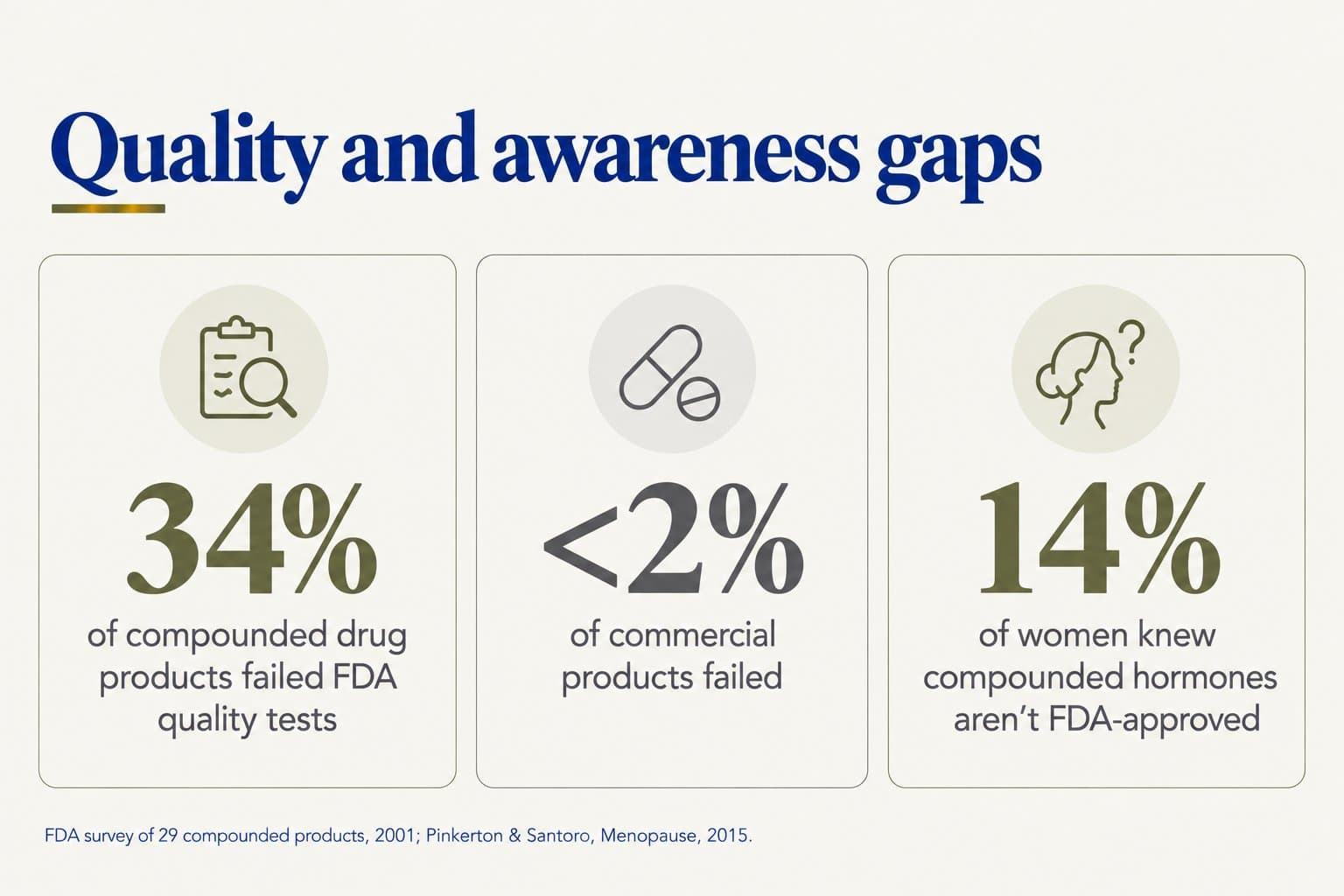
| FDA quality testing of compounded drugs (2001, 29 products) | 34% failed quality tests, mostly for low strength, vs under 2% of commercial products |
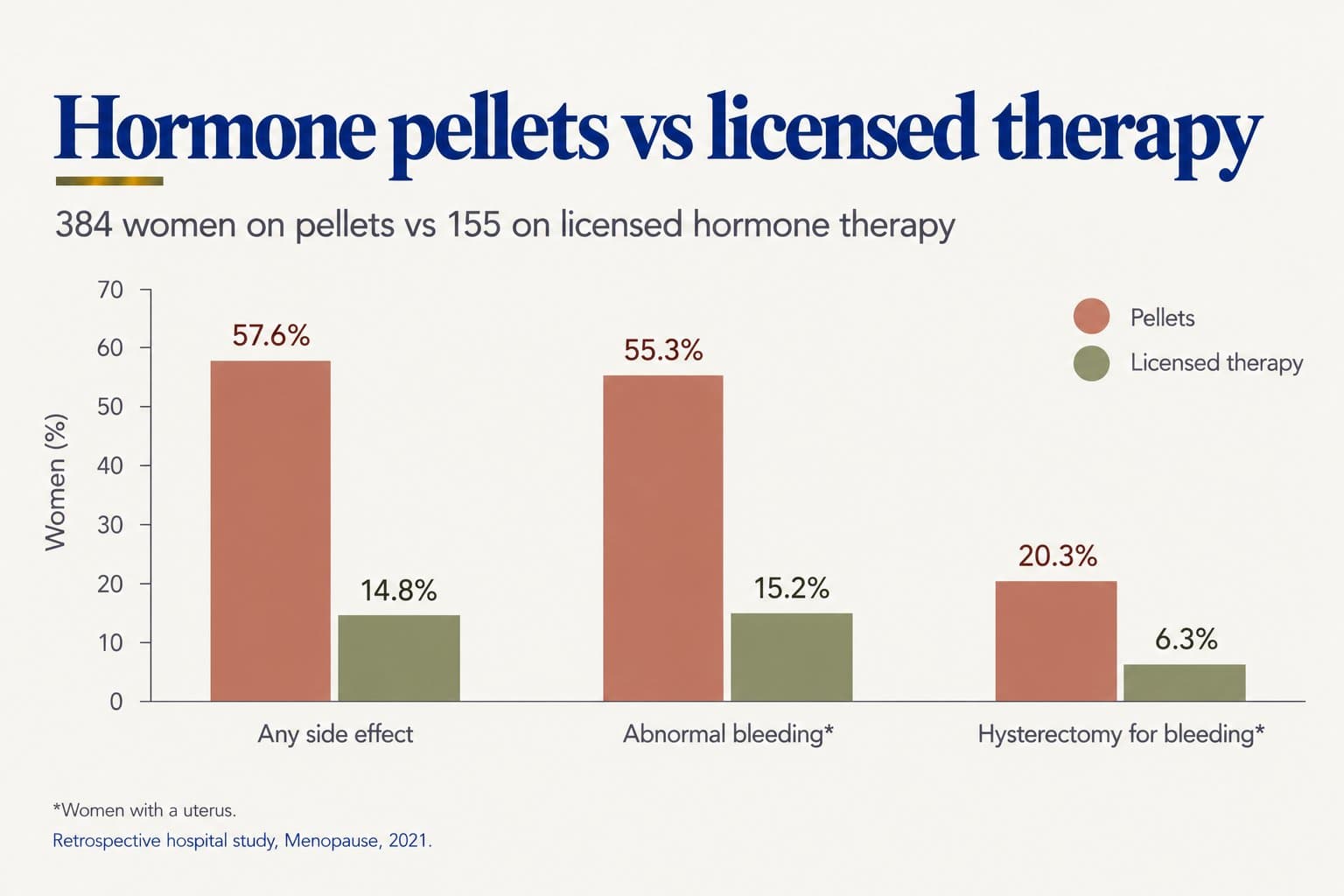
| Hormone pellets vs approved therapy (384 vs 155 women) | Side effects in 57.6% vs 14.8%; abnormal bleeding in 55.3% vs 15.2% of women with a uterus |
What the terms mean
Bioidentical hormones have the same molecular structure as the hormones the body makes, such as estradiol, progesterone and testosterone. They're usually made in a laboratory from plant sources, such as soy or yams. "Natural" is a marketing term: the body can't convert yam or soy extracts into these hormones on its own.
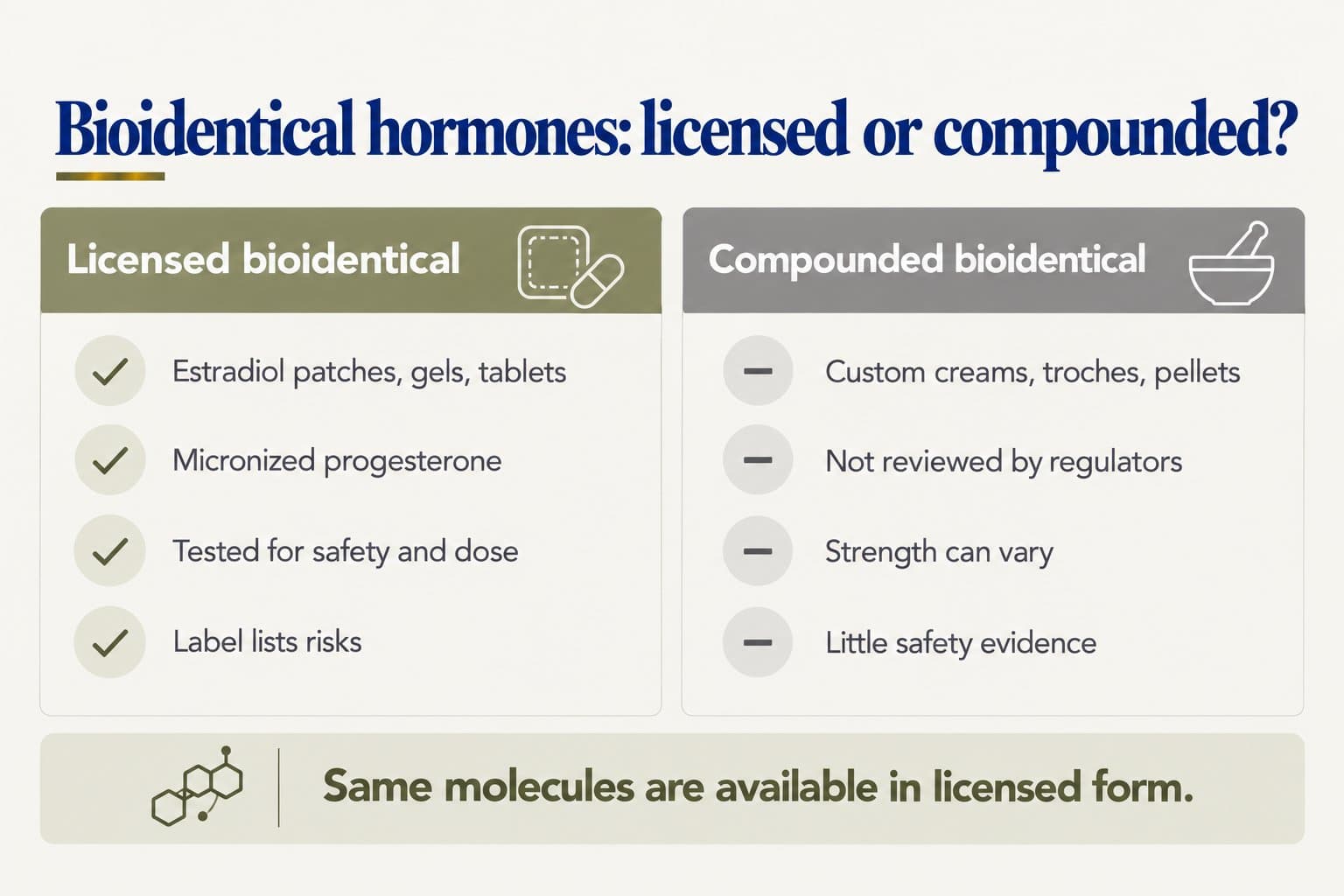
Licensed (regulated) bioidentical hormones are made by pharmaceutical companies, tested for safety, effectiveness and consistent dosing, and come with a label listing risks. Examples include:
- →Estradiol patches, gels, sprays and tablets
- →Micronized progesterone capsules
- →Vaginal estradiol tablets, rings and creams
These are the forms often recommended in modern menopausal hormone therapy (see Menopausal Hormone Therapy).
Compounded bioidentical hormones are mixed by a pharmacy for an individual patient, often as creams, gels, troches (lozenges), capsules or implanted pellets, sometimes combining several hormones, such as estradiol, estriol, progesterone, testosterone and DHEA. They aren't reviewed by regulators for safety or effectiveness, and doses are often adjusted based on saliva or blood hormone tests.
Evidence strength
Well established: licensed bioidentical hormones work and are well studied. Estradiol and micronized progesterone are standard, licensed treatments. Transdermal estradiol has a lower risk of blood clots than oral oestrogen in observational studies, and micronized progesterone is widely used to protect the womb lining. Women who want "bioidentical" hormones can get them in licensed form.
Well established: compounded hormones lack evidence of safety and effectiveness. In 2020, the US National Academies of Sciences, Engineering, and Medicine reviewed the evidence at the request of the FDA. It found "a lack of rigorous safety and effectiveness data" and that the data "were insufficient to support claims for the overall clinical utility" of compounded bioidentical hormones. It recommended that prescribers restrict their use to patients with a documented allergy to an ingredient in a licensed product, or who need a form that isn't available, and stated that "patient preference alone should not determine the use" of these preparations. It also recommended reviewing pellet products as potentially too difficult to compound safely.
Major medical societies agree. The North American Menopause Society says compounded hormones present "safety concerns, such as minimal government regulation and monitoring, overdosing or underdosing, presence of impurities or lack of sterility, lack of scientific efficacy and safety data, and lack of a label outlining risks". The American College of Obstetricians and Gynecologists advises doctors not to routinely prescribe them when licensed options are available.
Well established: doses can be unreliable. When the FDA tested 29 compounded drug products in 2001, 34% failed quality tests, almost all because they contained less of the active ingredient than stated. This compared with a failure rate of under 2% for commercially manufactured medicines. That survey covered compounded medicines in general, not only hormones, but it illustrates the risk of inconsistent dosing.
A survey of nearly 3,000 US women found that only 14% correctly knew that compounded bioidentical hormones aren't FDA-approved.
Well established: progesterone creams may not protect the womb. Women who have a uterus and take oestrogen need enough progestogen to protect the womb lining from overgrowth and cancer. The British Menopause Society states that progesterone absorbed through the skin "does not provide sufficient endometrial protection" and that there's no evidence the doses in compounded preparations are enough. Compounded regimens that combine oestrogen with a progesterone cream may leave the womb unprotected.
Moderate: hormone pellets carry extra risks. Pellets are small implants placed under the skin that release hormones for several months, and can't be removed once placed. A retrospective study from a US hospital compared 384 women using compounded pellets with 155 women using licensed hormone therapy. Women on pellets had much higher, above-normal levels of estradiol and testosterone, and more side effects overall (57.6% vs 14.8%), including anxiety, weight gain, hair changes, acne and breast tenderness. Among women with a uterus, abnormal bleeding occurred in 55.3% vs 15.2%, and hysterectomy for bleeding in 20.3% vs 6.3%. This was an observational study, but its findings are consistent with the concerns raised by regulators.
Not supported: the marketing claims.
- →"Safer than conventional hormones": there's no good evidence that compounded hormones are safer. Without large studies, their risks are simply unknown, and they don't carry the warnings that licensed products do.
- →"Personalised dosing based on saliva tests": saliva hormone levels vary widely and don't reliably reflect symptoms or tissue levels. ACOG states that hormone testing for prescribing or dosing "is not recommended".
- →Estriol as a "safe oestrogen": there's no good evidence that it's safer than estradiol when used systemically.
Recommendations by situation
- →You want bioidentical hormones for menopausal symptoms: ask about licensed options such as estradiol patches or gels with micronized progesterone. You get the bioidentical molecules with proven quality and dosing.
- →You're currently using compounded hormones: don't stop suddenly, but discuss switching to a licensed product with your doctor. If you have a uterus and use a progesterone cream, ask whether your womb lining is adequately protected.
- →You have any unexpected vaginal bleeding while on hormones: see a doctor promptly.
- →You're offered hormone pellets: be aware that doses can't be adjusted or removed once implanted, and pellets have been linked to above-normal hormone levels and more side effects.
- →You're offered saliva or repeated blood tests to "balance" your hormones: menopausal hormone therapy is usually guided by symptoms, not levels (see Perimenopause: Signs and Symptoms).
- →You're allergic to an ingredient in a licensed product: compounding may be a reasonable option, ideally from an accredited pharmacy and with regular review.
Hormone testing, including when it's useful and when it isn't, is covered in Hormone Testing.
Practical notes
"Bioidentical" describes a molecule, not a product's safety. Licensed bioidentical hormones, such as estradiol patches and gels and micronized progesterone, are well tested and widely recommended. Custom-compounded hormones, including creams, troches and pellets, lack rigorous evidence of safety and effectiveness, can vary in strength, may not protect the womb, and aren't recommended except in rare situations. For women who want bioidentical hormones, the safest route is usually a licensed product, prescribed after a proper assessment and reviewed regularly.
- National Academies of Sciences, Engineering, and Medicine. The Clinical Utility of Compounded Bioidentical Hormone Therapy: A Review of Safety, Effectiveness, and Use. Washington, DC: The National Academies Press, 2020.
- The North American Menopause Society. The 2022 hormone therapy position statement of The North American Menopause Society. Menopause, 2022;29(7):767-794.
- American College of Obstetricians and Gynecologists. Compounded Bioidentical Menopausal Hormone Therapy. Clinical Consensus No. 6. Obstetrics & Gynecology, 2023.
- Pinkerton JV, Santoro N. Compounded bioidentical hormone therapy: identifying use trends and knowledge gaps among US women. Menopause, 2015;22(9):926-936.
- US Food and Drug Administration. Report: Limited FDA Survey of Compounded Drug Products. 2001.
- Hamoda H, et al. British Menopause Society tools for clinicians: Progestogens and endometrial protection. Post Reproductive Health, 2022.
- Jiang X, et al. Safety assessment of compounded non-FDA-approved hormonal therapy versus FDA-approved hormonal therapy in treating postmenopausal women. Menopause, 2021;28(8):867-874.
Do you know whether your hormones
are licensed or compounded?
Take the free Aevum Protocol assessment to see how your stress & hormones and 6 other longevity domains are performing — and get a personalised 90-day plan.
Take the Free Assessment →