Stress & Hormones
Stress, Cortisol and Belly Fat:
What the Evidence Actually Shows
"Stress makes you fat around the middle" is one of the most popular health claims, and it contains some truth. Cortisol, the main stress hormone, encourages fat to be stored around the abdomen, and people with very high cortisol from a medical condition (Cushing's syndrome) develop marked central obesity. Research in the general population also links stress and cortisol to belly fat: women with more abdominal fat released more cortisol under stress in the lab, people with higher long-term cortisol measured in their hair had larger waists, and repeated stressful life events were linked to a growing waistline over seven years. But the effects in everyday life are modest, and much of the link runs through behaviour: stress changes what and how much people eat, how they sleep and how much they move. This article separates the evidence from the hype and explains what actually helps.
Key numbers
| Finding | Detail |
|---|---|
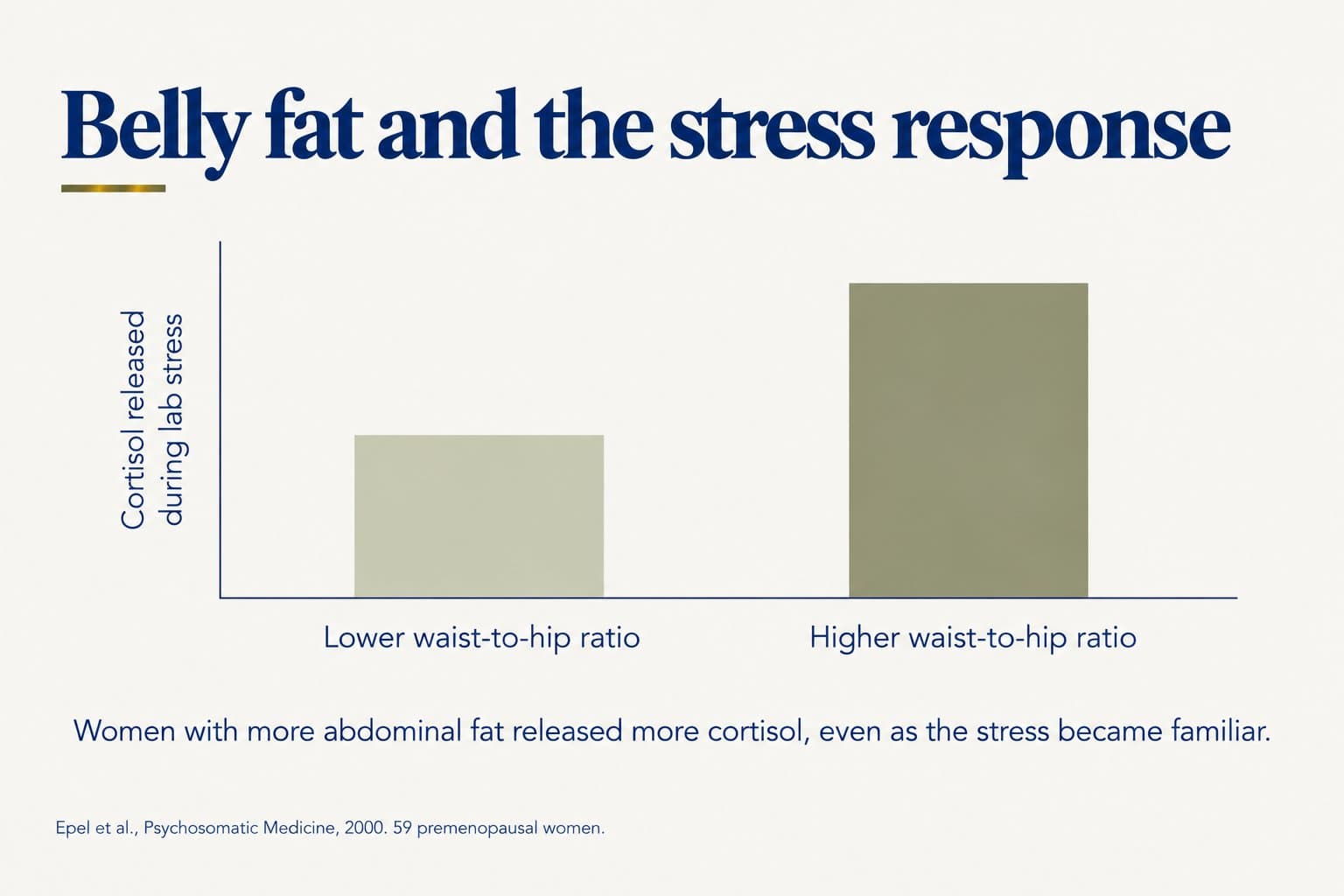
| Women with more abdominal fat, under lab stress (59 premenopausal women) | Released more cortisol, and kept doing so as the stress became familiar |
| Long-term cortisol measured in hair (2,527 adults aged 54+) | Higher in people with larger waists and obesity, and linked to obesity that persisted over 4 years |
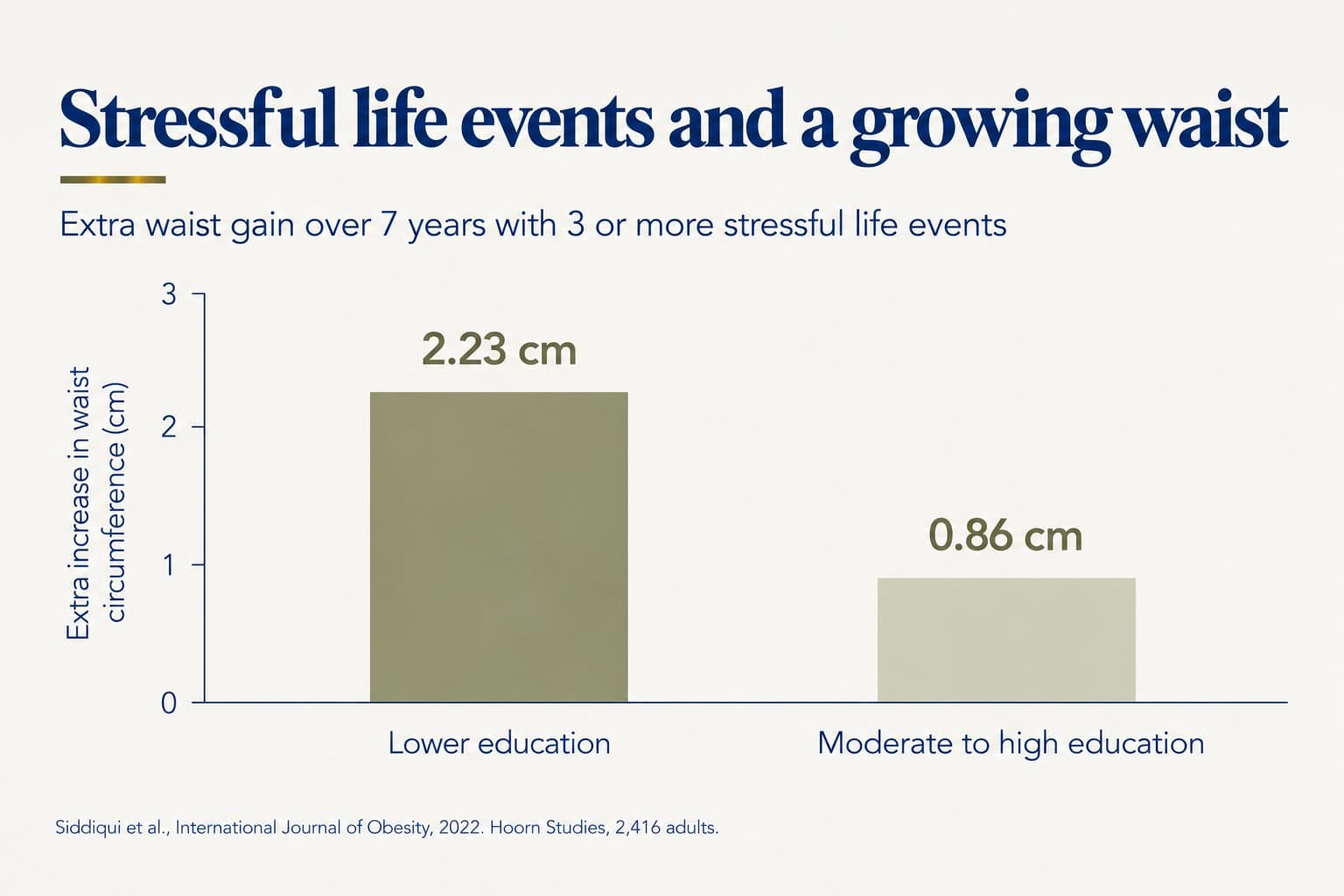
| Three or more stressful life events, over 7 years (Hoorn Studies, 2,416 adults) | Waist grew 2.23 cm more in people with lower education; 0.86 cm more in those with moderate to high education |
| Two nights of short sleep (12 healthy young men) | Fullness hormone leptin down 18%, hunger hormone ghrelin up 28% |
How stress could lead to belly fat
Cortisol favours abdominal fat storage. Cortisol helps mobilise energy during stress (see How the Stress Response Works). But when it stays high, it also promotes fat storage, particularly deep in the abdomen around the organs (visceral fat). Visceral fat tissue is especially responsive to cortisol. The clearest example is Cushing's syndrome, where the body produces too much cortisol and people typically develop marked central obesity, with thinner arms and legs.
Stress changes behaviour. Much of the effect of everyday stress on weight is indirect:
- →Eating: many people eat more under stress, often energy-dense "comfort" foods high in sugar and fat.
- →Sleep: stress disrupts sleep, and short sleep increases hunger hormones (see Insulin and the Metabolic Hormones).
- →Activity: stress and exhaustion reduce the time and energy for exercise.
- →Alcohol and smoking: often increase under stress.
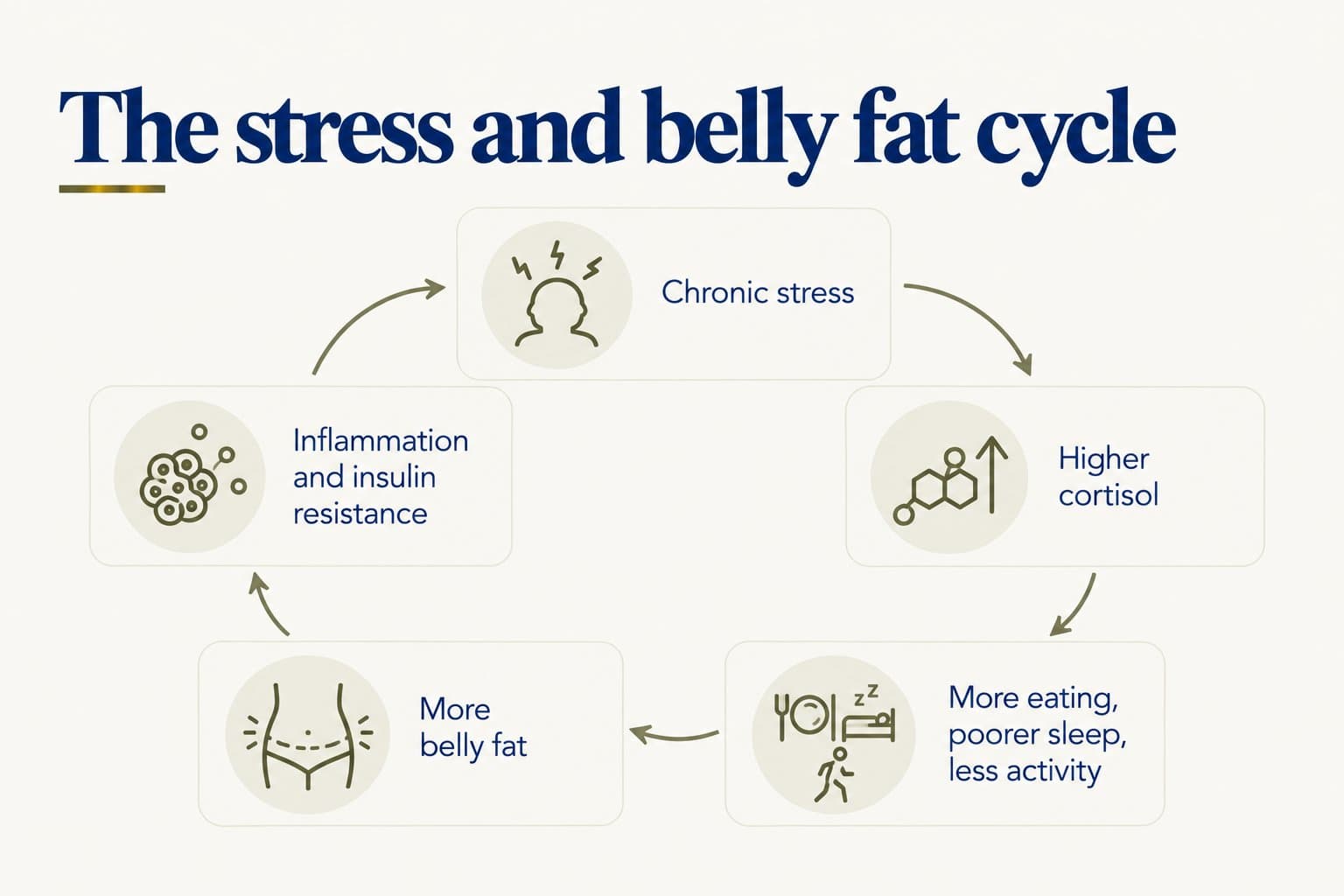
A two-way cycle. Belly fat is also linked to inflammation, insulin resistance and poorer sleep, all of which can add to physiological stress. Weight stigma and body-image concerns can themselves be stressful. This can create a cycle in which stress and abdominal fat reinforce each other (see Allostatic Load and Insulin Resistance).
Risk factor table: stress, cortisol and abdominal fat
| Factor | Association | Modifiable? | Evidence strength |
|---|---|---|---|
| Stronger cortisol response to stress | Women with more abdominal fat released more cortisol under lab stress | Partly | Limited (small lab study) |
| Higher long-term cortisol | Higher hair cortisol with larger waist and persistent obesity | Partly | Moderate (large population study; association only) |
| Repeated stressful life events | Larger increase in waist over 7 years, especially with lower education | Partly: support and coping | Moderate (long-term cohort) |
| Short or poor sleep | Raises hunger hormones, lowers fullness hormones | Yes | Moderate |
| Stress-related eating, drinking and inactivity | Main everyday route from stress to weight gain | Yes | Moderate |
| Cushing's syndrome (rare) | Marked central obesity from excess cortisol | Yes: medical treatment | Strong |
What the research shows
People with more belly fat may react more strongly to stress. In a 2000 study, 59 healthy premenopausal women, 30 with a high waist-to-hip ratio and 29 with a low ratio, went through three stressful lab sessions and one rest session over four days. Women with more abdominal fat released significantly more cortisol during the first stress session. Among lean women, those with more fat around the waist kept releasing more cortisol even when the challenges became familiar, suggesting their stress response didn't settle as quickly. They also rated the challenges as more threatening and reported more chronic stress in their lives.
This was a small study that can't show which came first, but it fits the idea that a more reactive stress system and abdominal fat go together.
Long-term cortisol is linked to larger waists. Blood and saliva cortisol change from hour to hour, but cortisol stored in hair reflects levels over the previous months. The English Longitudinal Study of Ageing measured hair cortisol in 2,527 adults aged 54 and over. Higher hair cortisol went with higher weight, BMI and waist circumference, was higher in people with obesity, and was linked to obesity that had persisted over the previous four years. The correlations were small, and the study couldn't show whether cortisol caused weight gain or the other way round (see The Cortisol Rhythm and Health).
Stressful life events and a growing waist. The Hoorn Studies in the Netherlands followed 2,416 adults, average age 56, for seven years. Among people with lower education, experiencing three or more stressful life events was linked to a 0.60 increase in BMI and a 2.23 cm increase in waist circumference. Among people with moderate to high education, only waist size increased significantly, by 0.86 cm. Smoking explained part of the link. The researchers concluded that multiple stressful life events are linked to increases in waist and BMI, particularly in people with fewer resources.
Keeping it in perspective. These studies support a real link between stress, cortisol and belly fat, but the effects in the general population are modest. Diet, physical activity, sleep, alcohol, genetics, age and, for women, menopause (see Menopause and Long-Term Health) are major drivers of abdominal fat. Stress acts partly through these and partly alongside them. Products marketed as "cortisol blockers" or "cortisol belly" cures don't have good evidence behind them.
What you can actually change
1. Break the stress-eating link. Notice when you eat in response to stress rather than hunger. Keep less-healthy snacks out of easy reach, plan regular meals, and have alternatives ready, such as a short walk, a call to a friend or a few minutes of slow breathing.
2. Move every day, including strength training. Exercise reduces visceral fat, improves insulin sensitivity and buffers stress, all at once (see Exercise and Brain Health).
3. Protect your sleep. Seven hours, on a regular schedule, helps keep hunger hormones in check.
4. Reduce ongoing stress and build recovery. Address the biggest sources of long-term stress where you can, and use evidence-based stress-reduction techniques (see Stress-Reduction Techniques That Work).
5. Limit alcohol and don't smoke. Both are linked to abdominal fat and often increase under stress.
6. Know when to get checked. Rapid weight gain around the middle combined with a rounded face, thin skin, easy bruising, purple stretch marks, muscle weakness or high blood pressure can be signs of Cushing's syndrome and should be checked by a doctor. It's rare, but important to recognise.
Recommendations
- →Take stress seriously as one factor in abdominal weight gain, but don't overlook diet, activity, sleep and alcohol.
- →Measure your waist, not just your weight, and track it over time.
- →Target the behaviours that connect stress and weight: eating, sleep, activity and alcohol.
- →Be sceptical of "cortisol belly" supplements and diets.
- →See a doctor if abdominal weight gain is rapid or comes with other unusual symptoms.
Practical notes
Stress and cortisol are linked to belly fat: cortisol favours visceral fat storage, people with more abdominal fat may have stronger cortisol responses, and long-term stress is linked to a growing waistline. But in everyday life the effects are modest, and much of the link runs through eating, sleep, activity and alcohol. The most effective approach tackles both sides: reduce and recover from stress, and directly address the behaviours that drive abdominal fat.
- Epel ES, et al. Stress and body shape: stress-induced cortisol secretion is consistently greater among women with central fat. Psychosomatic Medicine, 2000;62(5):623-632.
- Jackson SE, Kirschbaum C, Steptoe A. Hair cortisol and adiposity in a population-based sample of 2,527 men and women aged 54 to 87 years. Obesity, 2017;25(3):539-544.
- Siddiqui NZ, et al. The longitudinal association between chronic stress and (visceral) obesity over seven years in the general population: The Hoorn Studies. International Journal of Obesity, 2022;46:1808-1817.
- Spiegel K, et al. Brief communication: Sleep curtailment in healthy young men is associated with decreased leptin levels, elevated ghrelin levels, and increased hunger and appetite. Annals of Internal Medicine, 2004;141(11):846-850.
Has your waist grown during
a stressful period of life?
Take the free Aevum Protocol assessment to see how your stress & hormones and 6 other longevity domains are performing — and get a personalised 90-day plan.
Take the Free Assessment →