Stress & Mental Wellbeing
Purpose in Life and Longevity:
How Having a Reason to Get Up Protects Your Health
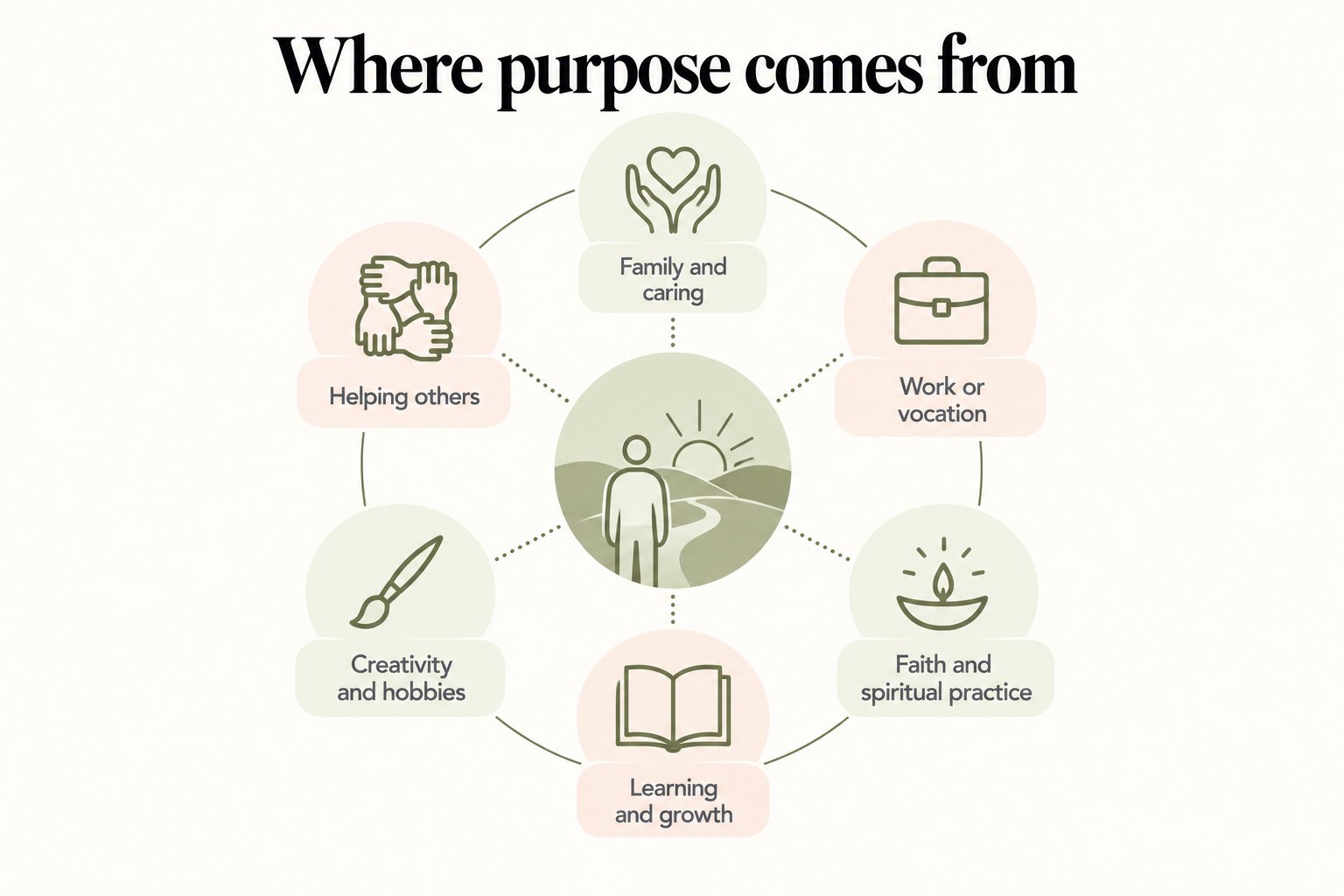
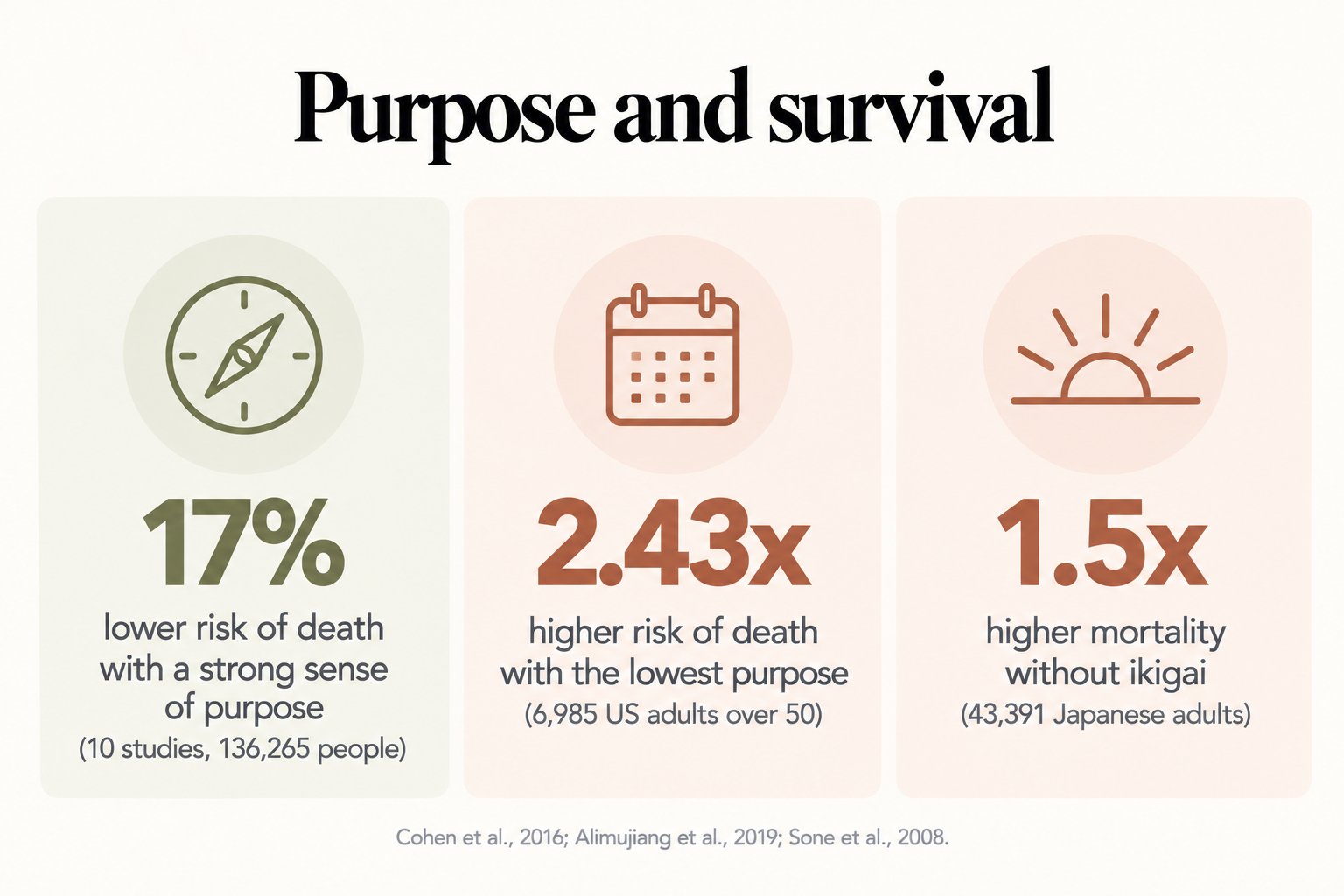
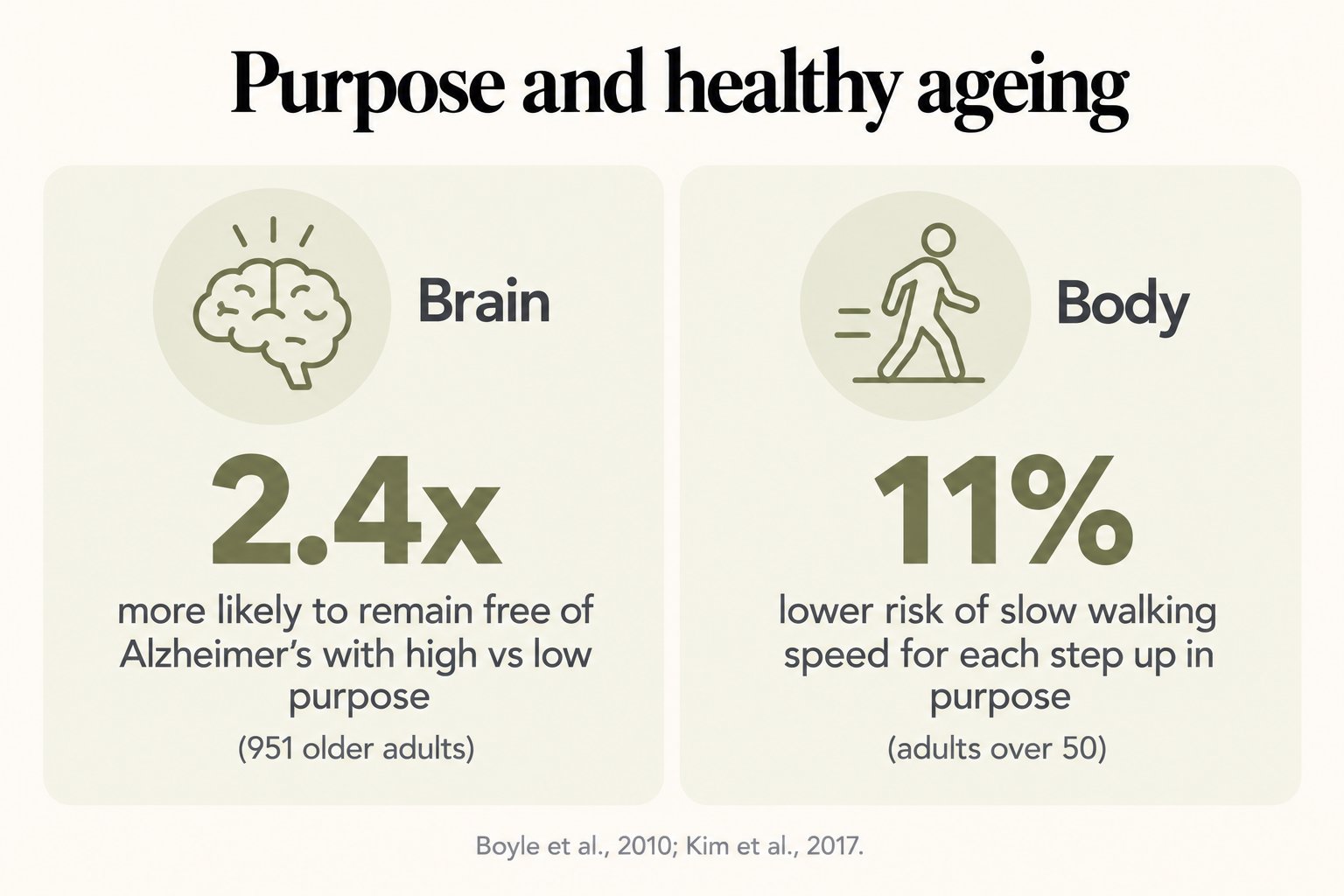
Purpose in life is the sense that your life has direction and that what you do matters, to you and to others. In Japan it's called ikigai, often translated as "a reason for being". Of all the parts of psychological wellbeing, purpose has some of the most consistent links to health. A meta-analysis of 10 studies with 136,265 people found that a strong sense of purpose was associated with about 17% lower risk of death and 17% fewer heart attacks and strokes. In 6,985 Americans over 50, those with the lowest purpose were 2.43 times more likely to die over about four years than those with the highest. In 43,391 Japanese adults, people without ikigai had 1.5 times higher mortality. Purpose is also linked to healthier ageing of the brain and body: in 951 older adults, those with high purpose were about 2.4 times more likely to remain free of Alzheimer's disease than those with low purpose. These are observational studies, so they can't prove that purpose causes better health, and people who are already healthy may find it easier to feel purposeful. But the findings are remarkably consistent across countries and ages, and people with purpose tend to look after their health more actively. Purpose isn't fixed: it can come from family, work, faith, learning, creativity or helping others, and it can be rebuilt after major life changes such as retirement, bereavement or illness.
Key numbers
| Finding | Detail |
|---|---|
| Meta-analysis (10 studies, 136,265 people) | Strong purpose: about 17% lower mortality and 17% fewer cardiovascular events |
| US adults over 50 (6,985 people) | Lowest purpose: 2.43 times more likely to die than highest |
| Japan, Ohsaki Study (43,391 adults) | No ikigai: 1.5 times higher mortality, 1.6 times higher cardiovascular mortality |
| Alzheimer's disease (951 older adults) | High purpose: about 2.4 times more likely to remain free of Alzheimer's |
| Physical function (US adults over 50) | Each step up in purpose: about 11% lower risk of slow walking speed |
What purpose in life means
Purpose is having goals and a sense of direction, and feeling that your life has meaning. It's one of the six dimensions of psychological wellbeing described by the psychologist Carol Ryff (see Psychological Wellbeing and Longevity).
Purpose doesn't need to be grand. For one person it's raising children or caring for grandchildren; for another it's their work, faith, a craft, a garden, a community role or helping others. What matters is that it feels meaningful to you and gives a reason to get up in the morning.
The Japanese concept of ikigai captures this well. In everyday Japanese use, it refers to the things that make life feel worth living, often small and personal. The popular Western diagram showing ikigai as the overlap of what you love, what you're good at, what the world needs and what you can be paid for is a modern adaptation; the original idea is simpler and doesn't depend on work or income.
What the research shows
Purpose and longer life
The overall picture. In 2016, Randy Cohen, Chirag Bavishi and Alan Rozanski combined 10 prospective studies, mainly from the US and Japan, with 136,265 participants followed for an average of seven years. People with a strong sense of purpose had about 17% lower risk of death from any cause and 17% lower risk of cardiovascular events, after adjusting for other factors. The authors described "a robust relationship between purpose in life and mortality".
Older Americans. In a 2019 study in JAMA Network Open, researchers at the University of Michigan analysed 6,985 adults over 50 in the US Health and Retirement Study. Those with the lowest purpose scores were 2.43 times more likely to die during follow-up than those with the highest, and 2.66 times more likely to die from heart, circulatory and blood conditions. The link held after accounting for other physical and social factors.
Purpose at every age. A 14-year study of more than 6,000 adults in the US found that greater purpose predicted lower mortality in younger, middle-aged and older adults alike. The benefit held regardless of retirement status, and after accounting for positive relationships and positive emotions. As the lead researcher, Patrick Hill, put it: "the earlier someone comes to a direction for life, the earlier these protective effects may be able to occur."
Ikigai in Japan. In the Ohsaki Study of 43,391 Japanese adults followed for about seven years, people who said they had no ikigai had 1.5 times the risk of dying from any cause, 1.6 times the risk of dying from cardiovascular disease, and 1.9 times the risk of dying from external causes such as injuries, compared with people who had ikigai. The link with cancer deaths wasn't statistically significant.
Purpose and a healthy brain. In a 2010 study by Patricia Boyle and colleagues at Rush University, 951 older adults without dementia were followed for up to seven years, during which 16.3% developed Alzheimer's disease. People with higher purpose had a substantially lower risk, and those at the 90th percentile for purpose were about 2.4 times more likely to remain free of Alzheimer's than those at the 10th percentile. The link held after accounting for depression, social networks and chronic illness. Higher purpose was also associated with lower risk of mild cognitive impairment and slower cognitive decline (see Cognitive Reserve).
Purpose and a strong body. In a 2017 Harvard study of nearly 4,500 adults over 50, each step up in purpose was associated with about 11% lower risk of developing slow walking speed over four years, even after accounting for health, depression and lifestyle. Walking speed is one of the strongest predictors of disability and survival in older adults (see Your Key Longevity Numbers). The researchers noted: "People with higher purpose are more proactive in taking care of their health."
How purpose may protect health
Healthier behaviour. Purpose gives a reason to look after yourself. People with more purpose tend to be more physically active, sleep better, and use preventive health services more.
Stress buffering. A sense of meaning helps people cope with difficulties and may soften the body's stress response, reducing the wear and tear of chronic stress (see Allostatic Load).
Social engagement. Purpose often involves other people, through family, work, faith or volunteering, and social connection is itself protective.
Mental stimulation. Purposeful activities often involve learning, planning and problem-solving, which may help build the brain's resilience.
Important limitations
- Observational evidence: these studies show associations, not proof that purpose causes better health.
- Reverse causation: illness, pain and disability can reduce purpose, so some of the link may run from poor health to lower purpose.
- Measurement: purpose is measured with questionnaires, and different studies use different scales.
- Interventions: there's limited evidence from randomised trials that deliberately increasing purpose improves health outcomes, although programmes involving volunteering, learning and meaningful roles are promising.
When purpose is lost
Purpose often comes under threat at major turning points:
- Retirement: losing a work role, routine and colleagues can leave a gap, especially for people whose identity was closely tied to their job.
- Children leaving home: parents may lose a central focus of daily life.
- Bereavement: losing a spouse or close family member can remove both companionship and a caring role.
- Illness or disability: health problems can make previous goals harder to reach.
These transitions are normal and don't mean purpose is gone for good. Many people find new purpose through grandparenting, mentoring, volunteering, faith communities, learning a skill, part-time work or creative projects. In Sri Lanka, extended family roles, religious and community activities, and helping others are common sources of purpose in later life. Finding purpose at different stages of life is covered in Finding Purpose at Every Age.
Why this matters for longevity
Purpose is one of the most consistent psychological predictors of longer, healthier life, linked to lower mortality, fewer cardiovascular events, healthier brain ageing and better physical function. It doesn't replace the foundations of good health, but it may be what keeps people committed to them. And unlike genes or age, purpose can be cultivated at any stage of life.
Practical notes
Ask yourself: What gets me up in the morning? Who depends on me, or benefits from what I do? What would I like to learn, build or contribute in the next few years? If the answers feel thin, start small: commit to one meaningful activity a week, such as helping a neighbour, teaching a skill, volunteering, joining a community or religious group, or returning to a hobby. Plan ahead for big transitions, especially retirement, by building interests and roles beyond work before you need them. If a loss of purpose comes with persistent low mood, hopelessness or loss of interest, speak to a doctor, as this can be a sign of depression. Our Longevity Doctors look at purpose and wellbeing alongside physical health, starting with the free longevity assessment.
- Cohen R, Bavishi C, Rozanski A. Purpose in life and its relationship to all-cause mortality and cardiovascular events: a meta-analysis. Psychosomatic Medicine, 2016;78(2):122-133.
- Alimujiang A, et al. Association between life purpose and mortality among US adults older than 50 years. JAMA Network Open, 2019;2(5):e194270.
- Hill PL, Turiano NA. Purpose in life as a predictor of mortality across adulthood. Psychological Science, 2014;25(7):1482-1486.
- Sone T, et al. Sense of life worth living (ikigai) and mortality in Japan: Ohsaki Study. Psychosomatic Medicine, 2008;70(6):709-715.
- Boyle PA, et al. Effect of a purpose in life on risk of incident Alzheimer disease and mild cognitive impairment in community-dwelling older persons. Archives of General Psychiatry, 2010;67(3):304-310.
- Kim ES, et al. Association between purpose in life and objective measures of physical function in older adults. JAMA Psychiatry, 2017;74(10):1039-1045.
- Ryff CD, Keyes CLM. The structure of psychological well-being revisited. Journal of Personality and Social Psychology, 1995;69(4):719-727.
Free longevity assessment
What gets you up
in the morning?
Take the free Aevum Protocol assessment to see how your stress & mental wellbeing and 6 other longevity domains are performing — and get a personalised 90-day plan.
Take the free assessment