Stress & Mental Wellbeing
Psychological Wellbeing and Longevity:
Why Feeling Well and Living Well Matter for Health
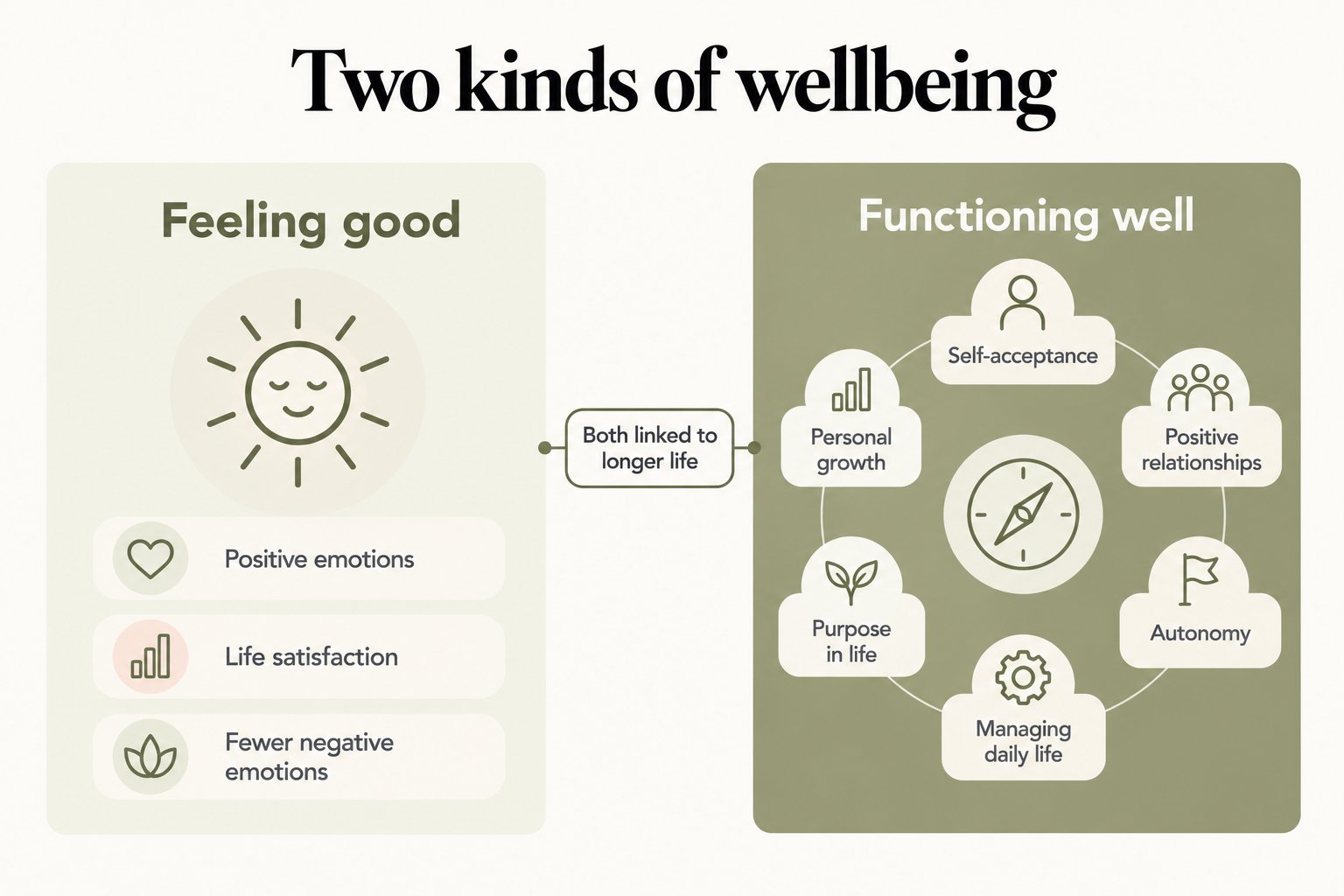
Longevity medicine usually focuses on blood pressure, cholesterol and fitness, but how you feel and how meaningful your life feels also matter. The World Health Organization defines mental health as "a state of mental well-being that enables people to cope with the stresses of life", not simply the absence of illness. Researchers describe two kinds of wellbeing: feeling good (happiness, enjoyment and life satisfaction) and functioning well (purpose, growth, good relationships and a sense of control). Both are linked to longer life. A review of 70 studies found that positive wellbeing was associated with 18% lower mortality in initially healthy people. In 3,853 older adults in England, 7.3% of the least happy died within about five years, compared with 3.6% of the happiest. In another English study of 9,050 adults, people with the strongest sense of purpose and worthwhile activity were 30% less likely to die over 8.5 years, after accounting for health and lifestyle. The evidence isn't all one way: a study of 719,671 women found that unhappiness itself didn't raise mortality once poor health was taken into account, suggesting that illness often causes unhappiness rather than the reverse. The most consistent message is that wellbeing works alongside, not instead of, healthy habits, and that purpose, relationships and a sense of meaning appear to matter more than momentary happiness. This article explains what psychological wellbeing is, how it may affect the body, and what the evidence can and can't tell us.
Key numbers
| Finding | Detail |
|---|---|
| Review of 70 studies (Chida & Steptoe, 2008) | Positive wellbeing linked to 18% lower mortality in healthy populations |
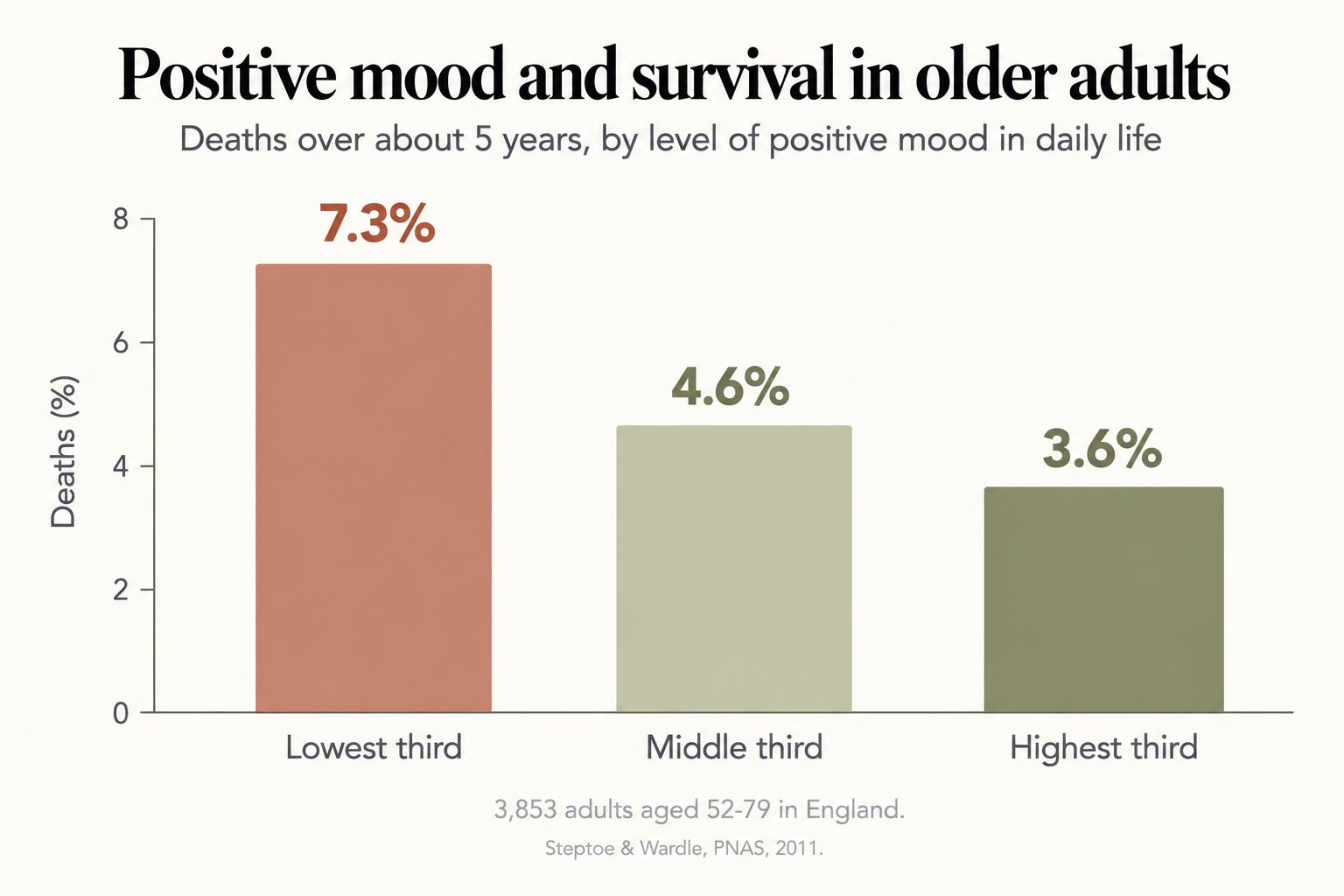
| Positive mood in daily life (3,853 adults aged 52-79) | 5-year mortality 7.3% in the least happy vs 3.6% in the happiest |
| Purpose and worthwhile activity (9,050 adults, 8.5 years) | 29% vs 9% died in the lowest vs highest wellbeing groups; 30% lower risk after adjustment |
| Million Women Study (719,671 women, 10 years) | Unhappiness not linked to higher mortality after accounting for poor health |
| Harvard Study of Adult Development (since 1938) | Men most satisfied with their relationships at 50 were the healthiest at 80 |
What psychological wellbeing means
Wellbeing is more than the absence of depression or anxiety. A person can be free of mental illness but still feel flat, isolated or without direction, and a person living with a health condition can still have a strong sense of meaning. Researchers usually describe two broad kinds of wellbeing.
Feeling good (hedonic wellbeing). This is the emotional side: how often you feel happy, calm, interested or content, how rarely you feel sad or worried, and how satisfied you are with your life overall. It reflects the quality of your day-to-day experience.
Functioning well (eudaimonic wellbeing). This is the meaning side, from the Greek idea of a life well lived. The psychologist Carol Ryff described six dimensions of this kind of psychological wellbeing:
- 1. Self-acceptance: a positive but realistic attitude towards yourself and your past.
- 2. Positive relations with others: warm, trusting relationships with empathy and affection.
- 3. Autonomy: living by your own values rather than only by others' expectations.
- 4. Environmental mastery: feeling able to manage daily life and your circumstances.
- 5. Purpose in life: having goals and a sense of direction and meaning.
- 6. Personal growth: continuing to learn, develop and be open to new experiences.
The two kinds overlap, but they aren't the same. A pleasant holiday raises how good you feel; caring for a grandchild, volunteering or mastering a skill may be tiring but deeply meaningful. As this article shows, the meaning side appears to be at least as important for health.
What the research shows
Positive wellbeing and longer life. In 2008, Yoichi Chida and Andrew Steptoe combined 35 studies of initially healthy people and 35 studies of people with existing illnesses. In healthy populations, positive wellbeing was associated with 18% lower mortality. In people who were already ill, the link was much weaker, with only about 2% lower mortality. Both positive emotions, such as feeling cheerful and energetic, and more stable traits, such as life satisfaction and optimism, were linked to longer survival.
Happiness measured in daily life. Many studies ask people to remember how they've felt, which is easily distorted. In a 2011 study, Steptoe and Jane Wardle asked 3,853 adults aged 52-79 in the English Longitudinal Study of Ageing to rate their feelings four times over a single day. Over about five years, 7.3% of those in the lowest third for positive mood died, compared with 4.6% in the middle third and 3.6% in the highest third. After adjusting for age, sex, other demographic factors, negative mood, depression, health conditions and health behaviours, the happiest group still had about 35% lower risk of death.
Purpose and a worthwhile life. In a study published in The Lancet in 2015, Steptoe and colleagues followed 9,050 English adults with an average age of 65 for 8.5 years, measuring eudaimonic wellbeing: a sense of control, feeling that what you do is worthwhile, and purpose. During that time, 29% of those in the lowest wellbeing group died, compared with 9% in the highest. After accounting for age, sex, socioeconomic status, physical health, depression, smoking, physical activity and alcohol, people in the highest group were still 30% less likely to die. As Steptoe cautioned, "We cannot be sure that higher well-being necessarily causes lower risk of death." Purpose in life is covered in more detail in Purpose in Life and Longevity.
Relationships across the lifespan. The Harvard Study of Adult Development has followed 724 men since 1938, from two groups: Harvard students and boys from disadvantaged Boston neighbourhoods. The study now also follows more than 2,000 of their children. One of its clearest findings is that the men most satisfied with their relationships at age 50 were the healthiest at age 80, while the more isolated men experienced earlier declines in health and brain function and died younger. Its director, Robert Waldinger, summarised: "Good relationships keep us happier and healthier" (see Social Connection and Cognitive Decline).
The important counterpoint. Not every study agrees. In the Million Women Study of 719,671 UK women followed for about 10 years, 17% said they were unhappy. Unhappiness was more common in women in poor health, and once the researchers accounted for poor health, lifestyle and socioeconomic factors, unhappiness was not linked to death from any cause, heart disease or cancer. The authors concluded that poor health causes unhappiness, rather than unhappiness directly shortening life.
How can both findings be true? A few explanations are likely:
- Reverse causation: illness makes people unhappy, so unhappiness can look like a cause when it's really a consequence.
- Different measures: the Million Women Study asked a single question about happiness, while studies that found benefits often measured purpose, positive emotions in daily life or a sense of control.
- Meaning may matter more than mood: feeling that life is worthwhile appears to be more consistently linked to health than simply feeling happy.
How wellbeing may affect the body
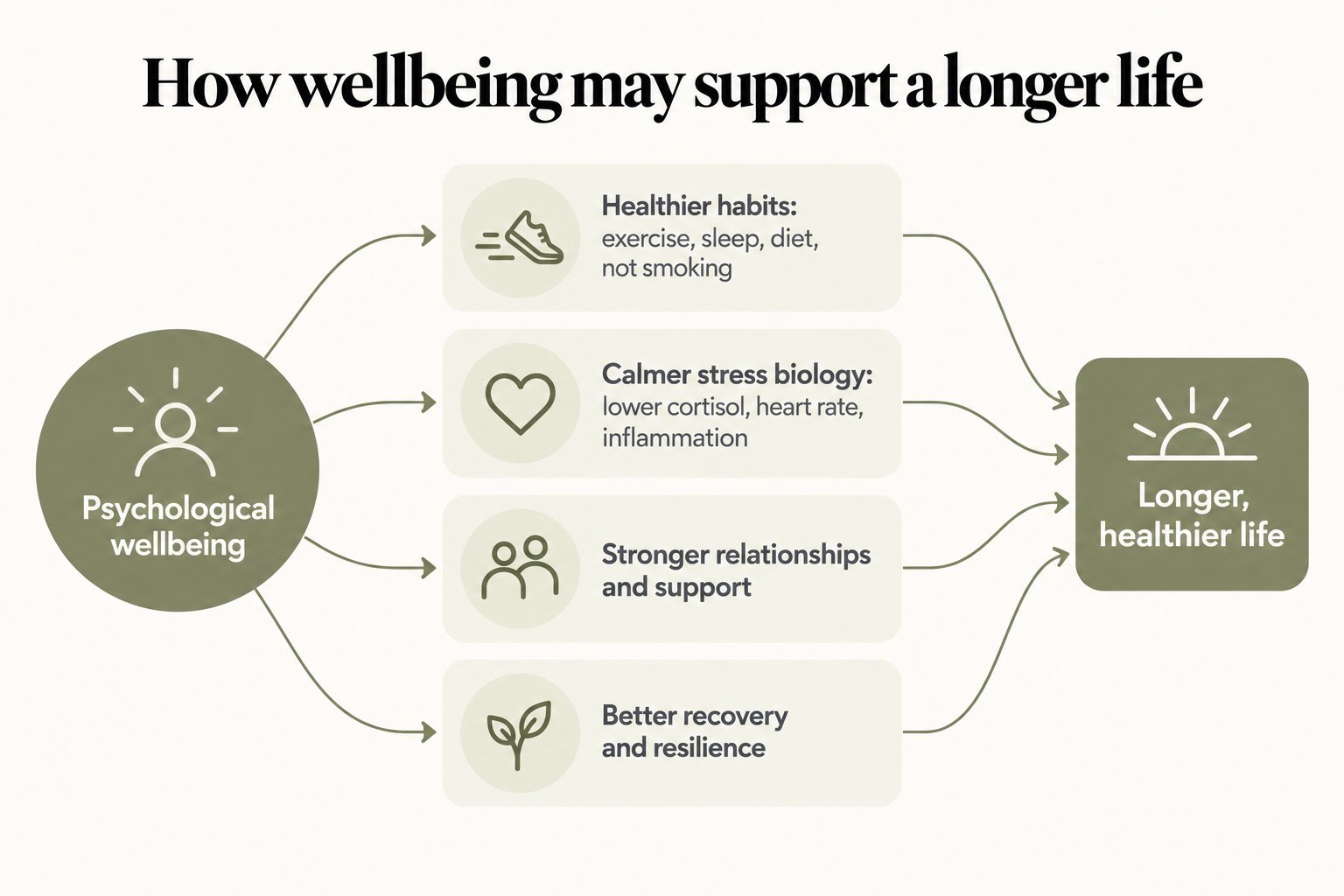
Researchers have identified several pathways that could explain the links, although proving cause and effect in people is difficult.
Health behaviours. People with higher wellbeing are more likely to exercise, eat well, sleep better, avoid smoking and follow medical advice. A sense of purpose gives a reason to look after yourself.
Stress biology. In a study of more than 200 middle-aged London civil servants, people who reported more happiness in daily life had lower levels of the stress hormone cortisol, men had lower heart rates through the day, and after a stressful task, happier people had lower levels of fibrinogen, a clotting protein linked to heart disease. Chronic stress, by contrast, wears the body down over time (see Allostatic Load).
Relationships and support. Wellbeing and good relationships reinforce each other. Supportive relationships buffer stress, encourage healthy habits and provide practical help when illness strikes.
Recovery and resilience. Positive emotions may help the body and mind recover more quickly from stress, and people with a sense of meaning often cope better with illness and setbacks.
Why this matters for longevity
Psychological wellbeing isn't a replacement for blood pressure control, exercise or a healthy diet, and nobody should feel blamed for being unhappy when they're unwell. But the research suggests that purpose, meaning, good relationships and a sense of control are valuable for their own sake and may also support a longer, healthier life. Unlike genes, these can be strengthened at any age. The rest of this section explores the main building blocks: purpose, optimism, spirituality, meditation and social connection, along with the mental health conditions that can undermine wellbeing and how to get help.
Practical notes
A useful first step is simply to notice how you're doing, beyond your physical health. Ask yourself a few questions: Do I feel that what I do each day is worthwhile? Do I have people I can rely on? Do I feel in control of my life? Do I still have things I'm learning or looking forward to? Short questionnaires such as the WHO-5 Wellbeing Index, a five-question measure developed by the World Health Organization, can help track this over time. Small, regular actions often help more than big changes: time with people who matter to you, activities that feel meaningful, time outdoors, movement, enough sleep and a regular practice of reflection, prayer or meditation (see Stress-Reduction Techniques That Work). If low mood, worry or loss of interest last more than two weeks, or start affecting daily life, speak to a doctor; these can be signs of depression or anxiety, which are treatable. Our Longevity Doctors include mental wellbeing in every assessment, starting with the free longevity assessment.
- World Health Organization. Mental health: health topic page. Geneva: WHO.
- Ryff CD, Keyes CLM. The structure of psychological well-being revisited. Journal of Personality and Social Psychology, 1995;69(4):719-727.
- Chida Y, Steptoe A. Positive psychological well-being and mortality: a quantitative review of prospective observational studies. Psychosomatic Medicine, 2008;70(7):741-756.
- Steptoe A, Wardle J. Positive affect measured using ecological momentary assessment and survival in older men and women. Proceedings of the National Academy of Sciences, 2011;108(45):18244-18248.
- Steptoe A, Deaton A, Stone AA. Subjective wellbeing, health, and ageing. The Lancet, 2015;385(9968):640-648.
- Liu B, et al. Does happiness itself directly affect mortality? The prospective UK Million Women Study. The Lancet, 2016;387(10021):874-881.
- Steptoe A, Wardle J, Marmot M. Positive affect and health-related neuroendocrine, cardiovascular, and inflammatory processes. Proceedings of the National Academy of Sciences, 2005;102(18):6508-6512.
- Waldinger R, Schulz M. The Good Life: Lessons from the World's Longest Scientific Study of Happiness. New York: Simon & Schuster, 2023.
Free longevity assessment
How is your wellbeing,
beyond your physical health?
Take the free Aevum Protocol assessment to see how your stress & mental wellbeing and 6 other longevity domains are performing — and get a personalised 90-day plan.
Take the free assessment