Stress & Mental Wellbeing
Finding Purpose at Every Age,
From Career to Retirement
A sense of purpose is one of the most consistent psychological predictors of a longer, healthier life, linked to lower mortality, fewer heart attacks and strokes, healthier brain ageing and better physical function (see Purpose in Life and Longevity). But purpose isn't fixed. It shifts as we move through life: from education and early career, to raising a family and building work, to retirement, grandparenthood and later life. Purpose often comes under pressure at turning points, especially retirement, children leaving home, bereavement and illness. The research gives some practical clues. In a US study of 2,956 retirees, healthy people who worked one year longer had an 11% lower risk of death, suggesting that staying engaged matters. In a study of about 13,000 adults over 50, volunteering at least 100 hours a year was linked to 44% lower mortality, and in a randomised pilot trial, older adults who volunteered as tutors in schools became more physically active, stronger and more cognitively active than controls. Regular physical activity also predicted increases in purpose over time, while depression and stroke predicted declines. This guide explains how purpose changes across life, where it comes from at each stage, and practical steps to build or rebuild it, including planning for retirement before it arrives.
Key numbers
| Finding | Detail |
|---|---|
| Purpose and longevity (10 studies, 136,265 people) | Strong purpose linked to about 17% lower mortality |
| Working one year longer (2,956 retirees) | 11% lower risk of death in healthy retirees |
| Volunteering 100+ hours a year (about 13,000 adults over 50) | 44% lower risk of death over 4 years |
| School-based volunteering pilot (128 adults aged 60-86) | More physical activity, strength, cognitive activity and social support than controls |
| Predictors of rising purpose (about 13,771 adults over 50) | Weekly physical activity linked to higher later purpose; depression and stroke to lower |
How purpose changes across life
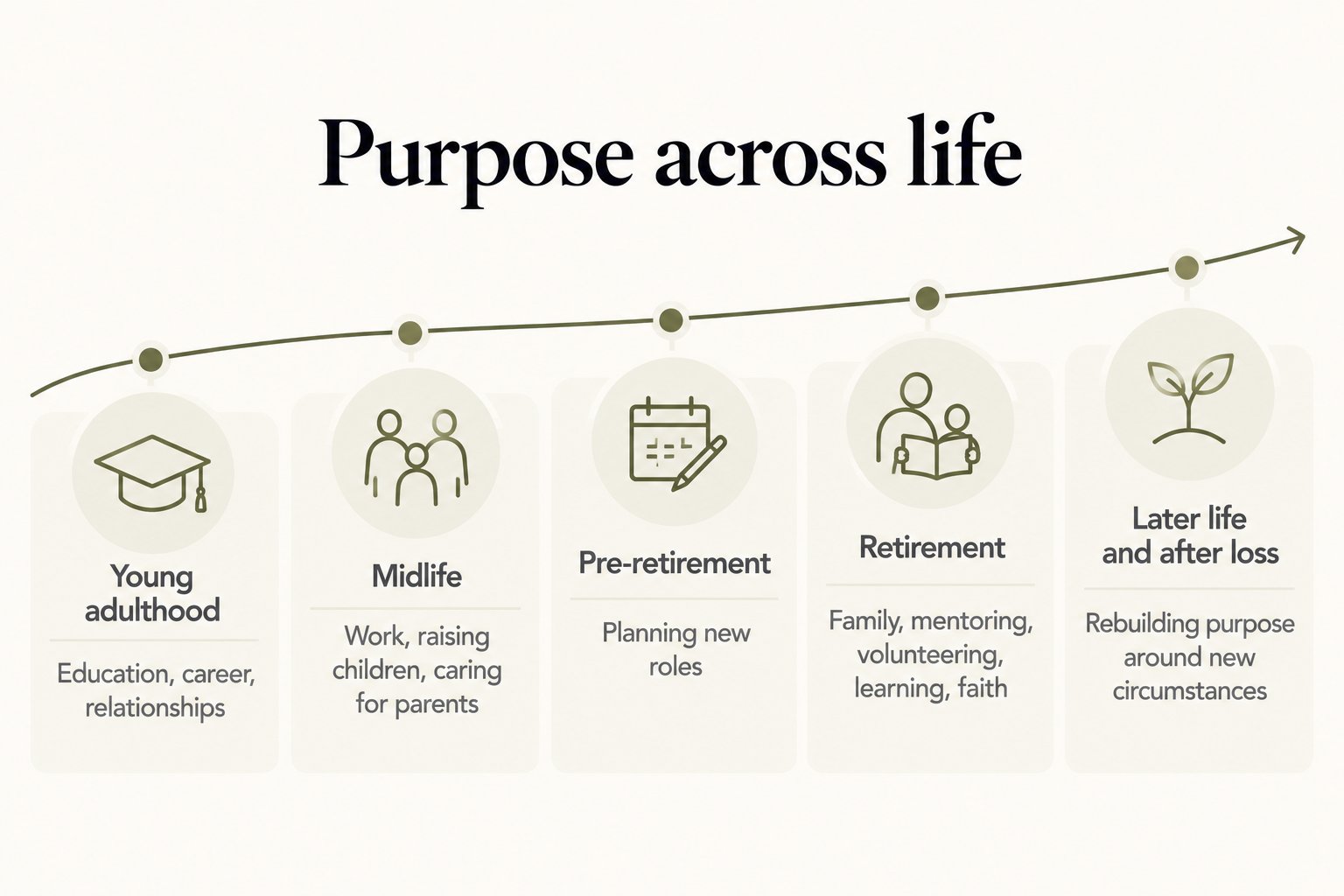
Purpose tends to follow the roles and responsibilities of each life stage:
- Young adulthood: exploring interests, education, career and relationships. Purpose often comes from future goals.
- Midlife: work, raising children, caring for parents and contributing to the community. Purpose is often abundant but can be crowded out by busyness and stress.
- Pre-retirement: a time to plan what will replace work as a source of structure, identity and meaning.
- Retirement and later life: new freedom, but also the risk of losing roles, routine and social contact. Purpose may come from family, mentoring, faith, learning and service.
- After loss or illness: purpose often needs to be rebuilt around new circumstances and abilities.
In Sri Lanka, purpose in later life is often closely tied to family, especially grandparenting, and to religious and community life. As more adult children live in cities or abroad, many older Sri Lankans need to find new ways to stay engaged.
What the evidence shows
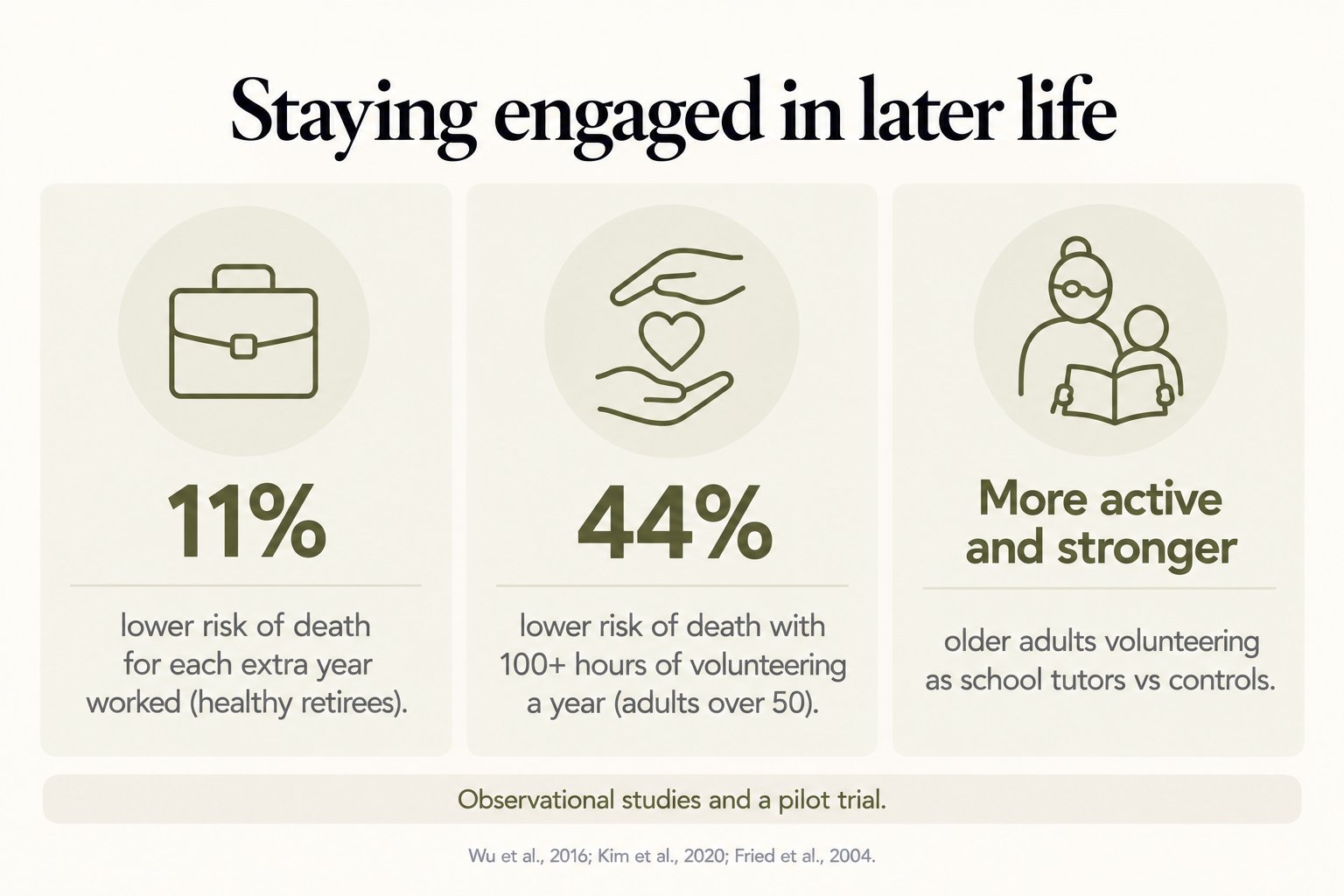
Staying engaged after retirement. In a 2016 study published in the Journal of Epidemiology and Community Health, Chenkai Wu and colleagues at Oregon State University followed 2,956 Americans from the Health and Retirement Study who retired between 1992 and 2010. To reduce the bias that poor health causes both early retirement and earlier death, they separated retirees whose health influenced their decision. Among healthy retirees, working one year longer was associated with an 11% lower risk of death, after accounting for demographic, lifestyle and health factors. As senior author Robert Stawski put it, "people who remain active and engaged gain a benefit from that." The study doesn't mean everyone should delay retirement; it suggests that what replaces work matters.
Volunteering: purpose, connection and health together. In a 2020 study of about 13,000 US adults over 50, Eric Kim and colleagues found that those who volunteered at least 100 hours a year, about two hours a week, had a 44% lower risk of death over four years than non-volunteers, and a 17% lower risk of physical limitations. They also reported more purpose, optimism and positive emotions, and less depression, hopelessness and loneliness (see Gratitude, Kindness and Positive Psychology).
A randomised pilot trial of the Experience Corps programme in Baltimore placed 128 adults aged 60-86 as volunteers in public primary schools, in roles designed to meet the schools' needs while increasing the volunteers' social, physical and mental activity. After four to eight months, compared with controls, the volunteers had increased their physical activity, strength, cognitive activity and social support, and their walking speed declined less. Meaningful roles bring purpose, movement and connection in one package.
What helps purpose grow. In a study of about 13,771 adults aged 50 and over in the US Health and Retirement Study, Eric Kim and colleagues tested 61 factors to see which predicted changes in purpose over time. Exercising at least once a week was linked to higher purpose four years later, and volunteering and time with friends were identified as promising targets. Depression and stroke predicted lower purpose. The authors suggested that purpose may be easier to build earlier in life, which is a good reason to cultivate it before retirement rather than after.
How to find or rebuild purpose
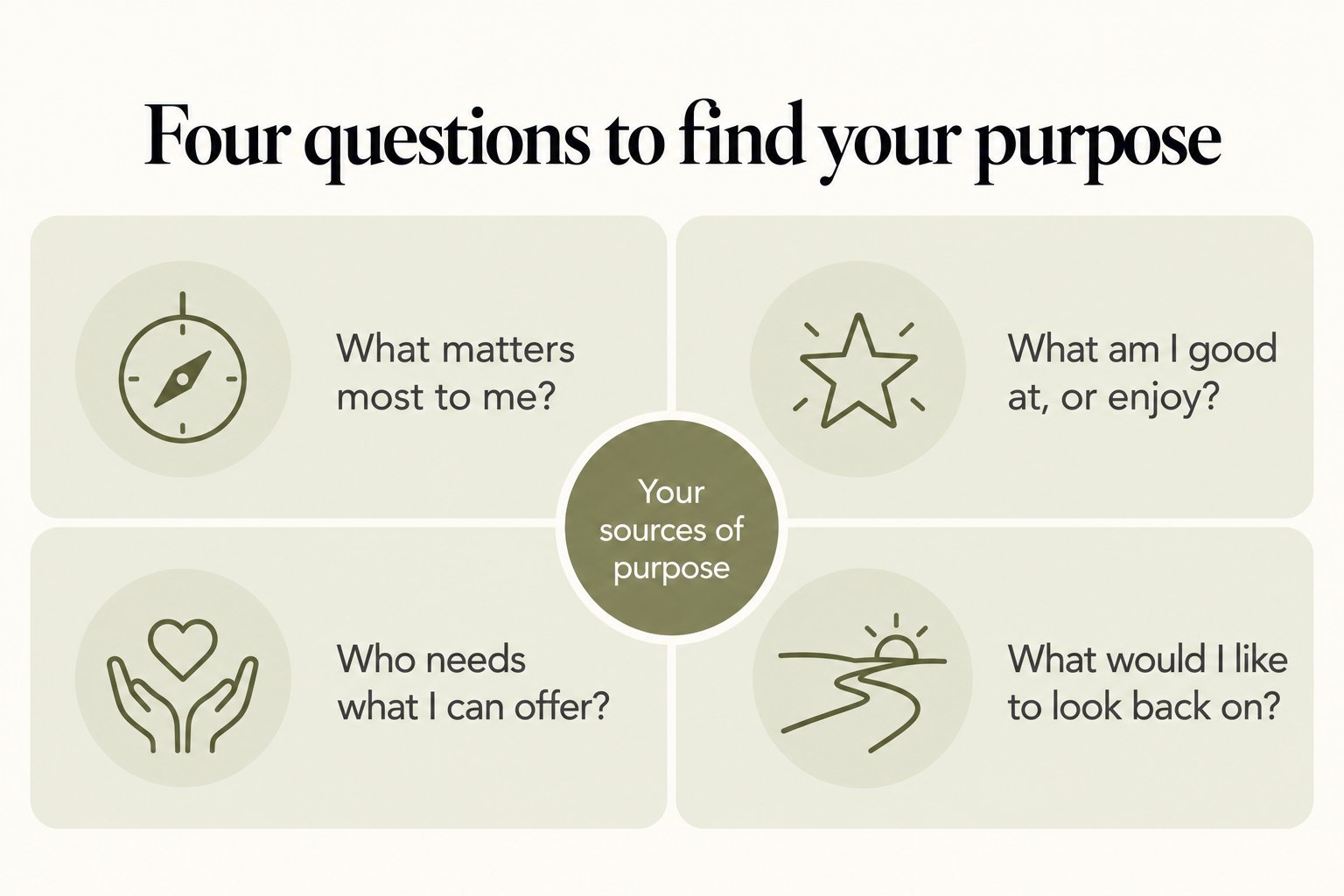
Start with four questions.
- 1. What matters most to me? Your values, such as family, faith, learning, fairness, creativity or service.
- 2. What am I good at, or what do I enjoy? Skills and interests you can use or develop.
- 3. Who needs what I can offer? Family members, neighbours, community groups, younger people, organisations.
- 4. What would I like to look back on? The contribution you want to make in the next five to ten years.
The overlap of these answers often points to meaningful roles.
Practical routes to purpose.
- Mentor or teach. Share your skills with younger colleagues, students or family members. This "generativity", investing in the next generation, is a powerful source of meaning in midlife and beyond.
- Volunteer regularly. Aim for about two hours a week with a temple, church, mosque, kovil, school, hospital, charity or community group.
- Keep learning. Take a course, learn a language, an instrument or a craft (see Learning New Skills and Brain Health).
- Stay physically active. Activity predicts higher purpose over time, and walking groups, gardening and sport also bring people together.
- Create. Writing, art, music, cooking, gardening or building something gives a sense of progress and contribution.
- Strengthen family roles. Grandparenting, supporting adult children and keeping family traditions alive.
- Consider part-time or flexible work. Consulting, advising or a new type of work after retirement.
- Set small goals. Purpose can be found in modest, daily aims, such as walking with a friend, tending a garden or cooking for family.
Planning for retirement. Retirement planning usually focuses on money. It's equally important to plan for time, identity and connection:
- Start building interests, friendships and roles outside work at least a few years before retiring.
- Consider a gradual transition, with reduced hours or part-time work, if possible.
- Plan a weekly structure, with regular commitments that get you out of the house and among people.
- Discuss expectations with your spouse or family, as retirement changes household routines.
- Look after your health, since illness and disability are among the biggest threats to purpose.
Recommendations by scenario
| Scenario | What to do |
|---|---|
| Young adult unsure of direction | Explore different interests, volunteer, and notice what energises you |
| Busy midlife, feeling stretched | Reconnect with values; protect time for one meaningful activity |
| A few years before retirement | Build interests, friendships and roles outside work; plan a weekly structure |
| Recently retired and feeling lost | Volunteer around 2 hours a week, join a group, take a course |
| Children have left home | Rediscover personal interests; mentor or volunteer |
| After bereavement | Allow time to grieve, then gradually rebuild roles and routines |
| Living with illness or disability | Adapt goals to your abilities; small daily purposes count |
| Low mood with loss of purpose | Talk to a doctor; this can be a sign of depression |
Practical notes
Purpose isn't something you find once and keep forever; it's something you renew at every stage of life. Start small: choose one meaningful activity this month, ideally one that involves other people and some physical activity. If you're approaching retirement, plan your time as carefully as your finances. If you're supporting an older parent, help them stay involved in family decisions, community life and activities that make them feel needed. If loss of purpose comes with persistent low mood or hopelessness, speak to a doctor (see Depression and Physical Health). Our Longevity Doctors consider purpose and wellbeing alongside physical health, starting with the free longevity assessment.
- Cohen R, Bavishi C, Rozanski A. Purpose in life and its relationship to all-cause mortality and cardiovascular events: a meta-analysis. Psychosomatic Medicine, 2016;78(2):122-133.
- Wu C, et al. Association of retirement age with mortality: a population-based longitudinal study among older adults in the USA. Journal of Epidemiology and Community Health, 2016;70(9):917-923.
- Kim ES, et al. Volunteering and subsequent health and well-being in older adults: an outcome-wide longitudinal approach. American Journal of Preventive Medicine, 2020;59(2):176-186.
- Fried LP, et al. A social model for health promotion for an aging population: initial evidence on the Experience Corps model. Journal of Urban Health, 2004;81(1):64-78.
- Kim ES, et al. Identifying factors associated with subsequent purpose in life: an outcome-wide approach. SSM - Population Health, 2022;19:101235.
Free longevity assessment
Planning for a purposeful
next chapter?
Take the free Aevum Protocol assessment to see how your stress & mental wellbeing and 6 other longevity domains are performing — and get a personalised 90-day plan.
Take the free assessmentKeep reading