Stress & Mental Wellbeing
How to Start Meditating:
A Practical Beginner's Guide
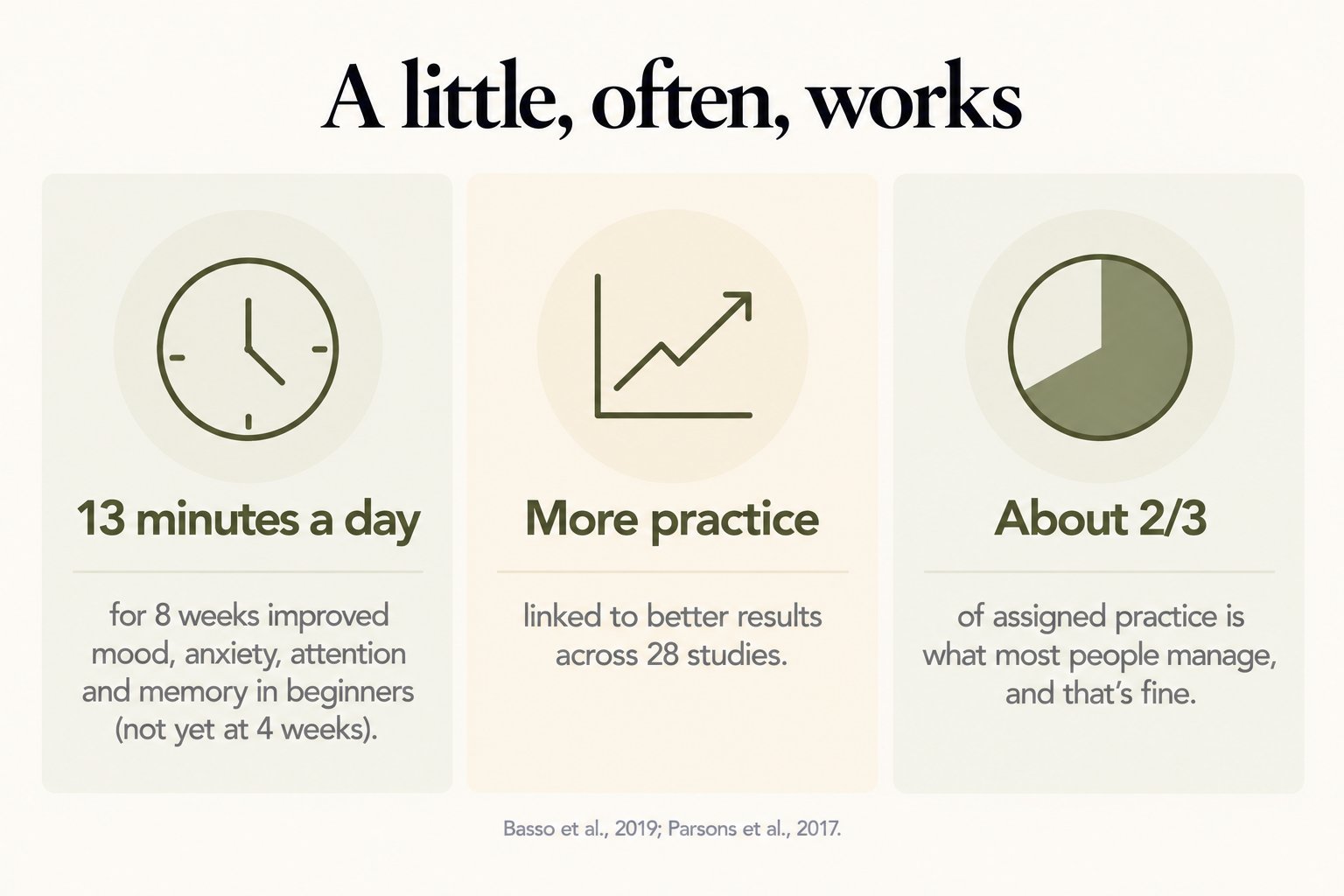
Meditation is simple to learn but takes practice to master, and many beginners give up because they think they're "doing it wrong" when their mind wanders. In fact, noticing that your mind has wandered and gently bringing it back is the practice. You don't need special equipment, beliefs or hours of free time. In a randomised trial of adults new to meditation, 13 minutes of guided meditation a day for eight weeks reduced negative mood and anxiety and improved attention and memory compared with listening to podcasts, but the benefits only appeared after eight weeks, not four. Consistency matters more than length: across 28 studies of mindfulness courses, people who practised more at home tended to get better results, although most people managed only about two-thirds of the practice they were asked to do. This guide explains what to expect, four simple practices to start with (breath meditation, body scan, loving-kindness and walking meditation, drawing on both traditional Sri Lankan practices such as anapanasati and metta and modern mindfulness programmes), a four-week starter plan, how to handle common obstacles, and when to seek guidance. Meditation is safe for most people, but a minority experience unsettling feelings, so it's worth knowing when to slow down or get support.
Key numbers
| Finding | Detail |
|---|---|
| Brief daily meditation (adults new to meditation) | 13 minutes a day for 8 weeks improved mood, anxiety, attention and memory; no benefit yet at 4 weeks |
| Home practice in mindfulness courses (28 studies) | More practice linked to better outcomes |
| Practice actually completed (49 studies) | About 64% of assigned home practice, roughly 29 minutes a day |
| Typical structured course | 8 weeks, a weekly class plus daily home practice |
| Unwanted effects (83 studies) | About 8% experience adverse effects, most often anxiety |
Before you start: what to expect
Your mind will wander, constantly. This isn't failure. Every time you notice your mind has drifted and bring it back, you're strengthening attention, like a repetition at the gym.
You don't need to "empty your mind". Meditation isn't about stopping thoughts; it's about changing your relationship with them, noticing them without getting carried away.
You may not feel calm every time. Some sessions feel peaceful; others feel restless or boring. Both are normal.
Benefits build gradually. Like exercise, effects come from regular practice over weeks, not from a single session (see How Meditation Affects the Brain and Body).
What the evidence shows
How much practice is enough. In a 2019 study published in Behavioural Brain Research, Julia Basso and colleagues at New York University randomly assigned adults aged 18-45 with no meditation experience to either 13 minutes of guided meditation a day or 13 minutes of listening to podcasts, for eight weeks. After eight weeks, the meditation group had less negative mood and less anxiety during a stress test, and better attention, working memory and recognition memory. After four weeks, these benefits hadn't yet appeared. Short daily sessions can work, but they need to be kept up for at least a couple of months.
Consistency matters. In a 2017 meta-analysis, Christina Parsons and colleagues examined home practice in mindfulness-based courses. Across 49 studies, participants completed about 64% of the practice they were asked to do, around 29 minutes a day out of a recommended 45 minutes, six days a week. Across 28 studies, people who practised more tended to have better outcomes, a small but consistent association. This suggests that regular practice matters, and that perfect adherence isn't necessary.
Safety. Meditation is generally safe, but in a 2020 review of 83 studies, about 8% of people experienced unwanted effects, most often anxiety, low mood or unusual perceptions. People with a history of trauma, psychosis, severe depression or bipolar disorder should learn with a qualified teacher or clinician, and anyone can stop, shorten sessions or switch to a gentler practice if meditation becomes distressing (see Meditation and Mindfulness: What the Evidence Really Shows).
Four practices to start with
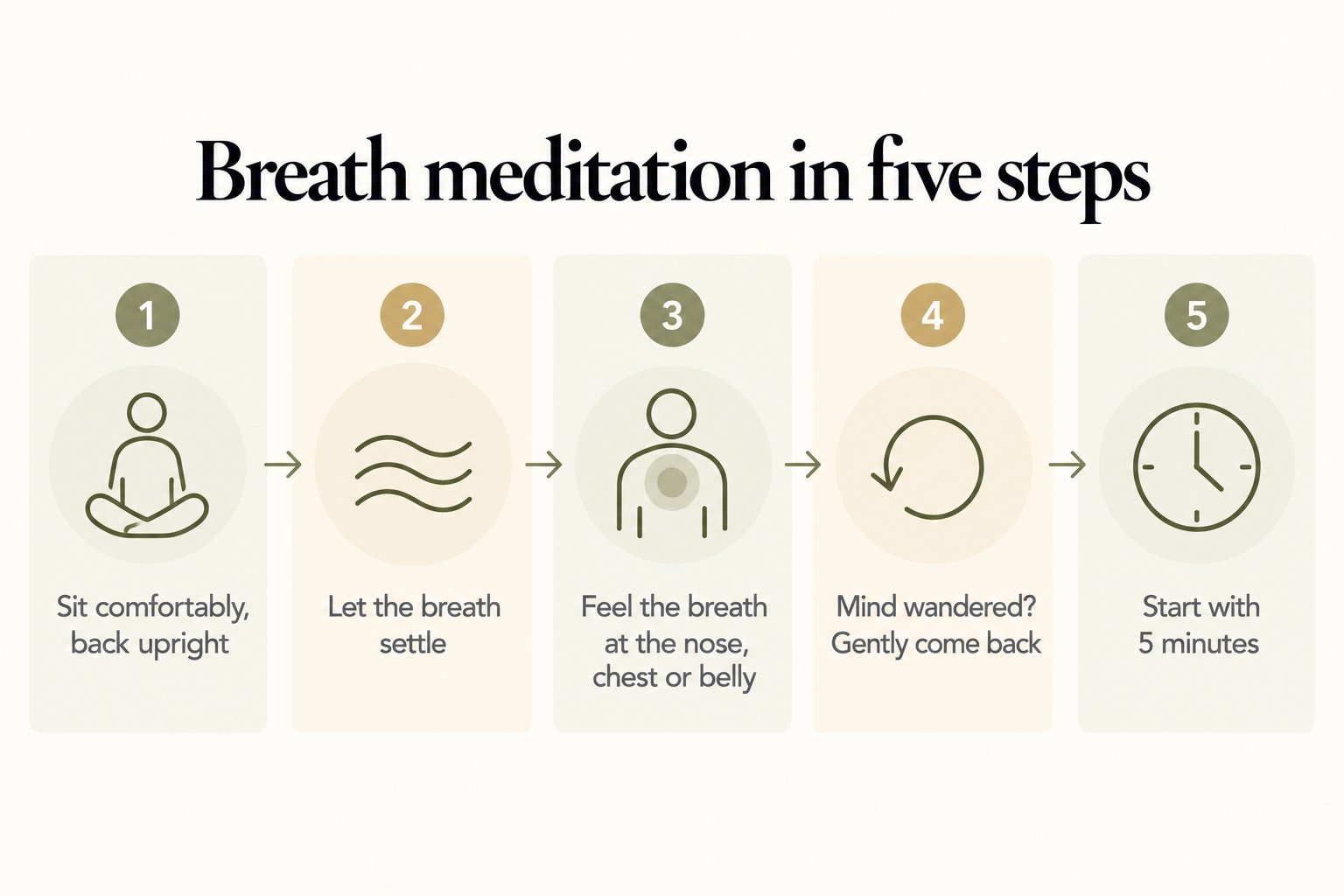
1. Breath meditation (anapanasati). The foundation of most traditions, and a good place to start.
- 1. Sit comfortably on a chair or cushion, with your back upright but relaxed. Close your eyes or lower your gaze.
- 2. Take a few slow breaths, then let your breathing settle into its natural rhythm.
- 3. Bring your attention to the sensation of breathing, at the nostrils, chest or belly, wherever you feel it most clearly.
- 4. When your mind wanders, which it will, gently notice where it went ("thinking", "planning", "remembering") and return to the breath, without criticising yourself.
- 5. Start with 5 minutes. At the end, open your eyes and notice how you feel.
Counting breaths, for example from 1 to 10 and then starting again, can help when the mind is very busy.
2. Body scan. Helpful for stress, tension and sleep.
- 1. Lie down or sit comfortably.
- 2. Slowly move your attention through your body, from the toes up to the head, noticing sensations such as warmth, pressure, tingling or tension, without trying to change them.
- 3. If you notice tension, breathe into that area and let it soften if it can.
- 4. Take 10-20 minutes. Guided recordings are especially useful for this practice.
3. Loving-kindness (metta). Cultivates warmth towards yourself and others, and is helpful if you tend towards self-criticism, resentment or loneliness.
- 1. Sit comfortably and bring to mind someone you care about easily.
- 2. Silently repeat phrases such as "May you be well. May you be happy. May you be at peace."
- 3. Then direct the same wishes towards yourself, a neutral person, someone you find difficult, and finally all beings.
- 4. Notice whatever feelings arise. It's normal if warmth doesn't come easily at first.
4. Walking meditation. Ideal if sitting still is difficult, or as a break during the day.
- 1. Walk slowly, indoors or outside, along a short path.
- 2. Pay attention to the sensations of each step: lifting, moving, placing the foot.
- 3. When your mind wanders, return to the feeling of your feet.
- 4. Try 10 minutes, perhaps in a garden, temple grounds or a quiet space at home.
For a very quick reset, slow breathing with a longer out-breath, or cyclic sighing (two breaths in through the nose and a long, slow breath out), for a few minutes can calm the body within minutes (see Stress-Reduction Techniques That Work).
A four-week starter plan
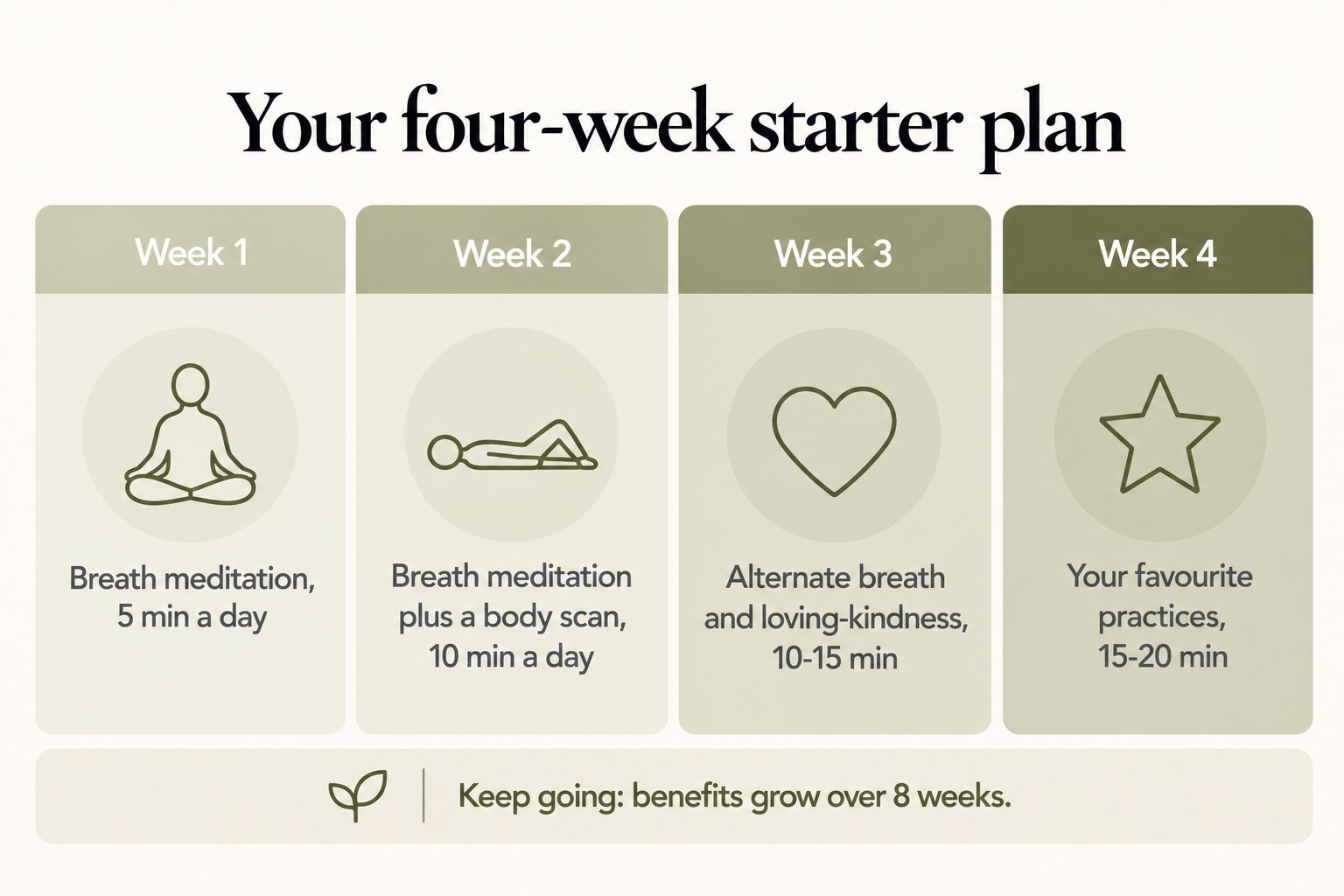
| Week | Practice | Time |
|---|---|---|
| Week 1 | Breath meditation | 5 minutes a day |
| Week 2 | Breath meditation, plus one body scan | 10 minutes a day |
| Week 3 | Alternate breath meditation and loving-kindness; walking meditation on busy days | 10-15 minutes a day |
| Week 4 | Choose the practices you prefer | 15 minutes a day, building towards 20 |
After four weeks, keep going: research suggests the benefits become clearer after about eight weeks of regular practice.
Common obstacles
- "My mind won't stop thinking." That's normal. Return to the breath, again and again. The returning is the exercise.
- "I don't have time." Start with five minutes, and attach practice to an existing habit, such as after brushing your teeth or before your morning tea.
- "I fall asleep." Sit upright rather than lying down, and practise at a time when you're more alert.
- "I feel restless or uncomfortable." Try walking meditation or a shorter session, and adjust your posture.
- "It makes me feel worse." Stop, open your eyes, ground yourself by noticing your feet on the floor, and try again later with a gentler practice. If distress continues, seek guidance.
- "I keep forgetting." Practise at the same time and place each day, or use a reminder or app.
Recommendations by scenario
| Scenario | What to do |
|---|---|
| Complete beginner | Breath meditation, 5 minutes a day, building up over four weeks |
| Busy schedule | Two short sessions, or attach practice to a daily routine |
| Stress and tension | Body scan and slow breathing |
| Trouble sleeping | Body scan in the evening, alongside good sleep habits |
| Self-criticism or loneliness | Add loving-kindness practice |
| Can't sit still | Walking meditation |
| Want structure and support | An 8-week course (MBSR or MBCT), a guided app, or a temple or meditation centre |
| History of trauma, psychosis or severe depression | Learn with a qualified teacher or clinician |
Practical notes
The best meditation practice is the one you'll actually do. Pick a regular time and place, start small, and be patient: give it at least eight weeks before judging the results. Guided recordings and apps help many beginners, and in Sri Lanka many temples and meditation centres offer instruction in traditional practices such as anapanasati and metta, while secular courses such as MBSR are also available. Meditation works best alongside other healthy habits, not as a replacement for treatment if you're struggling with depression or anxiety. Our Longevity Doctors can help you build stress management into your overall plan, starting with the free longevity assessment.
- Basso JC, et al. Brief, daily meditation enhances attention, memory, mood, and emotional regulation in non-experienced meditators. Behavioural Brain Research, 2019;356:208-220.
- Parsons CE, et al. Home practice in mindfulness-based cognitive therapy and mindfulness-based stress reduction: a systematic review and meta-analysis of participants' mindfulness practice and its association with outcomes. Behaviour Research and Therapy, 2017;95:29-41.
- Farias M, et al. Adverse events in meditation practices and meditation-based therapies: a systematic review. Acta Psychiatrica Scandinavica, 2020;142(5):374-393.
- Lutz A, et al. Attention regulation and monitoring in meditation. Trends in Cognitive Sciences, 2008;12(4):163-169.
- Balban MY, et al. Brief structured respiration practices enhance mood and reduce physiological arousal. Cell Reports Medicine, 2023;4(1):100895.
Free longevity assessment
Want help building
a daily practice?
Take the free Aevum Protocol assessment to see how your stress & mental wellbeing and 6 other longevity domains are performing — and get a personalised 90-day plan.
Take the free assessment