Movement & Strength
Pilates and Core Training:
What a Strong Core Really Does
Your "core" is more than your abdominal muscles. It includes the deep and outer muscles of the trunk, the muscles along the spine, the hips, the diaphragm and the pelvic floor, working together to keep the spine stable while the arms and legs move. Pilates is a system of controlled exercises, done on a mat or on equipment such as the reformer, that trains this core alongside flexibility, posture and body control. The evidence is strongest for chronic low back pain: a Cochrane review of 10 trials found Pilates reduced pain and disability more than minimal treatment, but not clearly more than other exercise, and a 2019 network meta-analysis of 89 studies ranked Pilates and core stabilisation among the most effective exercise types for back pain, alongside strength training and aerobic exercise. In older adults, Pilates improves some measures of balance and mobility and reduces fear of falling, although no trial has yet shown that it prevents falls. What core training can't do is burn belly fat in one place: in a 6-week trial, abdominal exercises 5 days a week improved muscular endurance but didn't reduce abdominal fat. Like yoga, most Pilates is low in aerobic intensity and provides limited load for building strength. This article explains what the core does, what Pilates offers and how to train your core effectively.
Key numbers
| Finding | Detail |
|---|---|
| Pilates for low back pain vs minimal treatment (10 trials, 510 people) | Reduced pain and disability; not clearly better than other exercise |
| Best exercise for chronic back pain (89 studies, 5,578 people) | Pilates, core stabilisation, strength and aerobic exercise most effective |
| Core stability vs general exercise for back pain (5 trials, 414 people) | Better in the short term; no difference at 6 or 12 months |
| Pilates in healthy adults aged 60 and over (12 trials, 702 people) | Less sway, better reach, less fear of falling; effect on falls unproven |
| Abdominal exercise and belly fat (24 adults, 6 weeks) | Endurance improved; abdominal fat didn't change |
| Pilates participation and death (55,023 US adults, observational) | 36% lower risk, likely partly due to healthier people practising Pilates |
What is the core?
- Deep stabilisers: the transverse abdominis, multifidus, diaphragm and pelvic floor, which stiffen the trunk before and during movement.
- Outer muscles: the rectus abdominis ("six-pack"), the obliques and the back extensors, which bend, twist and resist bending and twisting.
- Hips and glutes: these connect the trunk to the legs and are essential for walking, lifting and balance.
A strong core lets you lift, carry, twist and change direction while keeping the spine in a safe, controlled position. Much of its everyday job is resisting movement: holding steady while carrying shopping on one side, or keeping your back from arching when you push something overhead.
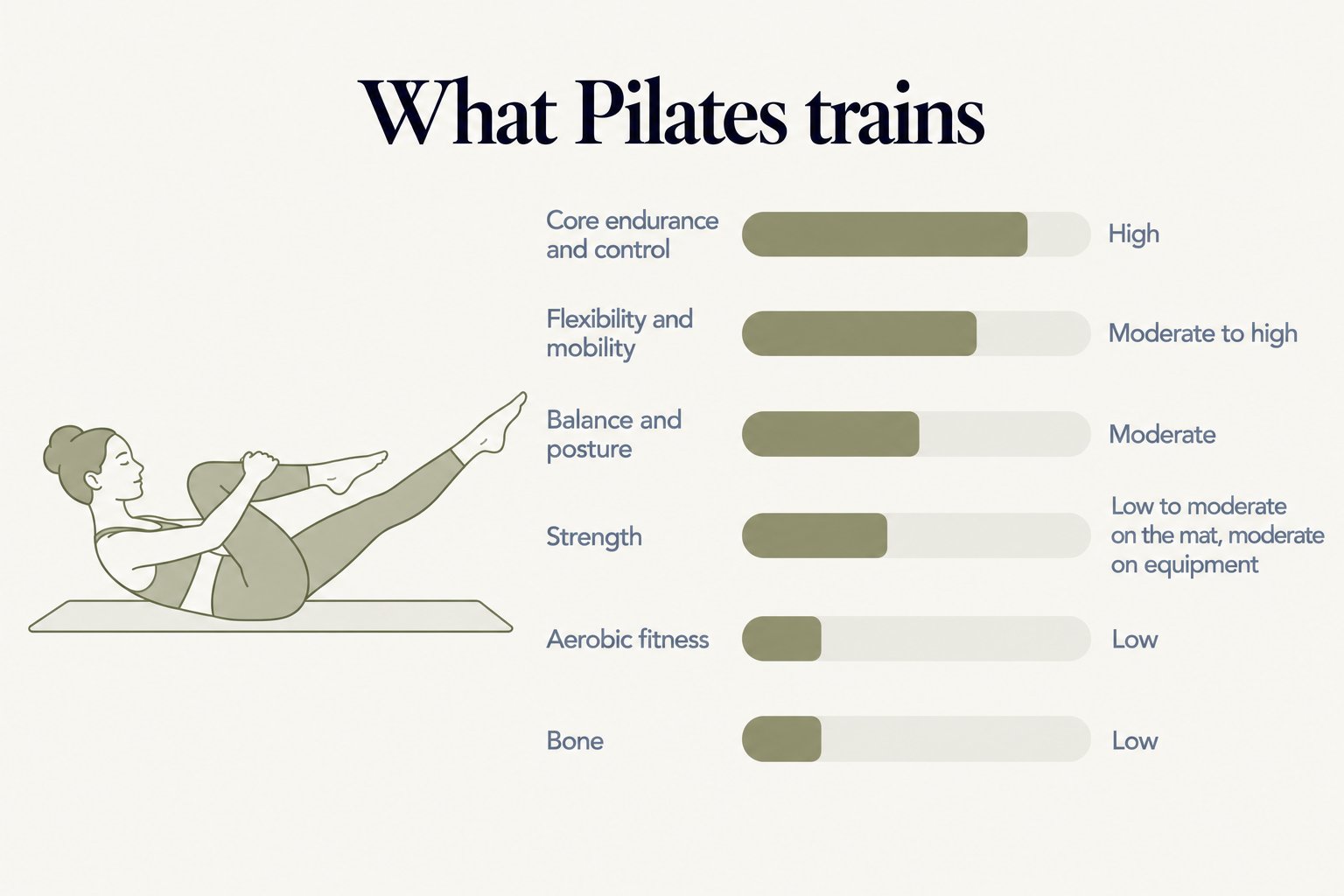
What Pilates trains
- Core endurance and control: high; most exercises focus on controlling the trunk and pelvis.
- Flexibility and mobility: moderate to high.
- Balance and posture: moderate.
- Strength: low to moderate on the mat; moderate on reformer and other equipment with springs.
- Aerobic fitness: low for most classes.
- Bone: low; little load or impact.
Types of Pilates.
- Mat Pilates: bodyweight exercises on a mat, sometimes with small equipment such as balls, rings and bands.
- Reformer Pilates: a sliding carriage with springs that adjust the resistance; offers more load and more support.
- Clinical Pilates: Pilates-based exercise delivered by physiotherapists, often for back pain or rehabilitation.
- Contemporary and fitness classes: faster-paced, group-style sessions that mix Pilates with other exercises.
Pilates was developed by Joseph Pilates in the early 20th century, who called his method "Contrology". Its core principles include concentration, control, precise movement, breathing and flowing movement.
What the research shows
Chronic low back pain.
- Pilates vs minimal treatment: a 2015 Cochrane review of 10 trials with 510 adults with non-specific low back pain found that Pilates reduced pain and disability more than minimal intervention (such as education or usual care) in the short and medium term. Compared with other forms of exercise, Pilates produced similar results, and the authors found "no conclusive evidence that it is superior to other forms of exercises". The quality of evidence was low to moderate.
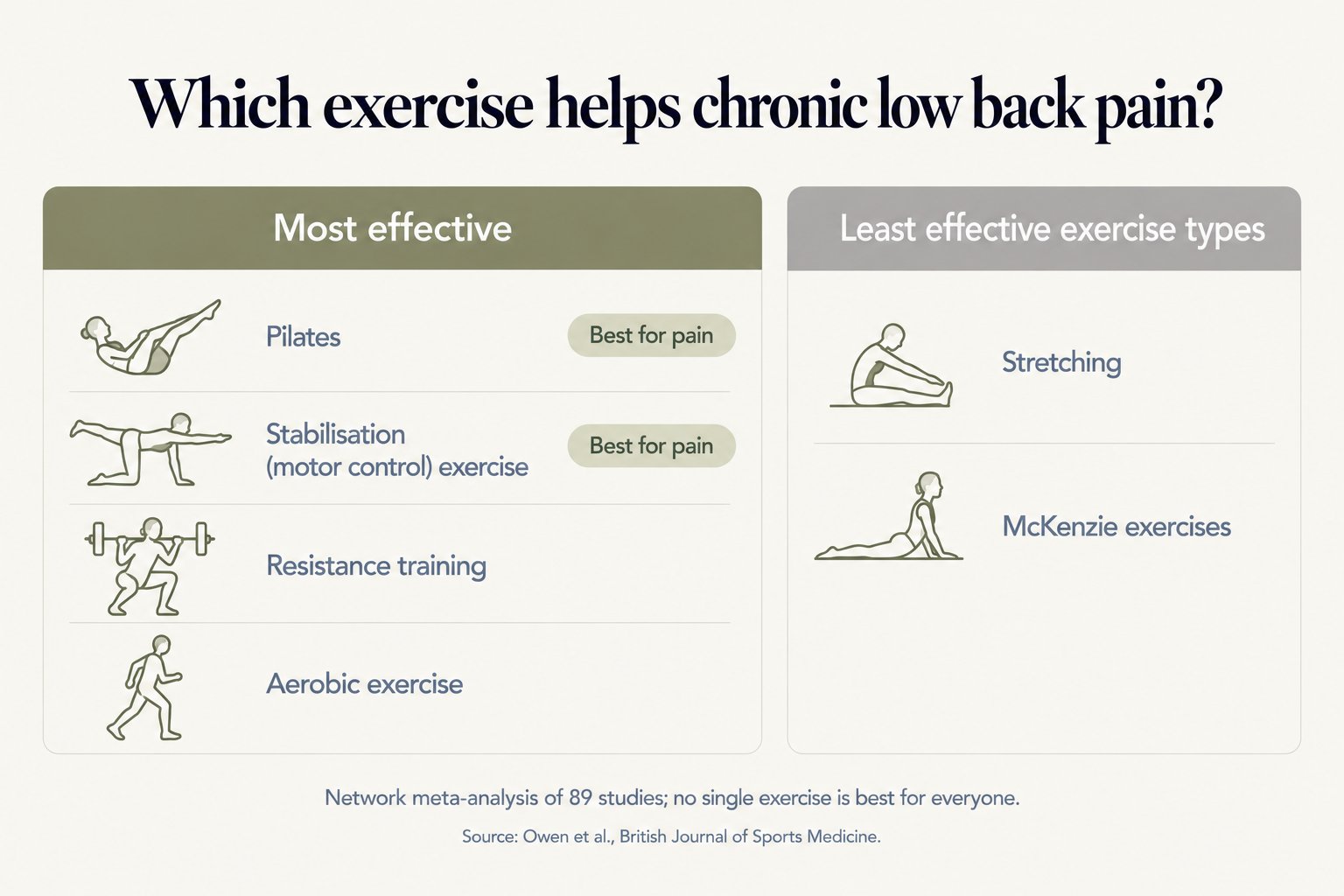
- Comparing exercise types: in a 2019 network meta-analysis in the British Journal of Sports Medicine, researchers at Deakin University analysed 89 studies with 5,578 people with chronic low back pain. Pilates, stabilisation (motor control) exercise, resistance training and aerobic exercise were the most effective for pain, function and mental health, with Pilates and stabilisation exercise the best for pain. Stretching and McKenzie exercises were the least effective exercise types. The lead researcher stressed that no single exercise is the best approach for everyone.
- Core stability vs general exercise: a 2012 meta-analysis in PLoS One of 5 trials with 414 people found that core stability exercise reduced pain and improved function more than general exercise in the short term, but there was no difference at 6 or 12 months. The trials were small and at high risk of bias.
The overall message: Pilates and core exercise help back pain, but mainly because they're structured, progressive and active. The best exercise for back pain is the one you'll do consistently.
Balance and fall risk in older adults. In a 2021 meta-analysis in Frontiers in Medicine, researchers at the University of Galway analysed 12 randomised trials with 702 healthy adults aged 60 and over. Compared with no exercise, Pilates reduced side-to-side body sway, improved how far people could reach without losing balance, and reduced fear of falling. Compared with other exercise, Pilates improved reach and the "Timed Up and Go" test of getting up from a chair, walking and returning. However, there wasn't enough data to show that Pilates reduces actual falls, and the authors called for higher-quality trials (see Balance and Fall Prevention).
Core training doesn't burn belly fat. In a 2011 trial in the Journal of Strength and Conditioning Research, 24 sedentary adults were randomised to 7 abdominal exercises (2 sets of 10, 5 days a week) or no exercise for 6 weeks, with diet held constant. The exercise group's abdominal endurance improved markedly, but abdominal fat, skinfolds and waist size didn't change. Losing belly fat depends on overall energy balance, aerobic and strength exercise, sleep and stress, not on targeted crunches (see Stress, Cortisol and Belly Fat).
Pilates and lifespan. In a 2026 analysis in the American Journal of Preventive Medicine using the US National Health Interview Survey, researchers followed 55,023 adults through 2019. People who practised Pilates had a 36% lower risk of death, after adjusting for income, education, smoking, body weight, other exercise and self-rated health. As with yoga, people who do Pilates tend to be younger, wealthier and healthier, so this result can't show that Pilates itself extends life (see Yoga for Health).
How to train your core
The basics.
- Train the core to resist movement: planks, side planks, bird dogs, dead bugs and loaded carries train the core's main job of holding the spine steady.
- Include movement too: controlled curl-ups, bridges, back extensions and rotation exercises train the core through its range.
- Breathe: keep breathing steadily rather than holding your breath; Pilates breathing patterns help coordinate the deep muscles.
- Progress gradually: lengthen holds, add limb movements, use less stable positions or add load.
- Don't forget the big lifts: squats, deadlifts, carries and overhead presses train the core heavily (see Weight Training).
A simple core routine. Do this 2 to 3 times a week, or after a strength or cardio session.
- Dead bug: 2 to 3 sets of 6 to 10 per side
- Bird dog: 2 to 3 sets of 6 to 10 per side
- Front plank: 2 to 3 holds of 20 to 45 seconds
- Side plank (knees or feet): 2 to 3 holds of 15 to 30 seconds per side
- Glute bridge: 2 to 3 sets of 10 to 15
- Suitcase carry (a heavy bag in one hand): 2 to 3 walks of 20 to 30 metres per side
Starting Pilates.
- Begin with a beginners' or small-group class: a qualified instructor can teach the foundations and adjust exercises.
- Mat or reformer: mat classes are cheaper and easy to continue at home; reformer classes add resistance and support.
- Clinical Pilates: if you have back pain or are recovering from injury, a physiotherapist-led class can tailor the exercises.
- Frequency: 2 to 3 sessions a week for at least 8 to 12 weeks.
- Combine it: pair Pilates with aerobic activity and progressive strength training.
Who should be careful
- Acute back pain or sciatica: start gently, avoid exercises that increase leg pain, and get assessed if symptoms are severe or not improving.
- Osteoporosis: avoid repeated or loaded forward bending (such as the "roll-up" and sit-ups) and forceful twisting; choose an instructor experienced with bone health (see Bone Density and Resistance Training).
- Pregnancy and after childbirth: choose prenatal or postnatal classes, avoid lying on your back for long periods later in pregnancy, and rebuild gradually after delivery, ideally with guidance on the pelvic floor and any separation of the abdominal muscles (see Pelvic Floor Health and Incontinence).
- Neck problems: support your head during curl-up exercises and avoid rolling onto the neck.
- High blood pressure: keep breathing during holds and avoid straining.
- Hernia or recent abdominal surgery: ask your surgeon or doctor before starting core exercises.
Pilates and core training in Sri Lanka
- Growing availability: mat and reformer studios are increasingly found in Colombo and other cities, and many physiotherapy clinics offer clinical Pilates.
- Cost: reformer classes can be expensive; mat Pilates and online classes are affordable alternatives, and a core routine at home costs nothing.
- Back pain at work: long hours sitting at a desk or driving are common causes of back discomfort; a short core and mobility routine can be done at home or in the office.
- Heat: most core work is low intensity, but practise in a ventilated space and drink water in warm weather.
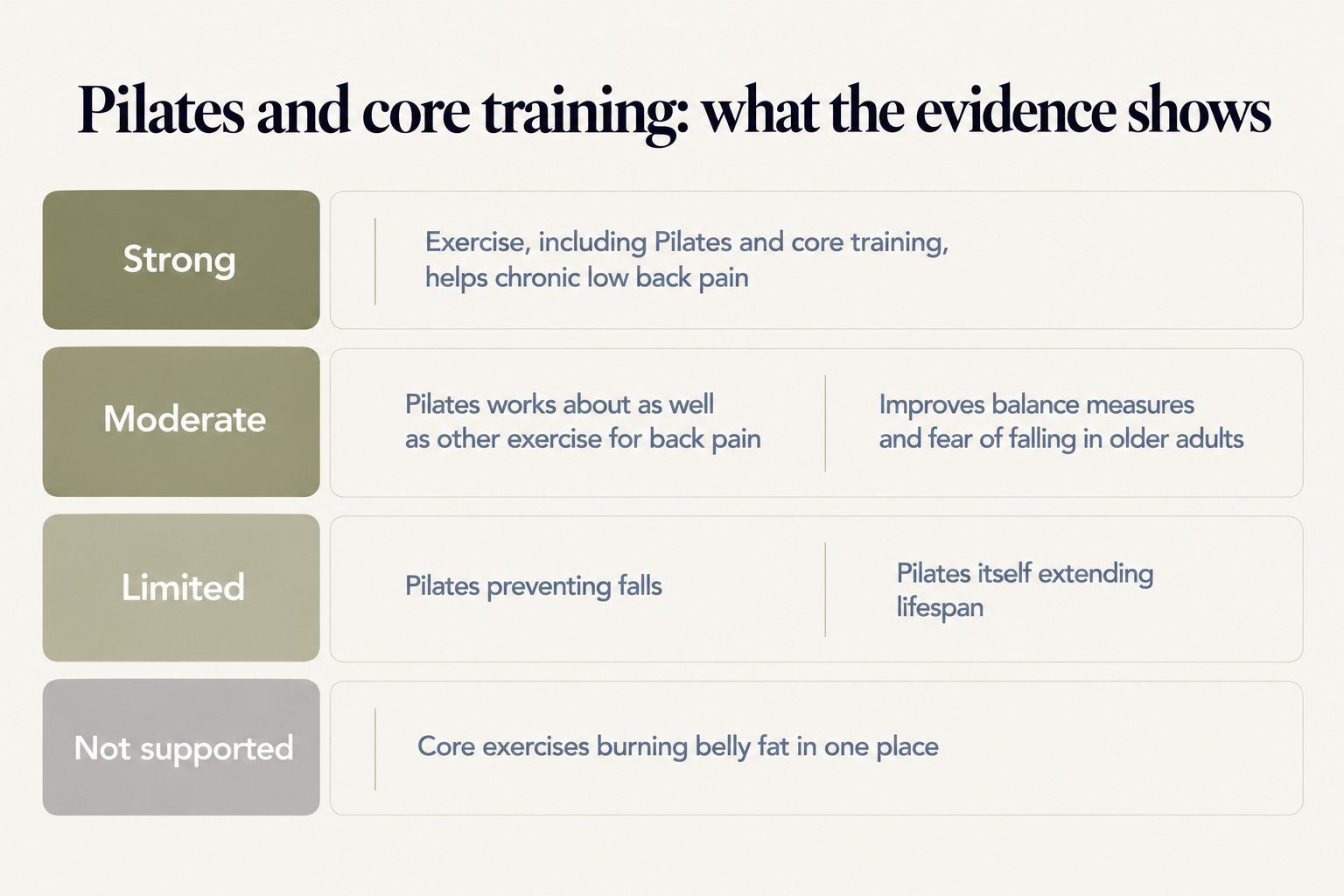
Evidence strength
- Exercise, including Pilates and core training, helping chronic low back pain: strong.
- Pilates working about as well as other exercise for back pain: moderate.
- Pilates improving balance measures and fear of falling in older adults: moderate.
- Core stability training beating general exercise for back pain in the long term: limited.
- Pilates preventing falls: limited; not yet tested properly.
- Pilates itself extending lifespan: limited; observational and likely confounded.
- Core exercises burning belly fat in one place: not supported.
Why this matters for longevity
Back pain is one of the leading causes of disability worldwide, and loss of trunk strength and control contributes to poor posture, falls and difficulty with everyday tasks as we age. A strong, well-controlled core helps you lift, carry, bend and recover your balance safely. Pilates is an enjoyable, low-impact way to build that control, especially for people with back pain, older adults and people who want a gentle start to exercise. Its limits are the same as yoga's: it's low in aerobic intensity and offers limited load, so it works best as one part of a balanced routine.
Recommendations by situation
- Chronic low back pain: Pilates, clinical Pilates or a core stabilisation programme 2 to 3 times a week, combined with walking or other aerobic activity and strength training.
- Older adults: gentle mat or reformer Pilates for balance, posture and confidence, alongside strength training and walking.
- Desk workers: a 10-minute core and mobility routine most days, and regular breaks from sitting.
- Gym-goers and runners: 2 short core sessions a week, focused on planks, side planks, carries and anti-rotation exercises.
- After childbirth: a gradual postnatal programme with guidance on the pelvic floor and abdominal wall.
- People wanting to lose belly fat: focus on overall diet, aerobic and strength exercise and sleep; core work helps posture and strength, not fat loss in one area.
Practical notes
A strong core is about control and endurance, not a visible six-pack. Train your core to resist movement with planks, side planks, bird dogs, dead bugs and carries, and add controlled movement exercises and the big strength lifts. Pilates is a well-supported option for chronic low back pain and a good way to improve balance and posture in older age, but it works about as well as other structured exercise, so choose what you enjoy and will keep doing. Combine it with aerobic activity and progressive strength training, and don't expect crunches to remove belly fat. If you have back pain with leg symptoms, osteoporosis, a hernia, or are pregnant or have recently given birth, get advice before starting. Our Longevity Doctors can assess your strength, posture, balance and back health, and help you build a core and exercise programme suited to your needs, starting with the free longevity assessment.
- Yamato TP, et al. Pilates for low back pain. Cochrane Database of Systematic Reviews, 2015;(7):CD010265.
- Owen PJ, et al. Which specific modes of exercise training are most effective for treating low back pain? Network meta-analysis. British Journal of Sports Medicine, 2020;54(21):1279-1287.
- Wang XQ, et al. A meta-analysis of core stability exercise versus general exercise for chronic low back pain. PLoS One, 2012;7(12):e52082.
- Donatoni da Silva L, Shiel A, McIntosh C. Pilates reducing falls risk factors in healthy older adults: a systematic review and meta-analysis. Frontiers in Medicine, 2021;8:708883.
- Vispute SS, et al. The effect of abdominal exercise on abdominal fat. Journal of Strength and Conditioning Research, 2011;25(9):2559-2564.
- Complementary health approaches and all-cause mortality among US adults (National Health Interview Survey 2007 and 2012 cohort). American Journal of Preventive Medicine, 2026.
Free longevity assessment
Living with back pain or
wanting a stronger core?
Take the free Aevum Protocol assessment to see how your movement & strength and 6 other longevity domains are performing — and get a personalised 90-day plan.
Take the free assessmentKeep reading