Movement & Strength
The Minimum Effective Dose:
The Least Exercise That Actually Works
This series has covered a lot of ground — progressive overload, VO2 max, bone density, recovery, joint health, decades of decline. The natural question after all of that is the practical one: what's the actual floor? What's the smallest amount of exercise that still produces a genuine, measurable benefit, for someone who isn't trying to optimize anything, just trying to get the real health return on the least time invested? The evidence across both cardiovascular and resistance training gives a surprisingly concrete, encouraging answer — and it's lower than most people assume, though "lower than you think" isn't the same as "none needed."
Key numbers
| Finding | Detail |
|---|---|
| Meeting minimum cardio guideline (150 min/week moderate or 75 min/week vigorous) | ~19-25% lower all-cause mortality vs. inactive |
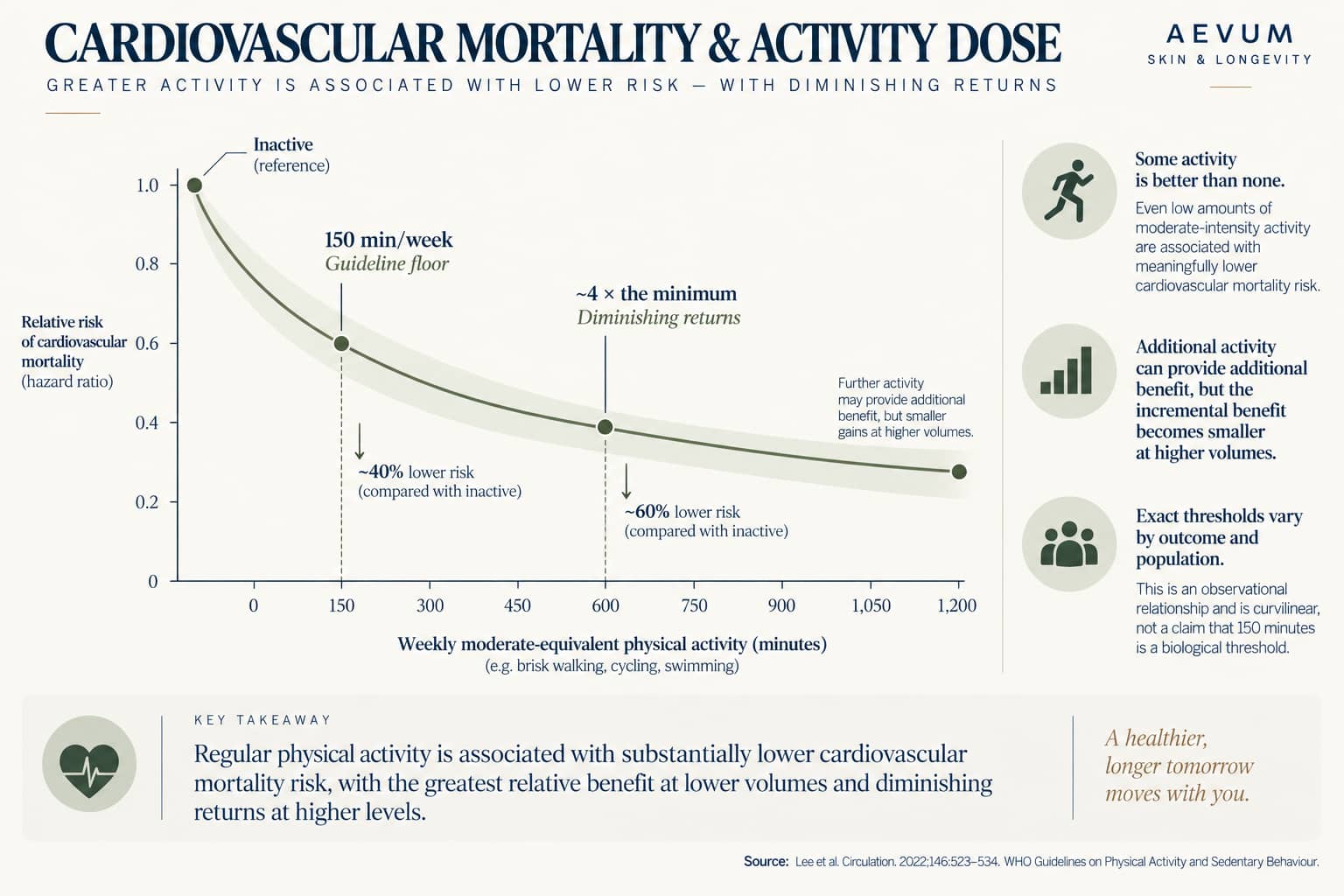
| Doubling to ~300-600 min/week moderate | Greater reduction, but past roughly 4x the minimum, no further gain |
| Study sample | 116,221 US adults, 30-year follow-up |
| Minimum resistance training dose for measurable strength gains in beginners | As little as 1 set per exercise, once weekly, for roughly 9-12 weeks |
| Exercise snacking minimum dose (from prior article) | ~3.4-4.1 min/day of vigorous bursts still shows 22-33% mortality risk reduction |
What "minimum effective dose" actually means here
The term borrows from pharmacology: the smallest dose of a drug that produces the intended effect, below which you're getting the side effects (in this case, time cost) without much of the benefit. Applied to exercise, the question isn't "what's the best program" — it's "what's the least input that still moves the needle in a real, evidence-backed way." This matters practically because the gap between doing nothing and doing the minimum effective dose is, across nearly every outcome covered in this series, larger than the gap between the minimum and doing a lot more.
What the evidence shows
Cardiovascular: the WHO minimum is a genuine floor, not an arbitrary number. A large prospective study following 116,221 US adults for 30 years found that simply meeting the standard minimum guideline — 150 minutes per week of moderate activity, or 75 minutes of vigorous activity — was associated with a meaningfully lower all-cause mortality risk compared to inactive people. Doubling or more (roughly 150-300 min/week vigorous, or 300-600 min/week moderate) pushed the reduction further, showing a genuine dose-response relationship rather than a flat cutoff. But there was a clear ceiling: beyond these durations — roughly four times the recommended minimum — no significant additional mortality benefit was found. The floor of 150 minutes a week — about 21-22 minutes a day — captures the large majority of the achievable benefit; going further helps somewhat more, but with clearly diminishing returns.
For context on the very low end: the exercise-snacking evidence covered in our Exercise Snacking article suggests that even a few minutes a day of genuinely vigorous effort — well below the 150-minute guideline — is associated with meaningful risk reduction for people doing literally nothing otherwise. The honest read across both bodies of evidence: something is dramatically better than nothing, the WHO minimum captures most of the achievable benefit, and more beyond roughly 4x that minimum adds little further.
Resistance training: the minimum dose is smaller than most people assume. For strength specifically, a body of minimal-dose resistance training research has converged on a genuinely low floor: for previously untrained or sedentary people, protocols using as little as a single set per exercise, performed once a week for roughly 9-12 weeks, have produced measurable, statistically significant strength gains — particularly for compound, multi-joint movements. This isn't the dose that builds serious strength or maximizes hypertrophy (the progressive-overload principles in our Progressive Overload article cover what's needed for continued gains), but as a floor — the minimum that produces a real, non-trivial training effect in someone starting from zero — it's a strikingly small commitment: a few minutes, once a week.

Why the floor matters more than the ceiling for most people
Across this series, the largest, most consistent finding is that the biggest health gap sits between "nothing" and "something," not between "something" and "a lot." This shows up in the balance research (see our Balance and Fall Prevention article), the bone density data (see our Bone Density and Resistance Training article), and the cardiovascular mortality curve above — in each case, the curve is steepest right at the low end. Practically, this means the minimum effective dose isn't a compromise or a lesser version of "real" exercise — for someone doing nothing, it's the single highest-leverage change available.
Recommendations by scenario
- 1Currently doing no structured exercise
The floor to aim for is 150 minutes/week of moderate activity (or 75 minutes vigorous) plus at least one weekly resistance session, even a single set per major movement pattern. This alone captures the majority of the achievable mortality and strength benefit documented in this series.
- 2Very limited and inconsistent time
Prioritize consistency at the minimum dose over sporadic higher volume — a steady 150 min/week (or even the few-minutes-a-day exercise-snacking floor) beats an occasional intense week followed by weeks of nothing.
- 3Already exceeding the minimum and wondering if more is worth it
The mortality data suggests real additional benefit up to roughly 2-4x the minimum guideline, with a genuine ceiling beyond that — useful context for calibrating expectations if the goal is specifically longevity rather than performance, aesthetics, or a sport-specific goal, which have their own separate demands.
- 4Returning to exercise after a long break
Starting at or near the minimum dose (rather than an ambitious full program) is both evidence-supported and more likely to be sustained — the strength research specifically shows a single weekly set is enough to restart real adaptation in detrained or untrained people.
- 5Using this as a baseline to build from
The minimum effective dose is a floor, not a target to stay at indefinitely if your goals include more than baseline health — the other articles in this series (progressive overload, VO2 max, bone density) cover what's needed to progress past this floor toward specific strength, fitness, or longevity goals.
Practical notes
This article closes out the series with what is arguably its most actionable single finding: the amount of exercise required to capture most of the available health benefit is genuinely small — about 20 minutes a day of movement, plus a few minutes of resistance training a week. The rest of this series exists for people who want to go further than that floor, for good reasons (strength, bone density, longevity optimization, sport performance) — but the floor itself is not out of reach for anyone.
Are you currently meeting
the 150-minute-a-week guideline?
Take the free Aevum Protocol assessment to see how your movement & strength and 6 other longevity domains are performing — and get a personalised 90-day plan.
Take the Free Assessment →