Movement & Strength
Building Your Weekly Exercise Mix:
A Plan for Every Age and Goal
This series has covered walking, running, cycling, swimming, weight training, bodyweight training, yoga, Pilates, tai chi and qigong, sports, dance and martial arts. Each has its own strengths, and none does everything. The aim is to combine them into a weekly routine that covers the four types of exercise (aerobic, strength, flexibility and balance), suits your age, goals and health, and is something you'll keep doing. Variety itself seems to matter: in a 2026 study in BMJ Medicine of over 111,000 American adults followed for more than 30 years, people who did the widest range of activities had a 19% lower risk of death than those with the least variety, even after accounting for how much they did in total. Combining cardio and strength doesn't undermine either: a 2022 meta-analysis of 43 studies found that adding aerobic exercise to strength training didn't reduce gains in muscle size or maximal strength, although it slightly blunted explosive power when both were done in the same session. And habits take time: in a well-known study, a new exercise behaviour took a median of about 91 days to become automatic. This article shows how to build your mix step by step, with example weekly plans for different ages, goals and situations.
Key numbers
| Finding | Detail |
|---|---|
| WHO weekly targets for adults | 150 to 300 min moderate or 75 to 150 min vigorous aerobic activity, plus strength on 2 or more days |
| WHO extra target for people over 65 | Balance and strength activities on 3 or more days |
| Meeting both aerobic and strength guidelines (479,856 US adults) | 40% lower risk of death vs neither |
| Widest vs narrowest variety of activities (111,373 US adults, 30+ years) | 19% lower risk of death, independent of total amount |
| Benefit of total activity in the same study | Levelled off at about 20 MET-hours a week |
| Cardio added to strength training (43 studies) | No loss of muscle growth or maximal strength; some loss of explosive power in same-session training |
| Time for exercise to become automatic (habit study) | Median about 91 days for exercise behaviours |
Step 1: Start from where you are
Before planning, think about:
- Your current activity: if you're inactive, start small; the biggest health gains come from moving from nothing to something (see The Minimum Effective Dose).
- Your goals: heart health, weight, strength, mood, sport, independence in older age, or managing a condition.
- Your age and life stage: priorities shift with age, with strength, balance and bone becoming more important from midlife (see Exercise Across the Decades).
- Your health: heart disease, diabetes, high blood pressure, arthritis, osteoporosis, pregnancy or recent injury may change what's safe; get advice before vigorous exercise.
- Your time, budget and access: a plan you can follow beats a perfect plan you can't.
- What you enjoy: the activities you like are the ones you'll keep doing.
Step 2: Build the foundation
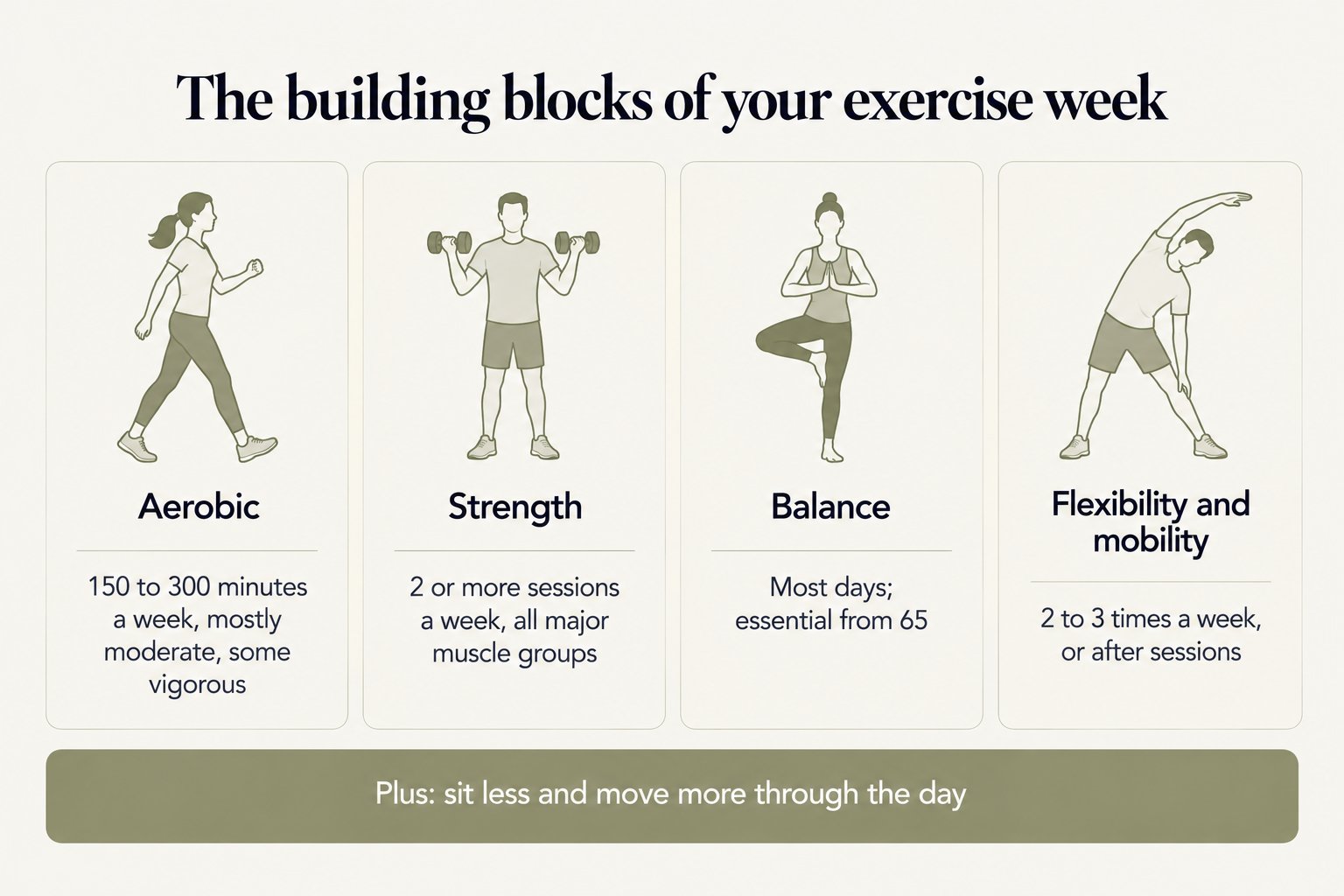
Every plan should include aerobic activity and strength training, the two types with the strongest links to a longer life (see Types of Exercise Explained).
Aerobic activity: 150 to 300 minutes a week.
- Most of it at a moderate, conversational pace: brisk walking, easy cycling, swimming or dancing (see Zone 2 Training).
- Some of it harder if you're able: intervals, running, a racket sport or a fast class, which build fitness efficiently (see HIIT vs. Steady-State Cardio).
- Options: Walking, Running, Cycling, Swimming or Sports, Dance and Martial Arts.
Strength training: 2 or more sessions a week.
- Train all the major muscle groups: legs, hips, back, chest, shoulders, arms and core.
- Push close to effort: finish most sets with only a few reps left in reserve, and increase the challenge over time (see Progressive Overload).
- About 30 to 60 minutes a week is enough for most of the benefit.
- Options: Weight Training with free weights, machines or bands, or Calisthenics.
Step 3: Add balance and flexibility
- Balance: important at every age and essential from about 65, when the WHO recommends balance and strength activities on 3 or more days a week. Tai chi, dance, yoga, single-leg exercises and many sports all count (see Balance and Fall Prevention and Tai Chi and Qigong).
- Flexibility and mobility: stretching, yoga or Pilates 2 to 3 times a week, or a few minutes after other sessions, especially if you're stiff, sit a lot or have back pain (see Flexibility and Mobility, Yoga for Health and Pilates and Core Training).
- Combine where you can: yoga, tai chi, dance and racket sports train balance, flexibility and coordination at the same time as other qualities.
Step 4: Add variety you enjoy
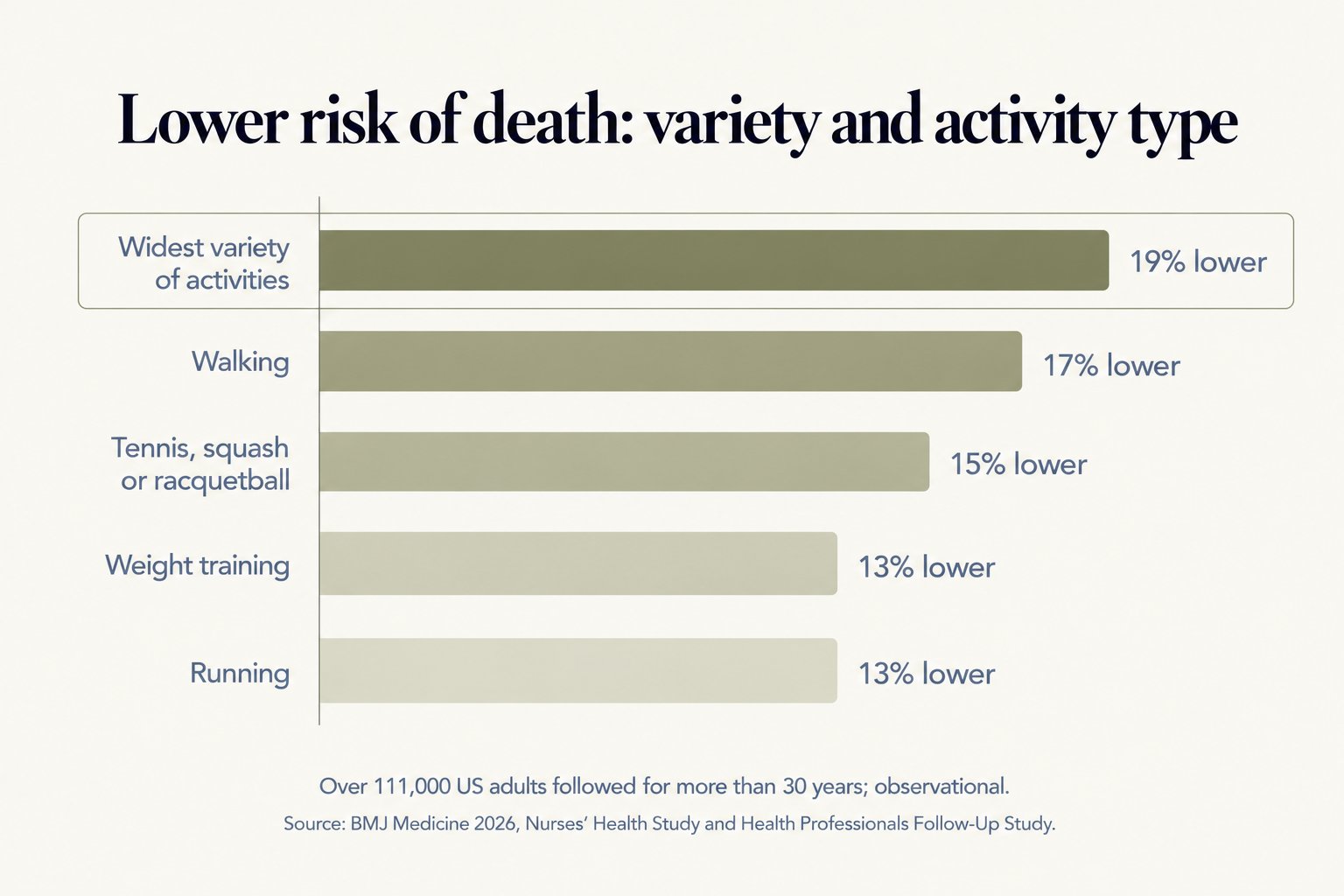
In the 2026 BMJ Medicine study, researchers followed 111,373 American nurses and health professionals for more than 30 years, with repeated questionnaires about their activities. People who did the widest variety of activities had a 19% lower risk of death than those who did the fewest, regardless of how much activity they did in total. Comparing the most with the least participation in each activity, the lower risk of death was:
- Walking: 17%
- Tennis, squash or racquetball: 15%
- Rowing or callisthenics: 14%
- Weight training: 13%
- Running: 13%
- Jogging: 11%
- Stair climbing: 10%
- Cycling: 4%
The benefit of total activity levelled off at about 20 MET-hours a week, roughly 5 hours of brisk walking. The study was observational and mostly included white health professionals, so it can't prove that variety itself causes the benefit, but there are good reasons it might: different activities train different systems, spread the load across joints and muscles, and keep exercise interesting.
Step 5: Put it into a week
Combining cardio and strength. A common worry is that cardio "kills gains". In a 2022 meta-analysis in Sports Medicine of 43 studies in healthy adults, combining aerobic and strength training produced the same gains in muscle size and maximal strength as strength training alone. Only explosive strength, such as jumping power, was slightly reduced, and mainly when both were done in the same session. Separating them by at least 3 hours removed this effect.
In practice:
- For general health: combine cardio and strength freely, in the same session or on different days.
- For athletes focused on power: separate strength and hard cardio by several hours or put them on different days.
- In the same session: do whichever matters more to you first.
Recovery.
- Alternate hard and easy days: follow a hard session with an easy one.
- Rest muscle groups: allow about 48 hours before training the same muscles hard again.
- Take at least one easier day a week: a walk, gentle yoga or complete rest.
- Sleep: most adaptation happens during recovery, and poor sleep slows it.
Use the whole day.
- Exercise snacks: short bursts of stair climbing, squats or brisk walking add up (see Exercise Snacking).
- Active travel: walking or cycling for part of your journey.
- Break up sitting: stand or walk for a few minutes every 30 to 60 minutes.
Step 6: Progress, track and keep going
- Progress gradually: increase time, distance or load by small amounts every week or two, not all at once.
- Track simply: a diary, an app or a calendar of ticks for sessions completed; watch trends in step count, walking pace, weights lifted or how far you can go.
- Test every few months: how long you can walk briskly, how many push-ups or sit-to-stands you can do, how long you can stand on one leg.
- Give habits time: in a 2010 study in the European Journal of Social Psychology, 96 volunteers chose a new daily behaviour and repeated it in the same situation. For those whose data could be modelled, it took a median of 66 days to become automatic, ranging from 18 to 254 days, and about 91 days for exercise behaviours. Missing a single day didn't derail the habit.
- Plan for disruptions: have a short backup routine for busy weeks, travel, illness and the monsoon.
Example weekly plans
A beginner starting from very little activity.
- Most days: a 10 to 30-minute brisk walk, building gradually.
- 2 days: a 20-minute bodyweight or band strength routine (sit-to-stands, wall push-ups, rows, bridges).
- Daily: a few minutes of stretching and standing on one leg while brushing your teeth.
- After 8 to 12 weeks: increase walking time and pace, and progress the strength exercises.
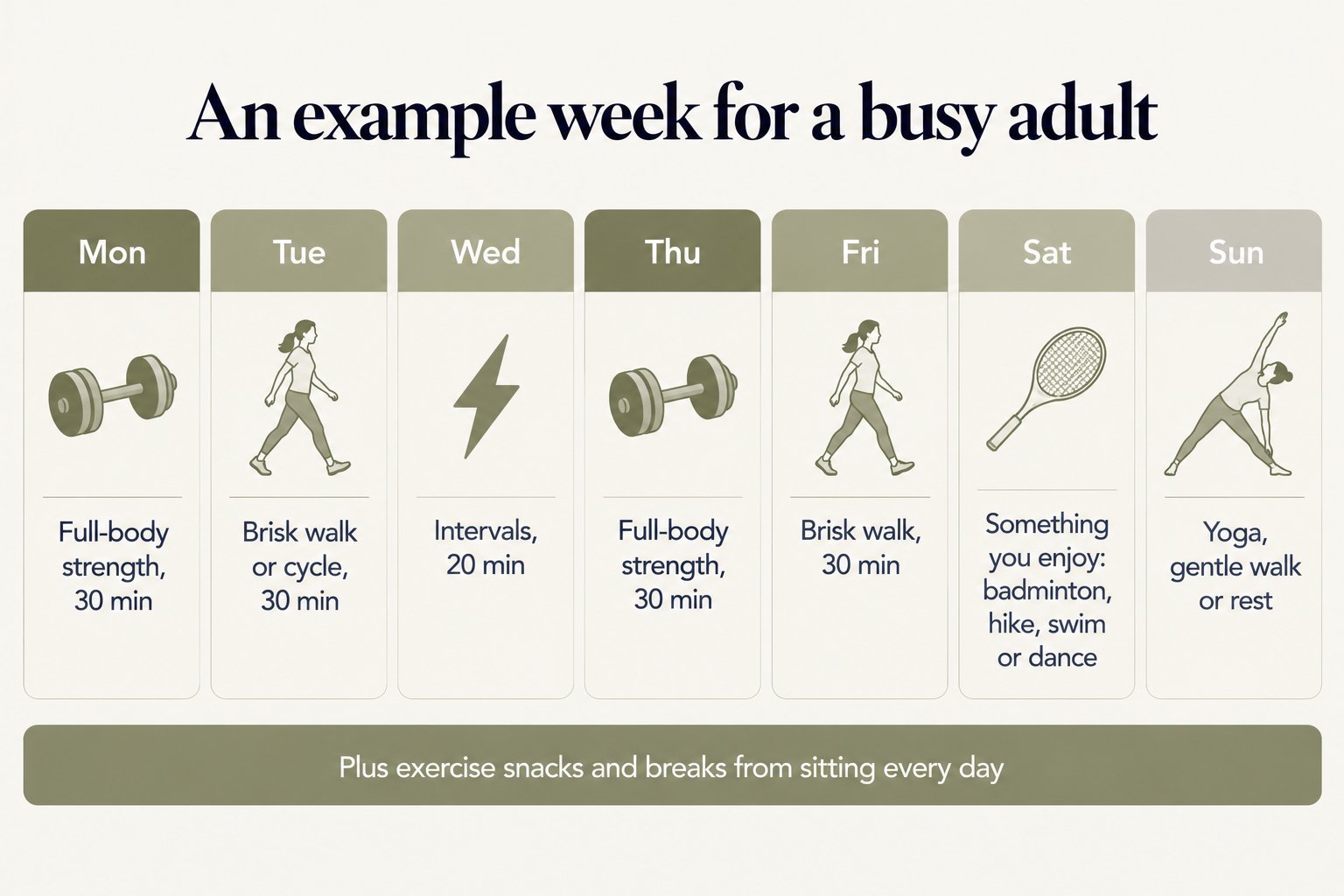
A busy working adult.
- Mon: 30-minute full-body strength session.
- Tue: 30-minute brisk walk or cycle commute.
- Wed: 20-minute interval session (running, cycling or a bodyweight circuit).
- Thu: 30-minute full-body strength session.
- Fri: 30-minute brisk walk.
- Sat: a longer activity you enjoy: badminton, a hike, a swim or a dance class.
- Sun: yoga, a gentle walk or rest.
- Throughout: exercise snacks and regular breaks from sitting.
An adult in their 40s to 60s focused on healthy ageing.
- 3 days: 30 to 45 minutes of moderate cardio (brisk walking, cycling or swimming), with one session including harder intervals.
- 2 to 3 days: strength training with weights or machines, emphasising legs, hips and back.
- 1 to 2 days: yoga, Pilates or a racket sport for mobility, balance and fun.
- Daily: 5 minutes of balance and mobility work.
An adult over 65.
- Most days: 20 to 40 minutes of walking, cycling or water exercise.
- 2 to 3 days: strength training, including sit-to-stands, step-ups, rows and carries.
- 3 or more days: balance training such as tai chi, dance or single-leg exercises.
- 2 to 3 days: gentle stretching, yoga or chair yoga.
- Practise getting down to the floor and up again safely, with support if needed.
Someone with knee or hip pain.
- Cardio: cycling, swimming, water walking or an elliptical trainer.
- Strength: 2 to 3 sessions focusing on the thighs and hips, within a comfortable range.
- Mobility and balance: tai chi, gentle yoga or Pilates.
- Keep moving: stay active through mild discomfort, but get advice if pain is severe, worsening or causes limping (see Exercise and Joint Health).
Someone who loves one sport.
- Keep your sport as the centre of your week.
- Add 2 strength sessions to improve performance and reduce injury risk.
- Add easy cardio of a different type to build fitness without overloading the same joints.
- Add mobility work for the areas your sport stresses most.
Common mistakes
- Doing only cardio or only strength: you need both for the greatest benefit.
- Forgetting balance after midlife: falls become a major risk with age, and balance can be trained.
- Too much, too soon: sudden jumps in training lead to injury and burnout.
- Never pushing hard enough: strength and fitness need a challenge that gradually increases.
- All hard sessions, no easy ones: recovery is when the body adapts.
- Waiting for the perfect plan: start with what you can do now and adjust as you go.
- Choosing exercise you hate: enjoyment predicts whether you'll still be exercising next year.
Exercising in Sri Lanka
- Beat the heat: train in the early morning or evening, drink water, wear light clothing and take extra care on humid days.
- Monsoon plans: have indoor options ready, such as home bodyweight routines, online yoga or Pilates, stair climbing or a gym.
- Low-cost options: walking, bodyweight training, home yoga, playing badminton or cricket with family and community sports cost little or nothing.
- Use local spaces: parks, beaches, walking tracks, school grounds and outdoor fitness stations.
- Make it social: walking groups, sports clubs, dance classes and family activities help you stick with it.
Why this matters for longevity
No single activity covers everything the body needs to age well. Aerobic exercise protects the heart, lungs, brain and metabolism; strength training preserves muscle, bone and independence; balance training prevents falls; flexibility keeps joints moving; and activities you enjoy keep you coming back. People who combine aerobic and strength activity, and who stay active in a variety of ways, have some of the lowest risks of death and disability. A balanced weekly mix, adjusted as your life changes, is one of the most powerful things you can do for a long, healthy life.
Recommendations
- Everyone: aerobic activity most days, strength training on 2 or more days, and less sitting.
- From midlife: prioritise strength and add regular balance and mobility work.
- From 65: balance and strength activities on 3 or more days a week.
- Busy people: short, efficient sessions plus exercise snacks.
- Beginners: start with walking and simple strength exercises, and build gradually over 2 to 3 months.
- People with health conditions: get assessed before starting vigorous exercise, and choose activities suited to your condition.
- Everyone: include at least one activity you enjoy, and change things up every few months.
Practical notes
Build your week around the foundation of aerobic activity most days and strength training on at least 2 days, then add balance and flexibility and at least one activity you enjoy. Mix different types of exercise, combine cardio and strength without worrying about losing gains, alternate hard and easy days, and use the rest of the day to move more and sit less. Progress gradually, track simply, plan for heat, monsoons and busy weeks, and give yourself 2 to 3 months for exercise to become a habit. Our Longevity Doctors can assess your fitness, strength, balance, flexibility and health, and design a personalised weekly exercise plan for your age, goals and any medical conditions, starting with the free longevity assessment.
- Bull FC, et al. World Health Organization 2020 guidelines on physical activity and sedentary behaviour. British Journal of Sports Medicine, 2020;54(24):1451-1462.
- Zhao M, et al. Recommended physical activity and all cause and cause specific mortality in US adults: prospective cohort study. BMJ, 2020;370:m2031.
- Momma H, et al. Muscle-strengthening activities are associated with lower risk and mortality in major non-communicable diseases: a systematic review and meta-analysis of cohort studies. British Journal of Sports Medicine, 2022;56(13):755-763.
- Variety of physical activity types and mortality in US men and women: Nurses' Health Study and Health Professionals Follow-Up Study. BMJ Medicine, 2026.
- Schumann M, et al. Compatibility of concurrent aerobic and strength training for skeletal muscle size and function: an updated systematic review and meta-analysis. Sports Medicine, 2022;52:601-612.
- Lally P, et al. How are habits formed: modelling habit formation in the real world. European Journal of Social Psychology, 2010;40(6):998-1009.
Free longevity assessment
Want a weekly exercise plan
built around you?
Take the free Aevum Protocol assessment to see how your movement & strength and 6 other longevity domains are performing — and get a personalised 90-day plan.
Take the free assessmentKeep reading