Movement & Strength
Exercise Across the Decades:
What Actually Changes and What to Prioritize
The advice to "exercise regularly" doesn't change much across a lifetime, but what actually declines, how fast, and what deserves priority changes substantially — and the decline isn't a steady, linear slope. Both cardiorespiratory fitness and muscle mass lose ground at accelerating rates as the decades pass, which means the training emphasis that made sense in your 20s isn't the one that protects you most in your 50s or 70s. This guide walks decade by decade through what the evidence shows is actually changing physiologically, and what to prioritize at each stage.
Key numbers
| Finding | Detail |
|---|---|
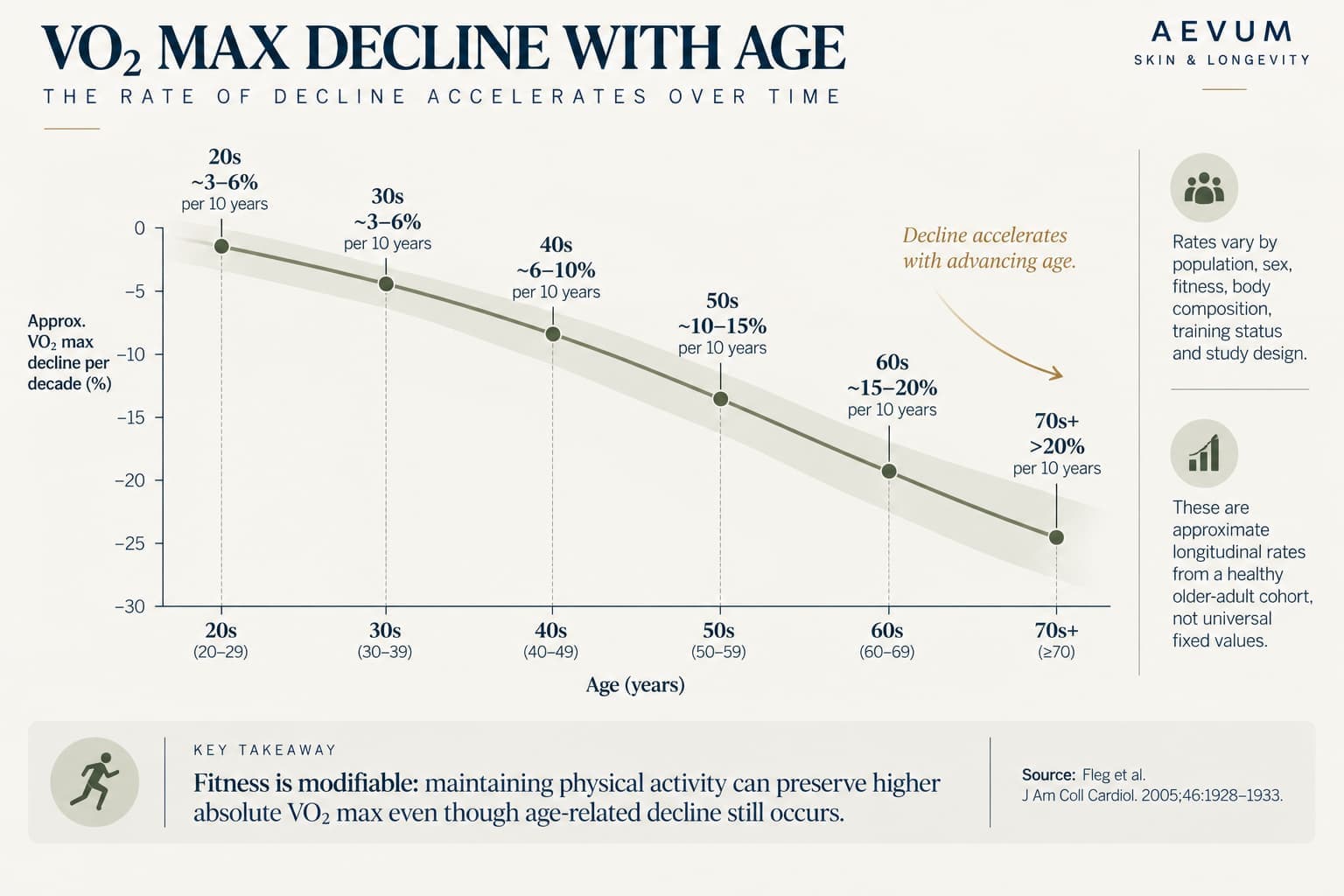
| VO2 max decline, 20s-30s | ~3-6% per decade |
| VO2 max decline, after age 70 | More than 20% per decade — the decline accelerates, it isn't linear |
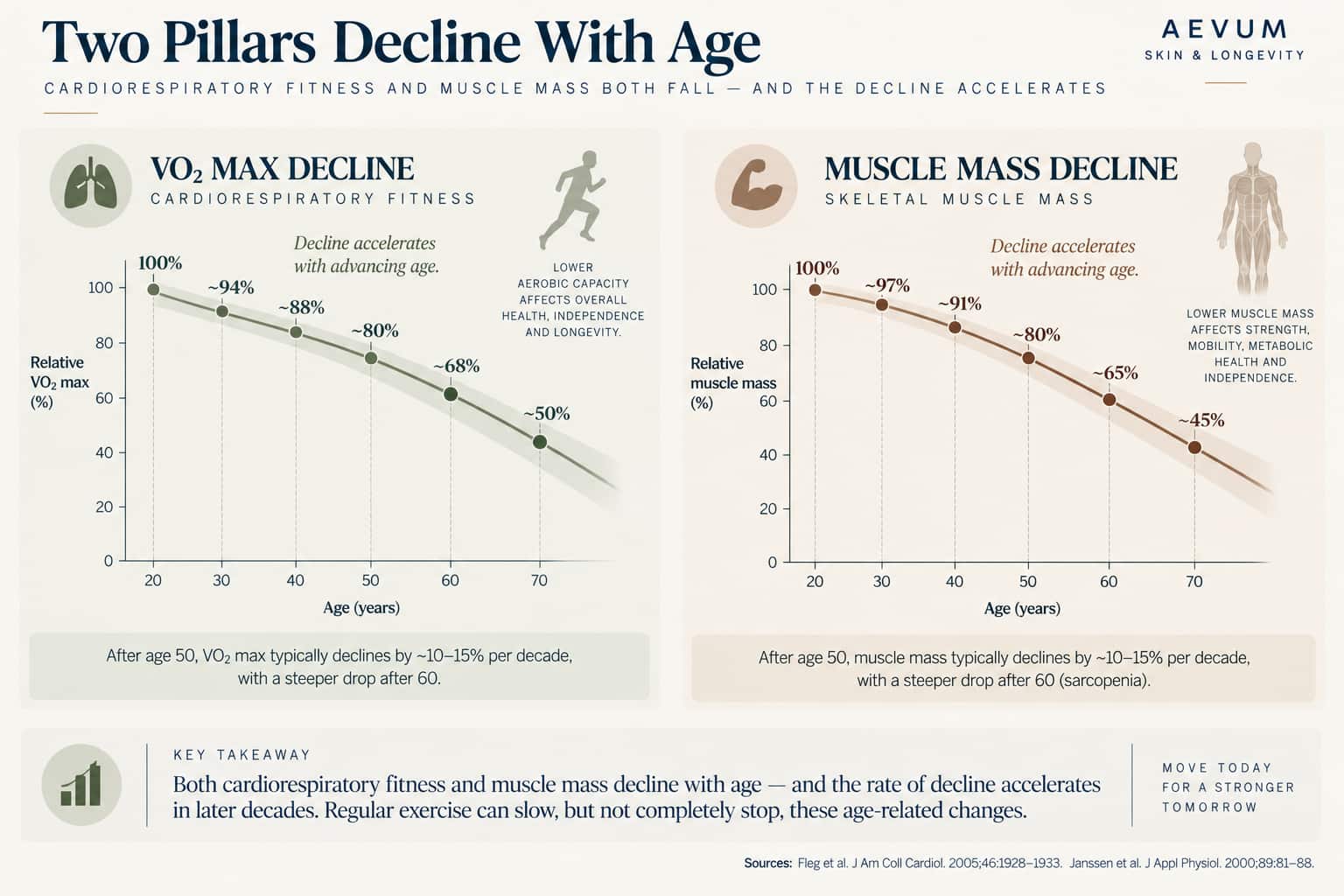
| Muscle mass loss, after age 30 | ~3-5% per decade, ~30% total lifetime loss without intervention |
| Resistance training in older adults (49 studies, 1,328 participants over 50) | Average lean body mass gain of ~1.1 kg (2.4 lbs) — muscle can still be rebuilt at any age |
| Sex-specific pattern | Steeper VO2 max decline in men beginning in the 40s onward |
Why the decline isn't a straight line
The intuitive mental model of aging and fitness is a steady, gradual downward slope — a little bit lost every year, evenly. The actual data, from longitudinal tracking in the Baltimore Longitudinal Study of Aging, tells a different story: cardiorespiratory fitness (VO2 max) declines relatively modestly through the 20s and 30s (roughly 3-6% per decade), then the rate of loss accelerates with each subsequent decade, reaching over 20% per decade past age 70. Muscle mass follows a broadly similar accelerating pattern — a slower, more linear-looking loss of 3-5% per decade starting around age 30 that compounds into a much steeper effective decline once sarcopenia (covered in our Muscle Mass and Longevity article) sets in more aggressively in the 60s and beyond.
The practical implication of this acceleration is important: the training you do in your 30s and 40s isn't just about how you feel in your 30s and 40s — it's setting the starting point and trajectory for a decline curve that gets steeper later. Higher fitness and more muscle mass earlier means more room before those accelerating losses become functionally limiting.
Recommendations by decade
- 120s: build the foundation, establish the habit
Physiologically, this is close to peak capacity for both cardiorespiratory fitness and muscle-building potential — the body responds efficiently to training stimulus and recovers quickly. The priority here isn't urgency (decline is still slow at this stage) but habit formation: establishing consistent resistance training and cardiovascular fitness as a genuine part of life, using foundational principles like progressive overload (see our Progressive Overload article) while recovery capacity is at its best. Building a strength and fitness "surplus" now pays dividends against the accelerating losses to come.
- 230s: the decline begins — quietly
Both muscle mass and VO2 max loss technically begin in this decade, even though the rate is still modest and rarely noticeable day to day. This is a good decade to get serious about resistance training specifically (not just general activity), since the 3-5% per decade muscle loss figure applies without intervention — consistent progressive resistance training substantially blunts or reverses it. Cardiovascular base-building is also worth prioritizing now rather than waiting until fitness feels like it's slipping.
- 340s: the acceleration point, especially for men
This is where the data shows a genuine inflection — VO2 max decline steepens meaningfully, and the pattern is more pronounced in men specifically starting in this decade. This is a reasonable point to start paying closer attention to actual numbers rather than assuming things are fine: a fitness test and periodic reassessment of strength benchmarks become more useful here than in the 20s or 30s. Resistance training and cardiorespiratory training both deserve continued, undiminished priority.
- 450s: protecting what's built becomes the explicit goal
By this decade, the cumulative effect of the accelerating declines becomes more tangible — strength, VO2 max, and bone density (see our Bone Density and Resistance Training article) are all past their peak and actively receding without deliberate counter-pressure. The framing shifts from "building" to "actively protecting and slowing the slope" — resistance training remains the single highest-leverage tool against both the muscle and bone components of this decline, and this is a sensible decade to add explicit balance training if it isn't already part of the routine.
- 560s: independence-preserving training becomes the priority
This is the decade where the accelerating decline curves start to matter functionally, not just on a fitness test — the difference between maintained and lost strength and balance increasingly determines whether daily tasks stay easy or become effortful. Functional movement patterns and balance training move from "worth doing" to genuinely high-priority, alongside continued resistance training — the meta-analysis evidence on older adults rebuilding measurable lean mass through progressive resistance training applies directly here: it is not too late to meaningfully change this trajectory, even starting fresh in this decade.
- 670s and beyond: the steepest part of the curve — and where training still helps most
This is where VO2 max decline exceeds 20% per decade without intervention — the steepest point on the curve. It's also, somewhat counterintuitively, one of the decades where structured exercise (resistance training in particular) has demonstrated some of its clearest, most consequential benefits, precisely because the untrained trajectory is steepest here. Working with appropriately qualified supervision is reasonable at this stage, but the core message from the evidence is unambiguous: this is not a decade to stop, even though it's often when people do.
Practical notes
The single clearest takeaway across the decades: the decline accelerates, so the earlier a strength and fitness foundation is built, the more room there is before that acceleration becomes functionally limiting — but the evidence is equally clear that starting later, even in the 60s or 70s, still produces real, measurable benefit. There is no decade in this data where training stops working.
Which decade are you in
right now?
Take the free Aevum Protocol assessment to see how your movement & strength and 6 other longevity domains are performing — and get a personalised 90-day plan.
Take the Free Assessment →