Movement & Strength
Sports, Dance and Martial Arts:
Exercise That Doesn't Feel Like Exercise
Not all exercise has to happen in a gym or on a running track. Racket sports, team sports, dance and martial arts combine fitness with skill, play and other people, and that may be part of why they're linked to some of the largest health benefits of any activity. In a study of over 80,000 British adults, people who played racket sports such as tennis, badminton and squash had a 47% lower risk of death from any cause and a 56% lower risk of death from heart disease and stroke than those who didn't. In a Danish study of 8,577 people followed for up to 25 years, tennis players lived about 9.7 years longer than sedentary people, badminton players 6.2 years and football players 4.7 years, compared with about 1.5 years for people who mainly exercised in a gym. Both studies were observational, so sport players may simply be healthier, wealthier or more sociable to begin with. Trials show that recreational football improves blood pressure and body fat, dance-based activities reduce falls in older adults, and dance is linked to lower dementia risk and better mood. Martial arts can improve mobility in older adults, although the evidence is limited. The trade-off is a higher risk of injury, especially in contact sports. This article explains the benefits, the risks and how to choose a sport, dance style or martial art that suits you.
Key numbers
| Finding | Detail |
|---|---|
| Racket sports and death (80,306 British adults, observational) | 47% lower death from any cause; 56% lower from heart disease and stroke |
| Aerobics classes and death (same study) | 27% lower death from any cause; 36% lower from heart disease and stroke |
| Life expectancy vs sedentary (8,577 Danish adults, up to 25 years) | Tennis +9.7 years; badminton +6.2; football +4.7; gym exercise +1.5 |
| Recreational football vs no exercise (31 studies) | Systolic blood pressure about 4 mmHg lower; fat mass about 1.7 kg lower |
| Dance-based and mind-motor activities in older adults (29 trials, 4,239 people) | 37% lower risk of falling; better balance, mobility and leg strength |
| Martial arts in older adults (10 small trials) | Better mobility; low-certainty evidence |
What sports, dance and martial arts train
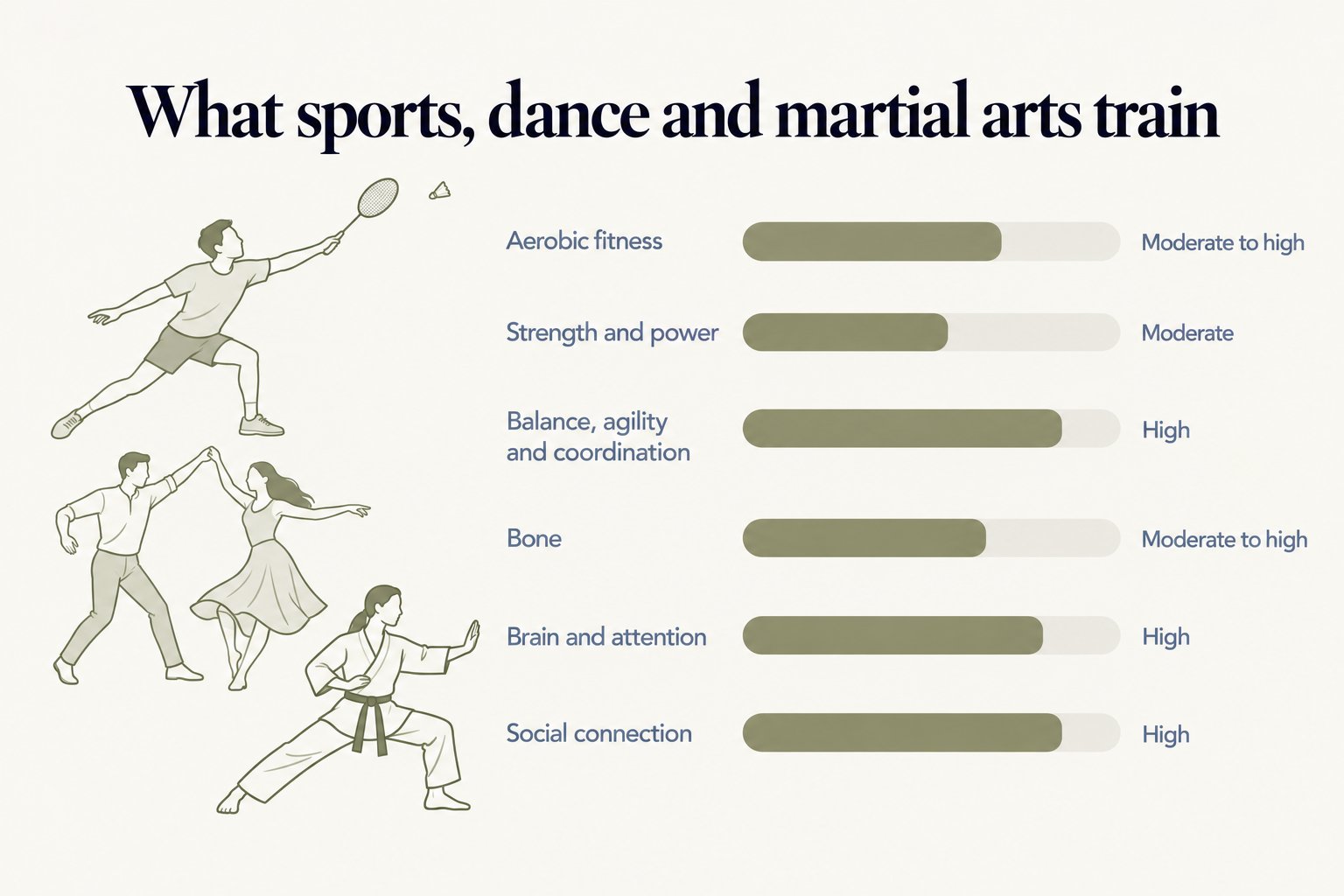
Each activity is different, but most combine several types of fitness:
- Aerobic fitness: moderate to high, from repeated bursts of running, jumping and changes of direction.
- Strength and power: moderate, especially in the legs; higher in martial arts and racket sports.
- Balance, agility and coordination: high; reacting to a ball, an opponent or a partner trains quick footwork and timing.
- Bone: moderate to high in sports with running, jumping and impact.
- Brain and attention: high; learning skills, steps and tactics challenges memory and attention.
- Social connection: high; most require a partner, team, class or opponent.
Types of activity.
- Racket sports: tennis, badminton, squash, table tennis and pickleball.
- Team sports: football, cricket, volleyball, netball, basketball, rugby and hockey.
- Dance: traditional and folk dance, ballroom, Latin, Zumba and other dance-fitness classes, and social dancing.
- Martial arts and combat sports: karate, taekwondo, judo, boxing, Muay Thai, and traditional forms such as angampora.
- Other recreational sports: golf, hiking, rowing and paddling.
What the research shows
Racket and team sports and lifespan.
- Sports and death risk: in a 2017 study in the British Journal of Sports Medicine, researchers followed 80,306 British adults for an average of 9 years. Compared with people who didn't play, racket sports players had a 47% lower risk of death from any cause and a 56% lower risk of death from heart disease and stroke. People who did aerobics had a 27% and 36% lower risk. Swimming and cycling were also linked to lower risk (see Swimming and Water Exercise and Cycling).
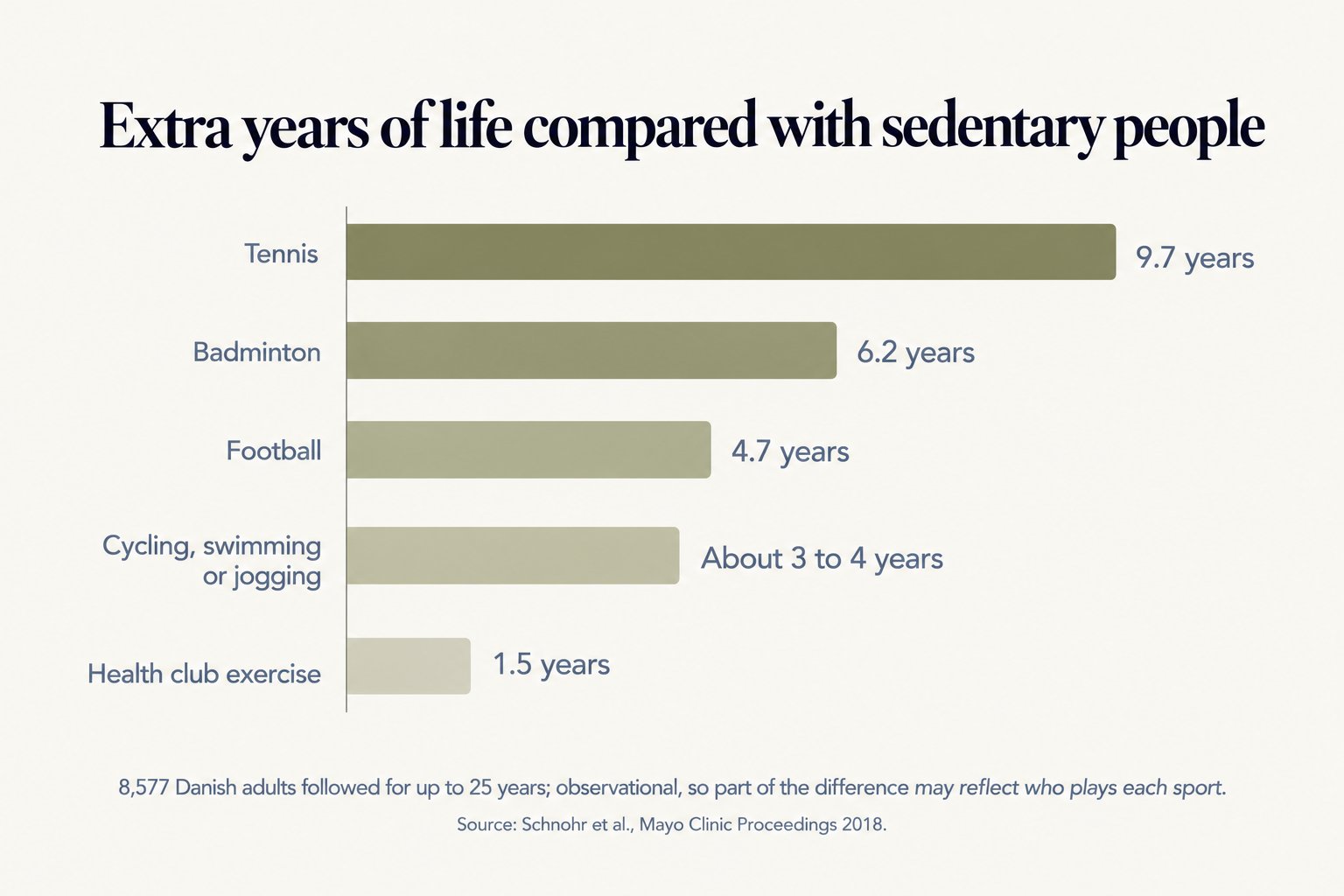
- Sports and life expectancy: in a 2018 study in Mayo Clinic Proceedings, Peter Schnohr and colleagues followed 8,577 people in the Copenhagen City Heart Study for up to 25 years. Compared with sedentary people, tennis players lived about 9.7 years longer, badminton players 6.2 years and football players 4.7 years. Cycling, swimming and jogging were linked to about 3 to 4 extra years, and health club exercise to about 1.5 years, even though gym-goers spent more time exercising. The authors suggested that the social side of sports played with a partner or team, and the bursts of effort they involve, may help explain the difference.
- Volleyball: in a 2020 study of 26,727 American adults followed for about 17 years, volleyball was one of the few activities still linked to lower death risk after all exercise types were analysed together.
These were observational studies. People who play tennis or badminton into later life tend to be healthier, wealthier and more socially connected, and that, rather than the sport itself, may explain part of the benefit.
Recreational football. In a 2019 meta-analysis in the British Journal of Sports Medicine, researchers analysed 31 controlled trials of recreational football, typically small-sided games for untrained adults. Compared with no exercise, football lowered systolic blood pressure by about 4 mmHg and diastolic by about 4 mmHg, and reduced fat mass by about 1.7 kg, with results broadly similar to running and Zumba. An earlier analysis found that 3 to 6 months of recreational football increased aerobic fitness (VO2 max) by about 3.5 mL/kg/min.
Dance.
- Falls and physical function: in a 2020 meta-analysis in JAMA Network Open of 29 trials with 4,239 healthy older adults, dance-based and mind-motor activities (including dance and tai chi) reduced the risk of falling by 37% and the rate of falls by 31%, and improved balance, mobility and leg strength. Most participants were women, and the authors noted that evidence for dance styles other than tai chi is still limited (see Tai Chi and Qigong).
- Dementia: in a 2003 study in the New England Journal of Medicine, 469 adults over 75 were followed for a median of 5 years. Reading, board games, playing a musical instrument and dancing were linked to a lower risk of dementia. Dancing was one of the few physical activities with this association, possibly because it combines movement with learning, memory and social contact (see Exercise and Brain Health).
- Mood: in a 2024 analysis of 218 trials of exercise for depression in the BMJ, dance showed strong effects, but this was based on only 5 studies, mostly in young women (see Depression and Physical Health).
Martial arts.
- Older adults: a 2025 meta-analysis in Clinics of 10 small randomised trials of taekwondo, Muay Thai, judo and Ving Tsun in older adults found improvements in mobility (the "Timed Up and Go" test), but not in grip strength or balance scores, and the certainty of evidence was low.
- Falling safely: martial arts such as judo teach controlled falling techniques, which may help people fall more safely, although this hasn't been tested well in older adults.
The downside: injuries
Sports with sprints, jumps, sudden changes of direction and contact carry a higher risk of injury than walking, cycling or swimming.
- Common injuries: ankle sprains, knee ligament injuries, hamstring and calf strains, Achilles tendon problems, and shoulder and elbow overuse injuries.
- Contact sports and combat sports: carry a risk of concussion and other head injuries, particularly boxing, rugby and full-contact martial arts.
- Cricket: fast bowlers are prone to lower back stress injuries, especially when young and bowling heavy workloads.
- The "weekend warrior": fitting all your exercise into one or two sessions is still beneficial. A 2017 study of 63,591 adults in JAMA Internal Medicine found that people who did all their recommended activity in one or two sessions a week had about 30% lower risk of death than inactive people. But playing hard occasionally without other training raises the risk of strains and sprains.
Reducing the risk.
- Build fitness alongside your sport: strength training, particularly for the legs, hips and core, reduces injury risk (see Weight Training).
- Warm up: 5 to 10 minutes of light jogging, dynamic stretches and sport-specific movements.
- Increase gradually: build up playing time and intensity over weeks, especially when returning after a break.
- Use the right equipment: supportive footwear, mouthguards and protective gear where appropriate.
- Play at your level: choose leagues, classes or partners that match your fitness and experience.
- Take head injuries seriously: stop playing after any suspected concussion and get medical advice before returning.
Who should be careful
- Heart disease, chest pain or breathlessness on exertion: get assessed before starting vigorous sports with sudden bursts of effort.
- Joint problems: choose lower-impact options such as doubles tennis, table tennis, walking football, golf or social dance (see Exercise and Joint Health).
- Osteoporosis or balance problems: avoid contact sports and high fall-risk activities; consider dance or tai chi.
- Previous concussions: discuss contact sports with your doctor.
- Returning after years away: start with skill sessions, shorter games or modified versions, rather than full competitive matches.
Sports, dance and martial arts in Sri Lanka
- Cricket: the country's most popular sport; batting and fielding are intermittent, so combine it with other aerobic and strength exercise.
- Volleyball, netball and football: widely played in schools, clubs and communities; volleyball is Sri Lanka's national sport.
- Badminton and tennis: courts and clubs are available in most cities, and doubles is a sociable, lower-intensity option.
- Traditional activities: Kandyan and other traditional dance forms, elle (a traditional bat-and-ball game) and angampora (a traditional martial art) combine physical activity with culture.
- Dance-fitness classes: Zumba and similar classes are widely available in gyms and community centres.
- Heat: play in the early morning or evening, drink water before and during play, and stop if you feel dizzy, sick or confused.
Evidence strength
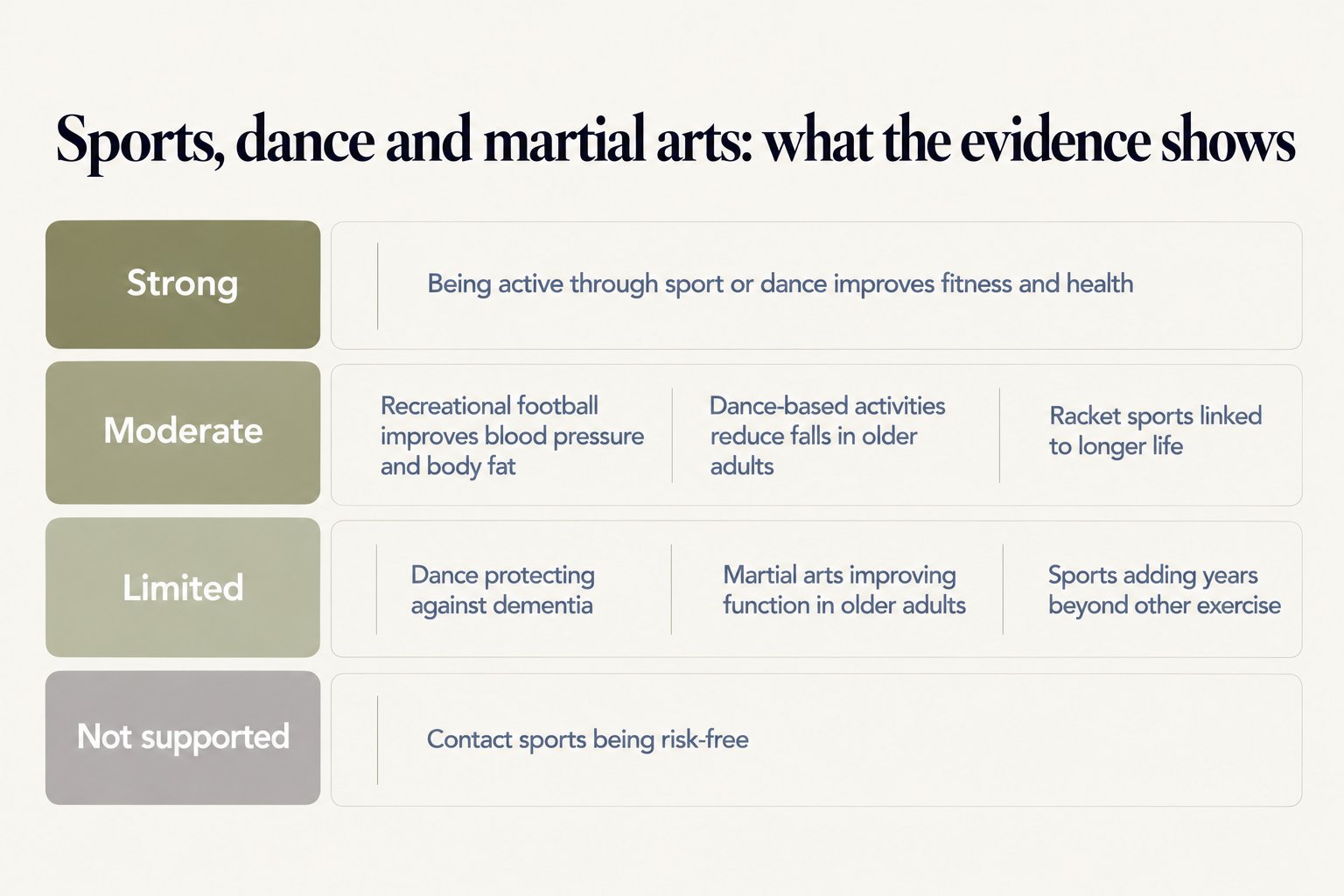
- Being active through sport or dance improving fitness and health: strong.
- Recreational football improving blood pressure and body fat: moderate.
- Dance-based activities reducing falls in older adults: moderate.
- Racket and team sports being linked to longer life: moderate, observational.
- Sports adding more years than other forms of exercise: limited; likely partly explained by who plays them.
- Dance protecting against dementia: limited; observational.
- Martial arts improving function in older adults: limited.
- Contact sports being risk-free: not supported.
Why this matters for longevity
The best exercise is the one you'll keep doing for decades, and sports, dance and martial arts are often the easiest to stick with because they're fun, social and challenging. They train fitness, balance, agility and the brain at the same time, and they connect you with other people, which is itself linked to better health and longer life (see Building Social Connection). Choosing activities that suit your joints, fitness and stage of life, and building strength alongside them, lets you keep playing safely into older age.
Recommendations by situation
- People who find exercise boring: try a racket sport, dance class or martial art; the skill and social side make time pass quickly.
- Older adults: doubles tennis, badminton, table tennis, walking football, golf, social dance or tai chi.
- People with knee or hip problems: table tennis, golf, swimming-based sports or gentle dance, rather than sports with jumping and cutting.
- Busy people: a weekly game or class plus short strength sessions during the week.
- People wanting to build confidence or fitness: a beginners' martial arts or boxing fitness class without sparring.
- Families: badminton, cricket, football or dancing together at home or in the park.
Practical notes
Choose an activity you enjoy and can keep doing: a racket sport, team sport, dance style or martial art can provide aerobic fitness, strength, balance and social connection at once. Racket sports and dance are linked to some of the largest health benefits, although part of that reflects who plays them. Build strength and fitness alongside your sport, warm up, increase gradually, play in the cooler parts of the day and take any head injury seriously. If you have heart disease, joint problems, osteoporosis or a history of concussion, choose lower-risk options and get advice first. Our Longevity Doctors can assess your fitness, joints, balance and heart health, and help you choose and prepare for the sports or activities that suit you, starting with the free longevity assessment.
- Oja P, et al. Associations of specific types of sports and exercise with all-cause and cardiovascular-disease mortality: a cohort study of 80 306 British adults. British Journal of Sports Medicine, 2017;51(10):812-817.
- Schnohr P, et al. Various leisure-time physical activities associated with widely divergent life expectancies: the Copenhagen City Heart Study. Mayo Clinic Proceedings, 2018;93(12):1775-1785.
- Sheehan CM, Li L. Associations of exercise types with all-cause mortality among U.S. adults. Medicine & Science in Sports & Exercise, 2020;52(12):2554-2562.
- Milanović Z, et al. Broad-spectrum physical fitness benefits of recreational football: a systematic review and meta-analysis. British Journal of Sports Medicine, 2019;53(15):926-939.
- Mattle M, et al. Association of dance-based mind-motor activities with falls and physical function among healthy older adults: a systematic review and meta-analysis. JAMA Network Open, 2020;3(9):e2017688.
- Verghese J, et al. Leisure activities and the risk of dementia in the elderly. New England Journal of Medicine, 2003;348(25):2508-2516.
- Noetel M, et al. Effect of exercise for depression: systematic review and network meta-analysis of randomised controlled trials. BMJ, 2024;384:e075847.
- de Mendonça DLC, et al. Benefits of martial arts on the functional capacity of elderly people: a systematic review and meta-analysis. Clinics, 2025;80:100830.
- O'Donovan G, et al. Association of "weekend warrior" and other leisure time physical activity patterns with risks for all-cause, cardiovascular disease, and cancer mortality. JAMA Internal Medicine, 2017;177(3):335-342.
Free longevity assessment
Want help choosing a sport
or activity that suits you?
Take the free Aevum Protocol assessment to see how your movement & strength and 6 other longevity domains are performing — and get a personalised 90-day plan.
Take the free assessment