Movement & Strength
Tai Chi and Qigong:
Gentle Movement With Surprisingly Strong Evidence
Tai chi and qigong are Chinese movement practices built on slow, flowing movements, deep breathing and focused attention. Tai chi began as a martial art and is practised as a sequence of linked movements called a "form"; qigong includes simpler, repeated movement sets such as Baduanjin ("Eight Pieces of Brocade"). They look gentle, but they've been tested in some of the strongest trials of any mind-body practice. In a 2018 trial of 670 older adults at high risk of falls, a tai chi programme reduced falls by 58% compared with stretching and by 31% compared with a standard exercise programme. In people with Parkinson's disease, tai chi improved balance more than resistance training or stretching and reduced falls by 67% compared with stretching. Tai chi has matched physical therapy for knee osteoarthritis, outperformed aerobic exercise for fibromyalgia, and in a 12-month trial in China lowered blood pressure slightly more than aerobic exercise in people with prehypertension. A 2023 trial found it improved cognition in older adults with mild cognitive impairment. The main limitation is that tai chi is light to moderate in intensity and doesn't build much maximal strength or aerobic fitness. This article explains what tai chi and qigong are, what they train, what the research shows and how to start.
Key numbers
| Finding | Detail |
|---|---|
| Tai chi for falls (670 older adults at high risk) | 58% fewer falls vs stretching; 31% fewer vs standard exercise |
| Tai chi in Parkinson's disease (195 people, 24 weeks) | Better balance than resistance training; 67% fewer falls vs stretching |
| Tai chi vs physical therapy for knee osteoarthritis (204 adults) | Similar pain and function benefits; more improvement in depression |
| Tai chi vs aerobic exercise in prehypertension (342 adults, 12 months) | Systolic blood pressure down 7.0 vs 4.6 mmHg |
| Tai chi vs aerobic exercise in fibromyalgia (226 adults) | Greater improvement in symptoms at matched frequency and duration |
| Tai chi in mild cognitive impairment (304 older adults, 6 months) | Cognitive scores improved more than with stretching |
What tai chi and qigong train
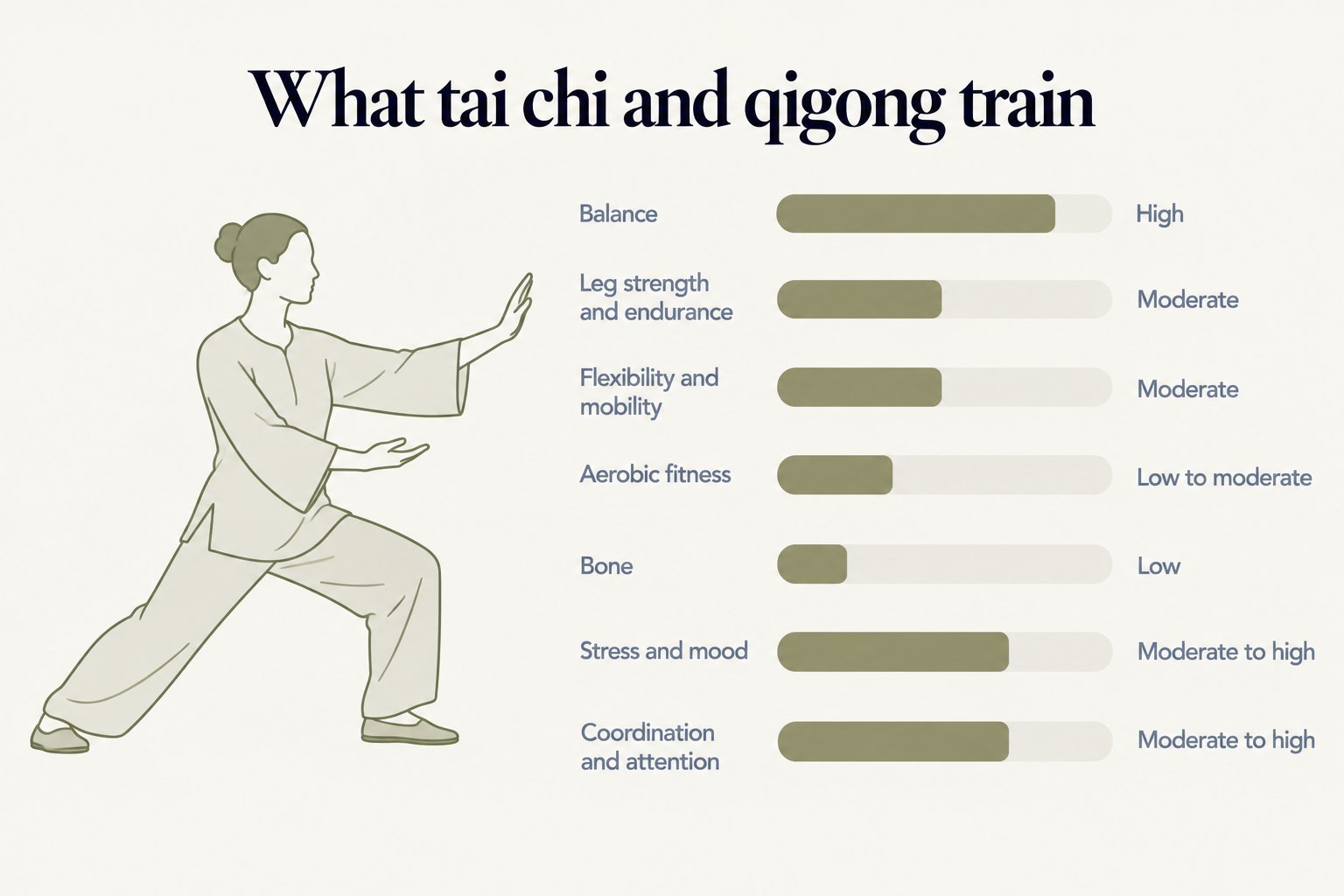
- Balance: high; slow weight shifts, single-leg positions and turning train balance and body awareness.
- Leg strength and endurance: moderate; much of tai chi is performed in a semi-squatting stance.
- Flexibility and mobility: moderate.
- Aerobic fitness: low to moderate; most practice is light to moderate intensity.
- Bone: low; weight-bearing but low impact.
- Stress and mood: moderate to high; breathing and focused attention are central.
- Coordination and attention: moderate to high; learning and remembering a sequence challenges the brain.
Common styles.
- Yang style: the most widely practised; slow, even and large movements; often taught in simplified forms such as the 24-movement form.
- Chen style: the oldest style; alternates slow movements with faster, more forceful ones.
- Sun style: small, higher stances with smooth steps; often used in arthritis programmes.
- Fall-prevention programmes: simplified, evidence-based forms such as "Tai Ji Quan: Moving for Better Balance".
- Qigong: shorter, repeated movement sets, such as Baduanjin and "Five Animal Frolics", often easier to learn than a tai chi form.
What the research shows
Falls in older adults.
- Large Cochrane review: tai chi may reduce the rate of falls in older adults by 19%, as covered in Yoga, Tai Chi and Breathwork.
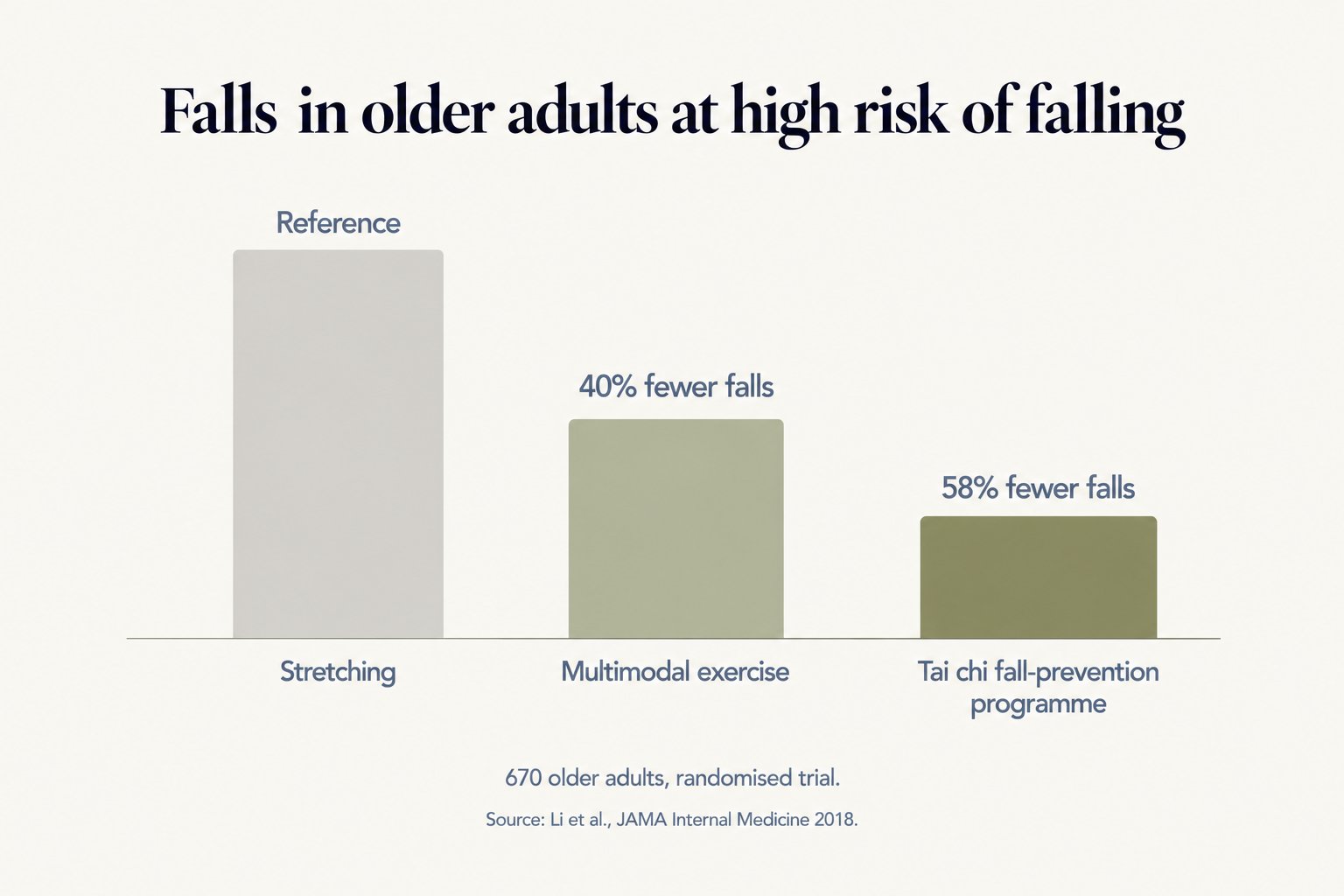
- A head-to-head trial: in a 2018 trial in JAMA Internal Medicine, Fuzhong Li and colleagues randomised 670 community-dwelling older adults at high risk of falls to "Tai Ji Quan: Moving for Better Balance", a multimodal exercise programme of strength, balance and flexibility exercises, or stretching. Compared with stretching, tai chi reduced falls by 58% and multimodal exercise by 40%. Compared directly, tai chi resulted in 31% fewer falls than the multimodal programme (see Balance and Fall Prevention).
Parkinson's disease. In a 2012 trial in the New England Journal of Medicine, the same research group randomised 195 people with mild to moderate Parkinson's disease to tai chi, resistance training or stretching, in one-hour sessions twice a week for 24 weeks. Tai chi improved every measure of balance and strength compared with stretching, and produced greater gains than resistance training in how far people could lean without losing balance, directional control and stride length. The tai chi group had 67% fewer falls than the stretching group, and fewer falls than both other groups in the 3 months after the programme.
Knee osteoarthritis. In a 2016 trial in Annals of Internal Medicine, Chenchen Wang and colleagues at Tufts Medical Center randomised 204 adults with knee osteoarthritis to group tai chi twice a week for 12 weeks or standard physical therapy. Both groups improved similarly in pain and physical function, and the benefits lasted to 52 weeks. The tai chi group improved more in depression and quality of life (see Exercise and Joint Health).
Fibromyalgia. In a 2018 trial in the BMJ, the same Tufts group randomised 226 adults with fibromyalgia to supervised aerobic exercise or one of four tai chi programmes. All groups improved, but tai chi produced greater improvement in symptoms than aerobic exercise when practised for the same frequency and duration, and longer tai chi programmes worked better than shorter ones. Attendance was also higher with tai chi (62% vs 40%).
Blood pressure. In a 2024 trial in JAMA Network Open, researchers in China randomised 342 adults with prehypertension (average age 49) to tai chi or aerobic exercise such as brisk walking, jogging, cycling and stair climbing, both for one hour four times a week for 12 months. Systolic blood pressure fell by 7.0 mmHg with tai chi and by 4.6 mmHg with aerobic exercise, a small but significant difference, and the difference was confirmed with 24-hour blood pressure monitoring (see Lowering Blood Pressure Without Medication).
Heart failure. In a 2011 trial in the Archives of Internal Medicine, 100 people with chronic heart failure were randomised to tai chi or education classes twice a week for 12 weeks. Tai chi didn't improve walking distance or peak oxygen uptake, but it improved quality of life, mood, confidence with exercise and daily activity. This shows both its value and its limit: it helps how people feel and function, but doesn't build much aerobic fitness.
Cognition. In a 2023 trial in Annals of Internal Medicine, 304 older adults with mild cognitive impairment took part in 6 months of online classes of stretching, traditional tai chi or "cognitively enhanced" tai chi with added mental challenges. Cognitive scores improved by about 1.5 points with traditional tai chi and almost 3 points with the enhanced version, both more than with stretching (see Mild Cognitive Impairment).
Qigong. A 2023 meta-analysis in BMC Complementary Medicine and Therapies of 14 randomised trials of Baduanjin qigong in middle-aged and older adults found improvements in grip strength, several balance tests, resting heart rate and diastolic blood pressure, with no adverse events reported. The authors called for larger, more rigorous trials.
How intense is tai chi?
A 2001 review in the British Journal of Sports Medicine concluded that tai chi doesn't demand more than about 55% of maximal oxygen uptake, putting it in the light-to-moderate intensity range. Lower stances, longer sessions and faster styles such as Chen raise the intensity. For most people, tai chi is excellent balance, mobility and stress training, but it should be combined with aerobic activity and strength training for full benefit (see Walking for Longevity and Weight Training).
How to start
A simple beginner approach.
- Find a class: a qualified instructor helps you learn the movements correctly; online classes are a good alternative once you know the basics.
- Start with a short form or qigong: a simplified Yang-style form or Baduanjin is easier to learn than a long traditional form.
- Frequency: most trials used 1-hour sessions 2 to 3 times a week for at least 12 to 24 weeks. Daily practice of 15 to 20 minutes at home is a good addition.
- Be patient: learning a form takes weeks, and benefits build over months.
- Keep going: benefits depend on continued practice.
Tips.
- Keep the knees soft and aligned: don't let them collapse inwards or go far past the toes.
- Adjust the stance: a higher stance is easier on the knees; go lower gradually as strength improves.
- Breathe naturally and deeply: coordinate breathing with movement once the movements feel familiar.
- Use a chair if needed: seated tai chi and qigong are options for people with limited balance or mobility.
- Practise outdoors: early morning practice in a park is traditional and pleasant, away from the midday heat.
Who should be careful
Tai chi and qigong are among the safest forms of exercise, and serious side effects are rare.
- Knee pain: use a higher stance and smaller steps.
- Poor balance or a history of falls: practise near a wall or chair and choose a fall-prevention programme.
- Dizziness or low blood pressure: move slowly when changing direction, especially in turning movements.
- Recent surgery, fractures or joint replacements: ask your surgeon or physiotherapist which movements to avoid.
- Heart failure or other heart conditions: tai chi is generally safe, but discuss it with your doctor first.
Tai chi and qigong in Sri Lanka
- Availability: classes are less common than yoga in Sri Lanka, but some community groups, martial arts schools and wellness centres offer them, and online classes are widely available.
- Low cost and no equipment: tai chi and qigong need only comfortable clothes and a small space.
- For older adults: tai chi suits elders who want to stay steady on their feet; it can be practised at home, in temple grounds or in parks.
- Heat: the movements are slow, but practise in the cooler morning or evening and drink water.
Evidence strength
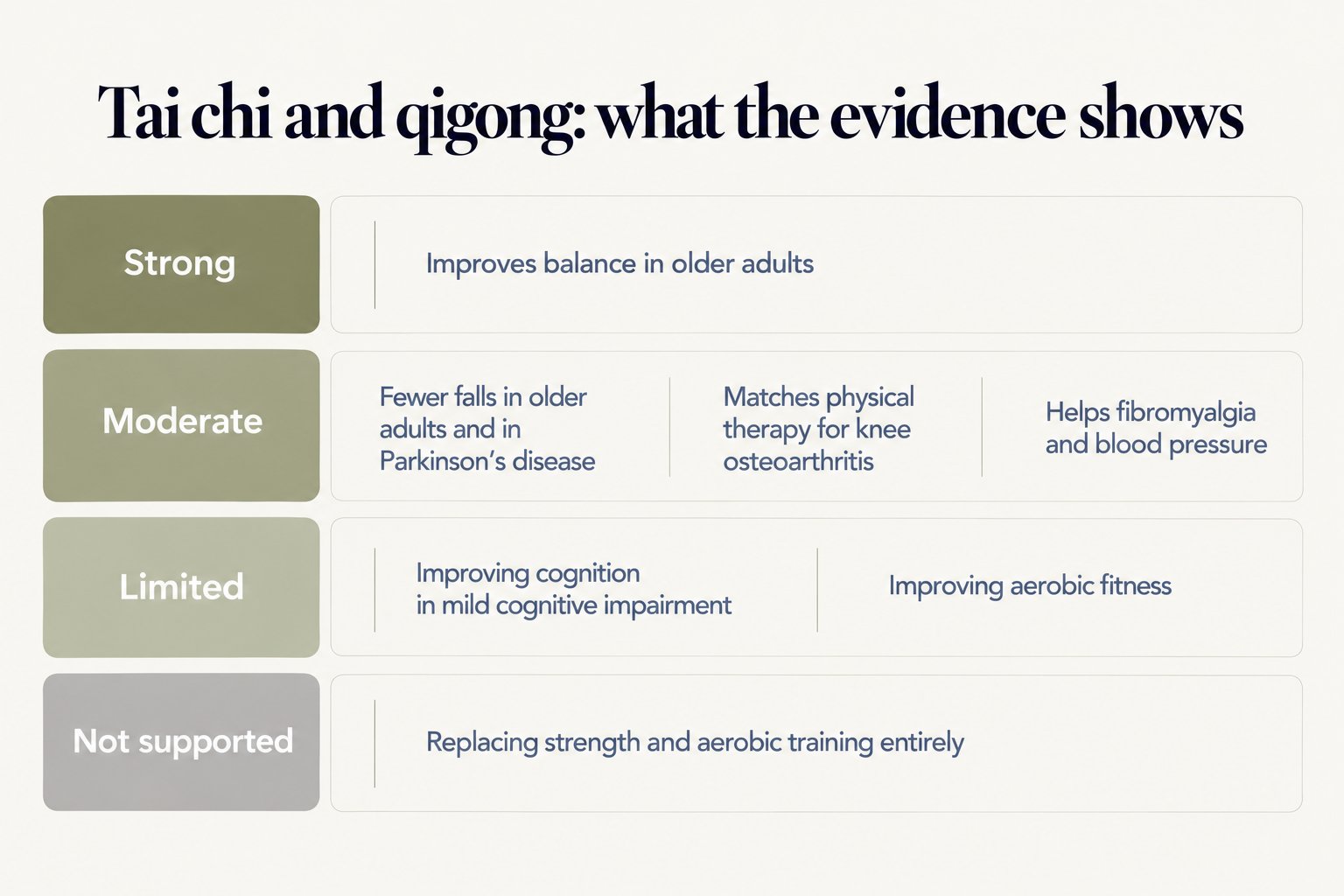
- Tai chi improving balance in older adults: strong.
- Tai chi reducing falls in older adults: moderate; one large trial and a Cochrane review with low-certainty evidence.
- Tai chi improving balance and reducing falls in Parkinson's disease: moderate.
- Tai chi matching physical therapy for knee osteoarthritis: moderate.
- Tai chi helping fibromyalgia symptoms: moderate.
- Tai chi lowering blood pressure: moderate.
- Tai chi improving cognition in mild cognitive impairment: limited; promising, but needs confirmation.
- Qigong improving physical function: limited to moderate; many small trials.
- Tai chi improving aerobic fitness: limited.
- Tai chi replacing strength and aerobic training entirely: not supported.
Why this matters for longevity
Falls are a major cause of injury, disability and loss of independence in later life, and few exercise programmes reduce them as effectively as tai chi. It also helps arthritis pain, mood, blood pressure and possibly cognition, while being safe, cheap, adaptable to almost any level of fitness and enjoyable enough that people keep doing it. Because it's light to moderate in intensity, it works best alongside walking or other aerobic activity and some strength training.
Recommendations by situation
- Older adults, especially those at risk of falling: a tai chi fall-prevention class 2 to 3 times a week.
- People with Parkinson's disease: tai chi as part of a programme supervised by a doctor or physiotherapist.
- People with knee osteoarthritis: tai chi 2 times a week as an alternative or addition to physical therapy.
- People with fibromyalgia or chronic pain: a longer tai chi programme of at least 24 weeks.
- People with high-normal blood pressure: tai chi or qigong several times a week, alongside other healthy habits.
- Busy or stressed people: 15 minutes of qigong in the morning or evening.
Practical notes
Tai chi and qigong look gentle, but they have some of the strongest trial evidence of any mind-body practice, especially for balance and falls in older adults. Start with a qualified instructor and a short form or a qigong set, practise 2 to 3 times a week for at least several months, adjust your stance to protect your knees, and keep practising, because the benefits depend on it. Combine tai chi with walking or other aerobic activity and some strength training. Our Longevity Doctors can assess your balance, strength, falls risk and cardiovascular health, and help you decide whether tai chi or qigong fits into your routine, starting with the free longevity assessment.
- Li F, et al. Effectiveness of a therapeutic Tai Ji Quan intervention vs a multimodal exercise intervention to prevent falls among older adults at high risk of falling: a randomized clinical trial. JAMA Internal Medicine, 2018;178(10):1301-1310.
- Li F, et al. Tai chi and postural stability in patients with Parkinson's disease. New England Journal of Medicine, 2012;366(6):511-519.
- Wang C, et al. Comparative effectiveness of tai chi versus physical therapy for knee osteoarthritis: a randomized trial. Annals of Internal Medicine, 2016;165(2):77-86.
- Wang C, et al. Effect of tai chi versus aerobic exercise for fibromyalgia: comparative effectiveness randomized controlled trial. BMJ, 2018;360:k851.
- Effect of tai chi vs aerobic exercise on blood pressure in patients with prehypertension: a randomized clinical trial. JAMA Network Open, 2024;7(2):e2354937.
- Yeh GY, et al. Tai chi exercise in patients with chronic heart failure: a randomized clinical trial. Archives of Internal Medicine, 2011;171(8):750-757.
- Li F, et al. Cognitively enhanced tai ji quan to prevent cognitive decline in older adults with mild cognitive impairment: a randomized controlled trial. Annals of Internal Medicine, 2023;176(11):1498-1507.
- Lin H, et al. Effects of Baduanjin exercise on the physical function of middle-aged and elderly people: a systematic review and meta-analysis of randomized controlled trials. BMC Complementary Medicine and Therapies, 2023;23:38.
- Li JX, Hong Y, Chan KM. Tai chi: physiological characteristics and beneficial effects on health. British Journal of Sports Medicine, 2001;35(3):148-156.
- Sherrington C, et al. Exercise for preventing falls in older people living in the community: an abridged Cochrane systematic review. British Journal of Sports Medicine, 2020;54(15):885-891.
Free longevity assessment
Worried about balance
or your risk of falling?
Take the free Aevum Protocol assessment to see how your movement & strength and 6 other longevity domains are performing — and get a personalised 90-day plan.
Take the free assessment