Stress & Mental Wellbeing
Building Social Connection:
Practical Ways to Strengthen Relationships
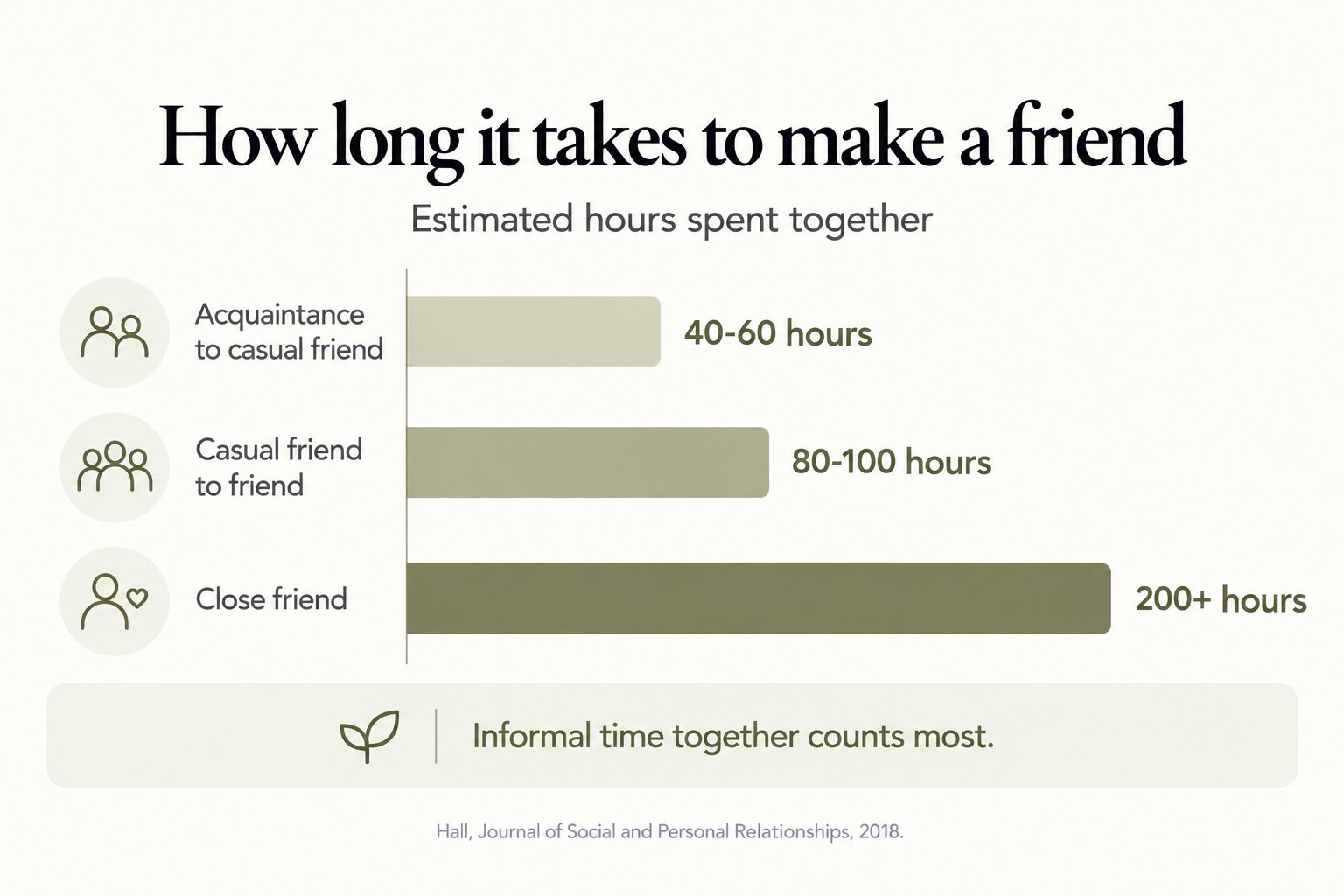
Strong relationships are one of the most powerful predictors of a long, healthy life: across 148 studies, people with stronger social relationships had 50% greater odds of survival, while loneliness and isolation are linked to higher risk of heart disease, stroke, depression and dementia (see Loneliness and Social Isolation). Knowing that is one thing; building connection, especially as an adult, is another. Research offers practical guidance. Friendships take time: a study of adults who'd moved to a new place estimated that it takes about 40-60 hours together to go from acquaintance to casual friend, 80-100 hours to become friends, and more than 200 hours to become close friends. People consistently underestimate how much others appreciate being contacted: in studies of more than 5,900 people, those who reached out to someone, with a brief message or small gift, underestimated how much it would be valued, especially when it came as a surprise. And small interactions count: people feel happier and more connected on days they talk with more acquaintances, and even a brief, friendly chat with a café worker increases positive feelings and belonging. This guide explains the different circles of connection, what the evidence shows, and practical steps to strengthen relationships at any age, including when family live far away.
Key numbers
| Finding | Detail |
|---|---|
| Social relationships and survival (148 studies, 308,849 people) | Stronger relationships: 50% greater odds of survival |
| Time to build friendship (adults who'd recently moved) | About 40-60 hours for a casual friend, 80-100 hours for a friend, 200+ hours for a close friend |
| Reaching out (studies of 5,900+ people) | People underestimate how much others appreciate being contacted |
| Everyday interactions with acquaintances | More interactions linked to greater happiness and belonging that day |
| Volunteering 100+ hours a year (adults over 50) | Linked to less loneliness and 44% lower mortality |
The circles of connection
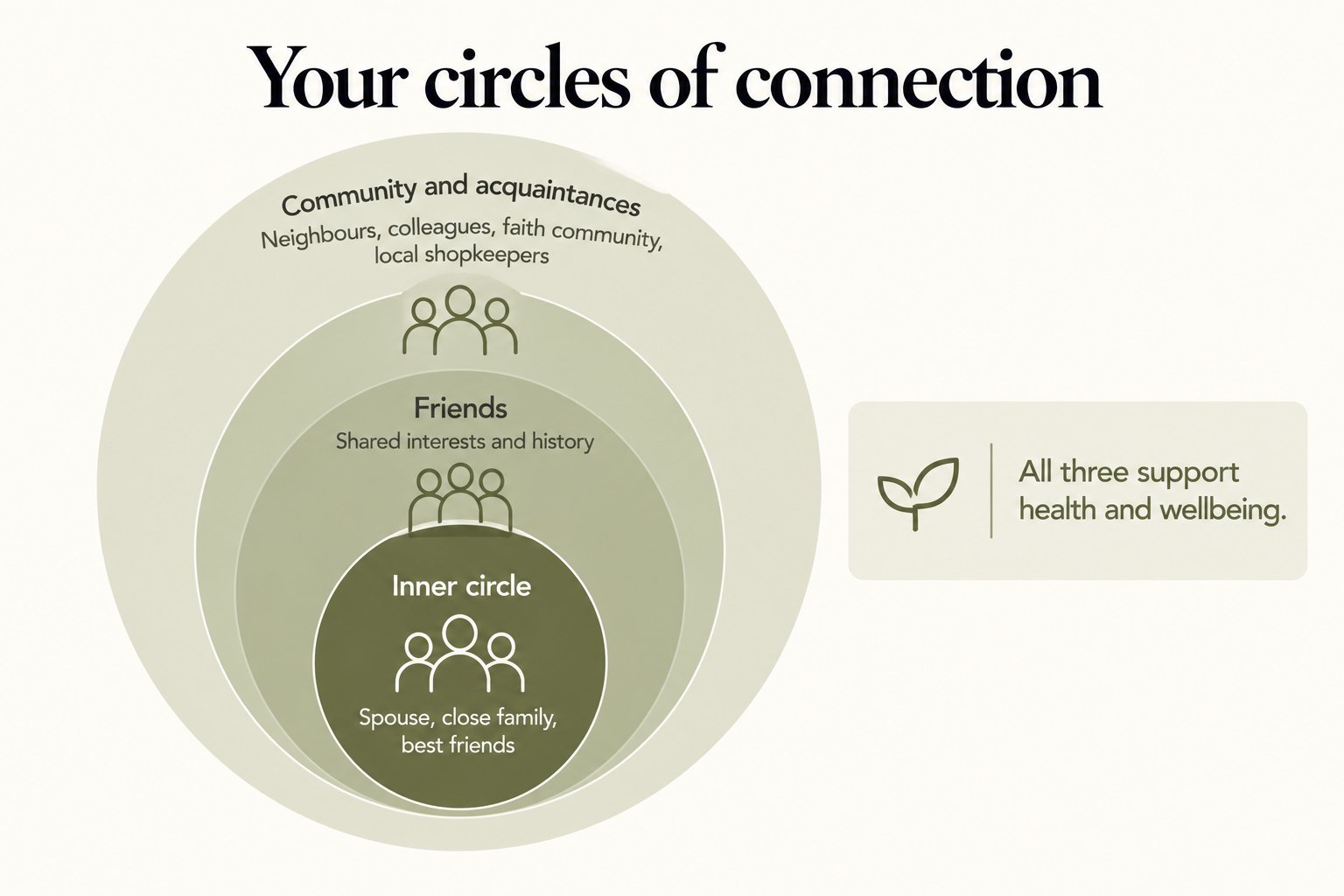
It helps to think of social connection as a set of circles:
- Inner circle: a few people you're closest to, such as a spouse, close family members and best friends, who you can rely on in a crisis.
- Friends: people you enjoy spending time with and share interests or history with.
- Community and acquaintances: neighbours, colleagues, members of your temple, church, mosque or kovil, the shopkeeper you chat with. These "weak ties" matter more than most people think.
Good social health involves all three: a few close, trusting relationships, some friendships, and a wider sense of belonging to a community. The WHO describes social connection as "the ways people relate to and interact with others".
What the evidence shows
Friendship takes time, and invitations. In a 2018 study at the University of Kansas, Jeffrey Hall surveyed 355 adults who'd recently moved and were looking for friends, and followed 112 university students who'd just arrived on campus. He estimated that moving from acquaintance to casual friend takes about 40-60 hours together, becoming friends takes 80-100 hours, and becoming close friends takes more than 200 hours. Informal time, such as chatting, joking and sharing activities, counted more than time spent working together. As Hall put it: "You can't make people spend time with you, but you can invite them."
Reaching out is appreciated more than we think. In a 2022 series of studies in the Journal of Personality and Social Psychology, Peggy Liu and colleagues found that people who reached out to someone in their social circle, with a short message, a note or a small gift, consistently underestimated how much the recipient appreciated it. This held for close and distant relationships, and the gap was largest when the contact was a surprise. As Liu concluded, "others are likely to appreciate being reached out to more than people think." The study focused on people with positive past relationships, not reconciling after a falling-out.
Small interactions matter. In 2014, Gillian Sandstrom and Elizabeth Dunn found that people felt happier and had a stronger sense of belonging on days they interacted with more acquaintances than usual. In a related experiment, coffee shop customers who smiled, made eye contact and chatted briefly with the barista felt more positive and connected than those who were told to be as efficient as possible. Everyday friendliness with neighbours, shopkeepers and colleagues adds up.
Shared purpose builds connection. Volunteering, faith communities and group activities create repeated contact with the same people, which is how friendships form. In a study of about 13,000 adults over 50, those who volunteered at least 100 hours a year reported less loneliness and had a 44% lower risk of death (see Finding Purpose at Every Age).
Practical ways to strengthen connection
Nurture your inner circle.
- Make regular time. Weekly meals, calls or walks with the people closest to you.
- Put the phone away. Give full attention during conversations; the WHO specifically recommends this.
- Share, and listen. Closeness grows when people share personal thoughts and feel heard.
- Repair conflicts early. Long-running resentment erodes relationships and wellbeing.
Grow friendships.
- Say yes to invitations, and make some of your own; someone has to suggest the meet-up.
- Choose repeated activities: a class, sports club, walking group, choir or study circle, where you'll see the same people regularly.
- Reconnect with old friends. A short message is likely to be more welcome than you expect.
- Be patient. Friendship takes dozens of hours, so consistency matters more than intensity.
Strengthen community ties.
- Greet neighbours and get to know local shopkeepers by name.
- Take part in community and religious life: festivals, almsgivings, services, shramadana (community service) and local events.
- Volunteer for a cause you care about, ideally on a regular basis.
- Help others. Offering practical help, such as visiting an older neighbour, builds connection both ways.
When family live far away. Many Sri Lankan families now have members working or living abroad, and older parents may live alone.
- Schedule regular video calls, ideally at a fixed time each week, and involve grandchildren.
- Help older relatives use technology: setting up video calls, messaging and photo sharing.
- Build a local support network: neighbours, relatives, friends and religious communities who can check in regularly.
- Visit when possible, and keep shared family traditions alive across distance.
Recommendations by scenario
| Scenario | What to do |
|---|---|
| New to a city or job | Join one regular group activity; accept and make invitations |
| Busy working adult | Protect one weekly meal or call with close people; combine exercise with friends |
| Recently retired | Volunteer, join a club or class, and plan a weekly social routine |
| Older adult living alone | Daily contact with someone, community or faith activities, treat hearing or mobility problems |
| Family living abroad | Fixed weekly video calls and a local support network |
| Shy or socially anxious | Start with small, structured activities; consider therapy if anxiety holds you back |
| Recently widowed or divorced | Lean on family and friends; bereavement or support groups |
| Caring for someone | Ask for help, and keep at least one regular social contact for yourself |
Practical notes
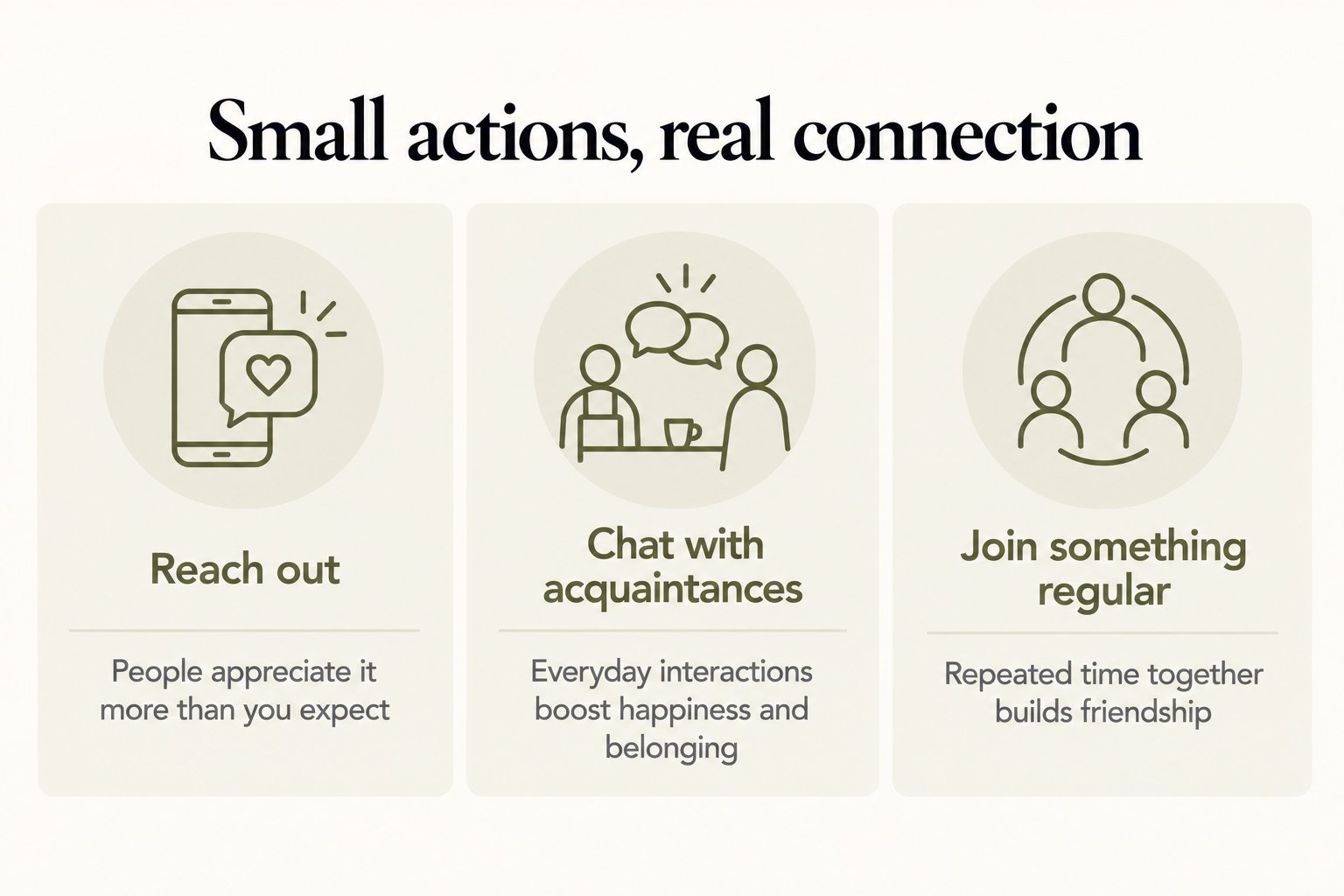
Connection is a habit, not a personality trait. This week, try three things: send a message to someone you've been thinking about, have one phone-free meal or conversation with someone close, and take a step towards joining something regular. If you're worried about an older relative, help them stay connected, and treat practical barriers such as hearing loss. If loneliness comes with persistent low mood or social anxiety that's hard to overcome, talk to a doctor; therapy can help (see Therapy and Counselling). Our Longevity Doctors ask about social connection as part of every assessment, because it matters as much as many physical health measures, starting with the free longevity assessment.
- Holt-Lunstad J, Smith TB, Layton JB. Social relationships and mortality risk: a meta-analytic review. PLOS Medicine, 2010;7(7):e1000316.
- Hall, J.A. How many hours does it take to make a friend? Journal of Social and Personal Relationships, 2019;36(4):1278-1296.
- Liu PJ, et al. The surprise of reaching out: appreciated more than we think. Journal of Personality and Social Psychology, 2023;124(4):754-771.
- Sandstrom GM, Dunn EW. Social interactions and well-being: the surprising power of weak ties. Personality and Social Psychology Bulletin, 2014;40(7):910-922.
- Sandstrom GM, Dunn EW. Is efficiency overrated? Minimal social interactions lead to belonging and positive affect. Social Psychological and Personality Science, 2014;5(4):437-442.
- Kim ES, et al. Volunteering and subsequent health and well-being in older adults: an outcome-wide longitudinal approach. American Journal of Preventive Medicine, 2020;59(2):176-186.
- World Health Organization. Social connection linked to improved health and reduced risk of early death (WHO Commission on Social Connection). News release, 30 June 2025.
Free longevity assessment
Want to talk about
social connection and health?
Take the free Aevum Protocol assessment to see how your stress & mental wellbeing and 6 other longevity domains are performing — and get a personalised 90-day plan.
Take the free assessment