Stress & Mental Wellbeing
Therapy and Counselling:
What Works, for Whom, and When to Seek It
Talking therapies, also called psychotherapy or psychological treatment, are among the best-studied treatments in medicine. The World Health Organization recommends them as first-line treatment for depression and anxiety. Yet many people still see therapy as something only for "serious" mental illness, or doubt that talking can help. The evidence says otherwise. A 2021 network meta-analysis of 331 randomised trials with 34,285 people found that all the major types of psychotherapy, including cognitive behavioural therapy (CBT), behavioural activation, problem-solving therapy and interpersonal therapy, were effective for depression, with benefits still present a year later. Most types worked about equally well, so personal preference and availability can guide the choice. Combining therapy with medication works better than medication alone, by a meaningful margin, including over follow-up periods of up to two years. One of the strongest predictors of success is the quality of the relationship with the therapist: across 295 studies with more than 30,000 patients, a stronger therapeutic alliance was consistently linked to better outcomes, both face to face and online. Therapy doesn't always need a specialist: in Zimbabwe's Friendship Bench trial, trained community "grandmothers" delivering six sessions of problem-solving therapy cut the proportion of people with depression symptoms from 50% to 14%. This article explains the main types of therapy, how well they work, who provides them, and when to seek help.
Key numbers
| Finding | Detail |
|---|---|
| Psychotherapy for depression (331 trials, 34,285 people) | All major types effective; most work about equally well; benefits lasting at 12 months |
| Therapy plus medication (52 studies) | Combined treatment better than medication alone, including at up to 2 years |
| Therapeutic relationship (295 studies, 30,000+ patients) | Stronger alliance consistently linked to better outcomes, in person and online |
| Lay counsellors (Friendship Bench, 550+ people) | Depression symptoms at 6 months: 14% vs 50% with standard care |
| Treatment gap (WHO) | Only about 1 in 3 people with depression in high-income countries receive treatment |
What therapy is, and isn't
Therapy is a structured, confidential conversation with a trained professional aimed at understanding and changing patterns of thinking, feeling, behaving and relating that cause distress. It's not just "having a chat" or receiving advice, and it doesn't mean you're weak or "mad". Most therapies are short-term, often 6-20 sessions, focused on specific problems and skills.
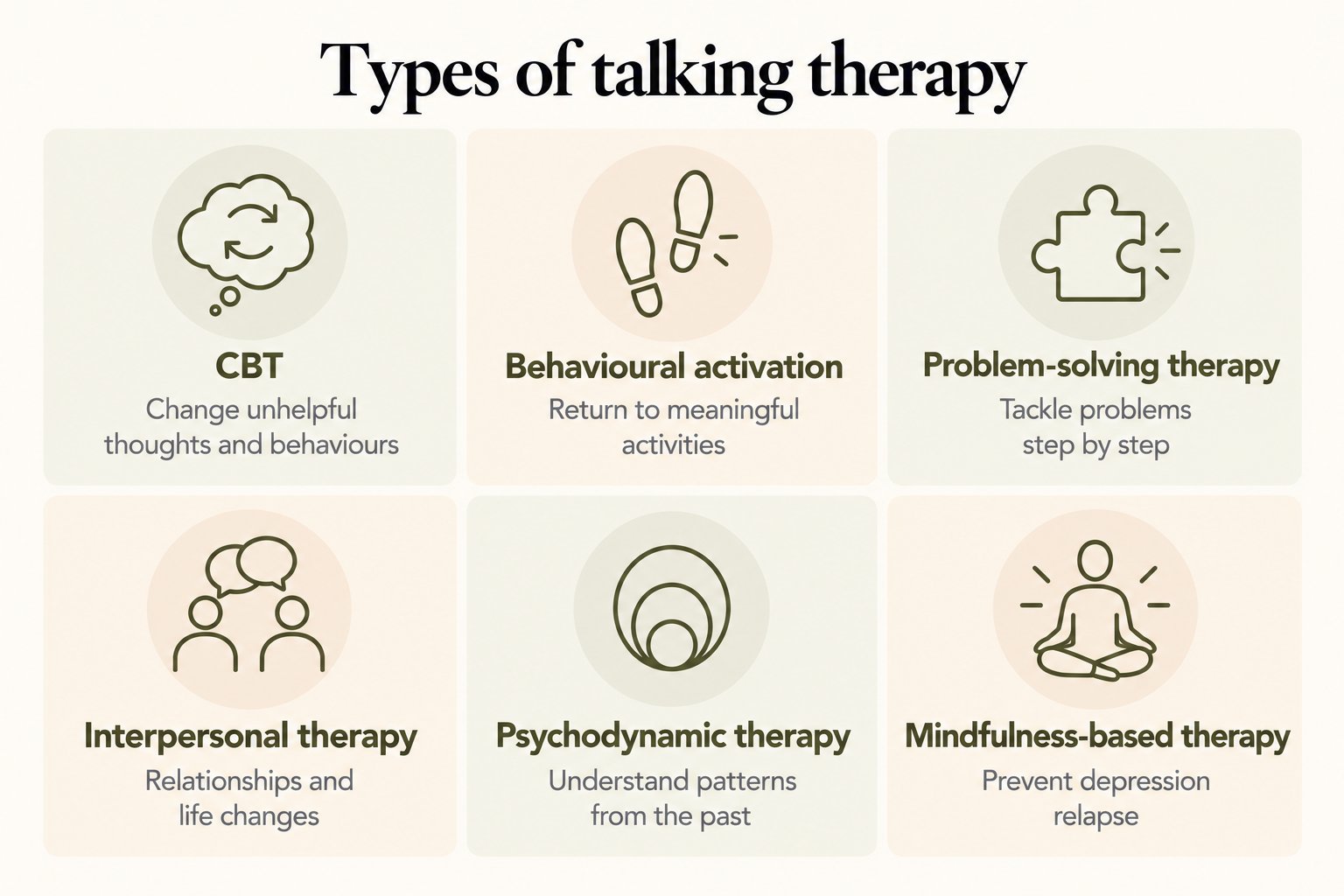
Main types of therapy.
- Cognitive behavioural therapy (CBT): identifies unhelpful thoughts and behaviours and practises new ones. It's the most widely studied therapy, used for depression, anxiety, insomnia (CBT-I), chronic pain and more.
- Behavioural activation: gradually reintroduces meaningful and enjoyable activities to break the cycle of withdrawal in depression.
- Problem-solving therapy: teaches a step-by-step approach to tackling practical problems that feel overwhelming.
- Interpersonal therapy (IPT): focuses on relationships, role changes, conflicts and grief.
- Psychodynamic therapy: explores how past experiences and unconscious patterns shape current difficulties.
- Mindfulness-based therapies: such as mindfulness-based cognitive therapy (MBCT) to prevent depression relapse (see Meditation and Mindfulness: What the Evidence Really Shows).
- Trauma-focused therapies: such as trauma-focused CBT and EMDR for post-traumatic stress.
- Supportive counselling: a listening, empathic approach that helps people talk through problems, often used for stress, grief and life difficulties.
Who provides therapy
| Professional | Training | What they offer |
|---|---|---|
| Your doctor | Medical degree | First assessment, physical health checks, medication, referral |
| Psychiatrist | Medical doctor specialising in mental health | Diagnosis, medication, complex and severe conditions, sometimes therapy |
| Clinical psychologist | Degree and specialist training in psychology | Assessment and structured psychological therapies |
| Counsellor | Training in counselling | Supportive and problem-focused talking therapy for stress, grief and life difficulties |
| Trained lay counsellor | Short, supervised training | Brief structured therapy in community settings |
In Sri Lanka, you can start with your doctor or a hospital psychiatry clinic, or contact the National Institute of Mental Health helpline on 1926 or the CCCline on 1333 for guidance and counselling.
Evidence strength
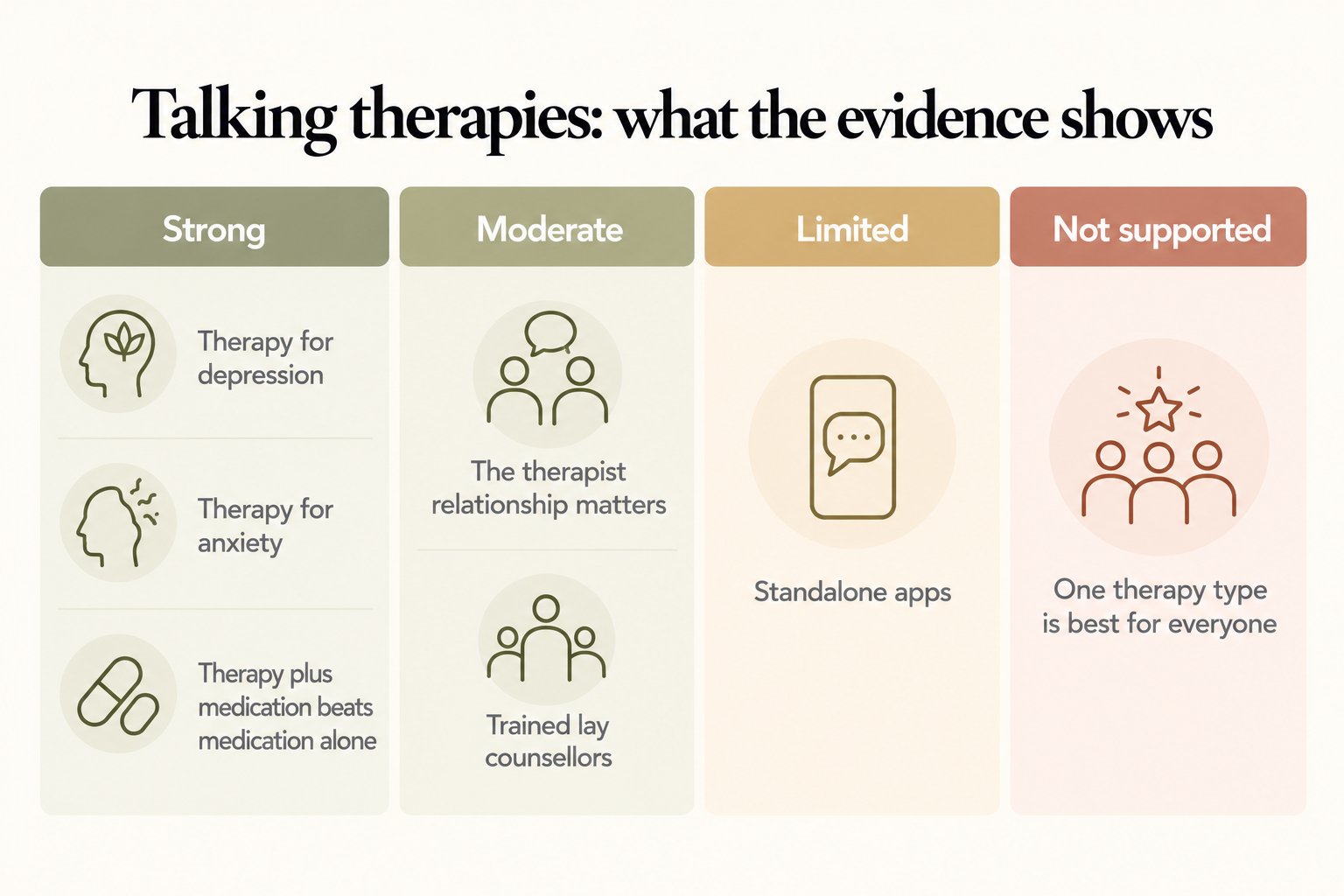
Strong: psychotherapy works for depression. In a 2021 network meta-analysis in World Psychiatry, Pim Cuijpers and colleagues analysed 331 randomised trials with 34,285 adults with depression. All the main types of psychotherapy, including CBT, behavioural activation, problem-solving therapy, interpersonal therapy, psychodynamic therapy, life-review and "third wave" therapies, were more effective than usual care or waiting lists. Most types didn't differ significantly from each other, although simple supportive counselling was less effective than the others. Most therapies were still better than usual care at 12-month follow-up, and dropout rates were similar across types. The authors concluded that patient preference and availability may matter more than the specific type (see Depression and Physical Health).
Strong: therapy plus medication beats medication alone. A 2014 meta-analysis by Cuijpers and colleagues of 52 studies found that combining psychotherapy with medication was more effective than medication alone for depression, panic disorder and obsessive-compulsive disorder, and the advantage persisted at follow-up of up to two years. For moderate to severe depression, combining both is often the best approach. Therapy also helps people develop skills that continue after treatment ends.
Strong: psychological treatment for anxiety. The WHO recommends psychological treatment, especially CBT including exposure therapy, as the main treatment for anxiety disorders, delivered in person, online or through guided self-help (see Anxiety and Physical Health).
Moderate: the relationship with your therapist matters. In a 2018 meta-analysis of 295 studies with more than 30,000 patients, Christoph Flückiger and colleagues found a robust link between the strength of the therapeutic alliance, the collaborative bond and agreement on goals between client and therapist, and treatment outcomes. The link was similar for face-to-face and internet-based therapy, and held across different types of therapy, patients and countries. Feeling understood and working together on agreed goals matters, so it's reasonable to look for a therapist you feel comfortable with.
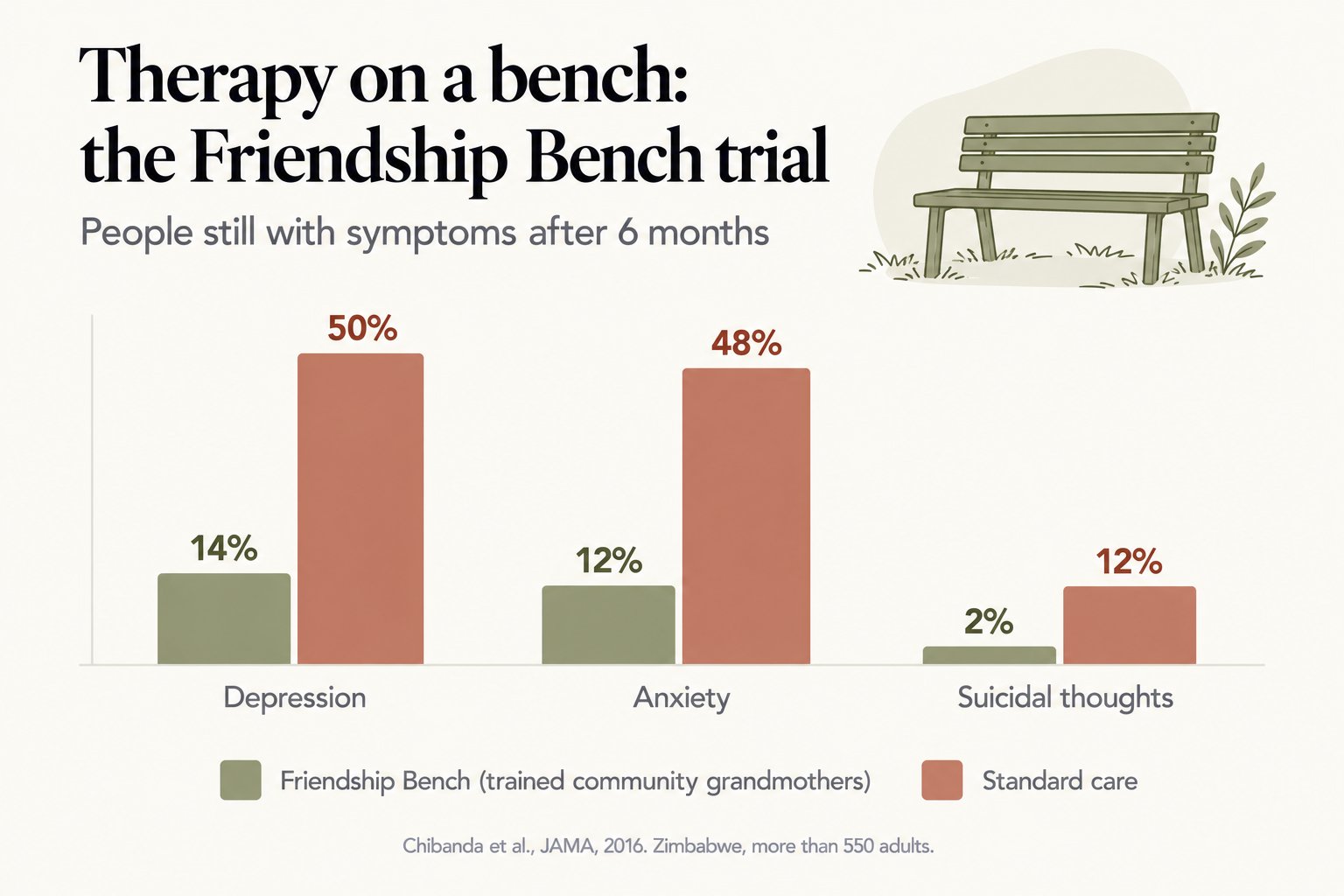
Moderate: trained lay counsellors can deliver effective therapy. Many countries have too few mental health specialists. In the Friendship Bench trial in Zimbabwe, published in JAMA in 2016, Dixon Chibanda and colleagues trained older women from the community, "grandmother health providers", to deliver six 45-minute sessions of problem-solving therapy on a bench in clinic grounds. Among more than 550 people with anxiety or depression symptoms, after six months only 14% of the Friendship Bench group still had depression symptoms, compared with 50% of those receiving standard care. Anxiety symptoms (12% vs 48%) and suicidal thoughts (2% vs 12%) also fell. Similar task-sharing approaches are being used across South Asia and Africa.
Limited: online and app-based therapy. Internet-delivered CBT and guided self-help programmes can be effective and widen access, and the therapeutic alliance appears similar online. Standalone apps without human support have smaller effects. They can be a useful first step or add-on, but aren't a substitute for professional care for moderate or severe problems.
Not supported: one therapy type is best for everyone. Despite strong opinions in the field, large analyses show that most structured therapies work about equally well for depression. The best therapy is usually one that's evidence-based, available, delivered by a skilled therapist you trust, and suits your preferences.
Important limitations.
- Trial quality varies, and publication bias may exaggerate some effects.
- Not everyone responds: a substantial minority don't improve enough with the first treatment and need a different approach.
- Access is the biggest barrier: waiting lists, cost, stigma and a shortage of trained therapists keep many people from getting help.
- Therapy takes effort: practising skills between sessions is an important part of most therapies.
Recommendations by situation
| Situation | What the evidence supports |
|---|---|
| Stress, grief or life difficulties | Counselling or a brief structured therapy |
| Mild depression | Psychological therapy, guided self-help and exercise; medication usually not needed |
| Moderate to severe depression | Therapy plus medication, guided by a doctor |
| Anxiety, panic or phobias | CBT including gradual exposure; medication if needed |
| Recurrent depression, now well | Mindfulness-based cognitive therapy to prevent relapse |
| Insomnia | CBT for insomnia (CBT-I) |
| After trauma with ongoing distress | Trauma-focused therapy |
| Thoughts of suicide or harming yourself | Seek urgent help: 1926, your doctor or the nearest hospital |
Why this matters for longevity
Mental health conditions affect sleep, habits, relationships, heart health and lifespan, and psychological therapies are one of the most effective tools to treat them. Unlike some treatments, they teach skills that keep working after treatment ends. Seeking therapy isn't a sign of weakness; it's a practical health decision, like seeing a physiotherapist for a back problem.
Practical notes
Consider therapy if low mood, worry, stress, grief or relationship problems have lasted for weeks, are affecting your work, sleep or relationships, or if you keep returning to the same difficulties. Start by speaking to your doctor, who can assess you, check for physical causes and refer you. When choosing a therapist, ask about their training, what type of therapy they offer, how many sessions are likely and what it will cost. Give it a few sessions, practise between them, and if it doesn't feel like a good fit, it's fine to try someone else. If you have thoughts of harming yourself, seek help immediately. Our Longevity Doctors include mental wellbeing in every assessment and can help you find appropriate support, starting with the free longevity assessment.
- Cuijpers P, et al. Psychotherapies for depression: a network meta-analysis covering efficacy, acceptability and long-term outcomes of all main treatment types. World Psychiatry, 2021;20(2):283-293.
- Cuijpers P, et al. Adding psychotherapy to antidepressant medication in depression and anxiety disorders: a meta-analysis. World Psychiatry, 2014;13(1):56-67.
- Flückiger, C. et al. The alliance in adult psychotherapy: a meta-analytic synthesis. Psychotherapy, 2018;55(4):316-340.
- Chibanda D, et al. Effect of a primary care-based psychological intervention on symptoms of common mental disorders in Zimbabwe: a randomized clinical trial. JAMA, 2016;316(24):2618-2626.
- World Health Organization. Depression: fact sheet; Anxiety disorders: fact sheet. Geneva: WHO.
Free longevity assessment
Not sure where to
start with support?
Take the free Aevum Protocol assessment to see how your stress & mental wellbeing and 6 other longevity domains are performing — and get a personalised 90-day plan.
Take the free assessment