Stress & Mental Wellbeing
Loneliness and Social Isolation:
A Hidden Risk to Longevity
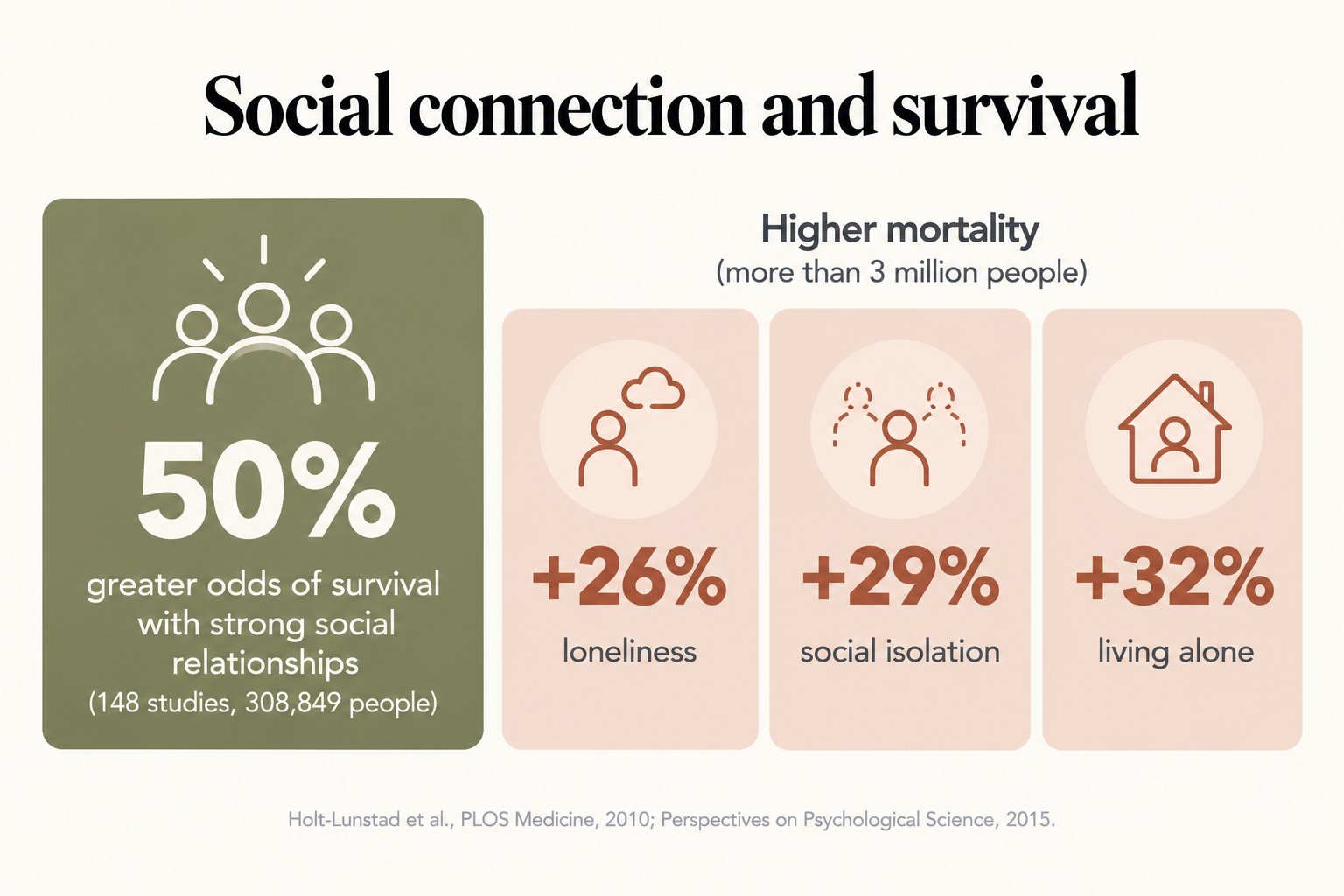
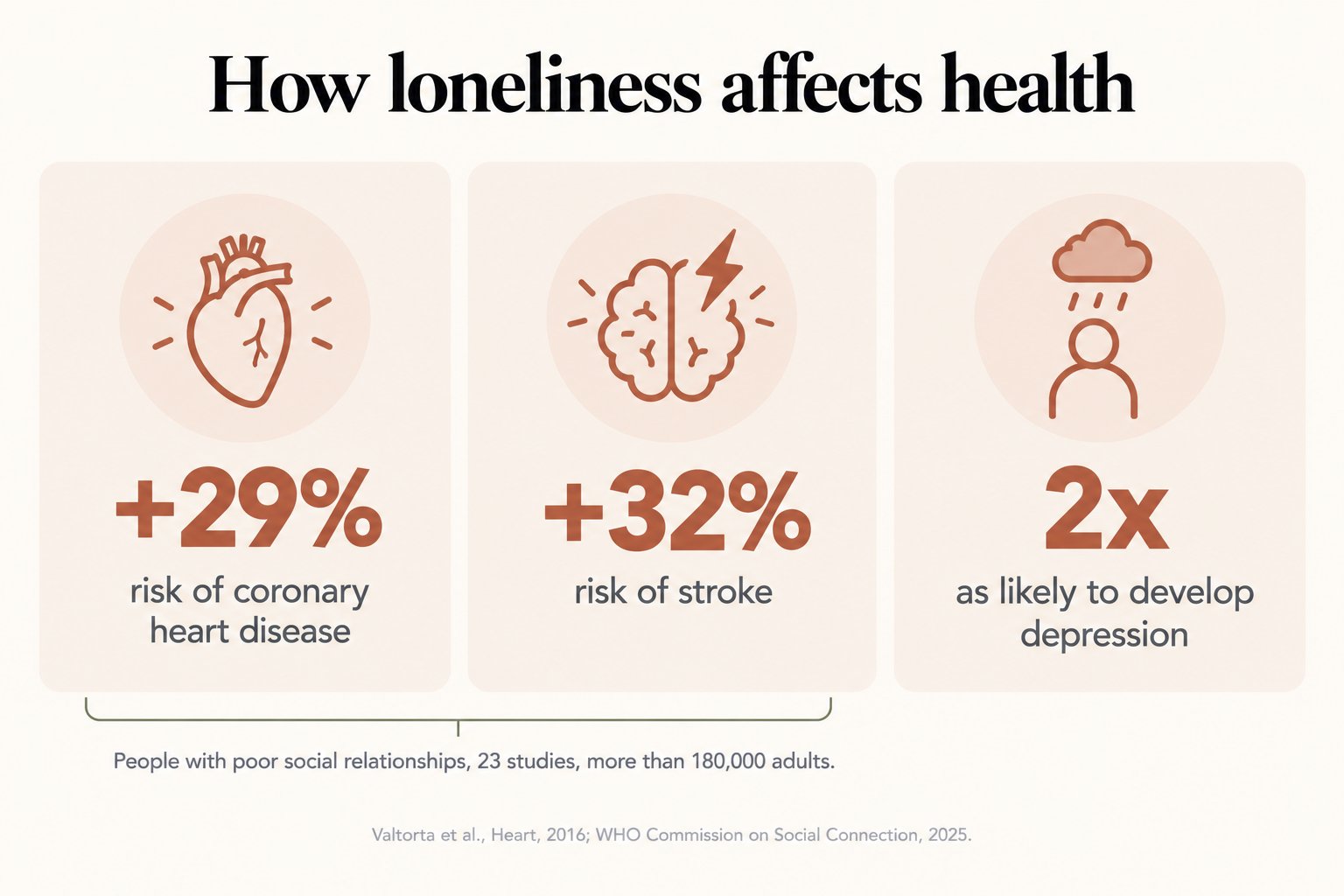
Humans evolved to live in groups, and our bodies still treat disconnection as a threat. Loneliness, the painful feeling that your relationships fall short of what you need, and social isolation, having few social contacts, are now recognised as serious public health problems. The World Health Organization's Commission on Social Connection estimated in 2025 that about 1 in 6 people worldwide are lonely, and that loneliness is linked to more than 871,000 deaths a year, about 100 every hour. A review of 148 studies with 308,849 people found that people with stronger social relationships had 50% greater odds of survival. Another analysis of more than 3 million people found that loneliness was linked to 26% higher mortality, social isolation to 29% and living alone to 32%. Poor social relationships are also linked to 29% higher risk of heart disease and 32% higher risk of stroke, and lonely people are twice as likely to become depressed. The US Surgeon General has said that social disconnection shortens lives by about as much as smoking 15 cigarettes a day. In Sri Lanka, an ageing population and the migration of younger family members for work are changing traditional family support, and a study of older adults in Hikkaduwa found that 47.8% were lonely. Loneliness isn't a personal failing, and it can be reduced: interventions that address unhelpful thoughts about relationships work best, and simple steps such as regular contact, shared activities and volunteering make a difference.
Key numbers
| Finding | Detail |
|---|---|
| Global prevalence (WHO, 2025) | About 1 in 6 people are lonely; linked to more than 871,000 deaths a year |
| Strong social relationships (148 studies, 308,849 people) | 50% greater odds of survival |
| Mortality (more than 3 million people) | Loneliness +26%, social isolation +29%, living alone +32% |
| Heart disease and stroke (23 studies, more than 180,000 people) | Poor social relationships: +29% heart disease, +32% stroke |
| Depression (WHO) | Lonely people are twice as likely to become depressed |
| Older adults in Hikkaduwa, Sri Lanka (120 people) | 47.8% lonely |
Loneliness and isolation: not the same thing
The WHO Commission on Social Connection uses these definitions:
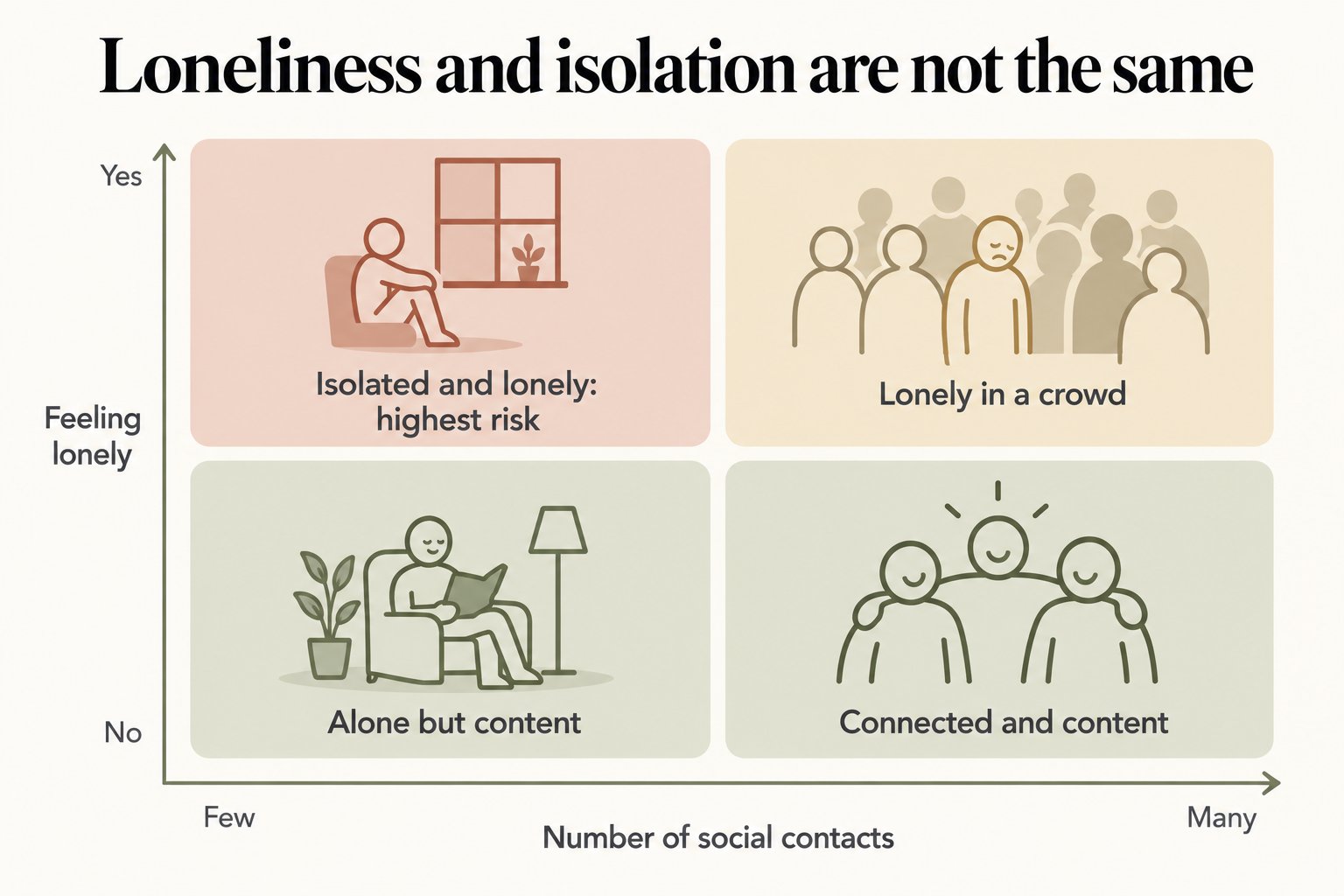
- Loneliness is "the painful feeling that arises from a gap between desired and actual social connections." It's subjective: you can feel lonely in a crowded house or a long marriage.
- Social isolation is "the objective lack of sufficient social connections": living alone, rarely seeing others or having few people to call on.
The two often overlap, but not always. Some people live alone and feel content; others are surrounded by family but feel unheard. Both matter for health, and they appear to raise risk by similar amounts.
How common is it?
The WHO estimates that about 1 in 6 people worldwide are lonely. Rates are highest among young people, with 17-21% of those aged 13-29 reporting loneliness, and in low-income countries, where about 24% are lonely, roughly double the rate in high-income countries. Social isolation affects up to 1 in 3 older adults.
In Sri Lanka, traditional extended families have long provided a strong safety net, but this is changing. The population is ageing rapidly, families are smaller, and many working-age adults move to cities or abroad for work, leaving older parents at home (see Ageing and Health in Sri Lanka). In a 2022 study of 120 older adults in Hikkaduwa, 47.8% had social and emotional loneliness. Being unmarried or widowed, not using a phone and rating one's own health as poor were linked to higher risk. The study was small, but it suggests loneliness is common among older Sri Lankans too.
What the research shows
Loneliness, isolation and lifespan. In 2010, Julianne Holt-Lunstad and colleagues combined 148 studies with 308,849 participants and found that people with stronger social relationships had 50% greater odds of survival over the study periods. A follow-up analysis of more than 3 million participants, published in 2015, found that loneliness was associated with 26% higher mortality, social isolation with 29% and living alone with 32%, after accounting for age, sex, socioeconomic status and existing health conditions. Based on this evidence, the US Surgeon General's 2023 advisory concluded that "social disconnection shortens lives by about as much as smoking 15 cigarettes a day."
Heart disease and stroke. In a 2016 meta-analysis of 23 studies with more than 180,000 adults, Nicole Valtorta and colleagues at Newcastle University found that loneliness or poor social relationships were associated with a 29% higher risk of coronary heart disease and a 32% higher risk of stroke. The authors concluded that "efforts to prevent CHD and stroke may benefit from taking social isolation and loneliness into account" (see Chronic Stress and Heart Disease).
Mental health and the brain. The WHO reports that lonely people are twice as likely to develop depression, and loneliness is linked to anxiety and thoughts of self-harm. The relationship runs both ways: depression makes people withdraw, which deepens loneliness. Social isolation is also one of the 14 modifiable risk factors for dementia identified by the 2024 Lancet Commission (see Social Connection and Cognitive Decline).
How loneliness harms the body
Researchers believe loneliness affects health through several pathways:
- Chronic stress: loneliness keeps the body on alert for social threats, raising stress hormones and blood pressure over time (see How the Stress Response Works).
- Poor sleep: lonely people tend to have more fragmented, less restorative sleep.
- Inflammation: loneliness has been linked to higher levels of inflammatory markers that contribute to heart disease and other conditions of ageing.
- Health behaviours: people without regular social contact may be less active, eat less well, smoke or drink more, and have no one to encourage them to see a doctor or take medicines.
- Less practical support: isolated people may have no one to notice early warning signs or help in an emergency.
Risk factors
| Risk factor | How it contributes | Who is most affected | What helps |
|---|---|---|---|
| Bereavement and widowhood | Loss of a central relationship and daily companionship | Older adults | Bereavement support, family contact, community groups |
| Living alone | Fewer daily interactions | Older adults, migrants, people after divorce | Regular planned contact, shared meals, neighbours |
| Family migration | Children living in cities or abroad | Older parents in Sri Lanka | Regular phone and video calls, local support networks |
| Retirement | Loss of work relationships and routine | People whose social life centred on work | Volunteering, clubs, part-time roles |
| Poor health, hearing or mobility | Harder to join activities and conversations | Older adults | Hearing aids, transport, home visits |
| Depression and social anxiety | Withdrawal and negative thoughts about others | All ages | Treatment, therapy, gradual re-engagement |
| Heavy social media use | Replaces face-to-face contact for some people | Teenagers and young adults | Prioritising in-person time |
What you can actually change
- 1. Make contact a habit, not an afterthought. Schedule regular calls, visits or meals with family and friends, just as you would schedule exercise. Small, frequent contacts build connection.
- 2. Join something regular. Religious communities, walking groups, clubs, classes and volunteering create repeated contact with the same people, which is how friendships form.
- 3. Help others. Volunteering, mentoring, caring for grandchildren or helping neighbours combats loneliness and builds purpose at the same time (see Purpose in Life and Longevity).
- 4. Challenge lonely thinking. Loneliness can make people expect rejection and withdraw further. A 2010 meta-analysis of 20 randomised trials found that interventions targeting these unhelpful thoughts, such as cognitive behavioural therapy, were far more effective than simply increasing social contact.
- 5. Fix barriers. Treating hearing loss, arranging transport and learning to use a phone or video calls can reconnect people who've become isolated.
- 6. Use technology to connect, not replace. Video calls with family abroad help; endless scrolling usually doesn't.
- 7. Check in on others. If you know someone who's recently widowed, retired, unwell or living alone, a visit or call can matter more than you think.
Why this matters for longevity
Social connection is as important to long-term health as many of the factors doctors routinely measure. Loneliness and isolation raise the risk of early death, heart disease, stroke, depression and dementia, by amounts comparable to well-known risks such as smoking and obesity. Yet they're rarely asked about in health checks. Strengthening relationships is one of the most powerful, and most enjoyable, things you can do for a long, healthy life.
Practical notes
Ask yourself: Who could I call at 2 am in an emergency? When did I last have a meaningful conversation? Do I feel understood by the people around me? If the answers worry you, start with one small step this week: call someone you've lost touch with, accept an invitation, or join one regular activity. If you're caring for an older relative, especially one who lives alone or whose children are abroad, help them stay connected through regular visits, calls, community activities and treating hearing or mobility problems. Practical ways to build social connection are covered in Building Social Connection. If loneliness comes with persistent low mood, hopelessness or thoughts of self-harm, speak to a doctor or contact a support service. Our Longevity Doctors ask about social connection as part of every assessment, starting with the free longevity assessment.
- World Health Organization. Social connection linked to improved health and reduced risk of early death (WHO Commission on Social Connection report). News release, 30 June 2025.
- Holt-Lunstad J, Smith TB, Layton JB. Social relationships and mortality risk: a meta-analytic review. PLOS Medicine, 2010;7(7):e1000316.
- Holt-Lunstad J, et al. Loneliness and social isolation as risk factors for mortality: a meta-analytic review. Perspectives on Psychological Science, 2015;10(2):227-237.
- Valtorta NK, et al. Loneliness and social isolation as risk factors for coronary heart disease and stroke: systematic review and meta-analysis of longitudinal observational studies. Heart, 2016;102(13):1009-1016.
- Office of the US Surgeon General. Our Epidemic of Loneliness and Isolation: The U.S. Surgeon General's Advisory on the Healing Effects of Social Connection and Community. 2023.
- Subathevan S, et al. Loneliness and associated factors among older adults in Hikkaduwa, Sri Lanka. Aging and Health Research, 2022;2(2).
- Masi CM, et al. A meta-analysis of interventions to reduce loneliness. Personality and Social Psychology Review, 2011;15(3):219-266.
- Livingston G, et al. Dementia prevention, intervention, and care: 2024 report of the Lancet standing Commission. The Lancet, 2024;404(10452):572-628.
Free longevity assessment
Want to talk about
social connection and health?
Take the free Aevum Protocol assessment to see how your stress & mental wellbeing and 6 other longevity domains are performing — and get a personalised 90-day plan.
Take the free assessmentKeep reading