Cognitive Longevity
A Brain-Healthy Routine by Life Stage:
What to Focus on in Your 20s to Your 80s
Dementia usually shows up late in life, but the risks build over decades. The 2024 Lancet Commission on dementia estimated that nearly half of dementia cases worldwide could be prevented or delayed by tackling 14 risk factors that act at different stages of life: education in early life, most of the physical-health factors in midlife, and social isolation, air pollution and vision loss in later life. That means there's no single brain-health plan. What matters most in your 30s is different from what matters most in your 70s. This guide brings together the evidence from the rest of this series into a practical routine for each stage of life, with the checks, habits and priorities that make the biggest difference.
Key numbers
| Finding | Detail |
|---|---|
| Dementia cases potentially preventable or delayed (Lancet Commission, 2024) | Nearly half (45%), across 14 risk factors |
| High LDL cholesterol in midlife (newly added in 2024) | About 7% of dementia cases |
| Untreated vision loss in later life (newly added in 2024) | About 2% of dementia cases |
| Intensive blood pressure control (SPRINT MIND, 9,361 adults) | 19% fewer cases of mild cognitive impairment |
| Sleeping 6 hours or less at age 50 (Whitehall II) | 22% higher dementia risk vs. 7 hours |
| About 3,800 / 9,800 steps a day (UK Biobank) | About 25% / 50% lower dementia risk |
| Hearing aid or cochlear implant users with hearing loss | 19% lower risk of long-term cognitive decline (HR 0.81) |
| Structured lifestyle programme (US POINTER, 2,111 older adults, 2 years) | Better cognition than a self-guided programme |
Why life stage matters
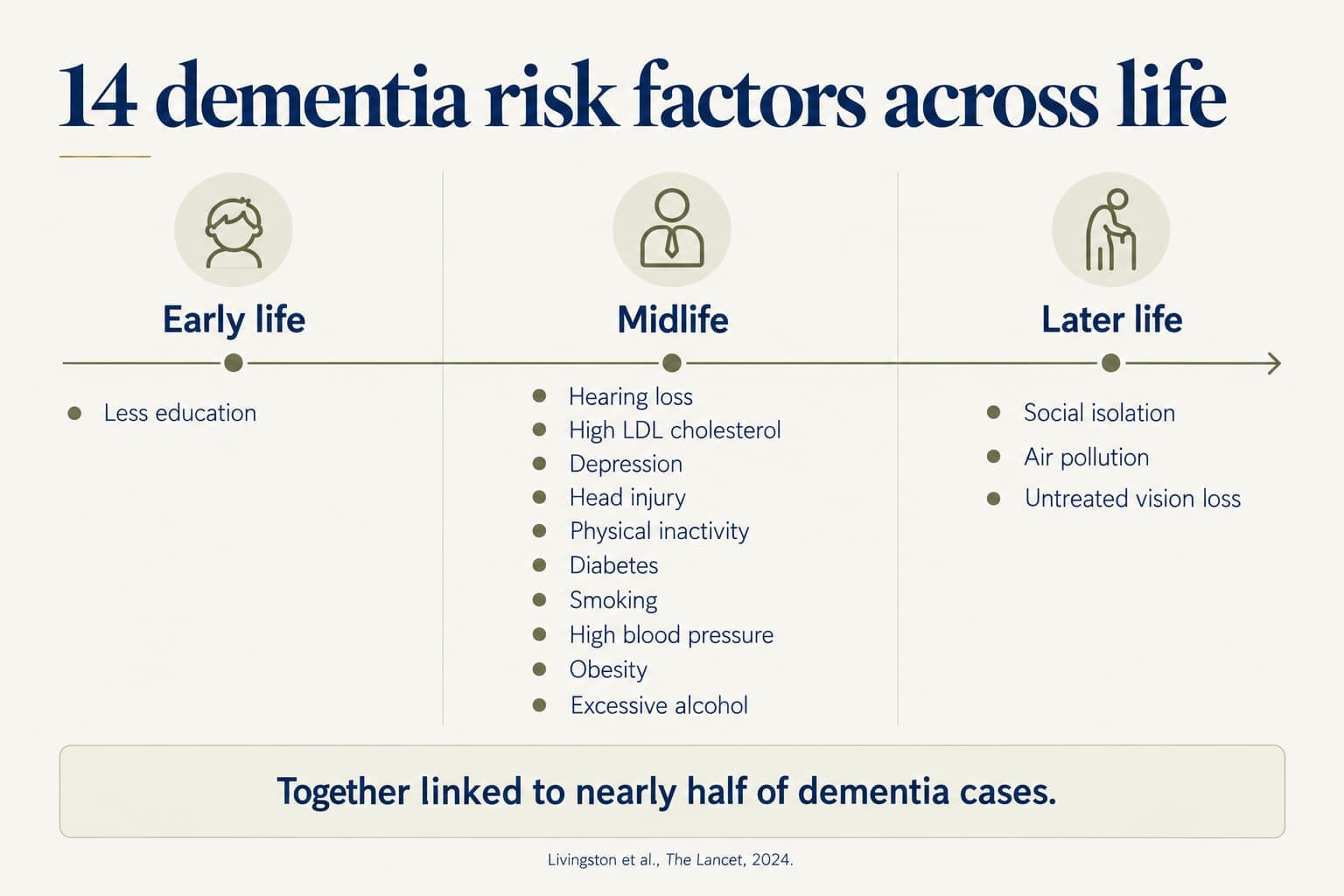
The Lancet Commission grouped its 14 modifiable risk factors by the stage of life when they seem to matter most:
| Life stage | Risk factors |
|---|---|
| Early life | Less education |
| Midlife | Hearing loss, high LDL cholesterol, depression, traumatic brain injury, physical inactivity, diabetes, smoking, high blood pressure, obesity, excessive alcohol |
| Later life | Social isolation, air pollution, untreated vision loss |
Most of the list sits in midlife. That's partly because vascular damage, inflammation and brain changes build up slowly over decades before symptoms appear (see Vascular Health and the Brain and How the Brain Changes With Age). But every stage offers something useful to do. For the full list and the size of each risk, see Alzheimer's Disease: Risk Factors You Can Actually Change.
The foundations at every age
Across this series, the same habits come up again and again:
- →Move regularly: aerobic activity plus strength training (see Exercise and Brain Health).
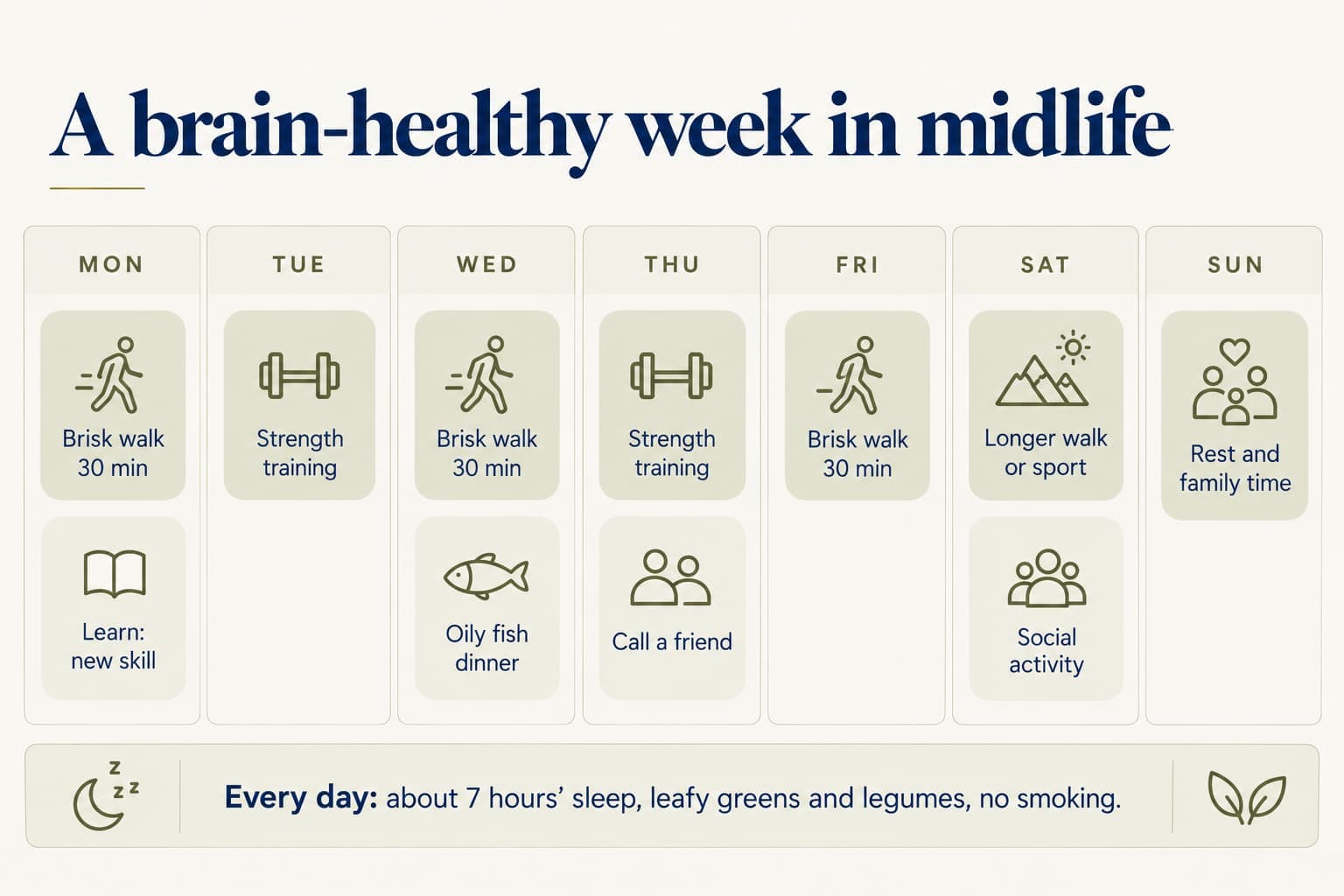
- →Sleep about seven hours on a regular schedule, and treat sleep apnoea (see Sleep and Memory Consolidation).
- →Keep blood pressure, blood sugar and cholesterol in range.
- →Eat a MIND-style diet rich in leafy greens, legumes, whole grains and fish (see The MIND Diet and Brain Health).
- →Protect your hearing and vision, and treat problems early (see Hearing Loss and Dementia Risk).
- →Stay socially connected (see Social Connection and Cognitive Decline).
- →Keep learning new, challenging things (see Learning New Skills and Brain Health).
- →Look after your mental health and manage chronic stress (see Depression and Cognitive Decline and Chronic Stress and the Brain).
- →Don't smoke, and keep alcohol low.
- →Protect your head from injury.
The routines below show how the emphasis shifts with age.
Your 20s and 30s: build the foundations
This is when habits form and cognitive reserve keeps building (see Cognitive Reserve). Brain disease is rare at this age, but the choices you make now shape your risk decades later.
Priorities
- →Keep learning. Education and mentally demanding work build reserve. If formal education ended early, courses, skills and challenging work still count.
- →Build an exercise habit you can sustain for life, including strength training.
- →Protect your head. Wear a helmet on motorcycles and bicycles, wear seatbelts, and take concussions seriously.
- →Protect your hearing. Keep headphone volume moderate and use ear protection around loud noise.
- →Don't start smoking, or stop now. Keep alcohol low.
- →Establish good sleep habits.
Checks: know your blood pressure, weight and, if there's a family history, your cholesterol and blood sugar.
Your 40s and 50s: the critical window
Midlife is where most of the modifiable risk sits. Blood pressure, cholesterol, blood sugar and weight often start to drift, and the effects on the brain build quietly.
Priorities
- →Control blood pressure. In the SPRINT MIND trial, intensive blood pressure control reduced mild cognitive impairment by 19%.
- →Check and treat high LDL cholesterol. The Lancet Commission recommends detecting and treating high LDL cholesterol from about age 40.
- →Manage blood sugar and weight, and prevent or treat diabetes.
- →Protect your sleep. Regularly sleeping six hours or less at 50 was linked to 22% higher dementia risk. Get checked for sleep apnoea if you snore loudly or feel sleepy during the day.
- →Get your hearing checked if you notice difficulty, and use hearing aids if you need them.
- →Treat depression and address chronic stress.
- →Stay active. Aim for about 150 minutes of moderate activity a week plus strength training twice a week. Even about 3,800 steps a day was linked to lower dementia risk, with more benefit up to about 9,800.
Checks: regular checks of blood pressure, cholesterol, blood sugar and weight, as your doctor advises; hearing and eye checks; and a review of mood and sleep.
Your 60s and 70s: stay connected and engaged
Later life brings new risks: retirement can remove daily mental and social challenge, hearing and vision often decline, and social circles can shrink.
Priorities
- →Replace what work provided. Plan structured learning, volunteering or a demanding hobby. In one study, the most mentally active older adults were diagnosed with Alzheimer's about five years later than the least active.
- →Stay socially connected. Social isolation is one of the later-life risk factors in the Lancet Commission. Group activities that combine exercise, learning and social contact, such as walking groups, dance or choir, cover several bases at once.
- →Treat hearing and vision loss. Hearing aids, cataract surgery and up-to-date glasses matter for brain health, not just convenience.
- →Keep exercising, including strength and balance training to prevent falls and head injury.
- →Keep managing blood pressure, cholesterol and blood sugar.
- →Review medicines with your doctor, especially sleeping pills and other sedating drugs.
- →Stay up to date with vaccinations recommended for older adults (see Chronic Inflammation and the Brain).
Checks: regular hearing and eye tests; ongoing cardiovascular risk checks; and a memory assessment if you or your family notice changes (see Cognitive Testing and Brain Screening).
Your 80s and beyond: maintain and adapt
At this stage, the goals shift towards maintaining independence, preventing falls and staying engaged.
Priorities
- →Stay as active as you safely can. Walking, gentle strength work and balance exercises help both body and brain.
- →Keep socially and mentally engaged, adapting activities to your abilities.
- →Keep hearing and vision corrected.
- →Review medicines regularly. Older adults are more sensitive to drugs that affect thinking.
- →Prioritise sleep and nutrition, including enough protein and fluids.
- →Plan ahead. Talk with family about wishes and support, especially if memory is changing.
Checks: regular medication reviews and hearing and vision checks, and prompt assessment of any new confusion, which can signal an infection, medicine side effect or other treatable problem.
If you have higher risk
- →Family history or APOE4: Follow the same routine, starting earlier and more consistently. Lifestyle changes help regardless of genes (see APOE4 and Genetic Risk).
- →Mild cognitive impairment: Exercise at least twice a week, manage vascular risk factors, treat hearing loss and stay engaged (see Mild Cognitive Impairment).
- →Several risk factors at once: Consider a structured programme with support. In FINGER and US POINTER, combining exercise, diet, brain challenge, social activity and risk-factor monitoring helped cognition, and more structure and support helped more.
What not to rely on
The Evidence Checks in this series found that several popular approaches have weak or no evidence for protecting the brain in most people:
- →Brain-training apps mostly improve performance on the games themselves (see Cognitive Training and Brain Games).
- →Most "brain supplements" lack good evidence, and some contain undeclared drugs (see Nootropics and Cognitive Enhancers).
- →Fish oil and B-vitamin capsules haven't improved cognition in large trials of healthy older adults, though B vitamins may help specific groups (see Omega-3s and Cognitive Function and B Vitamins, Homocysteine, and Brain Aging).
Your time, money and energy are better spent on the foundations.
Applying this in Sri Lanka
- →Blood pressure, diabetes and cholesterol are common and often undiagnosed. Regular checks from your 40s, or earlier with a family history, are one of the most valuable things you can do for your brain.
- →Helmets and road safety are brain-health issues, given the number of motorcycle and three-wheeler journeys.
- →Air pollution is a later-life risk factor. On high-pollution days in urban areas, exercise away from busy roads or indoors.
- →Food: a MIND-style Sri Lankan diet can be built from red rice, dhal, leafy greens such as gotukola and mukunuwenna, and oily fish, with fewer fried short eats and sweets.
- →Community: temples, churches, mosques, kovils, community groups and extended family can all be sources of social connection, learning and purpose at every age.
Practical notes
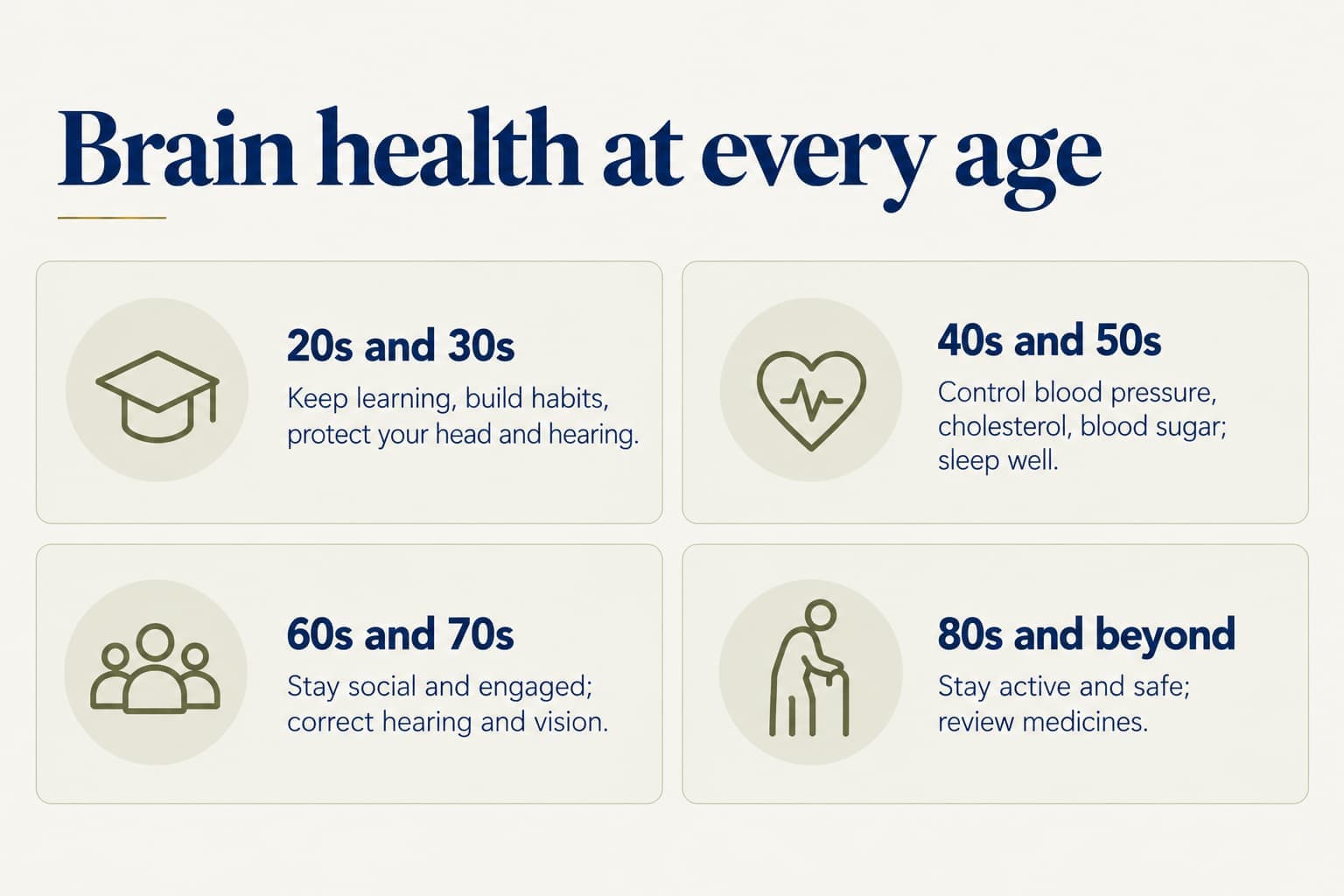
Brain health is built across a lifetime. In your 20s and 30s, the focus is on education, habits and protecting your head and hearing. In your 40s and 50s, it's controlling blood pressure, cholesterol, blood sugar and weight, sleeping well, and treating hearing loss and depression. In your 60s and 70s, staying socially and mentally engaged and correcting hearing and vision become especially important. In your 80s, the focus shifts to staying active, safe and connected. At every stage, the same foundations apply, and it's never too early or too late to start.
- Livingston G, et al. Dementia prevention, intervention, and care: 2024 report of the Lancet standing Commission. The Lancet, 2024;404(10452):572-628.
- SPRINT MIND Investigators. Effect of Intensive vs Standard Blood Pressure Control on Probable Dementia: A Randomized Clinical Trial. JAMA, 2019;321(6):553-561.
- Sabia S, et al. Association of sleep duration in middle and old age with incidence of dementia. Nature Communications, 2021;12:2289.
- del Pozo Cruz B, et al. Association of Daily Step Count and Intensity With Incident Dementia in 78 430 Adults Living in the UK. JAMA Neurology, 2022.
- Yeo BSY, et al. Association of Hearing Aids and Cochlear Implants With Cognitive Decline and Dementia: A Systematic Review and Meta-analysis. JAMA Neurology, 2023;80(2):134-141.
- Wilson RS, et al. Cognitive Activity and Onset Age of Incident Alzheimer Disease Dementia. Neurology, 2021;97(9):e922-e929.
- Baker LD, et al. Structured vs Self-Guided Multidomain Lifestyle Interventions for Global Cognitive Function: The US POINTER Randomized Clinical Trial. JAMA, 2025.
Which life stage are you in,
and what's your biggest brain-health gap?
Take the free Aevum Protocol assessment to see how your cognitive longevity and 6 other longevity domains are performing — and get a personalised 90-day plan.
Take the Free Assessment →