Reproductive & Sexual Health
Reproductive Health by Life Stage:
What to Know and Do from Your Teens to Later Life
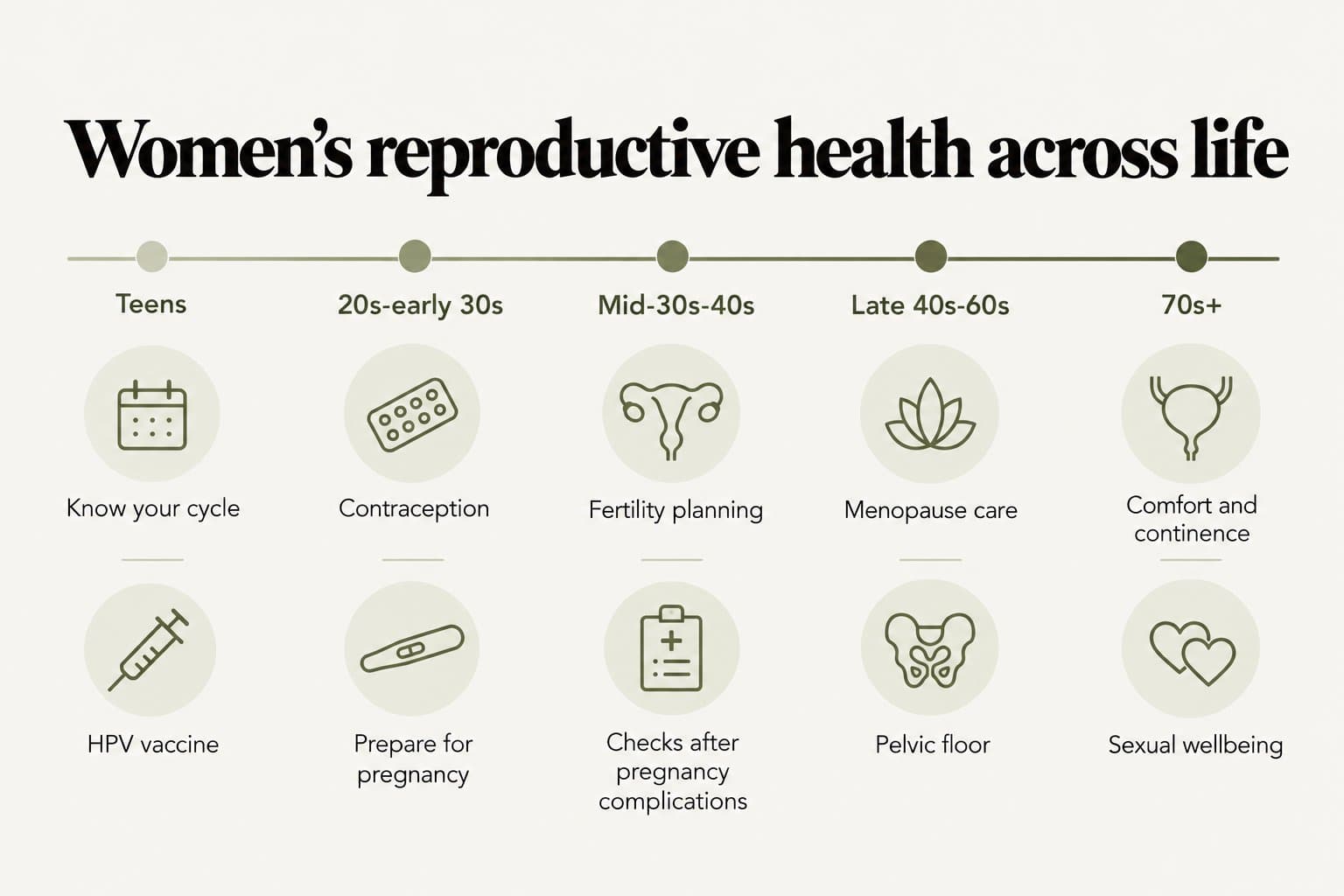
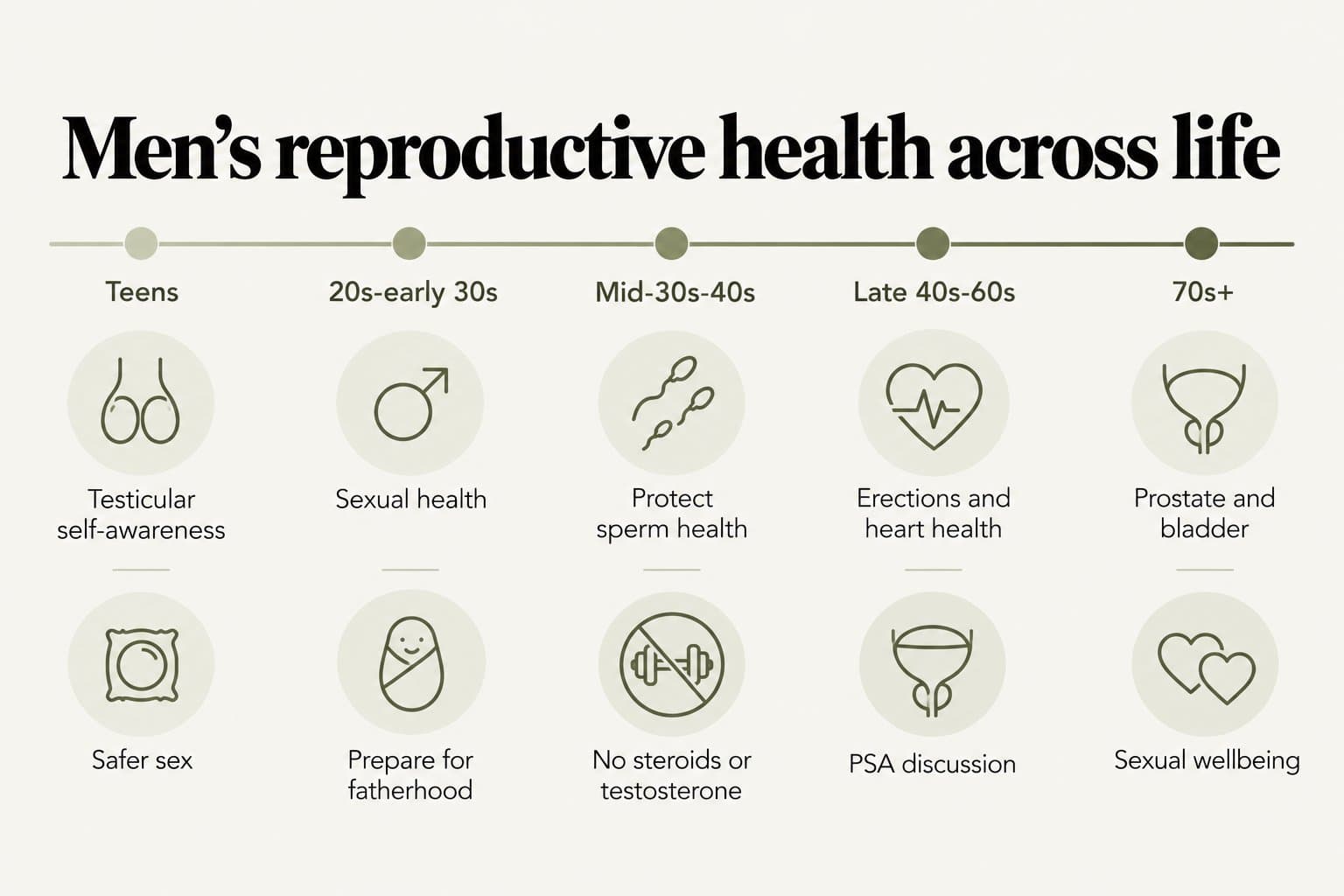
Reproductive and sexual health changes across life, and each stage brings different priorities. In the teens, the menstrual cycle becomes a vital sign of health and HPV vaccination protects against cervical cancer later. In the 20s and early 30s, the focus is on contraception, sexual health, recognising conditions such as polycystic ovary syndrome and endometriosis, and preparing for pregnancy. Female fertility declines gradually from about 32 and more steeply after 37, and men's semen quality also declines with age, so the mid-30s and 40s are a time for informed family planning. Pregnancy complications reveal long-term heart and diabetes risk. From the late 40s, menopause, prostate health, erectile function and the pelvic floor come to the fore, and in later life, sexual wellbeing and continence remain important parts of quality of life. Across every stage, the same foundations protect reproductive health: a healthy weight, regular activity, not smoking, limiting alcohol and seeing a doctor when something changes. This guide brings together the key steps for women and men at each stage of life, drawing on the articles in this section.
Key numbers
| Finding | Detail |
|---|---|
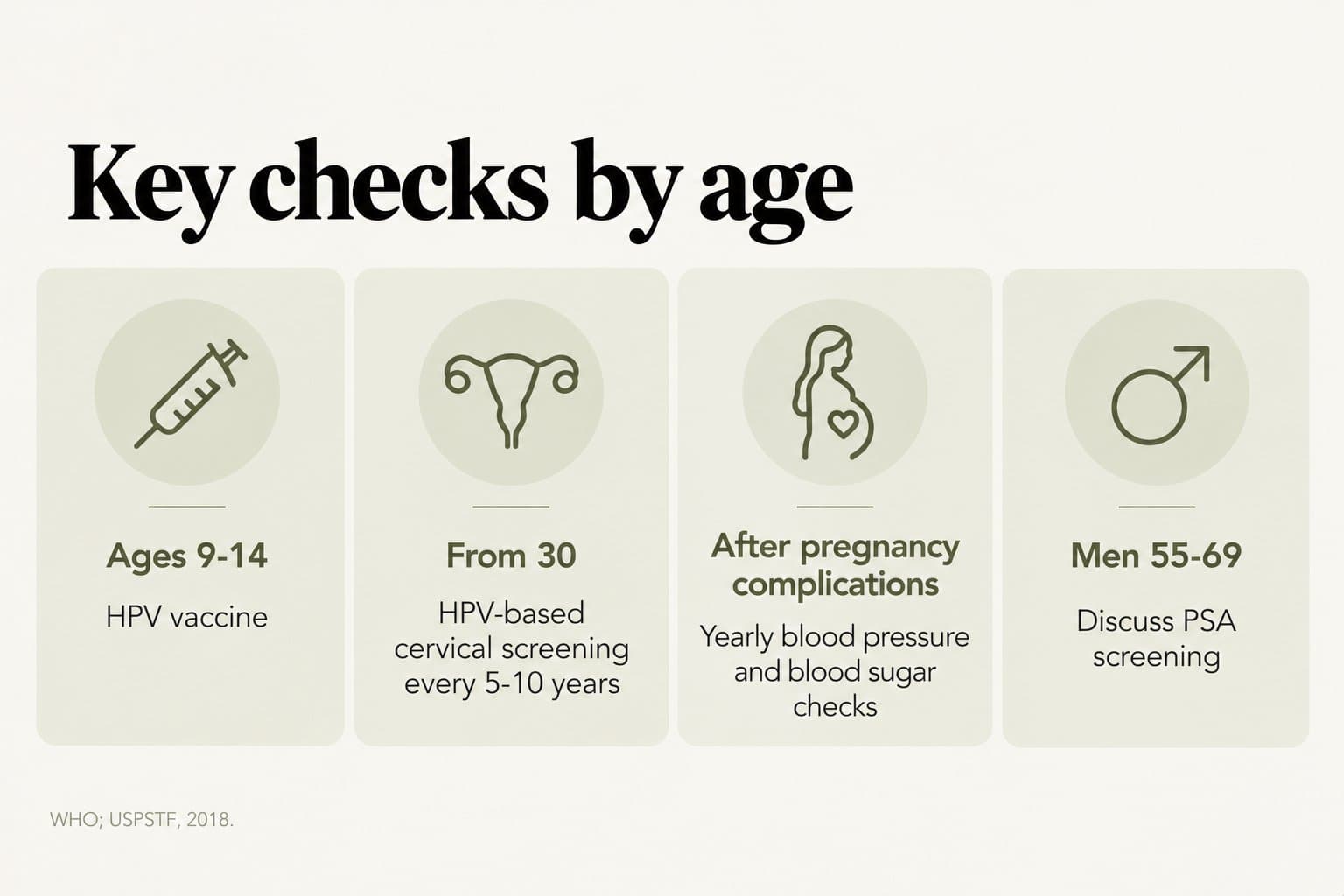
| HPV vaccination (WHO) | A priority for girls aged 9-14, with one or two doses |
| Cervical screening (WHO) | HPV test from age 30, every 5-10 years; from 25, every 3-5 years, for women living with HIV |
| Female fertility (ACOG/ASRM) | Declines from about 32 and more rapidly after 37 |
| Not conceiving within a year (782 couples) | About 8% of women aged 19-26 vs 18% aged 35-39 |
| PSA screening (USPSTF) | An individual decision at 55-69; not recommended routinely from 70 |
The foundations at every age
Whatever your age or sex, the same habits support reproductive and sexual health:
- Keep a healthy weight: excess weight affects ovulation, sperm, pregnancy, erections and the pelvic floor.
- Stay active: including muscle strengthening.
- Don't smoke and limit alcohol.
- Look after your heart and metabolic health: reproductive problems are often early signs of wider health issues.
- Treat sexual and reproductive symptoms as health signals, not embarrassments, and raise them with your doctor.
By life stage
Teens: build awareness.
- Know your cycle: the median age of a first period is about 12.4 years, and within a few years most cycles fall between 21 and 34 days. Periods that haven't started by 15, very heavy periods or severe pain deserve a check (see The Menstrual Cycle as a Vital Sign).
- Get the HPV vaccine: WHO makes HPV vaccination a priority for girls aged 9-14, before they become sexually active; boys can be vaccinated too where available.
- Learn about consent, contraception and safer sex before becoming sexually active.
- For boys: learn testicular self-awareness and see a doctor about any lump or swelling.
20s and early 30s: protect and prepare.
- Choose contraception that suits you; long-term hormonal methods are safe for most women and protect against ovarian and endometrial cancer (see Hormonal Contraception and Long-Term Health).
- Use condoms with new partners and get tested for sexually transmitted infections when needed.
- Recognise common conditions: irregular periods may point to PCOS, and disabling period pain to endometriosis (see Polycystic Ovary Syndrome (PCOS) and Endometriosis).
- Start cervical screening as your national programme advises; WHO recommends HPV-based testing from 30.
- Prepare for pregnancy: folic acid for at least three months beforehand, a healthy weight and a preconception check-up for both partners (see Preconception Health Guide).
Mid-30s and 40s: plan with the facts.
- Understand fertility and age: female fertility declines from about 32 and more steeply after 37; in one study, about 8% of women aged 19-26 didn't conceive within a year, compared with 18% of women aged 35-39 (see Reproductive Ageing Explained and How Fertility Works).
- Seek help sooner: after 6 months of trying if the woman is 35 or over, and sooner after 40. Both partners should be assessed.
- Consider egg freezing early if relevant: success is highest when eggs are frozen before 35 (see Egg Freezing).
- Don't rely on an AMH test to predict natural fertility (see AMH and Ovarian Reserve Testing).
- After a complicated pregnancy, have blood pressure and blood sugar checked regularly (see Pregnancy Complications and Long-Term Health).
- Heavy periods are common in this decade, often from fibroids, and can cause iron deficiency (see Fibroids and Heavy Periods).
- For men: semen quality declines with age, and testosterone, steroids, smoking and excess weight harm sperm (see Male Fertility and Sperm Health).
Late 40s to 60s: transition and screening.
- Prepare for perimenopause and menopause: changing cycles in the 40s are often the first sign, and menopause brings changes to heart, bone and vaginal health (see Menopause and Long-Term Health).
- Treat vaginal dryness and painful sex, which are common and treatable (see Sexual Wellbeing in Midlife and Beyond).
- Continue cervical screening as advised and report any bleeding after menopause promptly.
- Train your pelvic floor to prevent and treat leakage and prolapse (see Pelvic Floor Health and Incontinence).
- For men: treat new erection problems as a reason for a heart check, discuss PSA screening between 55 and 69, and seek advice about urinary symptoms (see Erectile Dysfunction and Heart Health, PSA Screening for Prostate Cancer and Prostate Enlargement (BPH)).
70s and beyond: comfort, function and connection.
- Stay active and keep the pelvic floor strong to support continence and independence.
- Investigate night-time urination, which disrupts sleep and can reflect heart, diabetes or prostate issues.
- Routine PSA screening isn't recommended from 70; new urinary or bone symptoms still need assessment.
- Sexual wellbeing still matters: treatments for dryness and erection problems remain effective, and safer sex matters with new partners (see Sexual Health and Longevity).
Recommendations by scenario
| Scenario | What to do |
|---|---|
| Teenager with very painful or heavy periods | See a doctor; this isn't something to put up with |
| Planning pregnancy at any age | Start folic acid and see a doctor for a preconception check-up |
| Woman 35 or over trying for 6 months | Both partners should be assessed |
| Thinking about delaying children | Learn about age and fertility; consider egg freezing early if relevant |
| History of pre-eclampsia or gestational diabetes | Yearly checks of blood pressure, blood sugar and cholesterol |
| Irregular periods or excess hair | Ask about PCOS and metabolic checks |
| New erection problems | See a doctor and have your heart health checked |
| Man aged 55-69 | Discuss the benefits and harms of PSA screening |
| Leaking urine at any age | Start pelvic floor training and seek advice |
| Bleeding after menopause | See a doctor promptly |
Practical notes
Reproductive and sexual health is a lifelong part of overall health, with different priorities at each stage: awareness and vaccination in the teens, protection and preparation in the 20s and 30s, informed planning in the mid-30s and 40s, and managing transition, screening and function from midlife onwards. Across every stage, a healthy weight, regular activity, not smoking, limiting alcohol and openness with your doctor protect fertility, sexual wellbeing and long-term health.
- World Health Organization. Cervical cancer. Fact sheet.
- World Health Organization. WHO updates recommendations on HPV vaccination schedule. December 2022.
- American College of Obstetricians and Gynecologists and American Society for Reproductive Medicine. Female age-related fertility decline. Committee Opinion No. 589. Fertility and Sterility, 2014;101(3):633-634.
- Dunson DB, et al. Increased infertility with age in men and women. Obstetrics & Gynecology, 2004;103(1):51-56.
- American College of Obstetricians and Gynecologists. Menstruation in girls and adolescents: using the menstrual cycle as a vital sign. Committee Opinion No. 651. Obstetrics & Gynecology, 2015;126(6):e143-e146.
- US Preventive Services Task Force. Screening for prostate cancer: recommendation statement. JAMA, 2018;319(18):1901-1913.
Free longevity assessment
Which reproductive health steps
matter most at your stage of life?
Take the free Aevum Protocol assessment to see how your reproductive & sexual health and 6 other longevity domains are performing — and get a personalised 90-day plan.
Take the free assessmentKeep reading
Related articles
Reproductive & Sexual Health
Reproductive Ageing Explained: How Fertility Changes with Age in Women and Men
Reproductive & Sexual Health
Preconception Health Guide: How Both Partners Can Prepare for a Healthy Pregnancy
Reproductive & Sexual Health