Reproductive & Sexual Health
AMH and Ovarian Reserve Testing:
What an "Egg Count" Test Can and Can't Tell You
Anti-Müllerian hormone (AMH) is a blood test often marketed as an "egg count" or "fertility test". It reflects the number of small follicles growing in the ovaries, so it gives an estimate of a woman's remaining egg supply, known as ovarian reserve. AMH is useful in specific situations: it helps predict how many eggs a woman is likely to produce during IVF or egg freezing, and a high level supports a diagnosis of polycystic ovary syndrome. But it doesn't predict a woman's natural fertility. In a US study of 750 women aged 30-44 trying to conceive, those with a low AMH were just as likely to get pregnant within a year as those with a normal level (84% vs 75%). The American Society for Reproductive Medicine states that ovarian reserve markers are "poor predictors of reproductive potential independently from age". AMH is also an imprecise guide to the timing of menopause for an individual woman. Age remains the single best predictor of both. This article explains what AMH measures, what the evidence shows and when the test is worth doing.
Key numbers
| Finding | Detail |
|---|---|
| Low AMH and natural conception within 12 cycles (750 women aged 30-44) | 84% with low AMH vs 75% with normal AMH; no significant difference |
| Within 6 cycles (same study) | 65% with low AMH vs 62% with normal AMH |
| What AMH predicts best (ASRM) | Number of eggs retrieved after ovarian stimulation |
| AMH and timing of menopause (2,596 women, 6 cohorts) | Adds little to age alone for predicting menopause (accuracy 84% with age, 86% with AMH added) |
| Low AMH threshold used in the US study | Below 0.7 ng/mL |
What AMH measures
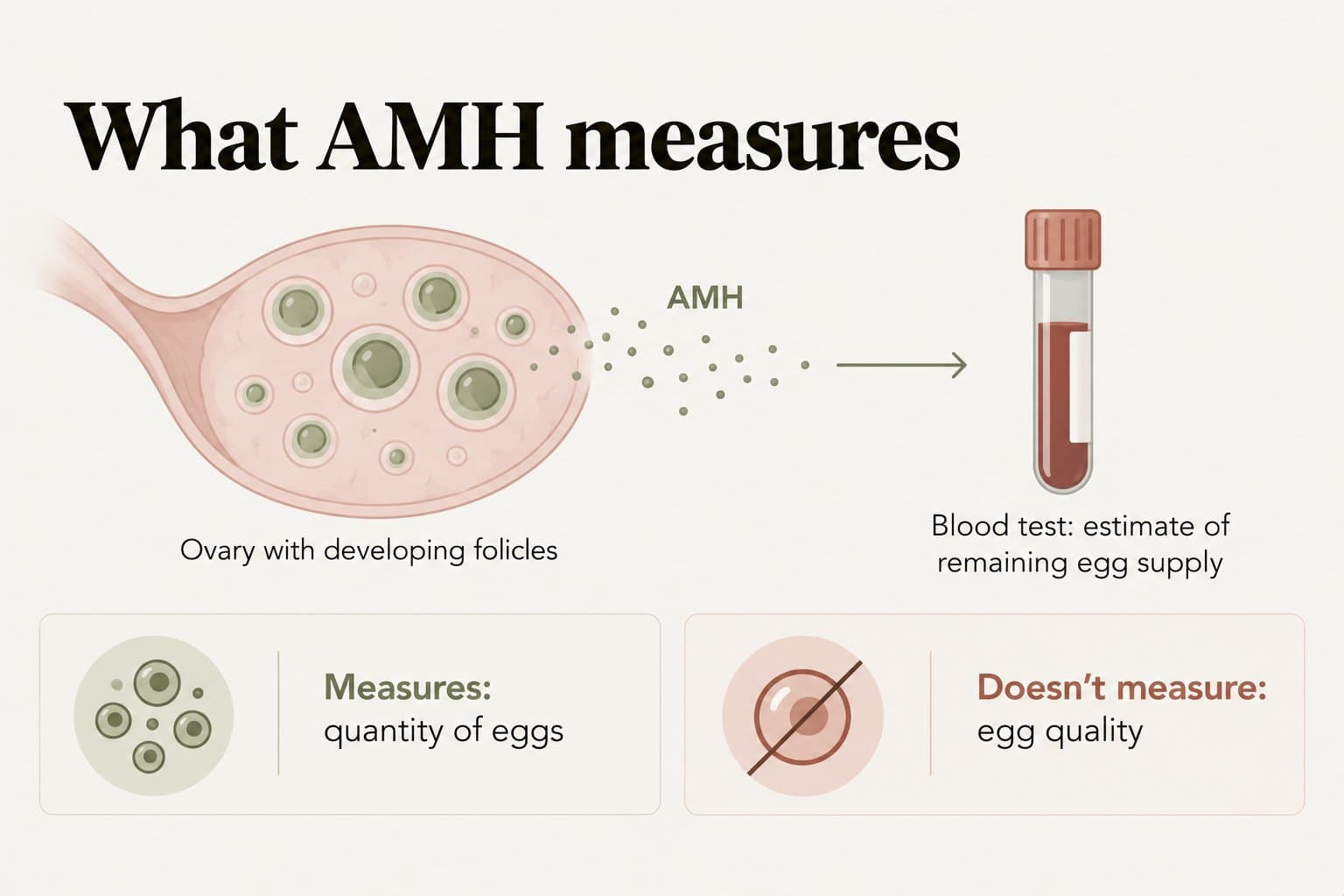
AMH is made by the small, growing follicles in the ovaries. Because the number of these follicles reflects the size of the remaining egg pool, AMH levels fall gradually with age, becoming very low as menopause approaches (see Reproductive Ageing Explained). Other tests of ovarian reserve include an ultrasound count of small follicles (antral follicle count, or AFC) and blood levels of FSH and inhibin B early in the cycle.
AMH measures the quantity of eggs, not their quality. Egg quality, which mainly determines the chance of a healthy pregnancy, depends largely on age and can't be measured with a blood test.
Evidence strength
Strong: AMH predicts how many eggs will be collected during IVF. The American Society for Reproductive Medicine (ASRM) states that ovarian reserve markers "can be useful as predictors of oocyte yield following controlled ovarian stimulation and oocyte retrieval". In practice, AMH and the antral follicle count help fertility specialists choose medicine doses and set expectations for IVF or egg freezing: a woman with a low AMH is likely to produce fewer eggs per cycle (see Egg Freezing).
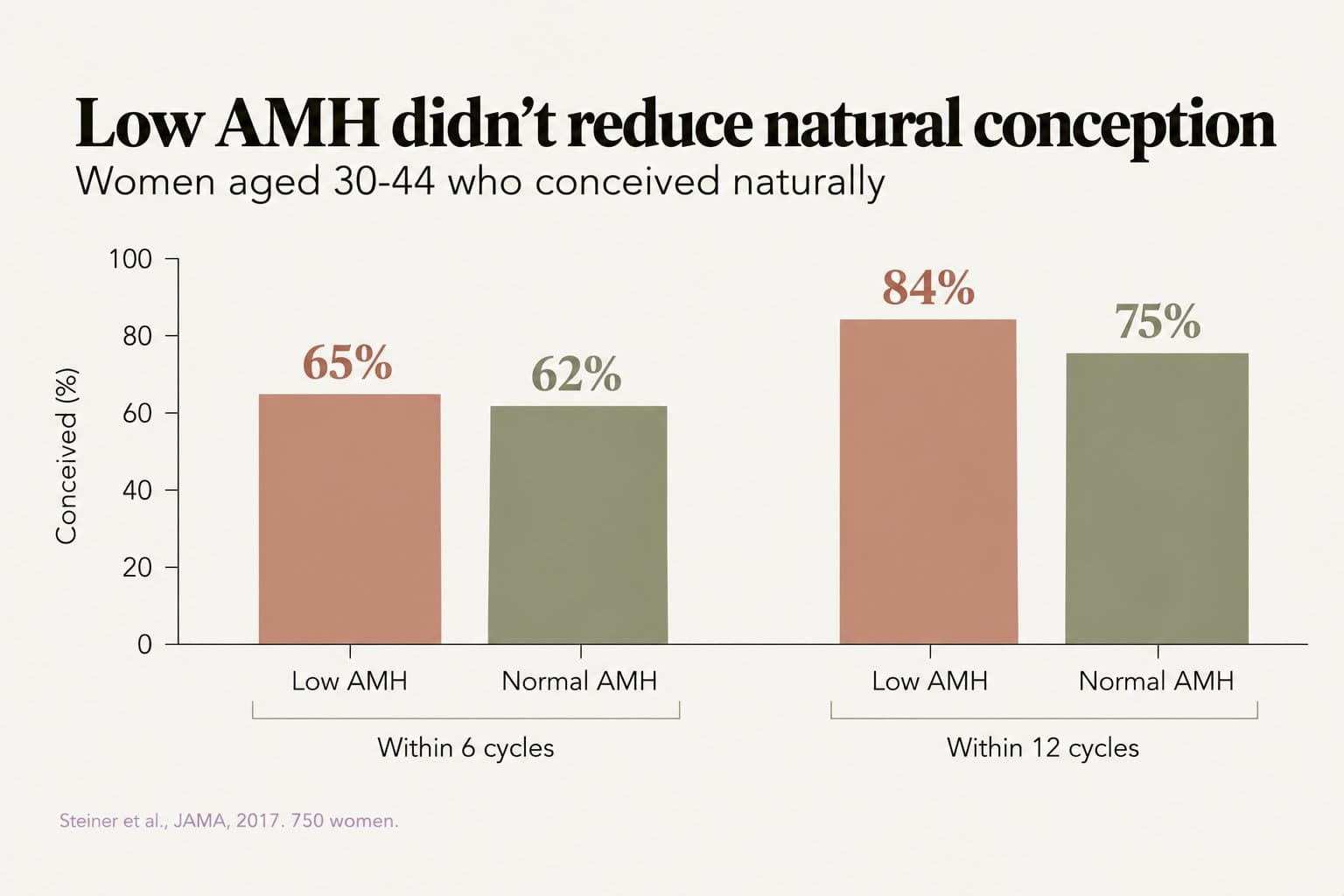
Strong: AMH doesn't predict natural fertility. The clearest evidence comes from a US study published in JAMA in 2017. Researchers followed 750 women aged 30-44 with no history of infertility who had been trying to conceive for three months or less. Women with a low AMH (below 0.7 ng/mL) were no less likely to conceive than women with a normal AMH: 65% vs 62% within six cycles and 84% vs 75% within twelve cycles. High FSH and inhibin B levels also didn't predict reduced fertility. The authors concluded that these tests should not be used to assess natural fertility.
The ASRM similarly states that ovarian reserve markers "are poor predictors of reproductive potential independently from age". A woman needs only one good egg each month to conceive naturally, so having fewer eggs doesn't necessarily lower her monthly chance of pregnancy.
Moderate: a high AMH supports a diagnosis of PCOS. The 2023 international PCOS guideline allows a raised AMH, in adults, to be used instead of an ultrasound to identify polycystic ovaries as one of the diagnostic features, provided other criteria are met (see Polycystic Ovary Syndrome (PCOS)). AMH alone can't diagnose PCOS.
Limited: AMH predicts the timing of menopause. An analysis combining data on 2,596 women from six studies found that lower AMH was linked to earlier menopause. But AMH improved the accuracy of prediction only slightly beyond age alone, from 84% to 86%. It was more helpful for identifying women likely to have early menopause (by 45), but the researchers concluded that "individual predictions of age at menopause demonstrated a limited precision", making clinical use "troublesome".
Important limitations.
- Results vary between laboratories and assays, so levels should be interpreted with the lab's own reference ranges.
- Hormonal contraception can lower AMH temporarily, so results may underestimate reserve.
- AMH tells you nothing about egg quality, fallopian tubes, the womb or the male partner.
- A single "normal" result can give false reassurance that it's safe to delay trying to conceive, while a low result can cause unnecessary anxiety.
Recommendations by situation
| Situation | What the evidence supports |
|---|---|
| Not trying to conceive, curious about "fertility" | AMH can't predict your chance of natural pregnancy; age is a better guide |
| Trying to conceive with no known problems | Not needed at the start; seek assessment after 12 months, or 6 months if 35 or over |
| Considering egg freezing | Useful for estimating how many eggs a cycle may yield |
| Undergoing IVF | Useful for planning medicine doses and setting expectations |
| Irregular periods or suspected PCOS | Can support the diagnosis in adults alongside other features |
| Before cancer treatment that may damage the ovaries | Can help in fertility preservation planning, with a specialist |
| Wanting to predict when menopause will happen | Of limited value for an individual woman |
Practical notes
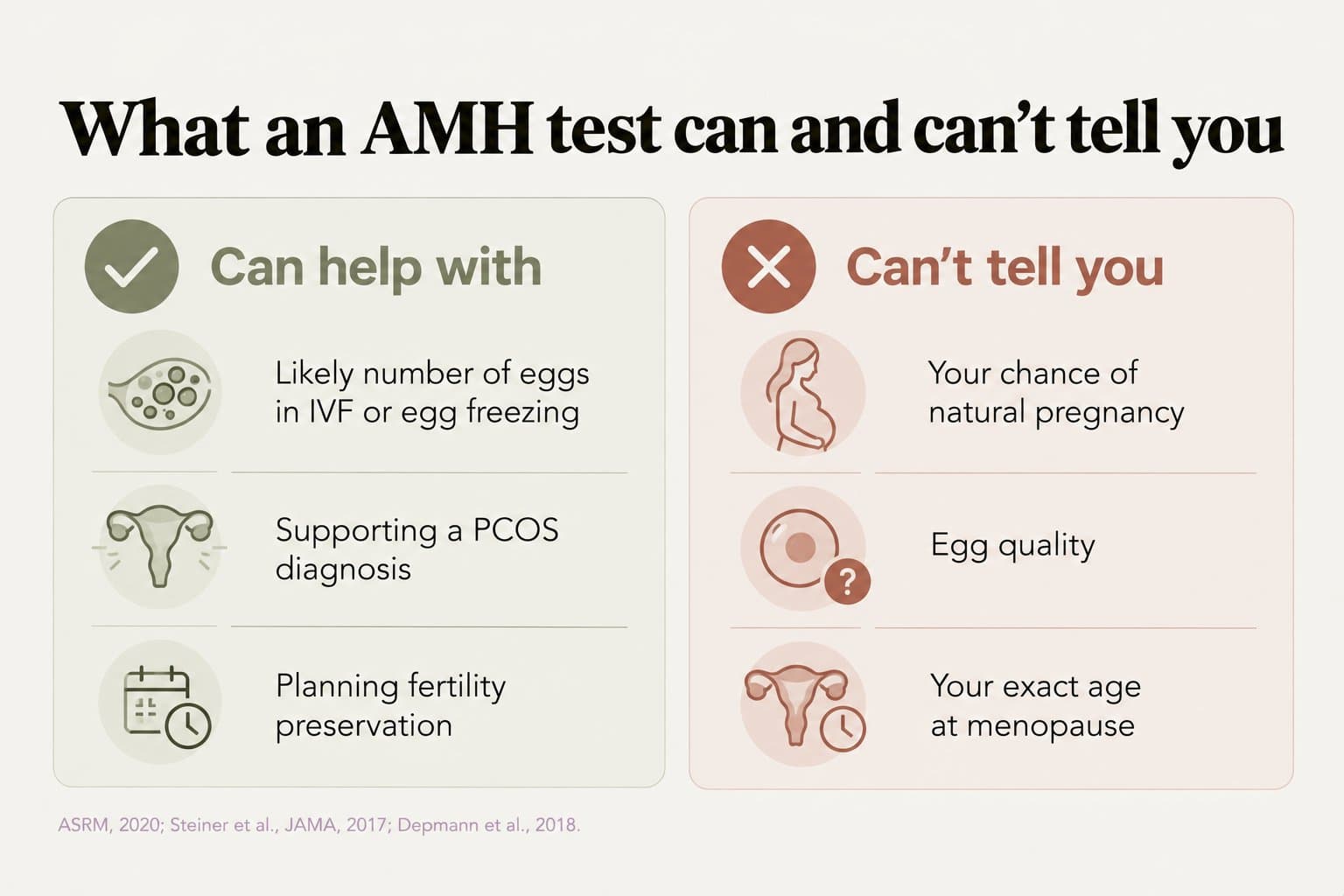
AMH gives an estimate of the remaining egg supply, and it's valuable for planning IVF and egg freezing and in diagnosing PCOS. But it isn't a test of natural fertility: women with low AMH conceive naturally at similar rates to women with normal AMH, and age matters far more than any blood test. If you're thinking about your fertility, the most useful steps are understanding how age affects it, knowing when to seek help, and discussing your plans with a doctor rather than relying on a single number (see How Fertility Works).
- Steiner AZ, et al. Association between biomarkers of ovarian reserve and infertility among older women of reproductive age. JAMA, 2017;318(14):1367-1376.
- Practice Committee of the American Society for Reproductive Medicine. Testing and interpreting measures of ovarian reserve: a committee opinion. Fertility and Sterility, 2020;114(6):1151-1157.
- Depmann M, et al. Does AMH relate to timing of menopause? Results of an individual patient data meta-analysis. Journal of Clinical Endocrinology & Metabolism, 2018;103(10):3593-3600.
- Teede HJ, et al. Recommendations from the 2023 International Evidence-based Guideline for the Assessment and Management of Polycystic Ovary Syndrome. Journal of Clinical Endocrinology & Metabolism, 2023;108(10):2447-2469.
Free longevity assessment
Thinking about an AMH test?
Know what it can and can't tell you
Take the free Aevum Protocol assessment to see how your reproductive & sexual health and 6 other longevity domains are performing — and get a personalised 90-day plan.
Take the free assessmentKeep reading
Related articles
Reproductive & Sexual Health
Egg Freezing: What the Evidence Says About Success Rates, Age and Realistic Expectations
Reproductive & Sexual Health
Reproductive Ageing Explained: How Fertility Changes with Age in Women and Men
Reproductive & Sexual Health