Reproductive & Sexual Health
Egg Freezing:
What the Evidence Says About Success Rates, Age and Realistic Expectations
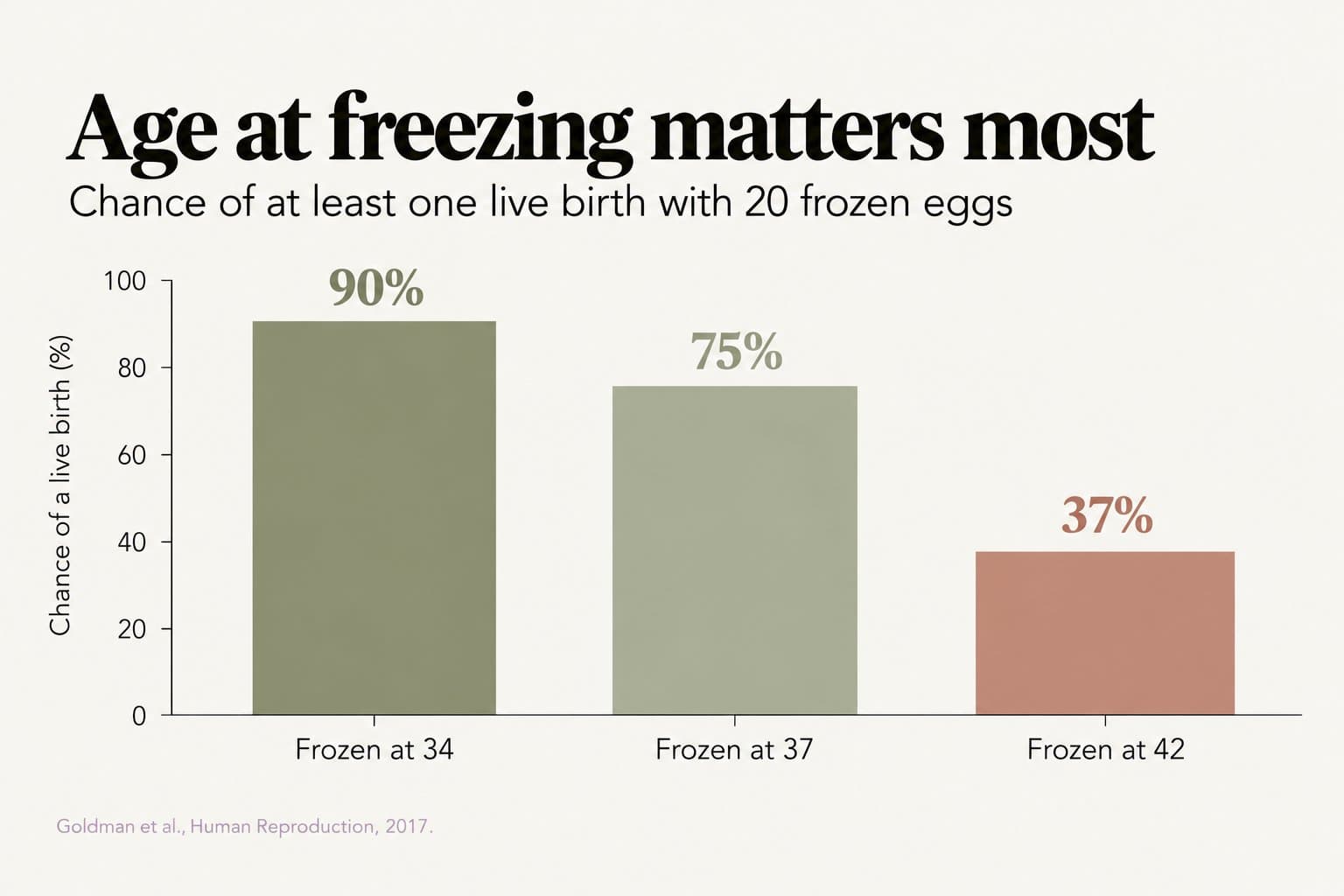
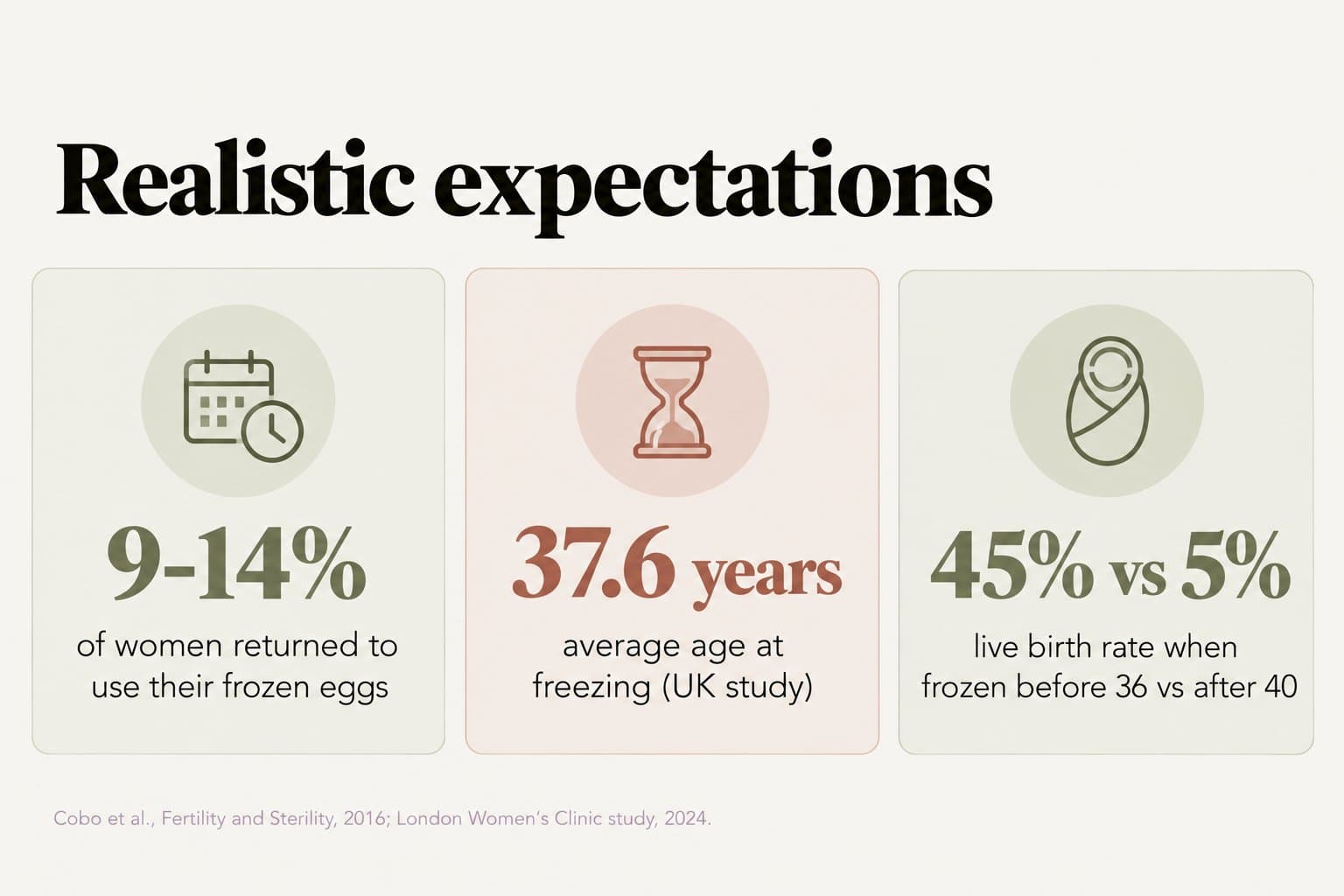
Egg freezing (oocyte cryopreservation) lets a woman store eggs at a younger age to use later, either before medical treatment that could damage the ovaries or to preserve the option of pregnancy while delaying childbearing. Modern fast-freezing (vitrification) has made it far more effective, but it isn't a guarantee. Success depends mainly on two things: a woman's age when her eggs are frozen and how many eggs are stored. A widely used model from Harvard researchers estimates that a 34-year-old who freezes 20 eggs has about a 90% chance of at least one live birth, compared with 75% at 37 and 37% at 42. In a UK study of 15 years of egg freezing, the live birth rate was 45% for women who froze eggs before 36 but only 5% for those over 40. Many women never use their eggs: only 9-14% returned in large Spanish and UK studies. Because women freeze eggs on average in their late 30s, results are often lower than hoped. This article explains what egg freezing involves, what the evidence shows and who benefits most.
Key numbers
| Finding | Detail |
|---|---|
| Chance of at least one live birth with 20 frozen eggs (Harvard model) | About 90% at 34; 75% at 37; 37% at 42 |
| Eggs needed for a 75% chance of a live birth (same model) | About 20 at 37; about 61 at 42 |
| Live birth rate per woman who used her eggs (Spain, 1,468 women) | 50% if frozen at 35 or younger; 22.9% if 36 or older |
| Live birth rate (UK, 15 years, London Women's Clinic) | 45% if frozen before 36; 5% if over 40 |
| Women who returned to use their eggs | 9.3% (Spain); 14% (UK) |
What egg freezing involves
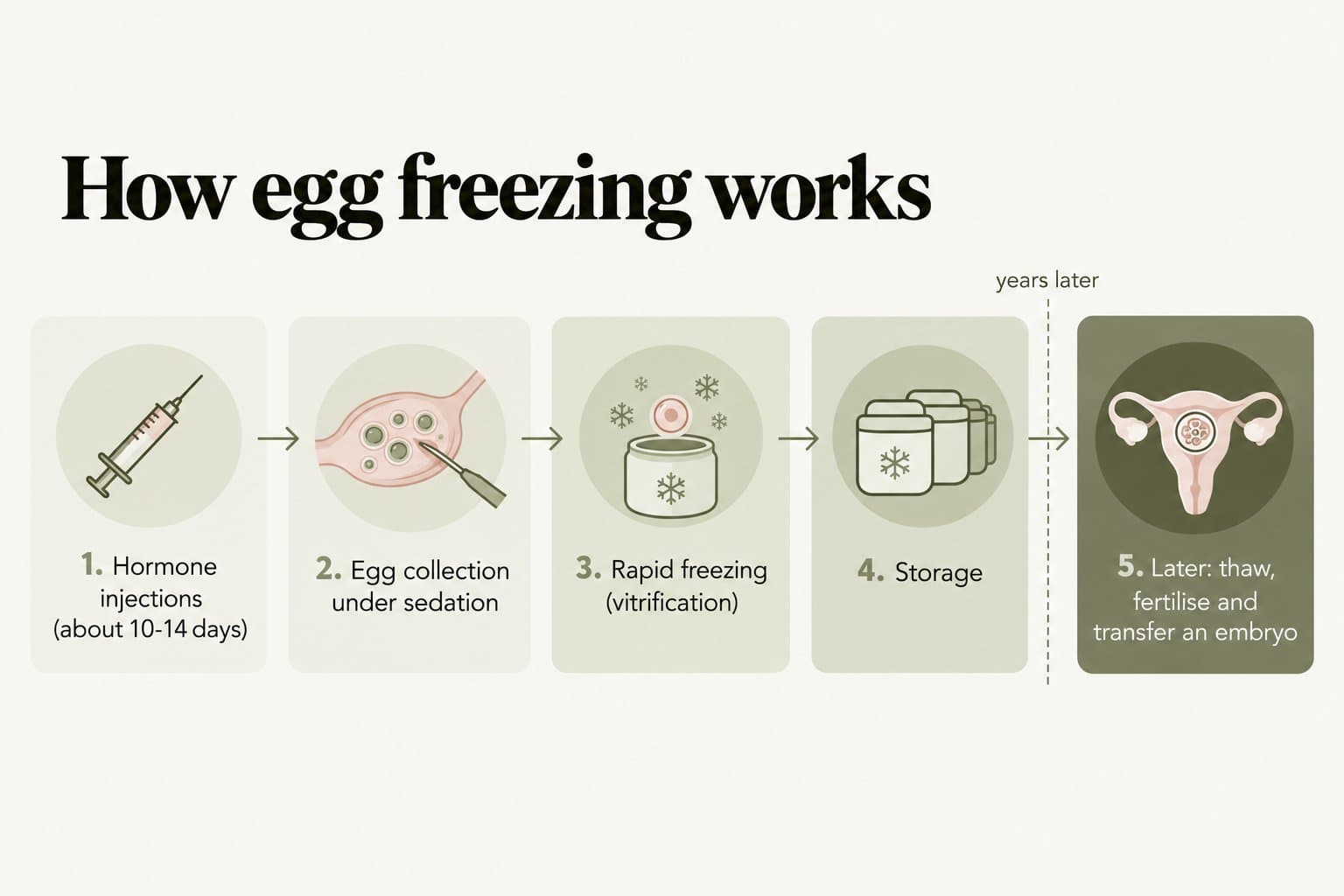
- 1. Ovarian stimulation: daily hormone injections for about 10-14 days encourage several eggs to mature at once, with monitoring scans and blood tests.
- 2. Egg collection: a short procedure under sedation, using a needle guided by ultrasound through the vaginal wall.
- 3. Vitrification: mature eggs are frozen rapidly, which prevents damaging ice crystals, and stored in liquid nitrogen.
- 4. Later use: when a woman wants to try for pregnancy, the eggs are thawed, fertilised with sperm by ICSI (injecting a single sperm into each egg), and the resulting embryos are grown in the laboratory and transferred to the womb, as in IVF.
Some women need more than one cycle of stimulation to store enough eggs. An AMH test helps predict how many eggs a cycle is likely to produce (see AMH and Ovarian Reserve Testing).
Evidence strength
Strong: age at freezing is the most important factor. Frozen eggs keep the quality they had when they were frozen, so a woman's age at freezing, not at use, determines her chances. The main reason is that the share of eggs with the correct number of chromosomes falls with age. The Harvard model used to counsel patients assumes that about 57% of embryos from women aged 35 or under are chromosomally normal, falling to about 13% at 44.
In a Spanish study of 1,468 women who froze eggs for non-medical reasons, 137 returned to use them. The live birth rate per woman was 50% for those who froze at 35 or younger, compared with 22.9% for those who froze at 36 or older. A 15-year study from the London Women's Clinic, the largest in the UK, found a live birth rate of 45% for women who froze before 36 and 5% for those over 40.
Strong: more eggs give a better chance. In the Spanish study, among women aged 35 or under, the chance of a live birth rose from 15.4% with 5 eggs to 40.8% with 8 and 85.2% with 15. For women aged 36 or over, the chance reached only 19.9% with 8 eggs and levelled off at 35.6% with 11. The authors concluded that "at least 8-10" mature eggs are needed for reasonable success.
The Harvard model put numbers on this for counselling. With 20 frozen eggs, the chance of at least one live birth was about 90% at 34, 75% at 37 and 37% at 42. To reach a 75% chance, a 37-year-old would need about 20 eggs, and a 42-year-old about 61 eggs, which often means several rounds of stimulation. With 10 eggs, a 34-year-old had about a 69% chance.
Moderate: results are similar to IVF with fresh eggs of the same age. The UK study's authors reported results "comparable with those nationally recorded in routine IVF", with a live birth rate of 26% per embryo transfer. Success depended on the same factors as IVF: the woman's age and embryo quality. Most eggs survive thawing: in the Spanish study, about 85% did.
Limited: most women never use their frozen eggs. Many women who freeze eggs later conceive naturally, decide not to have children or never return. Only 9.3% of women in the Spanish study and 14% in the UK study had come back to use their eggs. In the UK study, women froze eggs at an average age of 37.6 and returned at about 40. Because women often freeze eggs later than is ideal, many store fewer eggs of lower quality.
Important limitations.
- Egg freezing is an option, not a guarantee. Even with good numbers of eggs, some women won't have a baby.
- Each cycle involves hormone injections and a procedure, with small risks including ovarian hyperstimulation syndrome, bleeding and infection.
- It's costly, and storage fees and later IVF add to the total.
- Pregnancy at an older age carries higher risks, such as high blood pressure and gestational diabetes, even with eggs frozen when younger (see Pregnancy Complications and Long-Term Health).
- Most evidence comes from clinic studies of women who returned, so results may not apply to everyone.
Recommendations by situation
| Situation | What the evidence supports |
|---|---|
| Under 35, likely to delay childbearing | Offers the best chance of success if you choose to freeze; aim for at least 15-20 mature eggs |
| 35-37 | Still worthwhile for many women; expect to need more eggs and possibly more than one cycle |
| 38-40 | Lower success; discuss realistic chances and whether embryo freezing with a partner is an option |
| Over 40 | Low chance of a live birth with frozen own eggs; discuss alternatives with a specialist |
| Facing cancer treatment or surgery that may damage the ovaries | Seek fertility preservation advice before treatment starts |
| Low AMH | Expect fewer eggs per cycle; discuss the number of cycles needed |
| Ready to try for pregnancy now | Trying naturally, or IVF if needed, is usually better than freezing |
Practical notes
Egg freezing can preserve the chance of a future pregnancy, but its success depends heavily on age at freezing and the number of eggs stored. It works best before 35, and the chances fall steeply after 38. Most women who freeze eggs never use them, and those who do are often in their 40s. If you're considering egg freezing, get advice early, have your ovarian reserve assessed, and ask the clinic for success rates for women of your age and egg numbers. Understanding how fertility changes with age is the best starting point (see Reproductive Ageing Explained).
- Goldman RH, et al. Predicting the likelihood of live birth for elective oocyte cryopreservation: a counseling tool for physicians and patients. Human Reproduction, 2017;32(4):853-859.
- Cobo A, et al. Oocyte vitrification as an efficient option for elective fertility preservation. Fertility and Sterility, 2016;105(3):755-764.
- London Women's Clinic study reported in EurekAlert!: Egg freezing: Britain's largest ever study reports live birth outcomes comparable to those of routine IVF. 2024.
Free longevity assessment
Do you know your realistic chances
if you freeze your eggs?
Take the free Aevum Protocol assessment to see how your reproductive & sexual health and 6 other longevity domains are performing — and get a personalised 90-day plan.
Take the free assessmentKeep reading
Related articles
Reproductive & Sexual Health
AMH and Ovarian Reserve Testing: What an "Egg Count" Test Can and Can't Tell You
Reproductive & Sexual Health
Reproductive Ageing Explained: How Fertility Changes with Age in Women and Men
Reproductive & Sexual Health