Reproductive & Sexual Health
Reproductive Ageing Explained:
How Fertility Changes with Age in Women and Men
The reproductive system ages faster than almost any other part of the body. A woman is born with all the eggs she will ever have, and that supply falls steadily: by 30, most women have about 12% of their peak egg supply left, and by 40, about 3%. Fertility begins to decline gradually from around 32 and more steeply after 37, and the risk of miscarriage rises from about 10% in the late 20s to over 50% at 45 and older. Men keep producing sperm throughout life, but male reproductive ageing is real too: semen quality declines with age, and each extra year of a father's age adds about two new genetic mutations passed on to a child. Reproductive ageing also matters beyond fertility, because the timing of menopause and changes in male hormones are linked to long-term heart, bone and metabolic health. This article explains how and why reproductive ageing happens in both sexes, and what it means for health and family planning.
Key numbers
| Finding | Detail |
|---|---|
| Ovarian reserve (eggs remaining) | About 12% of the peak supply left by 30, and about 3% by 40 |
| Female fertility (US professional guidance) | Declines gradually from about 32 and more rapidly after 37 |
| Miscarriage by mother's age (421,201 pregnancies, Norway) | Lowest at 25-29 (about 10%); 53% at 45 and older |
| Father's age and new mutations (78 families, Iceland) | About 2 extra new mutations in the child per year of the father's age, doubling every 16.5 years |
| Semen quality and male age (90 studies, about 94,000 men) | Consistent declines in semen volume and sperm performance, with more abnormal and DNA-damaged sperm |
How female reproductive ageing works
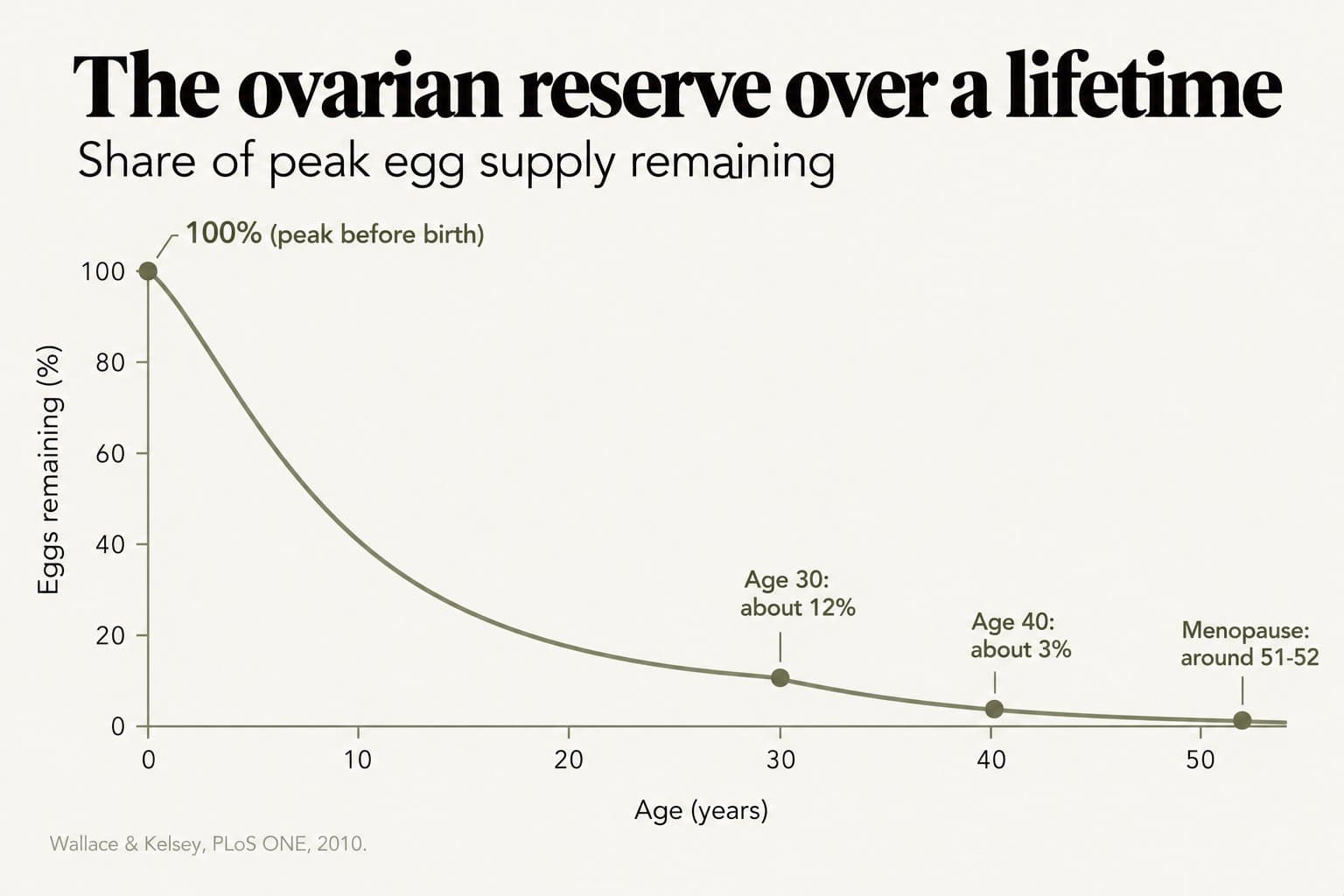
A baby girl's ovaries contain hundreds of thousands of immature eggs, each inside a small sac called a follicle. This "ovarian reserve" peaks before birth and then declines continuously, through natural loss rather than ovulation: only about 400-500 eggs are ever released over a lifetime.
A model combining eight studies estimated that the reserve peaks at about 300,000 follicles per ovary around 20 weeks of pregnancy. For most women, only about 12% of this peak remains by age 30 and about 3% by 40. When the supply falls to around a thousand, periods stop: menopause, which happens on average around 51-52.
Egg quality declines too. With age, more eggs have the wrong number of chromosomes, which makes conception less likely and raises the risk of miscarriage and chromosomal conditions such as Down syndrome. This is why age matters more than egg numbers alone, and why a woman's chance of pregnancy per cycle falls with age even when her periods remain regular.
What this means for fertility. American professional guidance states that female fertility "decreases gradually but significantly beginning approximately at age 32 years and decreases more rapidly after age 37 years." It recommends that women over 35 seek a fertility assessment after 6 months of trying without success, rather than the usual 12, and that women over 40 be assessed sooner (see How Fertility Works).
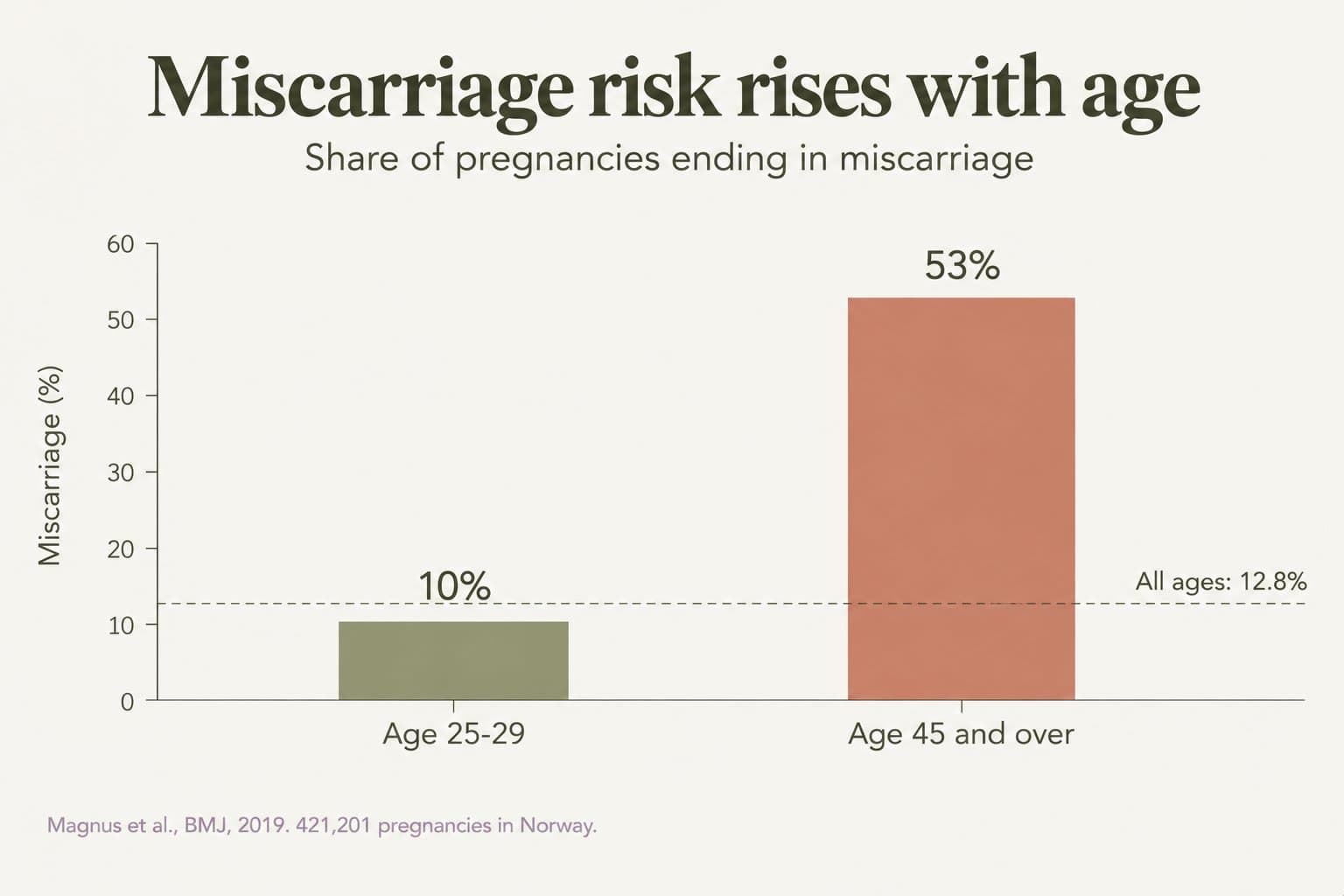
A Norwegian study of 421,201 pregnancies found the risk of miscarriage was lowest, about 10%, in women aged 25-29, and rose to 53% in women aged 45 and over. Overall, 12.8% of pregnancies ended in miscarriage.
How male reproductive ageing works
Men produce new sperm throughout life, so there's no equivalent of menopause. But male reproduction ages more gradually:
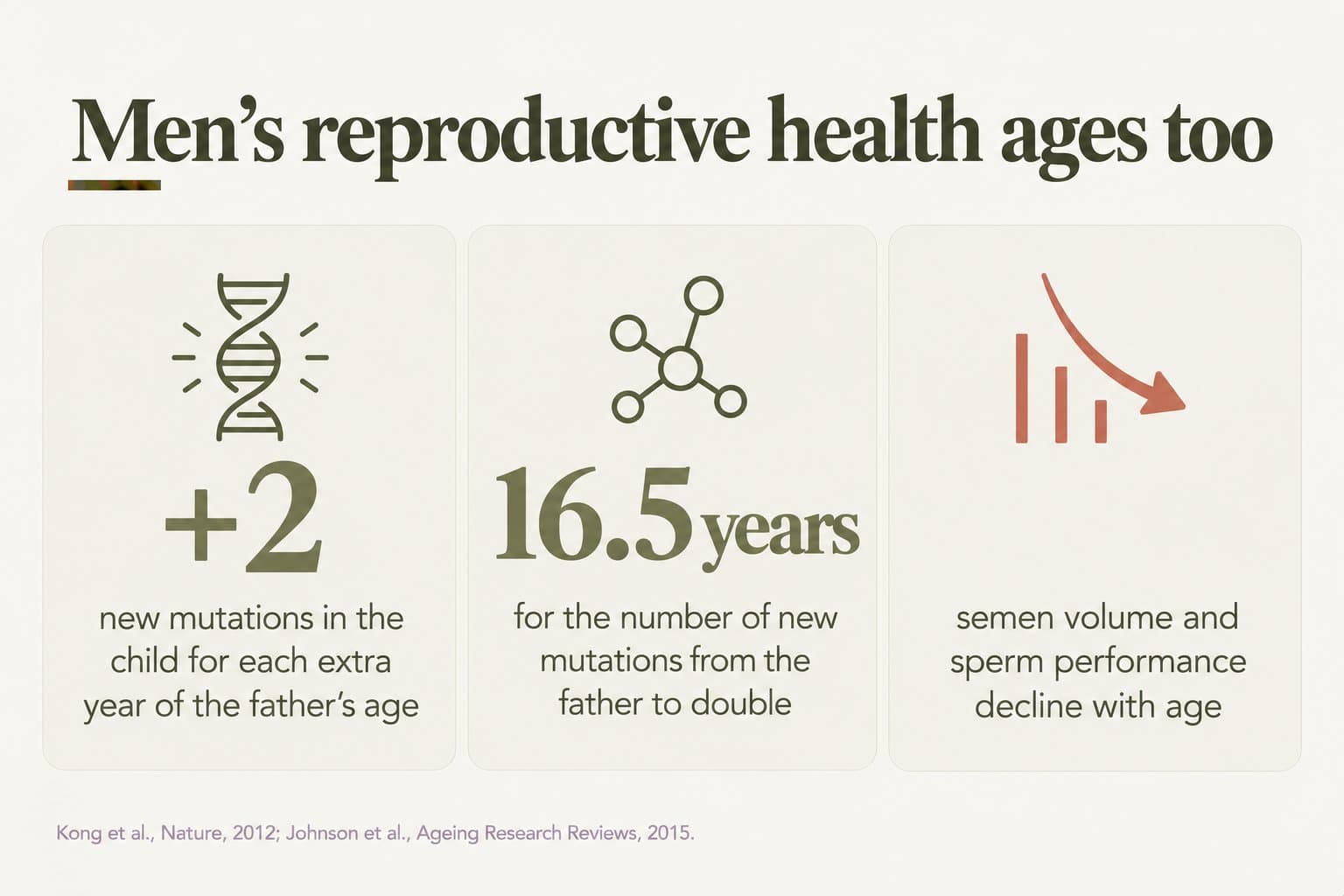
- Semen quality declines. A review of 90 studies with about 94,000 men from more than 30 countries found consistent age-related declines in semen volume and sperm performance, and increases in abnormal and DNA-damaged sperm.
- New genetic mutations accumulate. Sperm-producing cells divide continuously, and each division carries a small chance of a copying error. In a study that sequenced the genomes of 78 Icelandic families, each extra year of the father's age added about two new mutations in the child, with the number of mutations from the father doubling every 16.5 years. Most of these mutations are harmless, but older paternal age has been linked to a slightly higher risk of some conditions in children.
- Testosterone falls gradually, by roughly 1-2% a year from middle age, although health and weight matter more than age alone (see Testosterone Decline in Men).
Why reproductive ageing matters for longevity
Reproductive ageing is more than a fertility issue. It's a window into overall health:
- Early menopause raises long-term risk. Women whose periods stop before 40 have about a 55% higher risk of cardiovascular disease than those reaching menopause at 50-51, and are more prone to osteoporosis (see Menopause and Long-Term Health and Women's Heart Disease).
- Menstrual changes are a signal. Changes in cycle length and flow in the 40s often mark the start of perimenopause (see Perimenopause: Recognising the Signs and Symptoms and The Menstrual Cycle as a Vital Sign).
- Men's reproductive health tracks general health. Poor semen quality and low testosterone are associated with obesity, diabetes and poorer overall health, and erectile problems can be an early sign of heart disease (see Male Fertility and Sperm Health and Erectile Dysfunction and Heart Health).
- Lifestyle affects reproductive ageing. Smoking is linked to earlier menopause and poorer sperm quality, and excess weight affects ovulation, sperm and hormones in both sexes.
Practical notes
- If you're planning a family, be aware that female fertility declines from the early 30s and more steeply after 37, and that men's age matters too.
- Women over 35 who have been trying for 6 months without success, and women over 40, should seek assessment sooner rather than later.
- Know your menopause history: periods stopping before 40 (premature) or before 45 (early) are worth discussing with your doctor because of long-term heart and bone risks.
- Protect reproductive health by not smoking, keeping a healthy weight, limiting alcohol and staying active.
- Ovarian reserve tests and egg freezing are covered in AMH and Ovarian Reserve Testing and Egg Freezing.
- Wallace WHB, Kelsey TW. Human ovarian reserve from conception to the menopause. PLoS ONE, 2010;5(1):e8772.
- American College of Obstetricians and Gynecologists and American Society for Reproductive Medicine. Female age-related fertility decline. Committee Opinion No. 589. Fertility and Sterility, 2014;101(3):633-634.
- Magnus MC, et al. Role of maternal age and pregnancy history in risk of miscarriage: prospective register based study. BMJ, 2019;364:l869.
- Kong A, et al. Rate of de novo mutations and the importance of father's age to disease risk. Nature, 2012;488(7412):471-475.
- Johnson SL, et al. Consistent age-dependent declines in human semen quality: a systematic review and meta-analysis. Ageing Research Reviews, 2015;19:22-33.
- Zhu D, et al. Age at natural menopause and risk of incident cardiovascular disease: a pooled analysis of individual patient data. The Lancet Public Health, 2019;4(11):e553-e564.
Free longevity assessment
Planning a family?
Know how age affects your fertility
Take the free Aevum Protocol assessment to see how your reproductive & sexual health and 6 other longevity domains are performing — and get a personalised 90-day plan.
Take the free assessmentKeep reading