Reproductive & Sexual Health
Male Fertility and Sperm Health:
What Semen Quality Says About a Man's Health
Fertility is often treated as a women's issue, but men are involved in about half of all cases of infertility. According to American urology and reproductive medicine guidance, a male factor is solely responsible in about 20% of infertile couples and contributes in another 30-40%. A semen analysis is a simple, inexpensive test that should be done early, alongside the woman's assessment. Sperm counts appear to be falling worldwide: a 2023 analysis of 223 studies found that average sperm concentration fell by 51.6% between 1973 and 2018, with the decline speeding up after 2000. Semen quality is also a marker of general health. Men with fertility problems have higher rates of high blood pressure, high cholesterol, obesity and diabetes, and in a Danish study of 78,284 men, those with the best semen quality lived 2.7 years longer than those with the poorest. Many factors that harm sperm, including excess weight, smoking, heavy alcohol use and anabolic steroids or testosterone, can be changed. This article explains how sperm health is assessed, what affects it and what men can do.
Key numbers
| Finding | Detail |
|---|---|
| Male factor in infertile couples (AUA/ASRM guideline) | Sole cause in about 20%; contributes in another 30-40% |
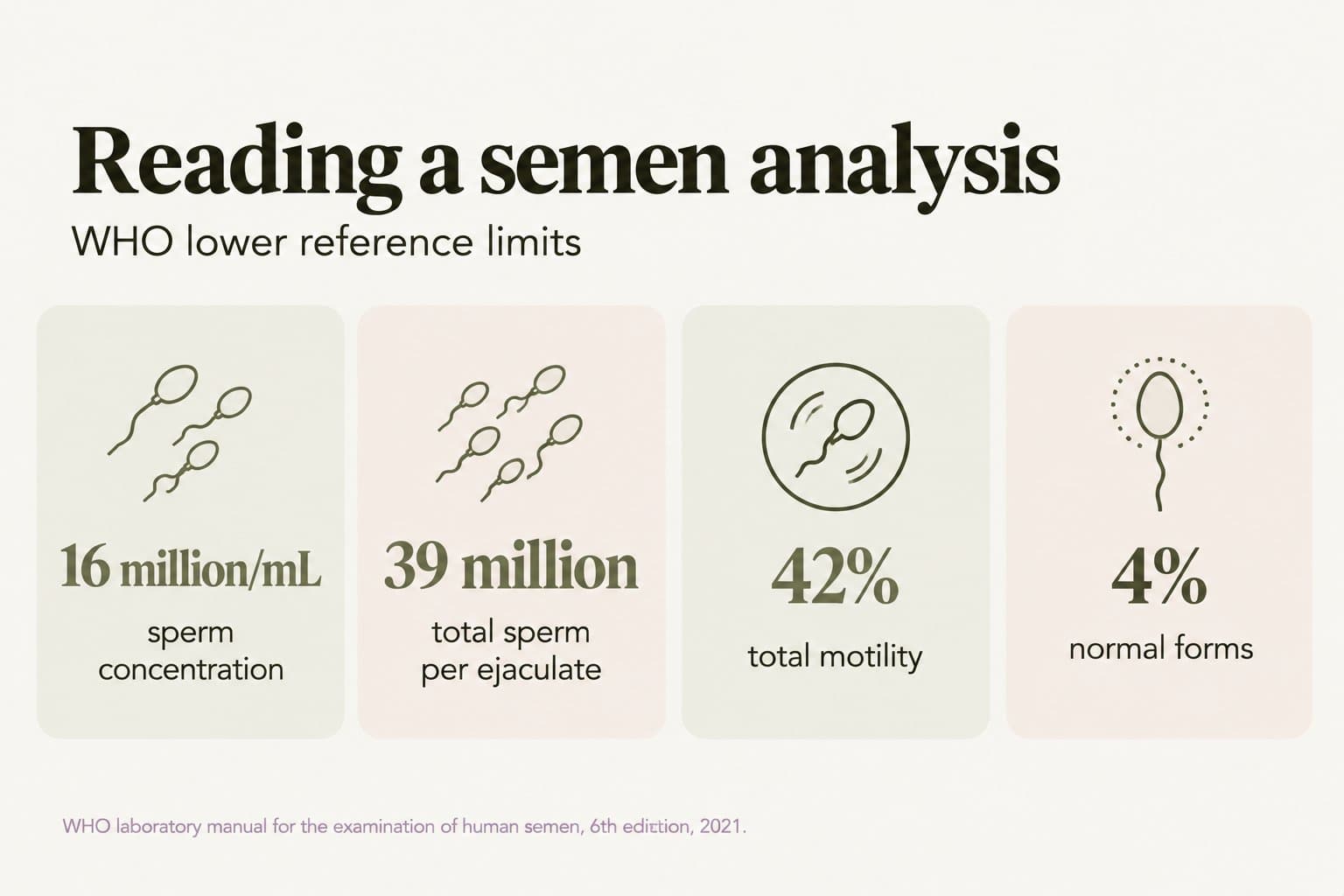
| WHO lower reference limits for semen (2021) | Concentration 16 million/mL; total count 39 million; total motility 42%; normal forms 4% |
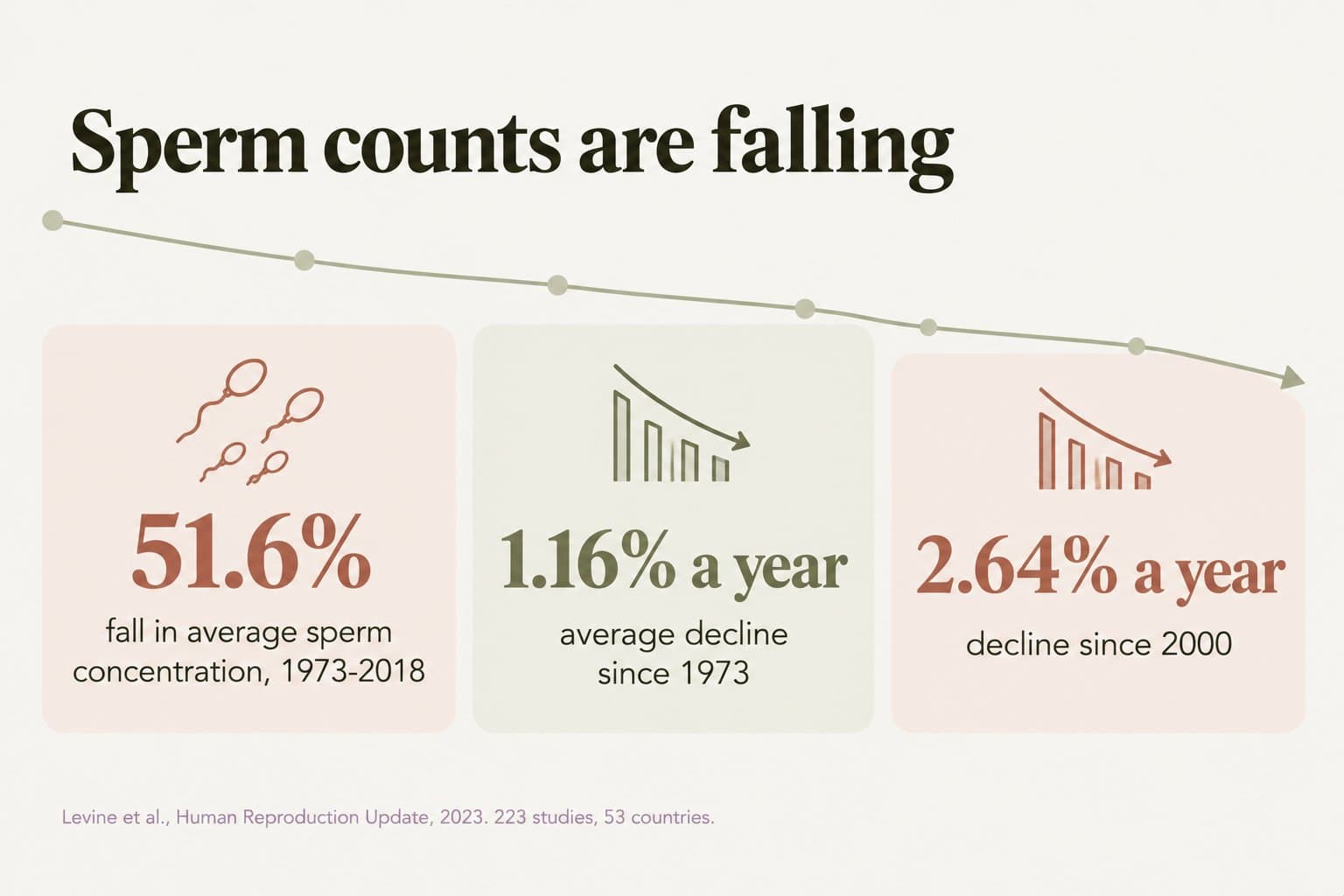
| Global sperm count trend (223 studies, 1973-2018) | Fell 51.6%; decline of 1.16% a year, rising to 2.64% a year after 2000 |
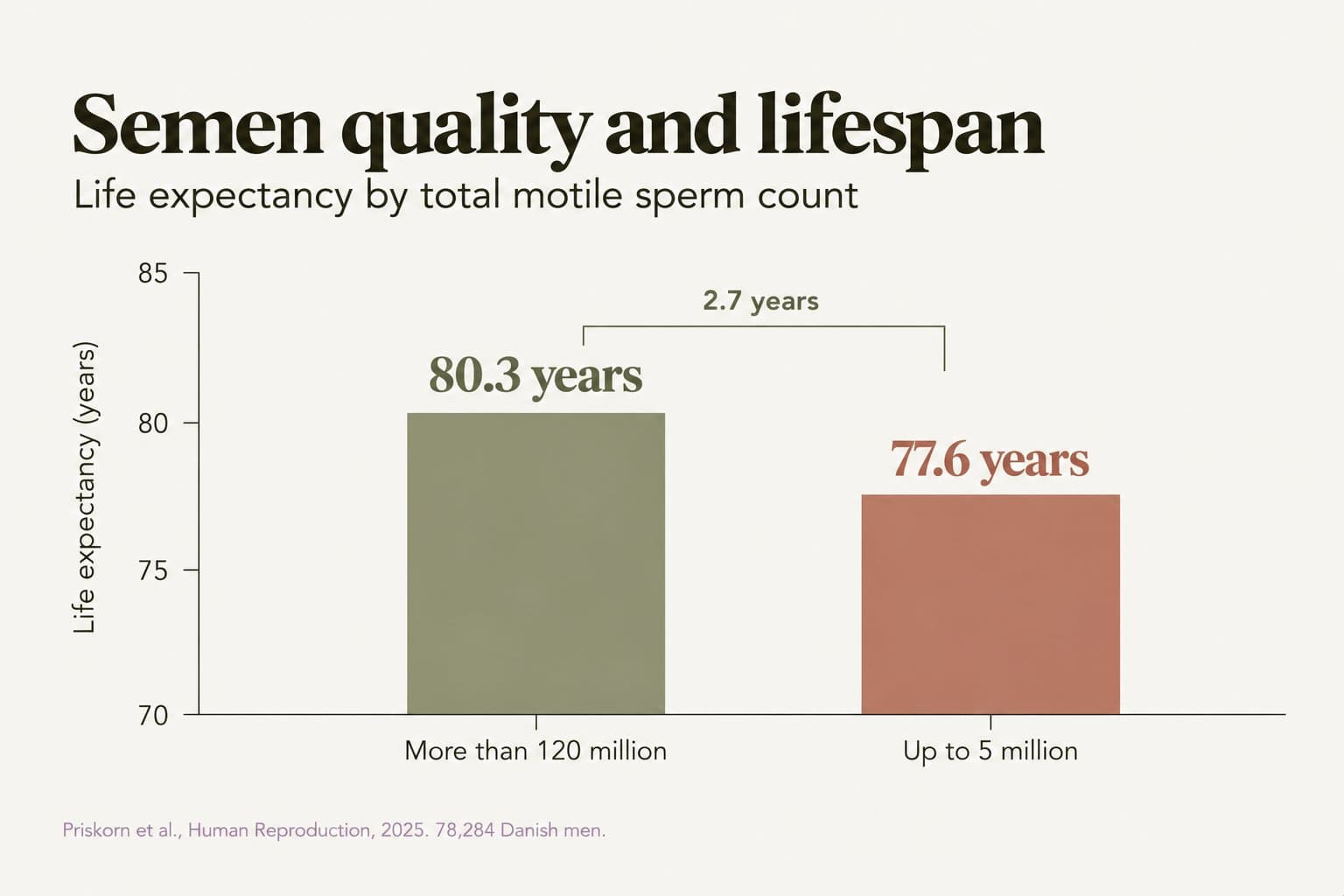
| Semen quality and lifespan (78,284 Danish men) | 80.3 years with the best vs 77.6 years with the poorest total motile count, a 2.7-year difference |
| Obesity and low sperm count (21 studies, 13,077 men) | 28% higher odds in obese men; about twice the odds with morbid obesity |
How male fertility works
Sperm are made continuously in the testes, a process that takes about two to three months from start to finish. It depends on hormones from the brain (FSH and LH), which stimulate the testes to produce sperm and testosterone, and on a slightly cooler temperature than the rest of the body. Sperm mature as they pass through the epididymis, then travel through the vas deferens and mix with fluid from the prostate and seminal vesicles to form semen.
According to the WHO, male infertility is "most commonly caused by problems in the ejection of semen, absence or low levels of sperm, or abnormal shape (morphology) and movement (motility) of the sperm". Causes include:
- Varicocele: enlarged veins around the testis that raise its temperature.
- Hormonal problems, including the use of anabolic steroids or testosterone.
- Blockages of the tubes that carry sperm, from infection, surgery or being born without a vas deferens.
- Testicular damage from undescended testes, mumps, injury, chemotherapy or radiotherapy.
- Genetic conditions, such as Klinefelter syndrome or small deletions on the Y chromosome.
- Ejaculation and erection problems.
- Lifestyle and environmental factors.
The semen analysis
A semen analysis measures the volume of semen, the number of sperm, how well they move and what proportion have a normal shape. The WHO's 2021 reference values are the lower limits seen in men whose partners conceived within a year:
- Volume: 1.4 mL
- Concentration: 16 million per mL
- Total sperm number: 39 million per ejaculate
- Total motility: 42%
- Progressive motility: 30%
- Normal forms: 4%
Results below these values don't mean a man can't father a child, and results above them don't guarantee fertility. Semen quality varies a lot from sample to sample, so an abnormal result is usually repeated, after two to four weeks for severe abnormalities or after three months for milder ones. The guideline recommends that both partners be assessed at the same time, rather than the man only after the woman's tests (see How Fertility Works).
Are sperm counts falling?
A 2023 systematic review analysed 288 estimates from 223 studies, covering about 57,000 men in 53 countries. Among men not selected for fertility problems, average sperm concentration fell by 1.16% a year between 1973 and 2018, a total decline of 51.6%. After 2000, the rate of decline doubled to 2.64% a year. The decline was seen for the first time in South and Central America, Asia and Africa, as well as in North America, Europe and Australia.
The causes aren't certain. Researchers suspect a combination of lifestyle factors, such as obesity, inactivity, smoking and diet, and exposure to chemicals that disrupt hormones, possibly starting before birth. Some experts debate how much of the trend reflects changes in laboratory methods, but the consistency of the findings is concerning (see Endocrine Disruptors and Fertility).
Sperm health as a window into overall health
Semen quality reflects a man's general health. The AUA/ASRM guideline notes that infertile men have higher rates of high blood pressure, high cholesterol, obesity and diabetes, and that 1-6% of men evaluated for infertility have a significant undiagnosed medical condition, including cancers.
In the largest study of its kind, Danish researchers followed 78,284 men who had a semen analysis between 1965 and 2015 for a median of 23 years. Mortality rose steadily as semen quality fell. Men with a total motile sperm count of more than 120 million had a life expectancy of 80.3 years, compared with 77.6 years for those with up to 5 million, a difference of 2.7 years. The link remained after accounting for education and existing illnesses. This doesn't mean poor sperm quality shortens life directly; rather, sperm production is sensitive to overall health, so it may be an early signal worth acting on. Erectile problems are another early warning sign (see Erectile Dysfunction and Heart Health).
What affects sperm health
| Factor | Effect | Modifiable? | Evidence strength |
|---|---|---|---|
| Anabolic steroids or testosterone therapy | Suppress sperm production, sometimes to zero | Yes | Strong |
| Obesity | Higher odds of low sperm count; lower testosterone | Yes | Strong |
| Smoking | Poorer semen quality; WHO lists it as a fertility risk | Yes | Moderate |
| Heavy alcohol use | Linked to poorer fertility | Yes | Moderate |
| Heat (hot baths, saunas, laptops on the lap, tight clothing) | Raises testicular temperature | Yes | Moderate |
| Varicocele | Raises testicular temperature; treatable | Yes, with surgery when indicated | Moderate |
| Older age | Gradual decline in semen quality; more new mutations | No | Strong |
| Environmental chemicals | May harm sperm production | Partly | Emerging |
| Undescended testes, past chemotherapy, genetic conditions | Reduce sperm production | No | Strong |
What you can actually change
1. Never use testosterone or anabolic steroids if you want children. The AUA/ASRM guideline states that clinicians "should not prescribe exogenous testosterone therapy" to men interested in current or future fertility. Testosterone switches off the brain's signals to the testes, and sperm production can stop. Recovery after stopping can take many months (see Testosterone Decline in Men).
2. Reach a healthy weight. In a meta-analysis of 21 studies with 13,077 men, overweight men had 11% higher odds, obese men 28% higher odds and morbidly obese men about twice the odds of a low or zero sperm count compared with men of normal weight.
3. Stop smoking and limit alcohol. The WHO lists smoking, excessive alcohol and obesity as lifestyle factors that affect fertility.
4. Keep the testes cool. Avoid frequent hot baths and saunas, laptops on the lap for long periods and very tight underwear when trying to conceive.
5. Give changes time. Because sperm take about three months to develop, improvements in lifestyle take two to three months to show in a semen analysis.
6. Get checked early. Have a semen analysis at the same time as your partner's assessment, and see a doctor about a varicocele, testicular lump or pain, or erectile or ejaculation problems.
Recommendations
- Have a semen analysis early if you and your partner haven't conceived after 12 months, or 6 months if she's 35 or over.
- Tell your doctor about any testosterone, steroid or other medicine use, past testicular problems, surgery or cancer treatment.
- Treat abnormal semen results as a health check: have blood pressure, cholesterol, blood sugar and weight assessed.
- Consider sperm banking before chemotherapy, radiotherapy or other treatment that could affect fertility.
- Examine your testes and see a doctor promptly about any lump or swelling.
Practical notes
Men contribute to about half of infertility cases, and a semen analysis is a simple first test. Sperm counts appear to have fallen sharply over recent decades, and poorer semen quality is linked to poorer general health and a shorter life expectancy. The biggest avoidable harms come from testosterone or anabolic steroid use, obesity, smoking, heavy drinking and heat. Because sperm take about three months to develop, healthy changes made now can improve fertility within a few months. Male age also matters (see Reproductive Ageing Explained).
- Schlegel PN, et al. Diagnosis and treatment of infertility in men: AUA/ASRM guideline. Journal of Urology, 2021;205(1):36-43 (2024 amendment).
- World Health Organization. WHO laboratory manual for the examination and processing of human semen, sixth edition. 2021.
- World Health Organization. Infertility. Fact sheet.
- Levine H, et al. Temporal trends in sperm count: a systematic review and meta-regression analysis of samples collected globally in the 20th and 21st centuries. Human Reproduction Update, 2023;29(2):157-176.
- Priskorn L, et al. Semen quality and lifespan: a study of 78,284 men followed for up to 50 years. Human Reproduction, 2025;40(4):730-738.
- Sermondade N, et al. BMI in relation to sperm count: an updated systematic review and collaborative meta-analysis. Human Reproduction Update, 2013;19(3):221-231.
Free longevity assessment
Trying for a baby?
Has your semen been checked too?
Take the free Aevum Protocol assessment to see how your reproductive & sexual health and 6 other longevity domains are performing — and get a personalised 90-day plan.
Take the free assessmentKeep reading
Related articles
Reproductive & Sexual Health
How Fertility Works: Conception, Timing and Your Chances of Pregnancy
Reproductive & Sexual Health
Endocrine Disruptors and Fertility: What the Evidence Shows and Practical Ways to Reduce Exposure
Stress & Hormones