Reproductive & Sexual Health
Fibroids and Heavy Periods:
Causes, Long-Term Effects and Treatment Options
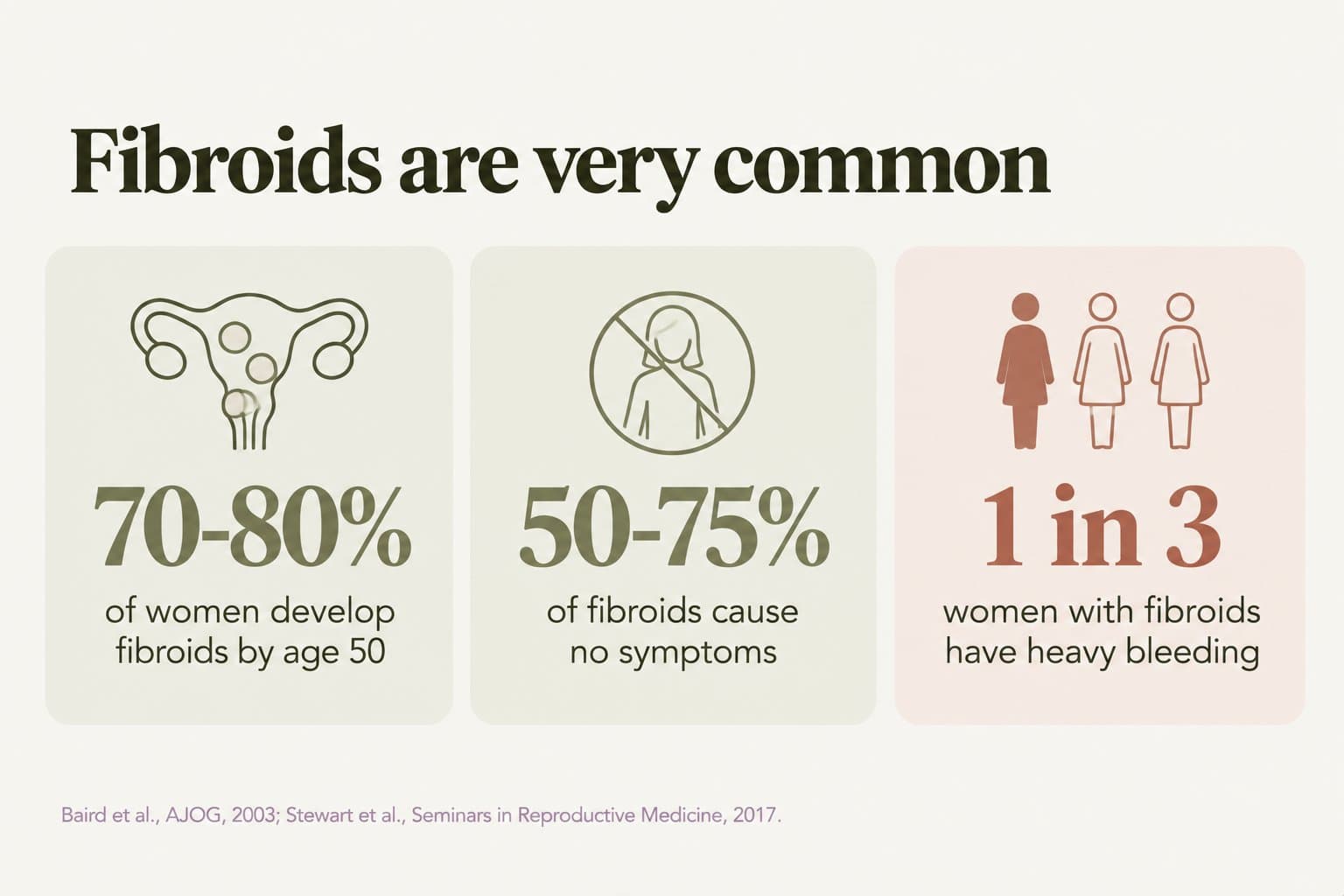
Heavy periods are one of the most common reasons women see a doctor, yet many put up with them for years, assuming they're normal. Fibroids, non-cancerous growths of the womb's muscle wall, are one of the main causes. They're extremely common: in a large US study using ultrasound, nearly 70% of white women and 80% of Black women had developed fibroids by the age of 50. Many cause no symptoms, but about a third of women with fibroids have heavy bleeding, and others have pelvic pressure, frequent urination or difficulty conceiving. Heavy periods matter for long-term health because they're a leading cause of iron deficiency and anaemia, which affect energy, concentration and pregnancy. Treatment choices matter too: fibroids are one of the leading reasons for hysterectomy, and a Mayo Clinic study found that even when the ovaries were kept, hysterectomy was linked to a 33% higher risk of coronary artery disease. Today, there are effective options that preserve the womb, from a hormonal IUD to minimally invasive procedures. This article explains the causes of heavy periods, how fibroids affect health and how to choose treatment.
Key numbers
| Finding | Detail |
|---|---|
| Fibroids by age 50 (US ultrasound study) | Nearly 70% of white women and 80% of Black women |
| Fibroids that cause no symptoms | About 50-75% |
| Heavy bleeding in women with fibroids | About 1 in 3 |
| Hysterectomies due to fibroids (US) | About 30-50% |
| Hysterectomy with ovaries conserved (2,094 women vs matched controls) | 33% higher risk of coronary artery disease; 2.5 times the risk in women aged 35 or younger |
What counts as a heavy period
The UK's National Institute for Health and Care Excellence (NICE) defines heavy menstrual bleeding as excessive blood loss that "interferes with the woman's physical, emotional, social and material quality of life". In other words, what matters is the impact on your life, not an exact volume. Signs include:
- Soaking through a pad or tampon every 1-2 hours.
- Needing double protection or getting up at night to change.
- Passing large clots.
- Bleeding for more than 7-8 days.
- Avoiding work, school or social activities because of your period.
Normal cycle limits are covered in The Menstrual Cycle as a Vital Sign.
Common causes of heavy periods
- Fibroids: non-cancerous growths of the womb muscle.
- Adenomyosis: womb-lining tissue growing into the muscle wall, often causing heavy, painful periods.
- Polyps: small growths of the womb lining.
- Hormonal causes: irregular ovulation, as in polycystic ovary syndrome, perimenopause or thyroid disease.
- Bleeding disorders, such as von Willebrand disease, particularly if heavy periods started from the first period.
- Some medicines, including blood thinners.
- Endometrial hyperplasia or cancer, which is uncommon but more likely after 45 or with risk factors such as obesity or very irregular periods.
Endometriosis can also cause heavy, painful periods (see Endometriosis: Recognising Painful Periods That Aren't Normal).
What fibroids are
Fibroids (also called myomas or leiomyomas) are benign growths of the smooth muscle of the womb. They range from a few millimetres to over 10 cm, and a woman may have one or many. They're described by where they grow:
- Submucosal: bulging into the womb cavity; most likely to cause heavy bleeding and fertility problems, even when small.
- Intramural: within the muscle wall.
- Subserosal: on the outer surface; more likely to cause pressure than bleeding.
Fibroids depend on oestrogen and progesterone, so they often grow during the reproductive years and shrink after menopause. They're almost never cancerous: a rare cancer called uterine sarcoma can look similar, but it's uncommon, especially in younger women.
Symptoms of fibroids.
- Heavy or prolonged periods.
- Pelvic pressure, bloating or a visibly enlarged abdomen.
- Frequent urination or constipation from pressure on the bladder or bowel.
- Pain during sex or back pain.
- Difficulty conceiving or pregnancy complications: fibroids are associated with about 10% of infertility cases and are the only identified cause in 1-3%.
Why fibroids and heavy periods matter for long-term health
Iron deficiency and anaemia. Heavy periods are one of the most common causes of iron deficiency and iron deficiency anaemia in women. A 2023 expert review in the American Journal of Obstetrics & Gynecology described these conditions as highly prevalent and "frequently normalized", with effects on energy, thinking, work and school performance, and noted that iron deficiency even in early pregnancy may affect the baby's brain development. Iron deficiency can cause fatigue and poor concentration before anaemia shows on a blood count.
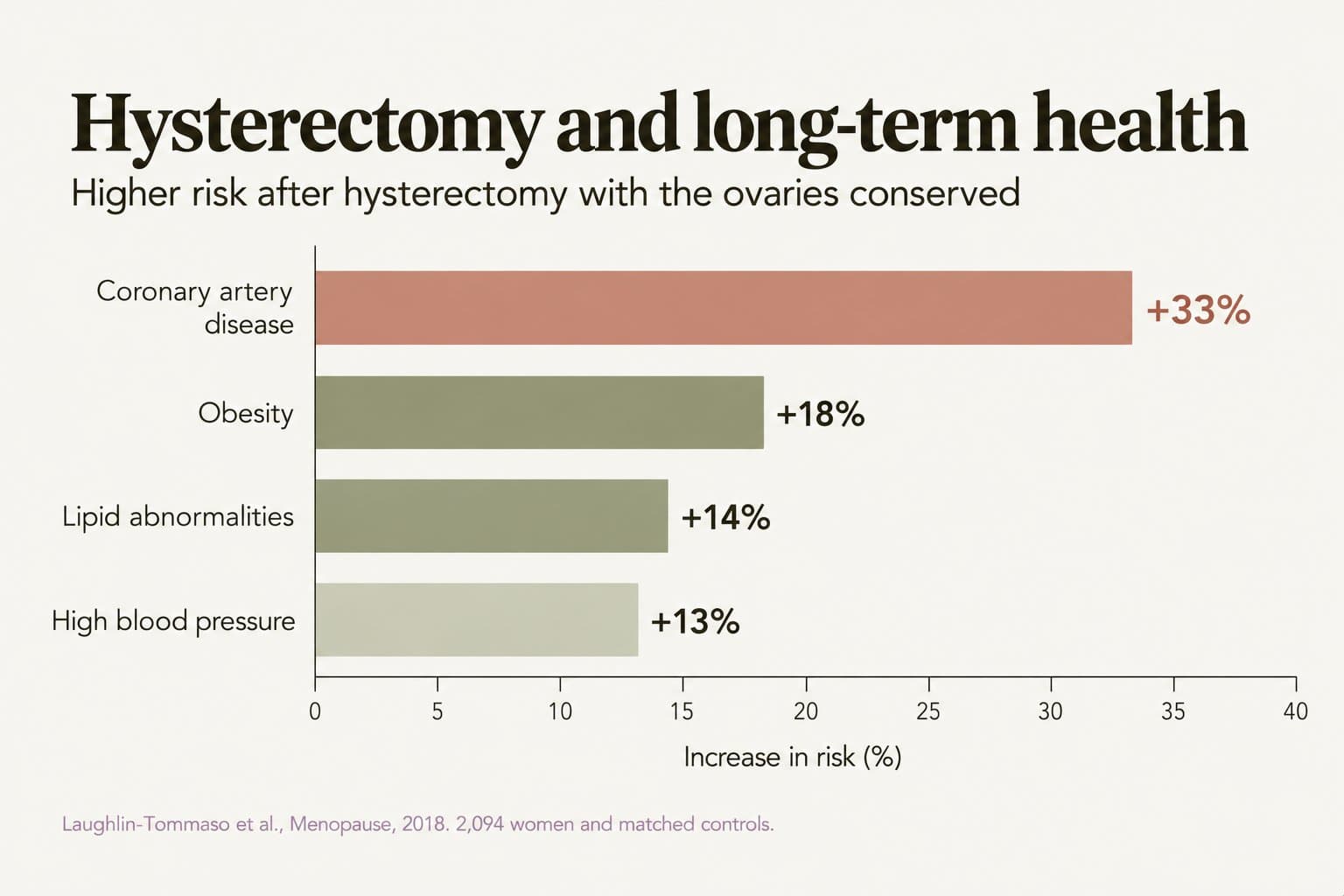
Treatment choices and heart health. Hysterectomy cures heavy bleeding, but it isn't free of long-term effects. A Mayo Clinic study compared 2,094 women who had a hysterectomy with both ovaries conserved with matched women who didn't. After hysterectomy, women had a:
- 33% higher risk of coronary artery disease
- 18% higher risk of obesity
- 14% higher risk of lipid abnormalities
- 13% higher risk of high blood pressure
In women who had a hysterectomy at 35 or younger, the risk of coronary artery disease was 2.5 times higher and of heart failure 4.6 times higher. Fibroids, endometriosis and prolapse were leading reasons for hysterectomy, and the researchers encouraged considering non-surgical alternatives. As an observational study, it can't prove cause and effect, but it supports choosing womb-preserving options where possible, especially for younger women, and keeping an eye on heart health after hysterectomy (see Women's Heart Disease).
What's linked to fibroids
| Factor | Effect | Modifiable? | Evidence strength |
|---|---|---|---|
| Age (late 30s to menopause) | Risk rises through the reproductive years | No | Strong |
| Black ancestry | About 3 times more common than in white women | No | Strong |
| Family history | Raises risk | No | Moderate |
| Never having been pregnant | Higher risk; each pregnancy lowers risk | No | Moderate |
| Excess weight | Higher risk with higher BMI | Yes | Moderate |
| High blood pressure | Linked to higher risk | Yes | Moderate |
| Low vitamin D | Linked to higher risk | Yes | Emerging |
| Diet high in red meat, low in vegetables and fruit | Linked to higher risk | Yes | Emerging |
What you can actually change
1. Don't accept heavy periods as normal. If your periods affect your daily life, see a doctor. NICE recommends a full blood count for women with heavy periods, and a pelvic ultrasound if the womb feels enlarged, there's a pelvic mass, or other concerning features.
2. Check and treat iron deficiency. Ask for a ferritin test as well as a blood count. Iron tablets, taken as advised, correct iron deficiency; treating the heavy bleeding stops it from coming back.
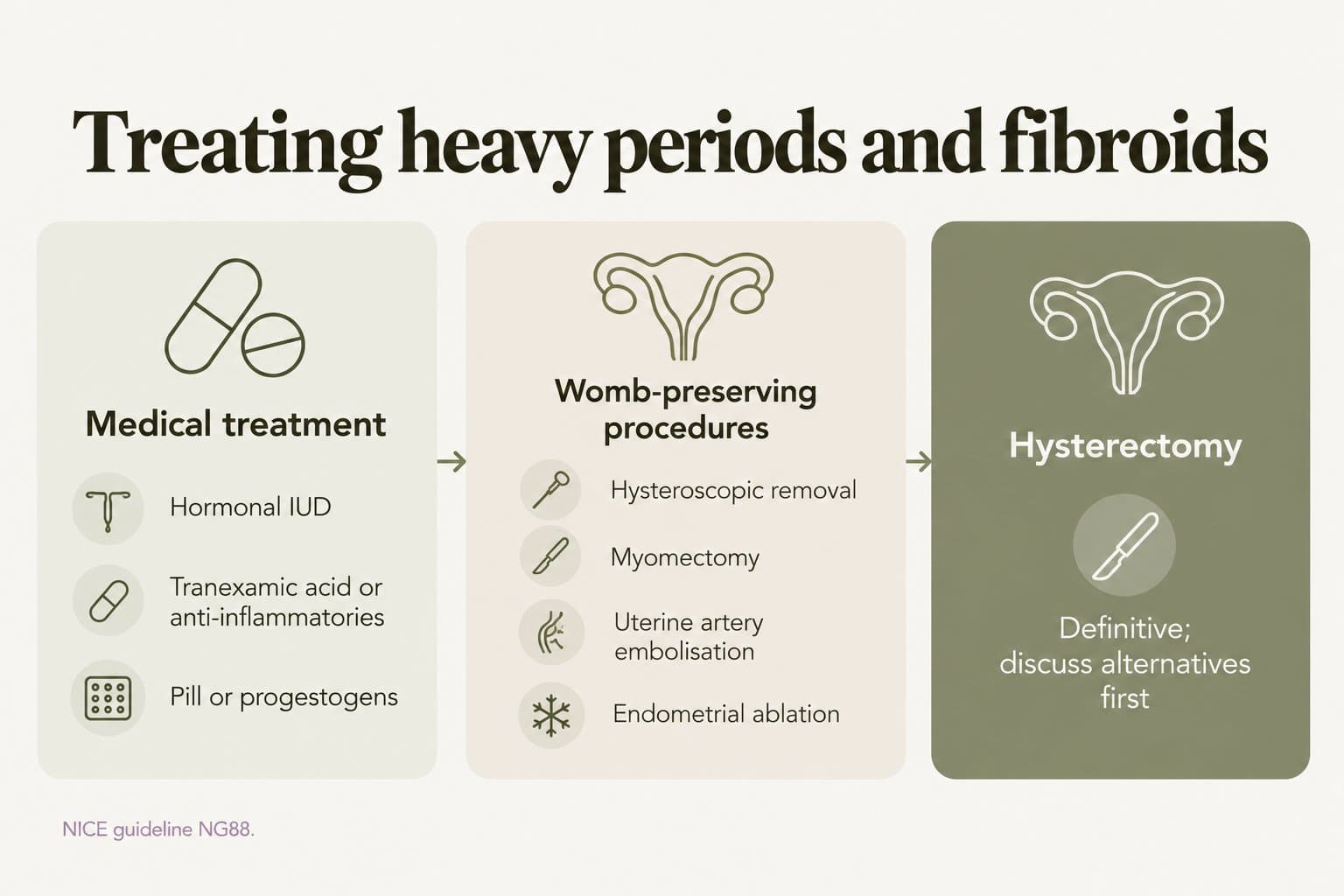
3. Start with effective medical treatment. For women not trying to conceive, the hormonal IUD (levonorgestrel intrauterine system) is the recommended first choice when there are no fibroids or only small ones, with a trial of at least six months. Alternatives include tranexamic acid or anti-inflammatory painkillers taken only during periods, which suit women trying to conceive, and the combined pill or progestogens (see Hormonal Contraception and Long-Term Health). Newer medicines that lower hormone levels can shrink fibroids and control bleeding.
4. Know the womb-preserving procedures. For larger fibroids, options include removing fibroids through the vagina (hysteroscopic myomectomy) for those inside the cavity, surgical removal (myomectomy), and uterine artery embolisation, which blocks the fibroids' blood supply. Endometrial ablation, which destroys the womb lining, can treat heavy bleeding in women who have completed their families.
5. Consider hysterectomy carefully. Hysterectomy is a definitive treatment and the right choice for some women. Discuss the alternatives, timing and whether to keep the ovaries, especially if you're young.
6. Look after your metabolic and heart health. Keeping a healthy weight and normal blood pressure is good for your heart and may lower fibroid risk.
Recommendations
- See a doctor if heavy periods affect your daily life, or if you have pelvic pressure, frequent urination or difficulty conceiving.
- Get urgent advice for bleeding between periods, after sex or after menopause, or heavy bleeding with dizziness or breathlessness.
- Ask for a blood count and ferritin if your periods are heavy.
- Explore womb-preserving options before hysterectomy, especially if you're under 40.
- Discuss fertility plans before any fibroid treatment.
Practical notes
Heavy periods are common but not normal when they affect your life. Fibroids are a leading cause and affect most women by 50, although many never cause symptoms. The main long-term risks of heavy periods are iron deficiency and anaemia, and the choice of treatment matters, since hysterectomy is linked to higher long-term cardiovascular risk. Effective treatments, from a hormonal IUD to minimally invasive procedures, can control bleeding while preserving the womb.
- Baird DD, et al. High cumulative incidence of uterine leiomyoma in black and white women: ultrasound evidence. American Journal of Obstetrics & Gynecology, 2003;188(1):100-107.
- Stewart EA, et al. Uterine fibroids: burden and unmet medical need. Seminars in Reproductive Medicine, 2017;35(6):473-480.
- National Institute for Health and Care Excellence. Heavy menstrual bleeding: assessment and management. NICE guideline NG88, 2018 (updated 2021).
- Munro MG, et al. The relationship between heavy menstrual bleeding, iron deficiency, and iron deficiency anemia. American Journal of Obstetrics & Gynecology, 2023;229(1):1-9.
- Laughlin-Tommaso SK, et al. Cardiovascular and metabolic morbidity after hysterectomy with ovarian conservation: a cohort study. Menopause, 2018;25(5):483-492.
- Yang Q, et al. Comprehensive review of uterine fibroids: developmental origin, pathogenesis, and treatment. Endocrine Reviews, 2022;43(4):678-719.
Free longevity assessment
Are heavy periods affecting
your energy and daily life?
Take the free Aevum Protocol assessment to see how your reproductive & sexual health and 6 other longevity domains are performing — and get a personalised 90-day plan.
Take the free assessmentKeep reading
Related articles
Reproductive & Sexual Health
The Menstrual Cycle as a Vital Sign: What Your Period Says About Your Health
Reproductive & Sexual Health
Endometriosis: Recognising Painful Periods That Aren't Normal
Reproductive & Sexual Health