Nutrition & Metabolism
Popular Diets Compared:
What Really Matters for Weight, Health and Longevity
Keto, carnivore, paleo, vegan, low-carb, low-fat, high-protein, gluten-free, intermittent fasting, detox: new diets appear every year, each promising to be the answer. The evidence tells a simpler story. When healthy versions of different diets are compared directly, they tend to produce similar weight loss. In the DIETFITS trial, 609 adults lost an average of 5.3 kg on a healthy low-fat diet and 6.0 kg on a healthy low-carbohydrate diet after a year, with no significant difference, and neither genetics nor insulin levels predicted who would do better. What matters most for long-term health is the quality of the food and whether you can keep it up. The diets with the strongest evidence for preventing heart disease and early death, the Mediterranean and DASH diets, share the same core: mostly plants, whole foods, healthy fats, legumes, fish and little processed food. Plant-based diets lower heart disease risk when built on whole foods, but not when built on refined grains and sweets. The portfolio diet can lower LDL cholesterol almost as much as a low-dose statin. Very restrictive diets such as carnivore lack long-term evidence and often raise LDL. Gluten-free diets help the roughly 1 in 100 people with coeliac disease but have no proven benefit for others, and detox and alkaline diets aren't supported by evidence. This guide summarises the key points of each popular diet, what they have in common, and how to choose an approach that works for you.
Key numbers
| Finding | Detail |
|---|---|
| Healthy low-fat vs healthy low-carb (609 adults, 12 months) | 5.3 kg vs 6.0 kg weight loss: no significant difference |
| Carbohydrate intake and mortality (432,179 people) | Lowest risk at about 50-55% of calories; replacing carbs with plant foods linked to 18% lower mortality, with animal foods 18% higher |
| Vegetarians vs meat-eaters (48,188 UK adults) | 22% lower coronary heart disease; 20% higher stroke |
| Portfolio diet vs statin (46 adults, 1 month) | LDL down 28.6% vs 30.9% with lovastatin |
| Low-fat diet (48,835 postmenopausal women, 8 years) | No significant reduction in heart disease or stroke |
| Coeliac disease worldwide | About 0.7% confirmed by biopsy; 1.4% by blood tests |
What the best diets have in common
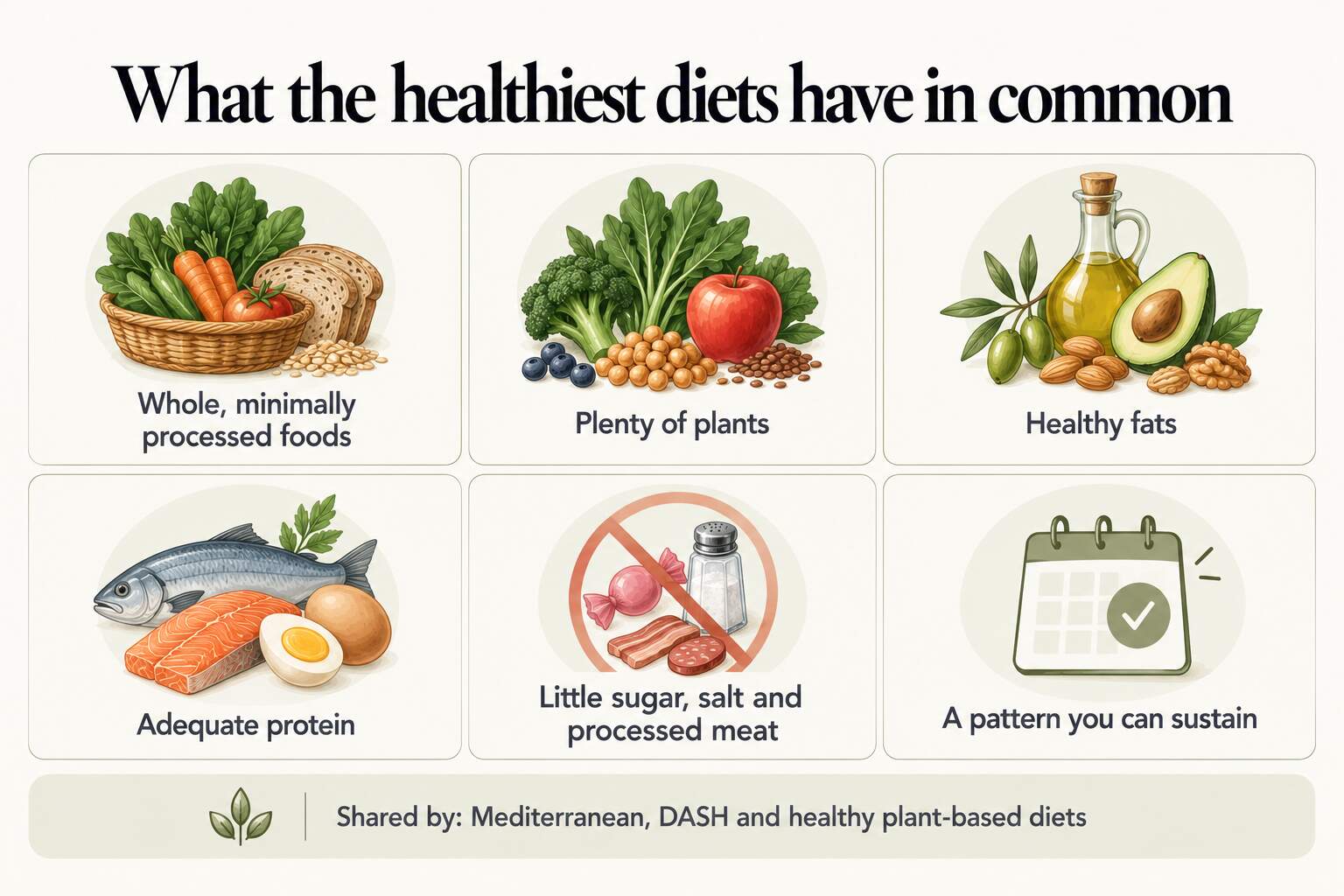
Despite their differences, the eating patterns with the strongest evidence for long-term health share a few principles (see Eating Patterns for Longevity):
- 1. Mostly whole or minimally processed foods, and few ultra-processed foods (see Ultra-Processed Foods).
- 2. Plenty of vegetables, fruit, legumes, whole grains, nuts and seeds.
- 3. Healthy fats from olive oil, nuts, seeds and fish, rather than saturated and trans fats.
- 4. Adequate protein, especially from fish, legumes, eggs, dairy and poultry.
- 5. Little added sugar, refined carbohydrate, processed meat and salt.
- 6. A pattern you can enjoy and sustain for years.
Diets that follow these principles tend to work, whatever they're called. Diets that break them, by cutting out entire healthy food groups or relying on processed products, tend to have weaker evidence or more risks.
The three diets covered in depth
Mediterranean. Built on vegetables, fruit, legumes, whole grains, nuts, olive oil and fish. It has the strongest trial evidence of any named diet: about 30% fewer heart attacks, strokes and cardiovascular deaths in the PREDIMED trial, and about 25% fewer repeat events in people with heart disease in CORDIOPREV. Best for: almost everyone, especially people at risk of heart disease. See The Mediterranean Diet.
DASH. Designed to lower blood pressure: rich in vegetables, fruit, whole grains, low-fat dairy and legumes, and low in salt, sugar and saturated fat. Combined with salt reduction, it lowered systolic blood pressure by 11.5 mmHg in people with hypertension. Best for: high blood pressure and heart disease prevention. See The DASH Diet.
Ketogenic. Very low in carbohydrates (about 20-50 g a day) and high in fat, putting the body into ketosis. It's an established treatment for drug-resistant epilepsy and can lower blood sugar quickly, but often raises LDL cholesterol, is hard to sustain and needs medical supervision with some diabetes medicines. Best for: epilepsy, and short-term use in selected people under supervision. See The Ketogenic Diet.
Low-carbohydrate diets (Atkins, LCHF)
What it is: reducing carbohydrates, usually to below about 26% of calories, or roughly 50-130 g a day, without necessarily reaching ketosis. Atkins starts very low and gradually adds carbohydrates back; "low-carb, high-fat" (LCHF) replaces carbohydrates mainly with fat.
The evidence:
- Weight: in the 2018 DIETFITS trial in JAMA, 609 adults were assigned to a healthy low-carbohydrate or healthy low-fat diet, both emphasising whole foods and vegetables. After 12 months, weight loss was similar: 6.0 kg vs 5.3 kg. Genetic patterns and insulin levels didn't predict who would do better on which diet.
- Blood sugar: reducing carbohydrates, especially refined ones, can improve blood sugar in type 2 diabetes.
- Long-term health: in a 2018 Lancet Public Health study of over 432,000 people, both very low and very high carbohydrate intakes were linked to higher mortality, with the lowest risk at about 50-55% of calories from carbohydrates. Replacing carbohydrates with animal fats and proteins was linked to 18% higher mortality, while replacing them with plant fats and proteins was linked to 18% lower mortality.
Main concerns: what replaces the carbohydrates matters; low-carb diets built on meat, butter and processed foods are linked to worse outcomes than those built on vegetables, nuts, olive oil and fish.
Best for: people with type 2 diabetes, prediabetes or insulin resistance, and those who find cutting refined carbohydrates helps control appetite. In Sri Lanka, a practical version is simply smaller rice portions, more vegetables and protein, and fewer sweets, bread and refined snacks (see Know Your Rice).
The carnivore diet
What it is: eating only animal foods: meat, fish, eggs and sometimes dairy, with no plant foods at all.
The evidence: there are no randomised trials or long-term studies. The main study is a 2021 online survey of 2,029 self-selected adults who had followed the diet for a median of 14 months. Most reported high satisfaction and improved health, but those who'd stopped because of problems weren't included, and nothing was independently verified. Among those who reported their results, average LDL cholesterol was markedly elevated, at 172 mg/dL (about 4.4 mmol/L).
Main concerns:
- Very high LDL cholesterol, a major cause of heart disease.
- No fibre, with likely effects on gut health and bowel habits (see The Gut Microbiome and Fermented Foods).
- Risk of low vitamin C, folate, magnesium, potassium and other plant nutrients.
- High intake of red and processed meat, linked to bowel cancer (see Meat, Fish and Eggs).
- Extremely restrictive and difficult to sustain socially.
Best for: not recommended for health or longevity. Anyone trying it should have their cholesterol, kidney function and nutrient levels monitored.
The paleo diet
What it is: eating foods supposedly available to our hunter-gatherer ancestors: meat, fish, eggs, vegetables, fruit, nuts and seeds, while avoiding grains, legumes, dairy, sugar, salt and processed foods.
The evidence: a 2015 meta-analysis in the American Journal of Clinical Nutrition of four small trials with 159 participants found that, over six months or less, paleo led to modest improvements in waist size (about 2.4 cm) and triglycerides compared with standard healthy diets; changes in blood pressure, HDL and blood sugar weren't significant. There are no long-term outcome studies.
What it gets right: cutting ultra-processed food, sugar and refined carbohydrates, and eating more vegetables and fruit.
Main concerns: excluding legumes and whole grains, which are among the most consistently healthy foods in long-term studies; excluding dairy, which may lower calcium intake; and the assumption that ancestral diets were uniform or optimal for long life.
Best for: people who want to cut processed food, if adapted to include legumes; not necessary for most.
Vegetarian and vegan diets
What it is: vegetarians avoid meat and fish but may eat dairy and eggs; vegans avoid all animal products. Many Sri Lankans follow vegetarian diets for religious or cultural reasons (see Vegetarian Protein in the Sri Lankan Diet).
The evidence:
- Heart disease and stroke: in the EPIC-Oxford study of 48,188 UK adults, published in the BMJ in 2019, vegetarians had 22% lower risk of coronary heart disease than meat-eaters, equivalent to 10 fewer cases per 1,000 people over 10 years, but a 20% higher risk of stroke, possibly linked to lower levels of some nutrients or very low cholesterol. Participants were mainly white Europeans.
- Quality matters: in a 2017 study in the Journal of the American College of Cardiology of more than 209,000 US adults, a healthy plant-based diet rich in whole grains, fruit, vegetables, legumes and nuts was linked to substantially lower heart disease risk, while an unhealthy plant-based diet high in refined grains, potatoes, sugary drinks and sweets was linked to higher risk.
Main concerns:
- Vitamin B12: vegans must take a supplement or fortified foods; vegetarians may need one too.
- Iron, zinc, iodine, calcium, vitamin D and omega-3 fats need attention, particularly for vegans.
- Protein: easily met with legumes, soy, dairy and eggs, but needs planning in older adults and athletes.
- "Junk food vegetarian": a diet of white rice, fried snacks and sweets isn't healthy, even without meat.
Best for: heart disease prevention, environmental or ethical reasons, and anyone willing to plan for B12 and other key nutrients (see Nutrient Blood Tests).
High-protein diets
What it is: increasing protein above the usual recommendation of 0.8 g per kg of body weight a day, often to 1.2-1.6 g per kg or more.
The evidence: protein is the most filling macronutrient and helps preserve muscle during weight loss. Expert groups recommend that older adults eat 1.0-1.2 g per kg a day, and 1.2-1.5 g per kg if they're unwell or very active, to protect against muscle loss (sarcopenia). Combined with resistance training, extra protein supports muscle strength (see Protein Timing and Resistance Training).
Main concerns:
- Kidney disease: high protein intake may worsen existing chronic kidney disease, so people with kidney problems need individual advice. There's no good evidence of harm in people with healthy kidneys.
- The source matters: protein from fish, legumes, eggs, dairy and poultry is linked to better outcomes than protein from red and processed meat.
Best for: older adults, people losing weight, and people doing strength training (see Protein in the Sri Lankan Diet).
Low-fat diets
What it is: limiting fat, usually to below 20-30% of calories. Low-fat eating dominated nutrition advice from the 1980s to the 2000s.
The evidence: in the Women's Health Initiative Dietary Modification Trial of 48,835 postmenopausal women, published in JAMA in 2006, a low-fat diet followed for an average of 8.1 years didn't significantly reduce heart disease, stroke or bowel cancer; there was a small, non-significant 9% reduction in breast cancer. In DIETFITS, a healthy low-fat diet led to similar weight loss to a healthy low-carbohydrate diet. In PREDIMED and CORDIOPREV, low-fat diets were less protective than Mediterranean diets rich in olive oil and nuts.
The lesson: the type of fat matters more than the amount. Replacing fat with refined carbohydrates and sugar, as many "low-fat" products did, isn't healthy. Cutting saturated and trans fats while keeping healthy fats from nuts, seeds, olive oil and fish is better.
Best for: some people prefer it for weight loss, and very low-fat diets are needed for a few medical conditions, such as some pancreatic and lipid disorders.
The portfolio diet
What it is: a plant-based eating pattern designed to lower LDL cholesterol by combining several cholesterol-lowering foods: plant sterols, soy protein, viscous fibre (from oats, barley, beans, okra and psyllium) and nuts.
The evidence: in a 2003 trial in JAMA, David Jenkins and colleagues assigned 46 adults with high cholesterol to a very low saturated fat control diet, the same diet plus a low-dose statin (lovastatin 20 mg), or the portfolio diet, for one month. LDL cholesterol fell by 8.0% on the control diet, 30.9% with the statin and 28.6% on the portfolio diet; C-reactive protein, a marker of inflammation, fell similarly with the statin and the portfolio diet.
Main concerns: results in everyday life are usually smaller than in carefully controlled trials, and plant sterol products aren't always easy to find in Sri Lanka.
Best for: people with high LDL cholesterol who want to lower it through diet, before or alongside medication (see Lowering LDL Cholesterol). Sri Lankan options include oats, okra (bandakka), dhal, beans, soy and a handful of nuts.
Gluten-free diets
What it is: avoiding gluten, a protein in wheat, barley and rye.
Who needs it: people with coeliac disease, an autoimmune condition in which gluten damages the small intestine, must avoid gluten strictly for life. A 2018 meta-analysis of 96 studies estimated that about 1.4% of people worldwide have positive blood tests and about 0.7% have coeliac disease confirmed by biopsy, with about 0.6% in Asia. Some people have non-coeliac gluten or wheat sensitivity and feel better on a lower-gluten diet. People with wheat allergy also need to avoid wheat.
Who doesn't: in a 2017 BMJ study of more than 110,000 US adults without coeliac disease followed for about 26 years, gluten intake wasn't linked to heart disease, while gluten eaten as part of whole grains was linked to 15% lower risk. The authors warned that avoiding gluten unnecessarily may lead to eating fewer whole grains.
Main concerns: many gluten-free processed foods are low in fibre and high in sugar and fat; and coeliac disease should be tested for before going gluten-free, because the tests become unreliable once gluten is removed.
Best for: people with coeliac disease, wheat allergy or confirmed gluten sensitivity. Sri Lankan meals based on rice, kurakkan and legumes are naturally gluten-free.
Intermittent fasting
What it is: limiting eating to certain times, such as a daily eating window (time-restricted eating), alternate-day fasting, or the 5:2 diet.
The key points: in a year-long trial of 100 adults with obesity, alternate-day fasting led to similar weight loss to daily calorie restriction, but more people dropped out. For most people, intermittent fasting works mainly by helping them eat less overall. It suits some people well and others not at all. People with diabetes on medication, pregnant women and anyone with a history of eating disorders should get advice first. See Eating Windows and Longevity and Calorie Restriction and Fasting for the full evidence.
Fad diets: detox, juice cleanses and alkaline diets
Detox and cleanses: a 2015 review of popular detox diets in the Journal of Human Nutrition and Dietetics found no rigorous clinical studies showing that they remove toxins or help with long-term weight loss. Commercial detox programmes rarely even name the toxins they claim to remove. The liver, kidneys, gut, lungs and skin already remove waste products continuously. Very low-calorie detoxes, laxatives and diuretics can cause nutrient deficiencies and dangerous electrolyte imbalances.
Alkaline diets: claim that eating "alkaline" foods changes your blood pH and prevents disease. In reality, the body keeps blood pH tightly controlled between about 7.35 and 7.45 regardless of diet. Alkaline diets encourage vegetables and fruit, which is helpful, but their claims about pH, cancer and disease aren't supported.
How to spot a fad diet:
- Promises rapid weight loss or a cure for many conditions.
- Cuts out whole food groups without a medical reason.
- Relies on special products, supplements, teas or powders you have to buy.
- Uses testimonials and "before and after" photos instead of research.
- Claims to "detox", "boost metabolism" or "balance pH".
- Isn't something you could eat for the rest of your life.
Comparing the diets
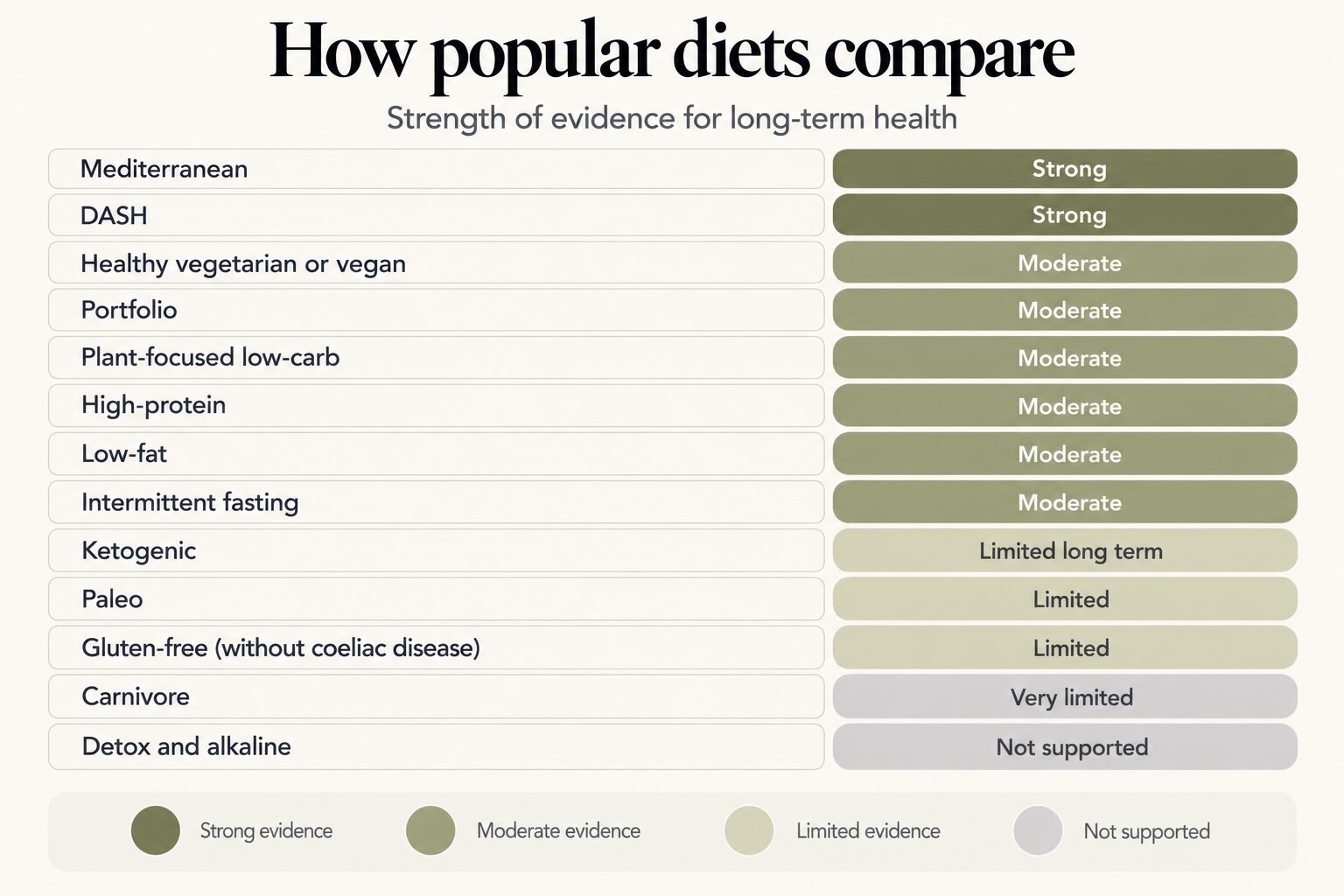
| Diet | Strength of evidence for long-term health | Best for | Main concerns |
|---|---|---|---|
| Mediterranean | Strong | Almost everyone; heart disease prevention | Portions of oil and nuts if losing weight |
| DASH | Strong for blood pressure | High blood pressure, heart health | Potassium in kidney disease |
| Healthy vegetarian or vegan | Moderate | Heart health, those avoiding meat | B12, iron, omega-3; stroke signal |
| Portfolio | Moderate for LDL | High cholesterol | Harder to follow long term |
| Low-carb (plant-focused) | Moderate | Type 2 diabetes, insulin resistance | Animal-based versions linked to higher mortality |
| High-protein | Moderate | Older adults, weight loss, strength training | Kidney disease |
| Low-fat | Moderate for weight; weak for heart disease | Some medical conditions | Replacing fat with sugar and refined carbs |
| Ketogenic | Strong for epilepsy; limited long term | Epilepsy; short-term supervised use | LDL rise, medication risks, sustainability |
| Intermittent fasting | Moderate for weight | People who find it suits their routine | Not for everyone; medication risks |
| Paleo | Limited | Cutting processed food | Excludes legumes and whole grains |
| Gluten-free | Strong for coeliac disease only | Coeliac disease, wheat allergy | No benefit for others; fewer whole grains |
| Carnivore | Very limited | Not recommended | Very high LDL, no fibre, nutrient gaps |
| Detox and alkaline | Not supported | Not recommended | Cost, nutrient deficiencies, false claims |
How to choose the right diet for you
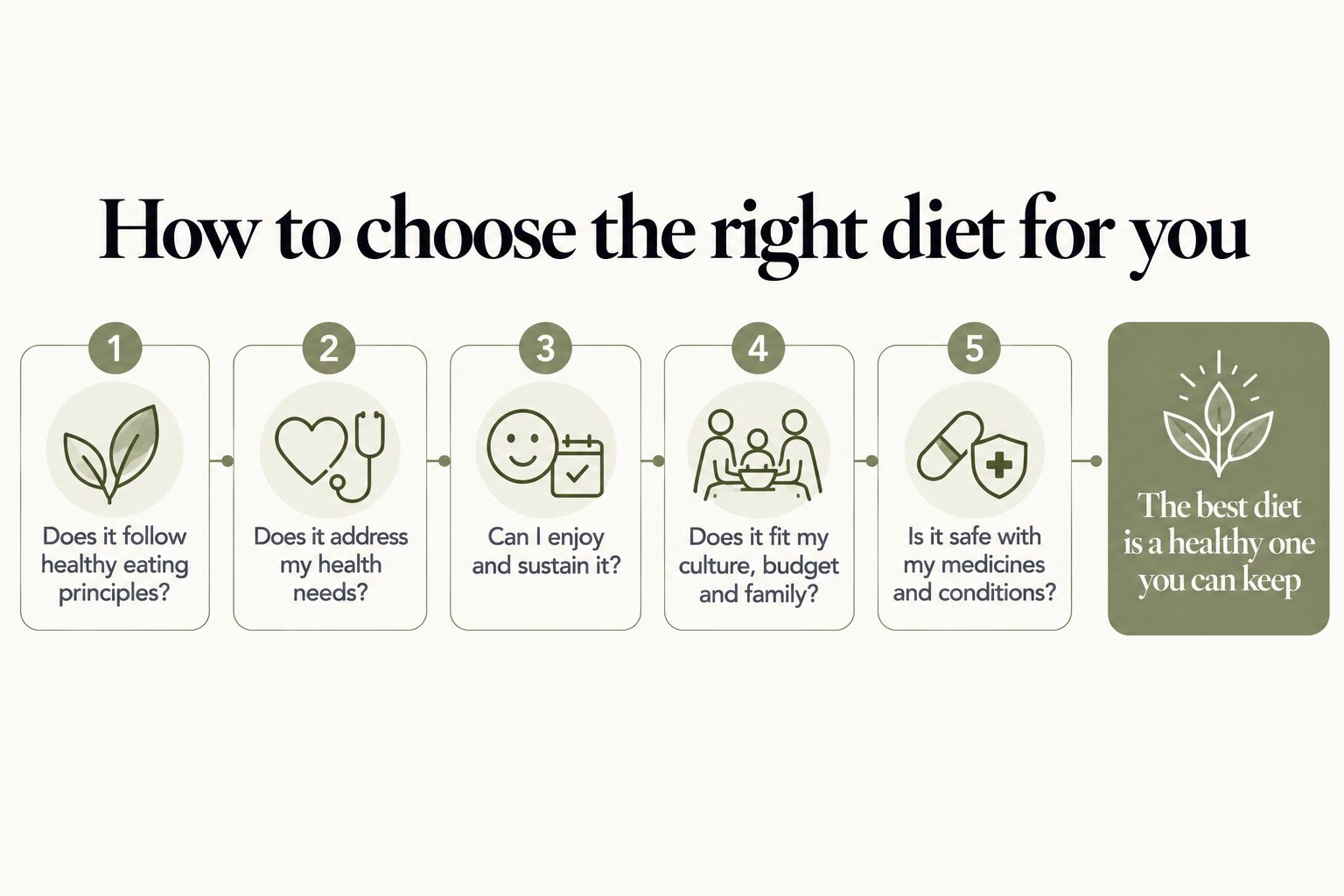
There's no single best diet for everyone. Instead, ask:
- 1. Does it fit the healthy principles above? Mostly whole foods, plenty of plants, healthy fats, adequate protein, little processed food.
- 2. Does it address my health needs? DASH for blood pressure, portfolio for cholesterol, Mediterranean for heart risk, carbohydrate reduction for diabetes, gluten-free only for coeliac disease.
- 3. Can I enjoy it and keep it up for years? The diet you can stick to will do more than a "perfect" diet you abandon in three weeks.
- 4. Does it fit my culture, budget and family? Healthy eating should work with Sri Lankan food, not against it.
- 5. Is it safe with my medicines and conditions? Especially diabetes, kidney disease, heart disease, pregnancy and any history of eating disorders.
Remember that diet is one part of health: physical activity, sleep, stress, alcohol and smoking matter just as much. For people living with obesity, diet changes work best alongside activity and, where appropriate, medical treatment (see GLP-1 Medications).
A Sri Lankan perspective
Traditional Sri Lankan food, with its vegetable curries, mallung, dhal, fish, coconut, spices and rice, already has many features of the healthiest diets. The main problems in modern Sri Lankan diets are large portions of white rice and refined flour, sugary tea and sweets, fried short eats, high salt, processed snacks and too few vegetables and fruit. For most Sri Lankans, the biggest gains come not from adopting a foreign diet but from improving their own: smaller rice portions or red rice, two or more vegetable dishes per meal, legumes daily, fish more often, less salt and sugar, and fewer fried and processed foods (see Building a Longevity Plate).
Why this matters for longevity
Diet is one of the most powerful influences on how long and how well we live, but the specific label matters far less than the underlying quality and consistency. The diets with the strongest evidence share the same foundations, and most fad diets succeed, when they do, only by accidentally following some of those principles. Choosing a healthy pattern that suits your body, health needs and culture, and sticking with it for years, is what makes the difference.
Recommendations by situation
| Situation | Diet approach to consider |
|---|---|
| Healthy adult wanting to eat for longevity | Mediterranean-style, adapted to Sri Lankan food |
| High blood pressure | DASH with salt reduction |
| High LDL cholesterol | Mediterranean or portfolio diet; medication if needed |
| Prediabetes or type 2 diabetes | Mediterranean or plant-focused lower-carb; supervised if on medication |
| Wanting to lose weight | Any healthy diet you can sustain, with fewer calories and more protein |
| Older adult | Mediterranean-style with adequate protein and strength training |
| Vegetarian or vegan | Healthy plant-based diet with B12 and attention to iron, protein and omega-3 |
| Coeliac disease | Strict gluten-free diet, with dietitian support |
| Drug-resistant epilepsy | Ketogenic diet under specialist supervision |
| Tempted by carnivore, detox or alkaline diets | Not recommended; talk to your doctor first |
Practical notes
Before starting any new diet, ask whether it's built on whole foods, whether it suits your health needs, and whether you could eat that way for the rest of your life. If it requires buying special products, cutting out whole healthy food groups or promises dramatic results, be cautious. Make changes gradually, track how you feel and, if you have a medical condition or take regular medicines, talk to your doctor first. Our Longevity Doctors can help you choose the eating pattern that best fits your health, goals and lifestyle, starting with the free longevity assessment.
- Gardner CD, et al. Effect of low-fat vs low-carbohydrate diet on 12-month weight loss in overweight adults and the association with genotype pattern or insulin secretion: the DIETFITS randomized clinical trial. JAMA, 2018;319(7):667-679.
- Seidelmann SB, et al. Dietary carbohydrate intake and mortality: a prospective cohort study and meta-analysis. The Lancet Public Health, 2018;3(9):e419-e428.
- Lennerz BS, et al. Behavioral characteristics and self-reported health status among 2029 adults consuming a "carnivore diet". Current Developments in Nutrition, 2021;5(12):nzab133.
- Manheimer EW, et al. Paleolithic nutrition for metabolic syndrome: systematic review and meta-analysis. American Journal of Clinical Nutrition, 2015;102(4):922-932.
- Tong TYN, et al. Risks of ischaemic heart disease and stroke in meat eaters, fish eaters, and vegetarians over 18 years of follow-up: results from the prospective EPIC-Oxford study. BMJ, 2019;366:l4897.
- Satija A, et al. Healthful and unhealthful plant-based diets and the risk of coronary heart disease in U.S. adults. Journal of the American College of Cardiology, 2017;70(4):411-422.
- Bauer J, et al. Evidence-based recommendations for optimal dietary protein intake in older people: a position paper from the PROT-AGE Study Group. Journal of the American Medical Directors Association, 2013;14(8):542-559.
- Howard BV, et al. Low-fat dietary pattern and risk of cardiovascular disease: the Women's Health Initiative Randomized Controlled Dietary Modification Trial. JAMA, 2006;295(6):655-666.
- Jenkins DJA, et al. Effects of a dietary portfolio of cholesterol-lowering foods vs lovastatin on serum lipids and C-reactive protein. JAMA, 2003;290(4):502-510.
- Singh P, et al. Global prevalence of celiac disease: systematic review and meta-analysis. Clinical Gastroenterology and Hepatology, 2018;16(6):823-836.
- Lebwohl B, et al. Long term gluten consumption in adults without celiac disease and risk of coronary heart disease: prospective cohort study. BMJ, 2017;357:j1892.
- Trepanowski JF, et al. Effect of alternate-day fasting on weight loss, weight maintenance, and cardioprotection among metabolically healthy obese adults: a randomized clinical trial. JAMA Internal Medicine, 2017;177(7):930-938.
- Klein AV, Kiat H. Detox diets for toxin elimination and weight management: a critical review of the evidence. Journal of Human Nutrition and Dietetics, 2015;28(6):675-686.
Free longevity assessment
Not sure which way of eating
is right for you?
Take the free Aevum Protocol assessment to see how your nutrition & metabolism and 6 other longevity domains are performing — and get a personalised 90-day plan.
Take the free assessment