Skin & Longevity
Female Pattern Hair Loss:
Thinning, Hormones, Menopause and PCOS
Female pattern hair loss is the most common cause of thinning hair in women. Unlike men, women rarely go bald. Instead, hair gradually thins over the top of the scalp, the parting widens and the ponytail becomes smaller, while the front hairline is usually kept. It's caused by follicles slowly shrinking, driven by genes and, in some women, by androgens (male-type hormones). Most affected women have normal hormone levels, but signs such as irregular periods, acne or excess facial hair point to conditions such as polycystic ovary syndrome (PCOS), which is found in about a third of women with this type of hair loss. It becomes more common with age, especially after menopause: about 40% of women show some signs by 50. Hair loss often appears or worsens after a bout of shedding from illness, childbirth or iron deficiency, so blood tests are worth doing. Treatment works best when started early. Minoxidil has the strongest evidence, low-dose minoxidil tablets are now widely used, and anti-androgen tablets such as spironolactone can help some women. This article explains the causes, the hormone links and what works.
Key numbers
| Finding | Detail |
|---|---|
| Women with signs of pattern thinning | About 40% by age 50 |
| UK women aged 18 to 99 (377 women) | 6% under 50, 38% at 70 and over |
| Women with this hair loss who have PCOS | About 32% (24 studies) |
| Women with PCOS who have this hair loss | About 23% |
| Oral minoxidil 1 mg vs topical 5% (52 women, 24 weeks) | Hair density up 12% vs 7%, not significantly different |
| Anti-androgen tablets (80 women, 12 months or more) | 44% regrew, 44% stayed stable, 12% kept losing hair |
How it works
Follicle shrinkage. As in men, susceptible follicles on the top of the scalp gradually shorten their growing phase and shrink, producing finer, shorter hairs over time (see How Hair Grows and Ages). Scalp hairs normally grow in small groups of three or four from each opening. In pattern hair loss, these groups gradually lose hairs, so the scalp shows through more easily. The follicles at the back and sides of the scalp are much less affected.
The role of hormones. Hormones matter, but less simply than in men:
- Androgens: in some women, testosterone and DHT drive follicle shrinkage, as in men. But most women with pattern hair loss have normal androgen levels, so it's likely that follicle sensitivity, not hormone levels, is the main factor.
- Oestrogen: pattern hair loss becomes more common after menopause, when oestrogen falls and the balance shifts towards androgens. But oestrogen's exact role remains uncertain.
- Genes: pattern hair loss is strongly inherited from both parents, through many genes. Genetic tests can't yet predict it reliably.
When to suspect a hormonal condition. Hair thinning together with irregular periods, acne, excess facial or body hair, or a male-type receding hairline suggests raised androgens. The most common cause is PCOS (see Polycystic Ovary Syndrome (PCOS)). A 2025 meta-analysis of 24 studies found PCOS in about 32% of women with pattern hair loss, and pattern hair loss in about 23% of women with PCOS. Rarer causes include congenital adrenal hyperplasia and androgen-producing tumours, which typically cause rapid onset of symptoms and need urgent assessment.
How it looks and progresses
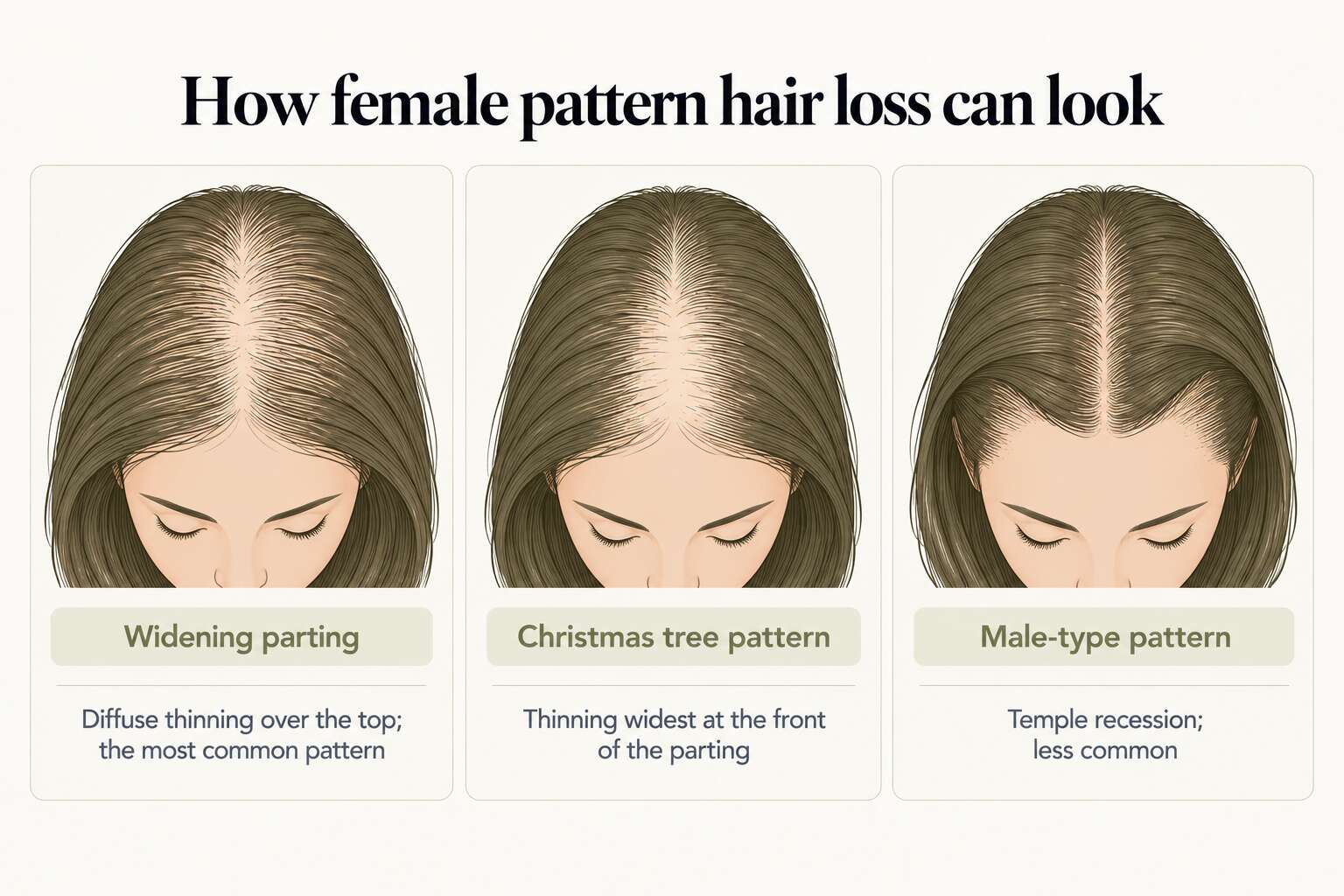
The most common sign is a widening central parting and more scalp showing on top, often noticed in photos or under bright light. Doctors describe the patterns in several ways:
- Diffuse thinning on top (Ludwig pattern): graded from mild to severe thinning over the crown and top, with the front hairline kept.
- "Christmas tree" pattern: described by the American dermatologist Elise Olsen, with thinning widest at the front of the parting and narrowing towards the crown.
- Male-type pattern: temple recession, more common in women with raised androgens or after menopause.
Without treatment, it usually progresses slowly over decades, often in bursts: periods of faster shedding lasting 3 to 6 months, followed by stable periods of 6 to 18 months. Women often first notice it after a bout of heavy shedding (telogen effluvium) from illness, childbirth, stopping the pill, crash dieting or iron deficiency. The shedding settles, but the underlying thinning has been revealed (see Types of Hair Loss).
Hormones across a woman's life
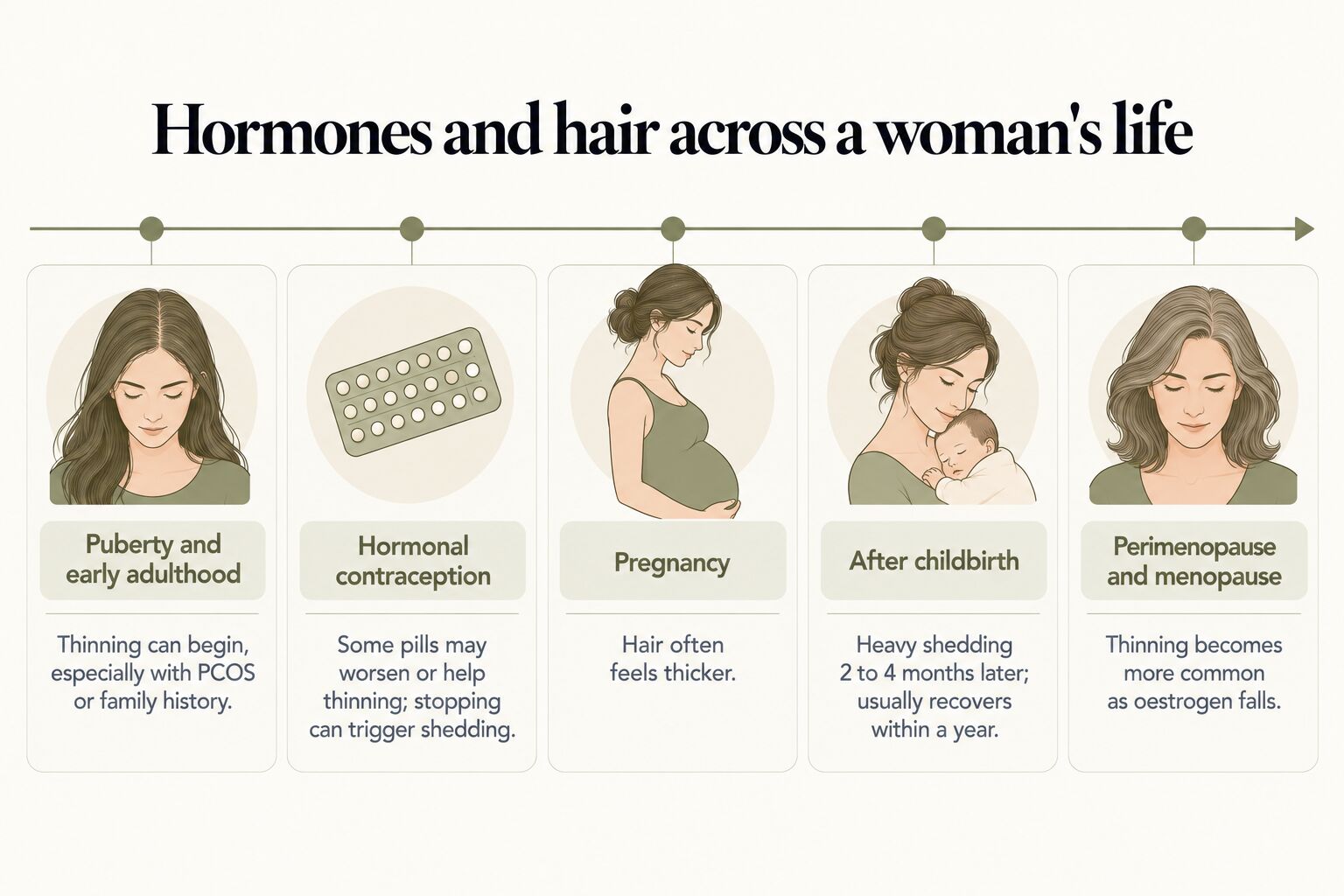
- Puberty and early adulthood: pattern hair loss can start as early as the teens, especially with a strong family history or PCOS.
- Hormonal contraception: pills containing progestins with androgen-like effects may worsen thinning in susceptible women, while some pills with anti-androgen progestins may help. Stopping the pill can also trigger temporary shedding (see Hormonal Contraception and Long-Term Health).
- Pregnancy and after birth: hair often feels thicker during pregnancy, then sheds heavily about 2 to 4 months after giving birth. This usually recovers within a year, but can unmask pattern thinning.
- Perimenopause and menopause: falling oestrogen makes pattern thinning more common and often noticeable for the first time (see Perimenopause: Recognising the Signs and Symptoms and Menopause and Long-Term Health). Whether menopausal hormone therapy helps hair isn't well established, and it isn't prescribed for hair alone (see Menopausal Hormone Therapy).
What the research shows
How common it is. In a UK study of 377 women aged 18 to 99, pattern hair loss was found in 6% of women under 50 and 38% of those aged 70 and over. Overall, about 40% of women show some signs by age 50, and fewer than half reach 80 with a full head of hair.
What works.
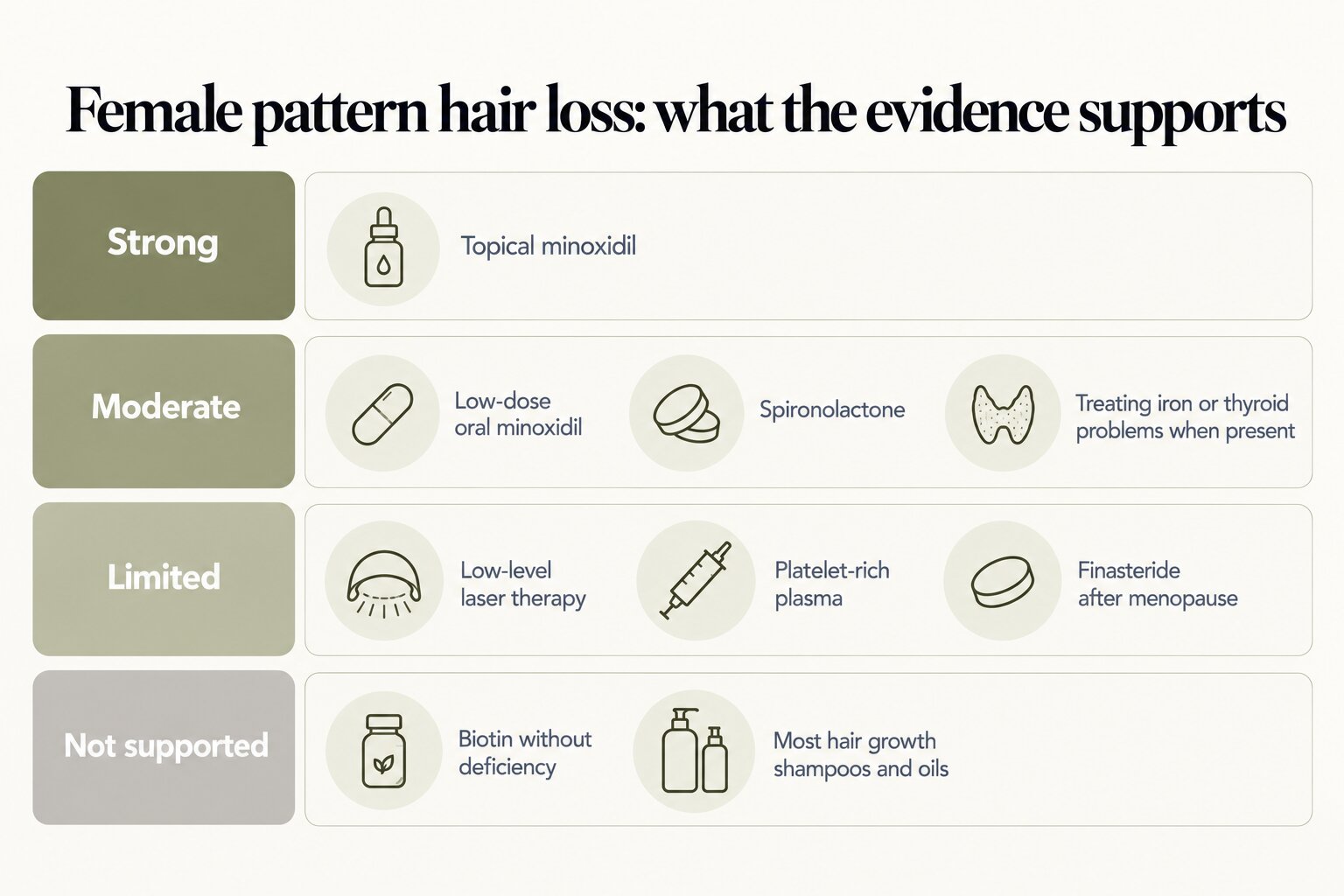
- Topical minoxidil: the best-established treatment, supported by a Cochrane review. It comes as a 2% or 5% solution or 5% foam. The stronger forms work a little better but are more likely to cause scalp irritation and unwanted hair growth on the face.
- Low-dose oral minoxidil: in a 2020 Brazilian trial of 52 women, a 1 mg daily tablet increased hair density by 12% over 24 weeks, compared with 7% for 5% topical minoxidil, a difference that wasn't statistically significant. The tablet caused more unwanted body and facial hair (27% vs 4%) and mild ankle swelling in 4%, while the solution caused more scalp itch (19%). Oral minoxidil is a useful option for women who find the topical form messy or irritating, but it needs a prescription and monitoring.
- Anti-androgen tablets: in a 2005 Australian study of 80 women treated with spironolactone or cyproterone acetate for at least a year, 44% regrew hair, 44% stayed stable and 12% continued to lose hair. A 2023 systematic review concluded spironolactone helps, but better-designed trials are needed. Combining low-dose oral minoxidil with spironolactone has shown benefit in early studies. These medicines can cause birth defects in a male baby, so reliable contraception is essential.
- Finasteride and dutasteride: sometimes used in women, mainly after menopause, but they must never be taken during pregnancy or when pregnancy is possible.
- Other options: microneedling, low-level laser therapy, platelet-rich plasma (PRP) and hair transplants, with evidence ranging from moderate to limited. Each is covered in detail in this series: see Minoxidil, Low-Level Laser Therapy and Microneedling for Hair Loss, PRP for Hair Loss and Hair Transplant Surgery.
Why this matters for longevity
Thinning hair can have a large effect on confidence and wellbeing, and many women feel their concerns are dismissed. That deserves to change. Hair loss can also be an early sign of conditions that matter for long-term health: PCOS, which raises the risk of type 2 diabetes and heart disease, thyroid problems and iron deficiency (see Living Well with PCOS and Thyroid Function and Ageing). And because treatment keeps hair better than it regrows it, starting early makes a real difference.
Recommendations
Tests worth doing.
- A full blood count and ferritin (iron stores), as iron deficiency is common and worsens shedding.
- Thyroid function.
- Vitamin D, especially if levels are likely to be low (see Nutrient Blood Tests).
- Hormone tests, such as testosterone, if you have irregular periods, acne, excess facial or body hair, or rapid onset of symptoms.
By life stage and situation.
- Young women with thinning: check for PCOS and iron deficiency, especially with irregular periods or acne.
- After childbirth: heavy shedding is normal and usually recovers within a year. If thinning persists beyond that, see a doctor.
- Women planning a pregnancy or who could become pregnant: avoid anti-androgens and finasteride unless using reliable contraception, and discuss oral minoxidil with your doctor.
- Perimenopause and after menopause: thinning is common; minoxidil remains first-line, and anti-androgens may be added.
- Rapid hair loss with deepening voice, a male-type hairline or fast-growing facial hair: see a doctor promptly.
Practical notes
Take photos of your parting every 6 months in the same lighting, as gradual change is hard to judge. If your hair is thinning, ask for blood tests for iron, thyroid and vitamin D, as correcting a deficiency can reduce shedding. In Sri Lanka, iron deficiency is common in women, especially those with heavy periods, recent pregnancies or a mainly vegetarian diet. Wear hair loosely where you can, and avoid tight buns, braids and extensions, which can add traction hair loss along the front hairline. Hair oiling is a pleasant tradition but won't stop pattern thinning. Give any treatment at least 6 to 12 months before judging it, and expect a temporary increase in shedding in the first weeks of minoxidil. Treatment needs to continue to keep its benefit. Hairstyles, volumising products and scalp-coloured powders can also help in the meantime. Our Longevity Doctors can identify the type of hair loss, check for PCOS, thyroid and iron problems and help you choose a treatment that fits your life stage, starting with the free longevity assessment.
- Birch MP, Messenger JF, Messenger AG. Hair density, hair diameter and the prevalence of female pattern hair loss. British Journal of Dermatology, 2001;144(2):297-304.
- Rayner DG, et al. Bi-directional association between female pattern hair loss and polycystic ovary syndrome: a systematic review and meta-analysis. JAAD International, 2025.
- Ramos PM, et al. Minoxidil 1 mg oral versus minoxidil 5% topical solution for the treatment of female-pattern hair loss: a randomized clinical trial. Journal of the American Academy of Dermatology, 2020;82(1):252-253.
- Sinclair R, et al. Treatment of female pattern hair loss with oral antiandrogens. British Journal of Dermatology, 2005;152(3):466-473.
- The efficacy and safety of oral spironolactone in the treatment of female pattern hair loss: a systematic review and meta-analysis. Cureus, 2023;15(8):e43559.
- van Zuuren, E.J. et al. Interventions for female pattern hair loss. Cochrane Database of Systematic Reviews, 2012 (updated 2016).
- DermNet. Female pattern hair loss. dermnetnz.org.
- Olsen EA. The midline part: an important physical clue to the clinical diagnosis of androgenetic alopecia in women. Journal of the American Academy of Dermatology, 1999;40(1):106-109.
Free longevity assessment
Noticing your parting
widening or hair thinning?
Take the free Aevum Protocol assessment to see how your skin & longevity and 6 other longevity domains are performing — and get a personalised 90-day plan.
Take the free assessmentKeep reading