Skin & Longevity
Low-Level Laser Therapy and Microneedling
for Hair Loss
Low-level laser therapy and microneedling are two device-based treatments that can support hair growth in pattern hair loss, especially alongside medicines. Low-level laser therapy (LLLT) uses red light, usually around 650 to 670 nanometres, delivered through caps, helmets, headbands or combs, to stimulate the energy-producing machinery of follicle cells. The first device for male pattern hair loss was cleared by the US FDA in 2007, and a 2021 meta-analysis of seven sham-controlled trials found a significant increase in hair density. In one trial, men using a laser comb gained about 20 hairs per square centimetre over 26 weeks, while those using a sham device lost about 8. Microneedling uses fine needles to create tiny wounds in the scalp, triggering a healing response and helping topical treatments penetrate. In a trial of 100 men, weekly microneedling plus minoxidil increased hair counts by about 91 hairs per square centimetre over 12 weeks, compared with 22 for minoxidil alone, and a 2025 meta-analysis of 12 trials confirmed that the combination outperforms minoxidil on its own. Both are low risk when done properly, but neither replaces proven medicines, and the benefits fade without ongoing use. This article explains how they work, what to expect and how to use them safely.
Key numbers
| Finding | Detail |
|---|---|
| Laser comb vs sham (110 men, 26 weeks) | About 20 more hairs per cm² vs about 8 fewer |
| Laser devices in men and women (269 people, 26 weeks) | About 15 more hairs per cm² than sham |
| LLLT meta-analysis (7 sham-controlled trials) | Significant increase in hair density |
| Microneedling plus minoxidil (100 men, 12 weeks) | Hair count up about 91 vs 22 with minoxidil alone |
| Microneedling meta-analysis (12 trials, 631 patients) | Combination better than minoxidil alone |
| FDA-cleared home laser devices (by 2020) | 32 |
How they work
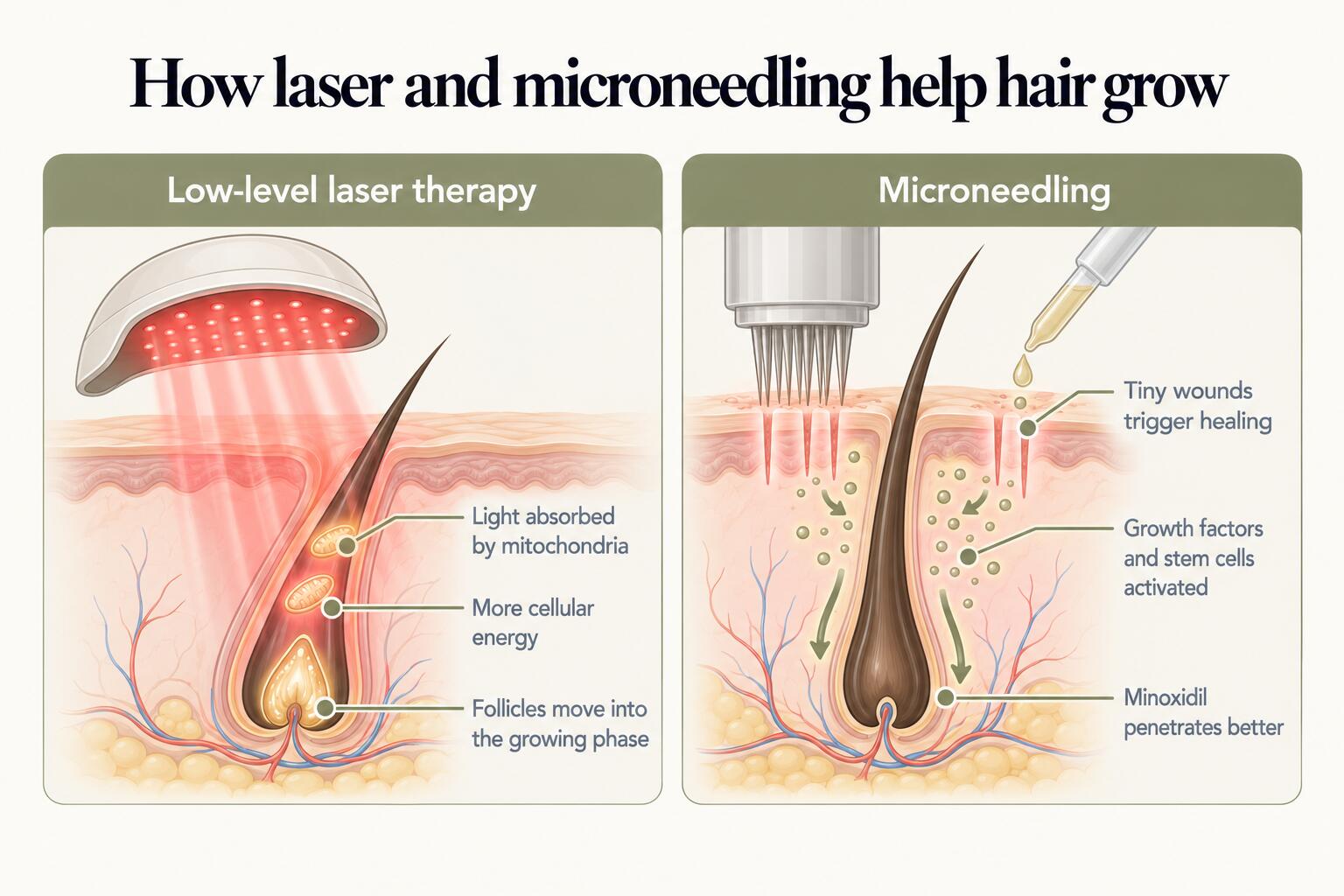
Low-level laser therapy. LLLT, also called photobiomodulation or red light therapy, uses low-energy red light that doesn't heat or damage tissue. The light is thought to be absorbed by an enzyme in the mitochondria, cytochrome c oxidase, increasing cellular energy (ATP) production in follicle stem cells. This may:
- Push resting follicles into the growing phase and prolong it (see How Hair Grows and Ages).
- Increase blood flow around follicles.
- Reduce inflammation in the scalp.
The same principle is used on the skin (see Red Light Therapy for Skin). Devices that use laser diodes appear to work better than those using only LEDs: in the 2021 meta-analysis, laser-diode devices had a larger effect than combination devices.
Microneedling. Microneedling uses a roller, stamp or pen with fine needles to create hundreds of tiny punctures in the scalp. This is thought to:
- Release growth factors from platelets as part of the wound-healing response.
- Activate signalling pathways, such as Wnt, that stimulate hair follicle stem cells.
- Increase blood flow to follicles.
- Improve absorption of topical treatments such as minoxidil (see Minoxidil).
The same technique is used to stimulate collagen in the skin (see Microneedling for Skin Rejuvenation).
What the research shows
Low-level laser therapy.
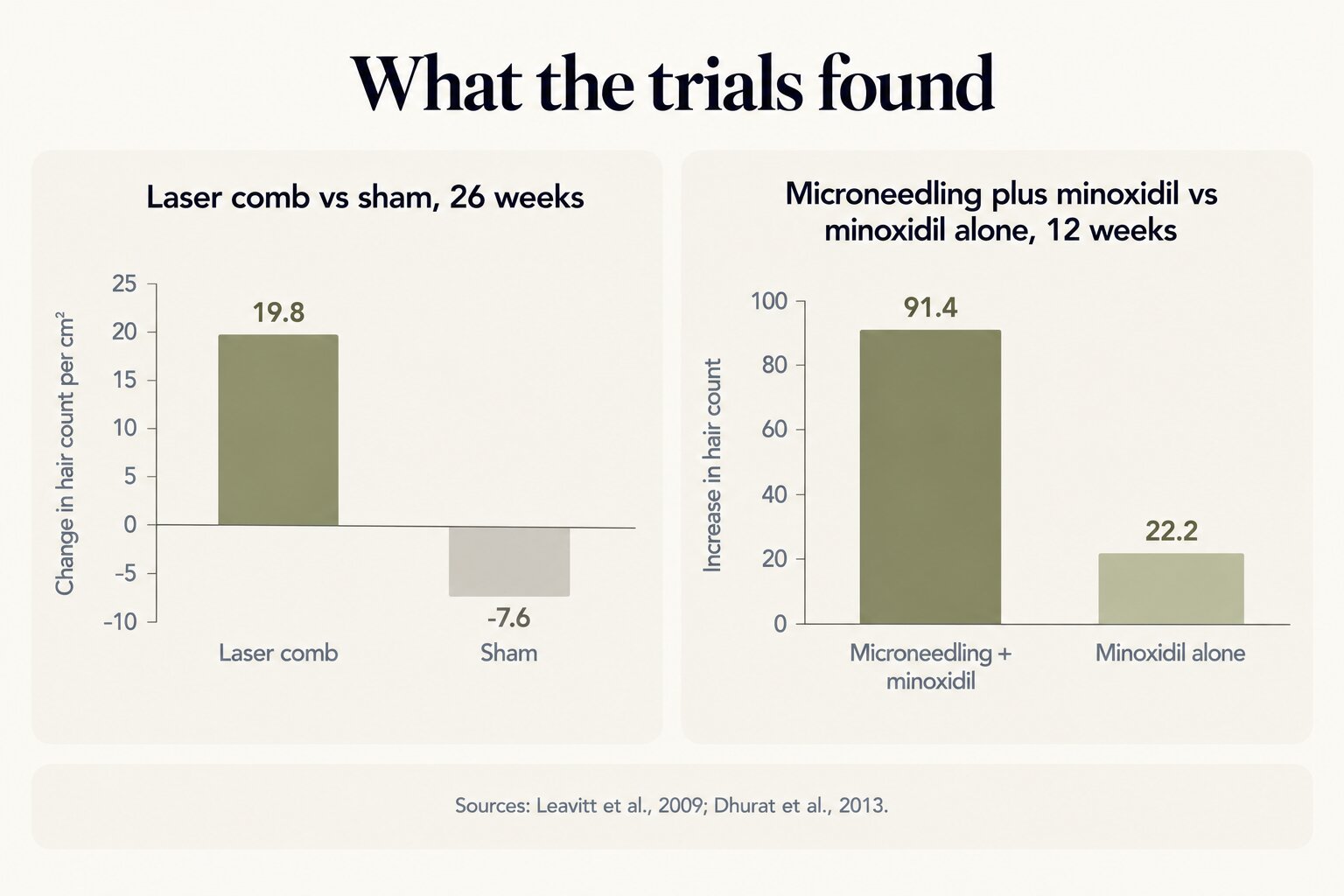
- Laser comb: in a 2009 double-blind trial, 110 men with pattern hair loss used a laser comb or an identical sham device for 26 weeks. Terminal hair counts rose by about 20 hairs per cm² with the laser comb and fell by about 8 with the sham.
- Men and women: in a 2014 multicentre trial of 128 men and 141 women, laser devices increased terminal hair density by about 15 hairs per cm² more than sham devices over 26 weeks.
- Meta-analysis: a 2021 review of seven double-blind, sham-controlled trials found a significant increase in hair density with LLLT, with no significant difference between men and women or between comb and helmet designs. By January 2020, the FDA had cleared 32 home-use devices, mostly caps and helmets, typically used for about 30 minutes three to four times a week.
The limitations are important: trials lasted 26 weeks or less, were relatively small, were often funded by device makers, and didn't include people with advanced hair loss. FDA "clearance" means a device is considered safe and similar to an existing device, which is a lower bar than the "approval" required for medicines.
Microneedling.
- The landmark trial: in a 2013 study, 100 men with mild to moderate pattern hair loss were randomised to weekly 1.5 mm microneedling plus twice-daily 5% minoxidil, or minoxidil alone, for 12 weeks. Hair counts rose by about 91 hairs per cm² with the combination, compared with 22 with minoxidil alone. Blinded investigators rated 40% of the combination group as having moderate to marked improvement, compared with none on minoxidil alone, and 82% of men in the combination group reported more than 50% improvement, compared with 4.5%.
- Meta-analysis: a 2025 review in the Archives of Dermatological Research of 12 randomised trials with 631 patients found that microneedling plus minoxidil significantly increased hair count and hair thickness compared with minoxidil alone. Side effects were mild and self-limiting, though results varied considerably between studies.
Microneedling on its own, without a topical treatment, is less well studied. It's also used with PRP (see PRP for Hair Loss).
Evidence strength
- LLLT for early to moderate pattern hair loss: moderate evidence of a modest benefit from several sham-controlled trials, all short term.
- Microneedling plus minoxidil: moderate evidence that it improves on minoxidil alone, though studies vary in technique and quality.
- Microneedling alone: limited evidence.
- Either for advanced baldness or scarring alopecia: not supported.
- Either as a replacement for minoxidil or finasteride: not supported.
What to expect
| Aspect | Low-level laser therapy | Clinic microneedling |
|---|---|---|
| Where | Mostly at home | Usually in a clinic |
| How often | About 3 to 4 times a week, around 30 minutes per session for many devices | Weekly to monthly, depending on depth and protocol |
| Discomfort | None; may feel slightly warm | Mild to moderate; numbing cream usually used |
| Downtime | None | Redness and tenderness for 1 to 2 days |
| Results | Typically 4 to 6 months | Often 3 to 6 months |
| Cost | Moderate to high one-off device cost | Moderate per session, repeated |
| Ongoing use | Needed to maintain benefit | Usually needed to maintain benefit |
How to use them safely
Low-level laser therapy.
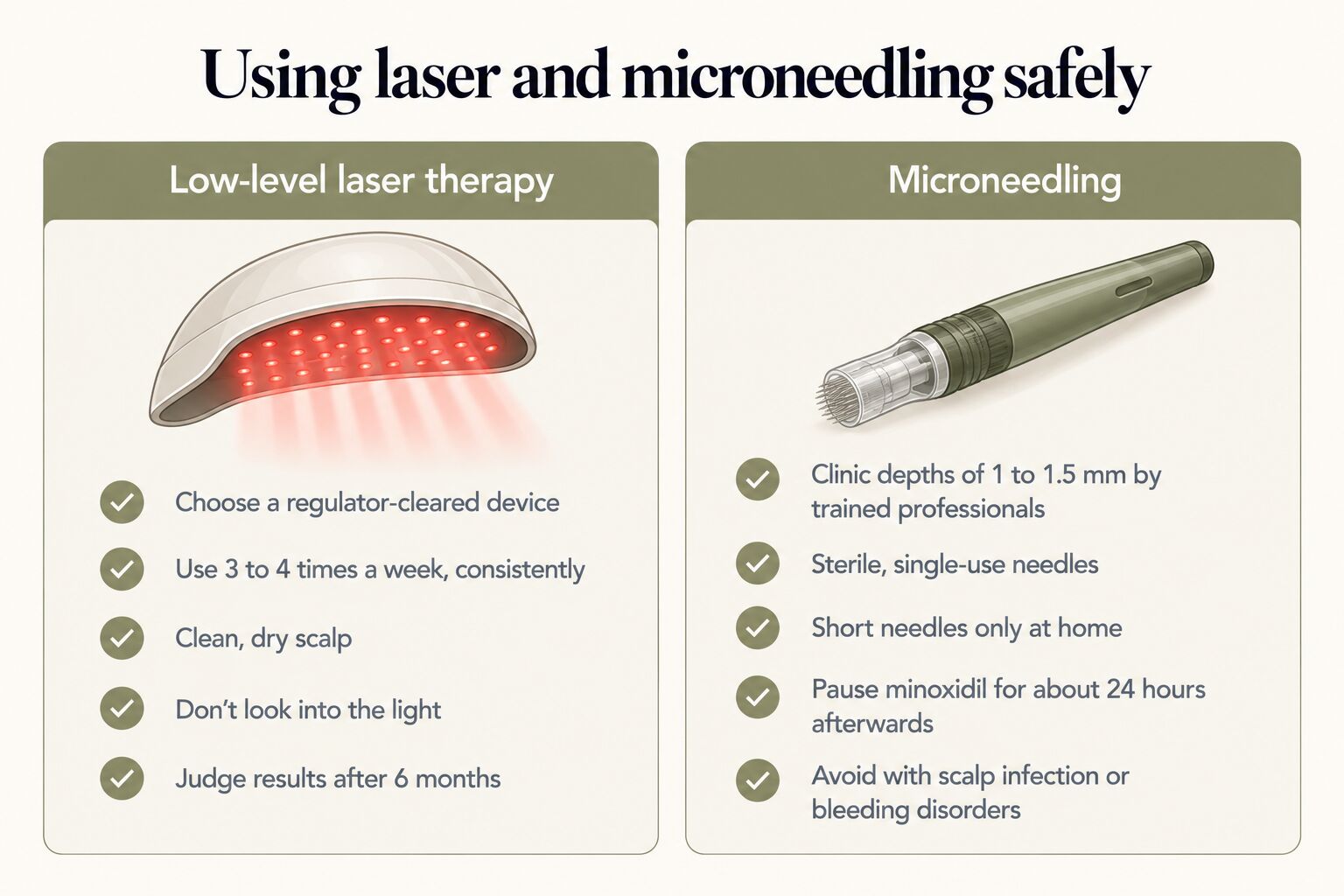
- Choose a device cleared or approved by a recognised regulator, and check whether it uses laser diodes or only LEDs.
- Use it consistently as directed, usually three to four times a week. Most benefit is lost if you stop.
- Use it on a clean, dry scalp so hair products don't block the light.
- Don't look directly into the light, and avoid use on areas with skin cancer or active scalp disease.
- Track results with photos every 3 months; if there's no improvement after 6 months, it may not be worth continuing.
Microneedling.
- Clinic treatment is safest: depths of 1 to 1.5 mm used in trials should be performed by trained professionals with sterile, single-use needles.
- Home rollers and pens: use only short needles, keep them clean and replace them often. Never share them. Deeper home use increases the risk of infection, scarring and skin damage.
- Timing with minoxidil: many clinicians advise pausing topical minoxidil for about 24 hours after microneedling, as absorption is greatly increased and irritation is more likely.
- Avoid microneedling if you have an active scalp infection, psoriasis or eczema flare, keloid scarring or a bleeding disorder, or are taking blood thinners, unless your doctor advises otherwise.
- Aftercare: avoid sun, swimming, sweaty exercise and harsh hair products for about 24 hours.
Why this matters for longevity
Device-based treatments can be useful for people who want to boost the results of minoxidil or finasteride, or who can't use those medicines. They're low risk when used correctly. But like all hair loss treatments, they work best early, require ongoing commitment and should be judged by results rather than marketing claims. Choosing the right combination for your hair loss type protects the follicles you still have.
Recommendations
- Early to moderate pattern hair loss, already on minoxidil: clinic microneedling is a reasonable add-on, with the best evidence among procedures.
- Want a home option without medicines: LLLT can offer a modest benefit, but expect smaller results than with medicines.
- Can't use finasteride or oral medicines: combining topical minoxidil, microneedling and LLLT is a reasonable medicine-light approach.
- Advanced baldness: devices won't regrow bald areas; consider a hair transplant assessment (see Hair Transplant Surgery).
- Alopecia areata or scarring hair loss: see a dermatologist, as these need different treatments (see Alopecia Areata and Types of Hair Loss).
Practical notes
Laser devices and microneedling can help thicken thinning hair, especially alongside minoxidil, but they aren't a substitute for proven medicines. If you buy a home laser device, choose one cleared by a recognised regulator, use it consistently and judge it after six months. Microneedling at depths used in trials should be done in a clinic, with sterile equipment; if you use a home roller, choose short needles, keep it clean and never share it. Pause minoxidil for about a day after microneedling to reduce irritation. Whatever you choose, take standardised photos to track your progress. Our Longevity Doctors can confirm your type of hair loss and help you decide which combination of medicines and procedures is likely to work best, starting with the free longevity assessment.
- Leavitt M, et al. HairMax LaserComb laser phototherapy device in the treatment of male androgenetic alopecia: a randomized, double-blind, sham device-controlled, multicentre trial. Clinical Drug Investigation, 2009;29(5):283-292.
- Jimenez JJ, et al. Efficacy and safety of a low-level laser device in the treatment of male and female pattern hair loss: a multicenter, randomized, sham device-controlled, double-blind study. American Journal of Clinical Dermatology, 2014;15(2):115-127.
- Lueangarun S, et al. Efficacy and safety of low-level light therapy for pattern hair loss: a systematic review and meta-analysis. Journal of Clinical and Aesthetic Dermatology, 2021;14(11):E64-E75.
- Dhurat R, et al. A randomized evaluator blinded study of effect of microneedling in androgenetic alopecia: a pilot study. International Journal of Trichology, 2013;5(1):6-11.
- Ahmed, et al. Microneedling plus minoxidil versus minoxidil alone for androgenetic alopecia: a systematic review and meta-analysis of randomized controlled trials. Archives of Dermatological Research, 2025.
Free longevity assessment
Considering a laser cap
or microneedling for your hair?
Take the free Aevum Protocol assessment to see how your skin & longevity and 6 other longevity domains are performing — and get a personalised 90-day plan.
Take the free assessment